

Why Does My Roof Leak Only in Heavy Rain?
Because a heavy storm does three things a light rain doesn't. Wind drives water sideways and uphill, under the laps of shingles and tile, behind flashings and into vents. Downpours bring more water than the valleys, gutters and drains can carry, so it backs up under the roofing. And hours of rain soak what a short shower only dampens, such as worn underlayment under tile or the joint where a wall meets the roof. When the leak starts and which side of the house it shows on often point to one of the three. In Los Angeles, a big winter storm can bring all of them at once: on February 4, 2024, Downtown Los Angeles got 4.10 inches of rain in a day, with the wind out of the east and southeast.
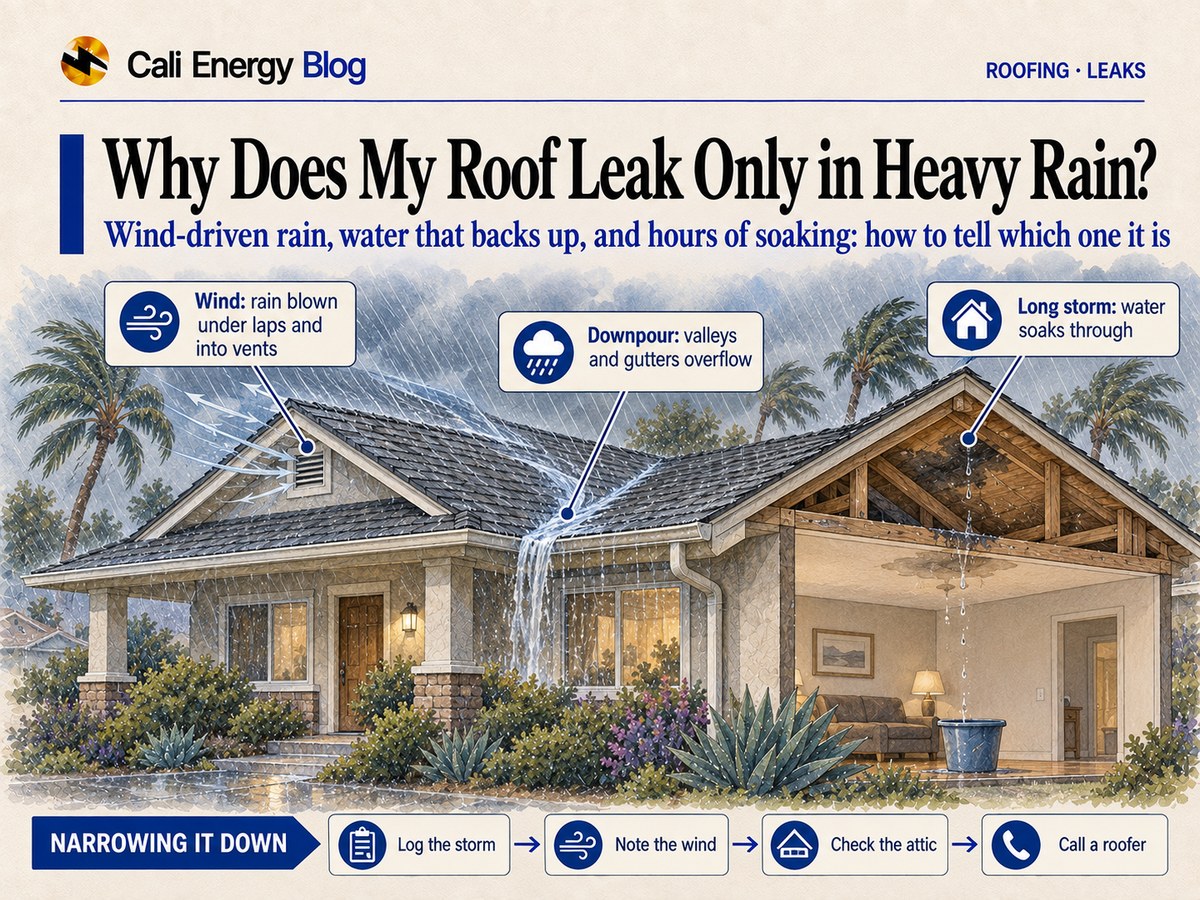
What heavy rain adds
A leak that only shows in storms has a weak spot that ordinary rain doesn't reach. The way it behaves narrows down where to look.
| What the storm adds | How the water gets in | What the leak looks like | Where to check |
|---|---|---|---|
| Wind | Rain blown sideways and up the slope, under shingle and tile laps, behind flashings, into vents | Only when the wind comes from one direction; on the side of the house that faced it; near a gable wall, eave or skylight | Slopes, walls, vents and flashings on the side that faced the wind |
| Volume | More water than the valleys, gutters, drains or a low slope can move, so it backs up under the roofing | Starts in the hardest rain and eases soon after; near a valley, an inside corner, an eave or a flat section | Valleys, gutters and downspouts, the cricket behind a chimney, flat-roof drains, low-slope sections |
| Duration | Hours of water reaching layers that are normally just damp, such as underlayment under tile or a wall joint | Starts late in a long storm and can drip for a day after | Tile underlayment, wall-to-roof flashings and kickouts |
Wind: water that goes sideways
In light rain, water runs down the roof and over the laps. In wind, it's blown up under them and against anything that stands up from the roof. The asphalt roofing industry's manual counts shielding the deck from wind-driven rain among the jobs of the underlayment, and lists the places where self-adhering underlayment is used to resist water backing up under the roofing: eaves, rakes, valleys, around skylights and chimneys, dormers, changes in slope and low-slope areas (Asphalt Roofing Manufacturers Association, ARMA). Those are also the places to suspect first.
Vents can let in rain without anything being wrong with the roofing. In simulated wind-driven rain at the Insurance Institute for Business & Home Safety (IBHS), with the wind at 30 mph or more, a gable-end vent facing the wind let in about as much water as was blown at it. An open soffit along the eave also let water in, most of it within about 10 feet of the eave, and a perforated vinyl soffit cut the water to about 6% of that at 50 mph. A stain near a gable wall or an outside wall after a windy storm is worth checking against the vents above it.
Los Angeles storms can bring strong wind with the rain. In the February 4–5, 2024 storm, the hourly observations at Downtown Los Angeles, Burbank and LAX show the wind blowing mostly from the east and southeast through the rainy hours, gusting to 44 mph at Burbank, and the National Weather Service reported a 68 mph gust at Whiteman Airport in Pacoima. In that storm, the east- and southeast-facing slopes, walls and vents took the brunt of the wind-driven rain. To find which way the wind blew in the storm that leaked, look up the hourly observations for the nearest airport, which NOAA archives.
Downpours: more water than the roof can move
- Valleys. Two slopes empty into each valley, which concentrates the water along one joint; ARMA's manual calls valleys especially vulnerable to leaks.
- Low slopes. Water drains slowly off a low slope, which, ARMA notes, makes backup more likely. California's residential code allows asphalt shingles down to a 2:12 slope and tile down to 2.5:12, and below 4:12 it requires a double layer of underlayment under both (CRC R905.2.2 and R905.3.2). A low porch roof, an addition or a section laid below those slopes can stay dry in a shower and leak in a downpour; the limits by material are in minimum roof slope by material.
- Debris. Leaves and needles dam valleys and gutters. ARMA points out that in warm climates water can back up behind such debris much as it does behind ice in cold ones. What to clear before the season is in preparing a roof for the rainy season.
- Gutters and downspouts. A clogged gutter spills over at the eave in a downpour. ARMA's manual says a downspout should never empty onto a roof below; the stream from an upper roof can overwhelm one spot on the lower one.
- Chimneys and wide penetrations. Water collects on the uphill side of a chimney. The code requires a cricket or saddle there, which splits the flow around it, on any chimney or penetration more than 30 inches wide (CRC R903.2.2). The other ways a chimney lets water in are in why a roof leaks around the chimney.
- Flat roofs. Unless a roof drains over its edges, the code requires drains at its low points, and where a parapet would trap water, overflow drains or scuppers as a backup (CRC R903.4 and R903.4.1). A clogged drain turns a downpour into standing water that finds any weak seam; the options are in flat roof repair, coating or replacement.
Long storms: water that soaks through
Some layers handle a little water but not hours of it. Tile sheds water but doesn't seal, so in a long storm far more water runs on the underlayment beneath it; worn underlayment that coped with showers starts to leak, as covered in why a tile roof leaks when the tiles look fine. Where a roof runs into a wall, the code requires flashing at the joint and a kickout flashing that turns the water away where the eave meets the wall (CRC R903.2.1); without it, water from a long storm can run into the wall. And water held in soaked insulation or on the deck can keep dripping for a day after the rain stops, so a late drip isn't proof of plumbing.
How to narrow it down
1. Write down the storm. The date, how hard and how long it rained, when the drip started and when it stopped.
- Note the wind and the side of the house. Which way the wind blew during the rain, from the nearest airport's observations, and which wall or room the stain is near.
- Look in the attic during or right after the storm. Follow the wet trail uphill to the highest wet spot, as described in how to find a roof leak, and note any vent, valley or flashing above it.
- Look from the ground. With binoculars, check the slope and wall that faced the wind, the valleys and gutters, and any downspout emptying onto a lower roof. Stay off a wet roof.
- Give the roofer the log. A water test runs water down the roof the way rain does, so a leak that needs wind or a downpour may not show in it. Then the attic in the next storm, with the log, is the surest check.
If it isn't a roof at all, the clues in ceiling water stain: roof, plumbing or AC sort it out. If it's leaking now, start with what to do when the roof leaks in a storm.
What we've seen on our jobs
Wind-driven rain is why a solar mount needs more than a flashing on top. On a 2025 job in San Fernando, every mount got a ring of sealant under it before the flashing went over: the flashing handles water running down the roof, and the sealant the gap right around the bolt, where wind-driven rain or a lifted shingle edge could otherwise reach the hole (the San Fernando case). A problem that shows up only in heavy rain follows the path the water takes then. When an array we hadn't installed in Porter Ranch shut down after heavy rain in 2023, we read it as water getting in somewhere rather than a failed part, and the service visit opened, checked and photographed every junction box and connector under the array (the Porter Ranch case).
Frequently asked
Why does my roof leak only when the wind blows from one direction?
Why doesn't it leak when I spray the roof with a hose?
Can a gable or soffit vent leak?
Is a leak that only happens in heavy rain urgent?
Can gutters make the roof leak?
Related reading
Sources & methodology
Code sections, rules and figures on this page come from the primary sources below. Codes, local requirements and product terms change; each was verified October 7, 2026.
- Asphalt Roofing Manufacturers Association, Residential Asphalt Roofing Manual: Design and Application Methods, 2014 edition (Chapter 1,…
- California Residential Code 2025, Chapter 9, Roof Assemblies (R903.2.1, R903.2.2, R903.4, R903.4.1, R905.2.2, R905.3.2)
- Stephen L. Quarles, Tanya M. Brown, Anne D. Cope, Carlos Lopez and Forrest J. Masters, Water Entry through Roof Sheathing Joints and Attic Vents:…
- National Weather Service Los Angeles/Oxnard, Public Information Statement, 6:00 a.m. PST February 6, 2024 (record rainfall in Downtown Los…
- National Weather Service Los Angeles/Oxnard, Public Information Statement, 5:55 p.m. PST February 4, 2024 (highest wind gusts), Iowa Environmental…
- Hourly weather observations for Downtown Los Angeles (USC), Burbank and Los Angeles International Airport, February 4–5, 2024, Iowa Environmental…
We find where the storm gets in, then fix that spot
Call (323) 844-7777. We check the attic and the roof above the stain, starting with the side that faced the wind, the valleys, vents, drains and flashings, and repair what lets the water in. Have ready the date of the storm that leaked, where it showed inside and any photos taken while it was wet.
Prepared by Cali Energy, October 7, 2026. This article is for general educational purposes only and is not legal, tax, financial, engineering, or utility advice. Rates, incentives, codes, permit requirements, equipment specifications, prices, and program terms may change; figures and timelines are estimates, not guarantees. Confirm current requirements with the applicable utility, AHJ, program administrator, manufacturer, or a licensed professional. See our Content Disclaimer. Cali Energy · 19201 Parthenia St, Unit E, Northridge, CA 91324 · CSLB #1032379 (B, C-10, C-39)