

Heat-Pump Water Heaters & Solar in California: Run Hot Water on Your Own Sunshine
Straight answer: a heat-pump water heater moves heat instead of making it, so it uses far less electricity — the U.S. Department of Energy puts it at two to three times the efficiency of a standard electric tank, and ENERGY STAR estimates about $550 a year in savings for a family of four. With solar it becomes a daytime load that can use your own power, which pays most on SCE’s Net Billing Tariff. LADWP customers can get a rebate of up to $2,500 in 2026; the federal 25C credit ended with 2025.
Get a free estimate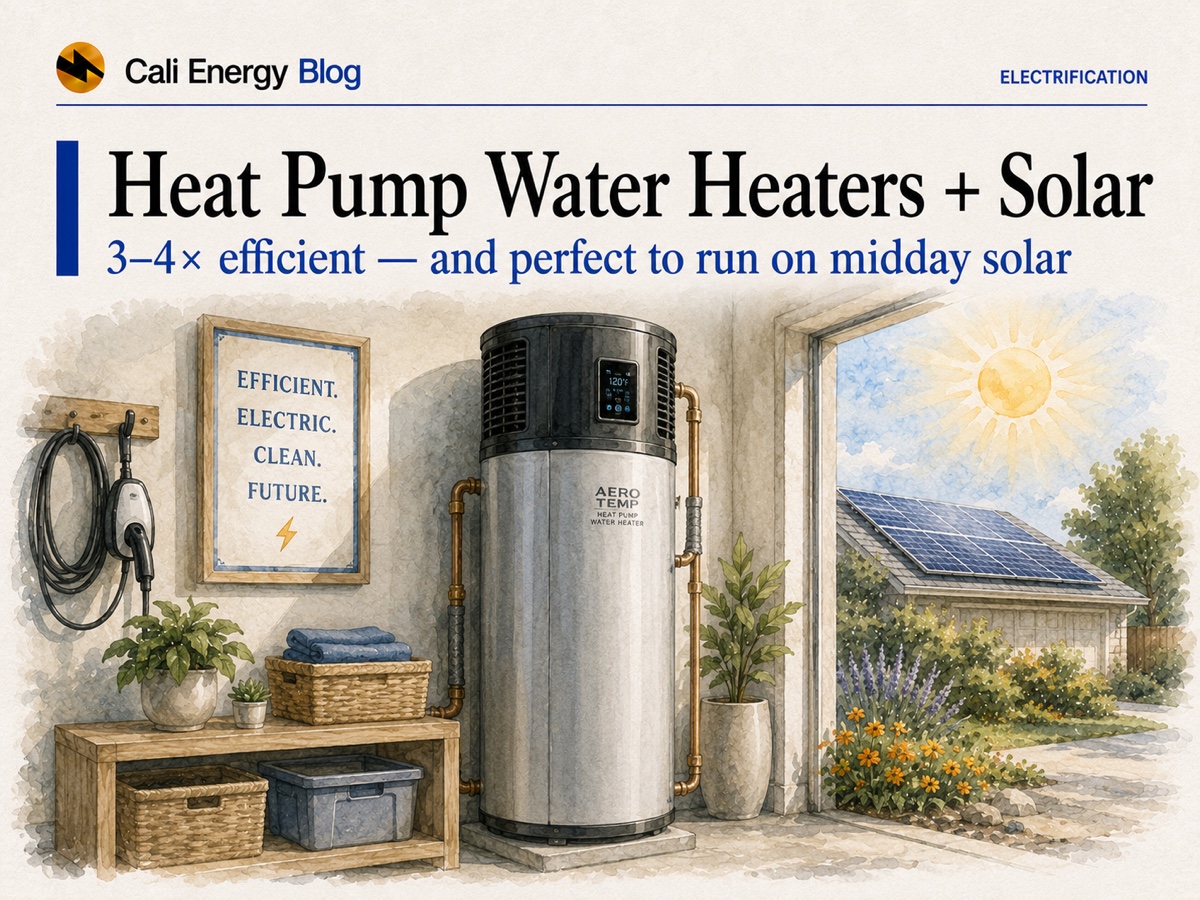
- A heat-pump water heater is two to three times as efficient as a conventional electric tank (DOE); ENERGY STAR estimates about $550 a year saved for a family of four.
- On SCE’s Net Billing Tariff, exports earn about 3¢–21¢ per kWh for 2026 customers, so heating water with your own midday solar beats exporting it. LADWP nets kWh over each billing period, so there the total use matters more than the timing.
- It needs air around it — DOE says at least 1,000 cubic feet, ENERGY STAR cites 700 — a spot that stays between 40 and 90°F, and a condensate drain. 120-volt plug-in models can help avoid a panel upgrade.
- LADWP pays $1,500–$2,500 per qualifying unit. TECH Clean California’s statewide single-family incentives have been reserved since November 2025, with a San Fernando Valley program announced for late summer 2026. The federal 25C credit does not apply to 2026 installs.
What a heat-pump water heater is
It works like a refrigerator in reverse: a small compressor pulls heat from the surrounding air and pumps it into the tank, rather than heating the water directly with an electric element or a gas flame. That is why the Department of Energy describes heat-pump water heaters as two to three times more energy efficient than conventional electric-resistance water heaters (DOE Energy Saver), and why ENERGY STAR estimates a family of four can save about $550 a year on its energy bill with one (ENERGY STAR). Many models also carry a backup electric element for heavy demand.
The market is heading this way regardless. DOE’s April 2024 standards require the most common sizes of electric storage water heaters to reach heat-pump levels of efficiency from 2029; DOE expects heat pumps to rise from 3% to more than half of new electric storage units, and puts the saving at about $1,800 over the life of a unit for an average household replacing an electric-resistance tank (DOE).
Why it pairs with solar — and when the timing matters
A tank of hot water is stored energy: heat it while the panels are producing, and it covers the evening shower. How much that is worth depends on your utility. On SCE’s Net Billing Tariff, exported solar earns hourly credits of about 3¢ to 21¢ per kWh for customers who start in 2026 (SCE), well below what the account pays for power in the evening, so a kilowatt-hour used by the water heater at noon is worth far more than one exported. Use the heater’s schedule, or a connected control if it has one, to heat during solar hours. More on the tariff in NEM 3.0 explained.
LADWP works differently: it nets the kilowatt-hours you export against those you import over each billing period (LADWP), so on its standard rate the heater’s total use matters more than the hour it runs; see LADWP net metering. Either way the efficiency gain is the same, and the lower demand can mean a smaller array or battery. If storage is on the table too, see do I need a battery under NEM 3.0?
Heat pump, electric resistance or gas
| Type | How it heats | Can it run on your solar? | Typical install needs |
|---|---|---|---|
| Heat pump | Moves heat from the air — two to three times the efficiency of electric resistance (DOE) | Yes, and it uses the least of it | Air space, a 40–90°F location, a condensate drain; 240 V circuit or a 120 V plug-in model |
| Electric resistance | An element heats the water directly | Yes, but it needs two to three times the energy for the same hot water | 240 V circuit |
| Gas | Burns natural gas | No — solar electricity cannot offset gas | Gas line and venting |
Sources: DOE Energy Saver · ENERGY STAR.
The electrical side
A water heater is a load, so it counts in your home’s service load calculation, not in the 120% busbar rule that limits solar and exporting batteries. Most models run on a dedicated 240-volt circuit; replacing an electric tank may reuse the existing circuit, while replacing a gas unit usually needs a new one. ENERGY STAR notes that models using a standard 120-volt outlet are now available to help avoid an expensive panel upgrade (ENERGY STAR). On a panel that is already close to its limit, a heat-pump water heater on top of solar, a battery and an EV charger can be the load that forces an upgrade — see do you need a main panel upgrade and what an upgrade costs in Los Angeles. In the City of Los Angeles, replacing a water heater is on LADBS’s express permit list (LADBS).
Where it can go
Give it air
DOE says at least 1,000 cubic feet of air space; ENERGY STAR cites 700 — about a 10-by-10-foot room with a 7-foot ceiling. The manufacturer’s manual sets the minimum for your model.
Keep it between 40 and 90°F
DOE’s range for the installed location, year-round. A garage is the usual spot, but a Valley garage can run hotter in summer, so check the model’s rated operating range.
Plan for condensate
Pulling heat out of the air also pulls out moisture, so the unit needs a drain or a condensate pump.
Expect cool air and some sound
It exhausts cooler, drier air and runs a compressor, which suits a garage better than a closet next to a bedroom.
Sources: DOE Energy Saver · ENERGY STAR.
Rebates and credits in 2026
LADWP. Its Consumer Rebate Program pays $1,500 to $2,500 per ENERGY STAR heat-pump water heater, depending on capacity and efficiency, for units with a UEF of at least 3.3 and 30 gallons or more. The rebate rose for equipment purchased and installed from November 1, 2025; the applicant must be an active LADWP residential electric customer, new construction, additions and ADUs are not eligible, applications must be postmarked within 12 months of purchase, and funding is first come, first served (LADWP).
TECH Clean California. Its statewide single-family heat-pump water heater and HVAC incentives have been reserved since November 14, 2025, and the federally funded HEEHRA rebates for single-family homes have been fully reserved statewide since February 24, 2026, with waitlists in both (TECH Clean California). A separate San Fernando Valley program was announced for late summer 2026 for Aliso Canyon priority communities — Porter Ranch, Granada Hills, Northridge, Chatsworth, North Hills, Canoga Park, Reseda, Winnetka, West Hills, Van Nuys and Lake Balboa — with income-qualifying incentives that may cover the full installation cost; check its page for whether enrollment has opened (TECH, San Fernando Valley).
Federal. The 25C Energy Efficient Home Improvement Credit, which allowed up to $2,000 a year for a heat-pump water heater, does not apply to equipment placed in service after 2025 (IRS). General information, not tax advice.
Where Cali Energy fits. The water heater swap itself is plumbing work. Our part is the electrical and solar side: checking whether the panel can carry a new 240-volt load, running the circuit, and sizing or resizing the solar so more of your hot water runs on your own production. Cali Energy holds general building (B), electrical (C-10) and roofing (C-39) classifications under CSLB #1032379. If you are adding a heat-pump water heater, an EV charger and a battery, we can model the load together. Call +1 (323) 844-7777.
Get a solar-ready electrical assessmentFrequently asked
How much more efficient is a heat-pump water heater?
The U.S. Department of Energy says two to three times more efficient than a conventional electric-resistance water heater. ENERGY STAR estimates about $550 a year in savings for a family of four compared with a standard electric model.
Is a heat-pump water heater worth it with solar?
It uses far less electricity for the same hot water, so it takes a smaller share of your solar. On SCE’s Net Billing Tariff, heating water with midday solar is worth more than exporting it at about 3–21¢ per kWh. With LADWP, which nets kWh over the billing period, the saving comes from the efficiency rather than the timing.
Does a heat-pump water heater need a new circuit or panel upgrade?
Most run on a dedicated 240-volt circuit, which an existing electric tank may already have. Replacing a gas unit usually needs a new circuit, and 120-volt plug-in models can help avoid a panel upgrade. Whether your panel has room is a load calculation.
Where should a heat-pump water heater go?
Somewhere with enough air — DOE says at least 1,000 cubic feet, ENERGY STAR cites 700 — that stays between 40 and 90°F, with a drain for condensate. A garage is the common choice; check the model’s operating range against summer heat.
What rebates are available in Los Angeles in 2026?
LADWP pays $1,500–$2,500 per ENERGY STAR unit (UEF 3.3+, 30 gallons+), first come, first served. TECH Clean California’s statewide single-family incentives and HEEHRA rebates are reserved with waitlists, and TECH has announced a San Fernando Valley program for Aliso Canyon priority communities.
Can I still get the federal tax credit for a heat-pump water heater?
No. The 25C credit, up to $2,000 a year for a heat-pump water heater, does not apply to equipment placed in service after 2025.
Related reading
Sources & methodology
Figures on this page come from the primary sources below and, where noted, from Cali Energy calculations using the stated assumptions. Rates, incentives, and program terms change; each was verified September 30, 2026.
- U.S. Department of Energy — Energy Saver: Heat Pump Water Heaters
- ENERGY STAR — Is a heat pump water heater right for your home? (February 2024)
- U.S. Department of Energy — Final efficiency standards for water heaters (April 30, 2024)
- IRS — Energy Efficient Home Improvement Credit (25C)
- LADWP — Consumer Rebate Program (heat pump water heaters)
- TECH Clean California — Single-family incentives status
- TECH Clean California — San Fernando Valley residential incentives
- LADBS — Information Bulletin P/GI 2026-003, Express Permits (replacing water heaters)
- SCE — Solar Billing Plan (Energy Export Credit values)
- LADWP — Service Rider NEM, Net Energy Metering
Run your hot water on your own solar
Cali Energy handles the solar and electrical side of going all-electric in LA — panel capacity, the 240V circuit, and sizing solar so your heat-pump water heater runs on sunshine. CSLB #1032379 (B, C-10, C-39). Call +1-323-844-7777 for a straight-answer assessment.
Get a free estimatePrepared by Cali Energy, September 30, 2026. This article is for general educational purposes only and is not legal, tax, financial, engineering, or utility advice. Rates, incentives, codes, permit requirements, equipment specifications, prices, and program terms may change; figures and timelines are estimates, not guarantees. Confirm current requirements with the applicable utility, AHJ, program administrator, manufacturer, or a licensed professional. See our Content Disclaimer. Cali Energy · 19201 Parthenia St, Unit E, Northridge, CA 91324 · CSLB #1032379 (B, C-10, C-39)