

Solar Panel Types: Mono vs Poly vs Thin-Film
For a home in 2026 the answer is monocrystalline. Of the solar homes connected in SCE’s part of Los Angeles County in 2025 whose panel we could match to the state’s module list, 98.8% used mono panels, 1.2% polycrystalline and none thin-film. The typical panel was 405 W and 21.3% efficient, up from 255 W and 15.6% in 2015. The choice that is left is inside mono: standard panels around 21%, or premium heterojunction and n-type panels around 22–23% that also lose less power in heat.
Get a free estimate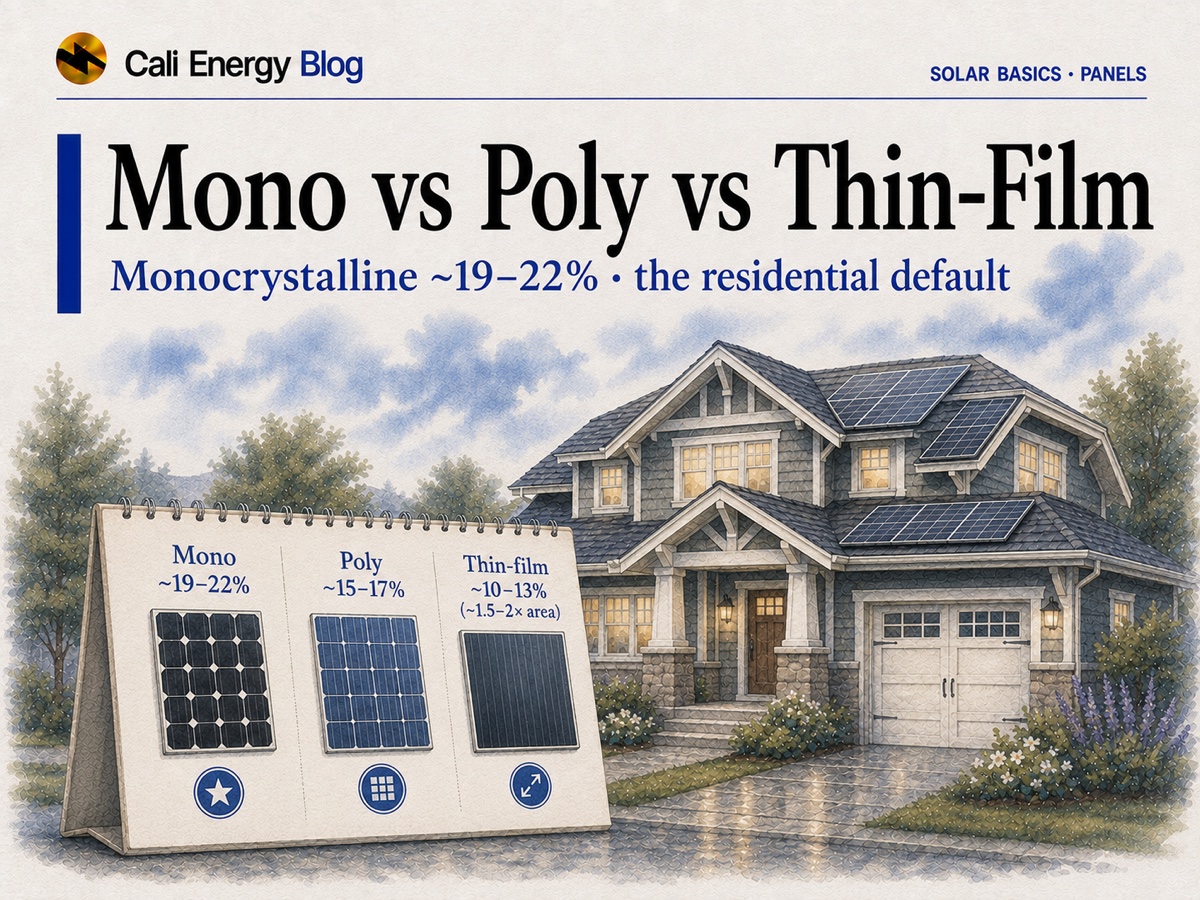
- Mono won: it went from 21% of matched LA installs in 2015 to 98.8% in 2025; polycrystalline fell from 79% to 1.2%.
- Panels got bigger and better: the median model rose from 255 W at 15.6% efficiency to 405 W at 21.3%.
- Thin-film is better than its reputation, but still not for roofs: recent listings run about 18%, so a 7 kW array needs about 23% more area than with mono.
- Within mono, heat matters in LA: heterojunction panels lose about 0.24% of power per °C, standard ones about 0.34%.
What Los Angeles homes actually installed
The CPUC’s interconnection records list the panel model on each system, and the California Energy Commission’s PV Module List records each model’s technology, wattage and size. Matching the two for residential SCE customers in Los Angeles County:
| Year | Mono | Poly | Typical panel | Typical efficiency | Matched |
|---|---|---|---|---|---|
| 2015 | 21.3% | 78.7% | 255 W | 15.6% | 19% |
| 2017 | 62.0% | 37.9% | 290 W | 17.9% | 55% |
| 2019 | 85.8% | 14.2% | 315 W | 19.4% | 69% |
| 2021 | 98.2% | 1.8% | 340 W | 20.1% | 79% |
| 2023 | 98.3% | 1.7% | 400 W | 20.8% | 79% |
| 2025 | 98.8% | 1.2% | 405 W | 21.3% | 82% |
| 2026 (Jan–Aug) | 98.6% | 1.4% | 410 W | 21.4% | 90% |
Sources: California DG Stats (data through August 31, 2026) matched to the CEC PV Module List (October 1, 2026) by model number; “typical” is the median; shares are of matched systems; thin-film was 0.0% in every year. Efficiency = rated watts ÷ module area. Cali Energy count.
The three types today
| Type | Models | Efficiency (middle 80%) | Median | Area for 7 kW |
|---|---|---|---|---|
| Monocrystalline | 5,308 | 20.7–23.5% | 22.2% | ~340 sq ft |
| Thin-film (mostly CdTe) | 49 | 16.9–19.3% | 18.1% | ~415 sq ft |
| Polycrystalline | 1 | — | — | — |
Source: CEC PV Module List, models with a 2024–2026 listing date; area at the median efficiency. Cali Energy calculation.
Monocrystalline cells are cut from a single silicon crystal; they are black and the most efficient per square foot. Polycrystalline cells are cast from many crystals, look blue and speckled, and have all but disappeared: one new model listed in almost three years. Thin-film panels deposit a thin layer, usually cadmium telluride, on glass. The old “10–13%” figure is out of date — recent listings run about 18% — but that still means about 23% more area for the same power, and the products are built for large commercial and utility arrays. See the Department of Energy’s PV basics and NREL’s research-cell chart for where each technology stands in the lab.
The panels on LA roofs in 2025
| Model | Homes | Rating | Efficiency | Power loss per °C | Cell type |
|---|---|---|---|---|---|
| Qcells Q.PEAK DUO BLK ML-G10+ | 1,544 | 410 W | 21.5% | -0.337% | Standard |
| JA Solar JAM54S31-405/MR | 1,532 | 405 W | 21.3% | -0.329% | Standard |
| LONGi LR5-54HABB-400M | 1,292 | 400 W | 21.1% | -0.342% | Standard, bifacial glass-glass |
| REC Alpha Pure-RX (REC460AA) | 419 | 460 W | 22.8% | -0.248% | Heterojunction (HJT) |
| Qcells Q.TRON BLK M-G2+ | 245 | 430 W | 22.8% | -0.276% | Premium line |
| REC Alpha Pure 2 (REC420AA) | 197 | 420 W | 22.3% | -0.234% | Heterojunction (HJT) |
Sources: DG Stats × CEC PV Module List (rating, area, temperature coefficient γPmax) · REC (heterojunction). Cali Energy count.
Every model in the table uses half-cut cells, which cut resistive losses and soften the effect of partial shade. The LONGi model is bifacial glass-glass, but on a flush-mounted roof the back face sees little light, so the front rating is what to plan on. For brands and warranties, see best solar panels for California and solar warranties explained.
PERC, TOPCon, heterojunction: the choice inside mono
PERC
The established p-type design: a passivated rear layer adds efficiency to a conventional cell.
TOPCon
A newer n-type cell with a tunnel-oxide contact. Early national-lab field data show a 1.3–1.8% first-year loss, with longer records still building (NLR).
Heterojunction (HJT)
Crystalline silicon layered with thin amorphous silicon. REC’s Alpha Pure-RX and Pure 2 use it, at 22.3–22.8% and the lowest heat losses in the table.
Back contact
All contacts on the rear, so nothing shades the front; used in some of the highest-efficiency residential panels.
Why heat matters on an LA roof
Panels are rated at a 25°C cell temperature, and on a summer roof cells run far hotter. Each degree costs a fixed share of power: about 0.34% for the standard panels above, 0.28% for Q.TRON and 0.23–0.25% for REC’s heterojunction panels. At a cell temperature of 65°C, 40 degrees above the rating, that is about 14% lost against about 10%. Inland valley roofs feel it most; see heat and solar output in LA and how panels age.
How to choose
Roof space
At about 20 W per sq ft, a 22.8% panel fits about 7% more power than a 21.3% one on a tight roof. See roof space for solar.
Heat
Compare the temperature coefficient on the datasheet: closer to zero is better on hot inland roofs.
Warranty
Product terms run 12–40 years by brand; check the year-25 output guarantee too.
The list
Check the model on the CEC PV Module List, which records its tested specifications.
Where to go next
Cali Energy installs monocrystalline panels in Los Angeles and can compare models for your roof, heat and budget. Call +1-323-844-7777 or ask for panel options — output figures are estimates, not guarantees.
Frequently asked
What are the main types of solar panels?
Monocrystalline, polycrystalline and thin-film. Mono is cut from a single silicon crystal and is the most efficient; poly is cast from many crystals and has nearly disappeared; thin-film deposits a thin layer, usually cadmium telluride, on glass and is used mainly in large arrays.
Which type of solar panel is best for a house?
Monocrystalline. It was on 98.8% of the 2025 Los Angeles County solar homes (SCE) whose panel model could be matched, because it puts the most power on a limited roof.
Are polycrystalline panels still sold?
Barely. Only one new polycrystalline model has been added to the California Energy Commission’s list since 2024, and poly made up 1.2% of matched LA installs in 2025.
How efficient is thin-film solar?
About 17–19% for modules listed by the CEC since 2024, median 18.1% — better than the old 10–13% figure, but below mono’s 22.2%, so it needs about 23% more area.
What’s the difference between PERC, TOPCon and HJT?
They are cell designs inside monocrystalline panels. PERC is the established p-type design; TOPCon is a newer n-type design now common in production; heterojunction layers amorphous silicon on crystalline silicon and loses less power in heat.
How efficient are residential solar panels in 2026?
The typical panel on LA homes in 2025 was 405 W and 21.3% efficient; mono models added to the CEC list since 2024 run 20.7–23.5% for the middle 80%.
Does LA heat change which panel I should choose?
It can. Standard panels lose about 0.34% of power per °C above 25°C, heterojunction panels about 0.24%; at 65°C that is about 14% vs 10%. The gap matters most on hot inland roofs.
Related reading
Sources & methodology
Figures on this page come from the primary sources below and, where noted, from Cali Energy calculations using the stated assumptions. Rates, incentives, and program terms change; each was verified October 5, 2026.
- California Energy Commission — PV Module List (technology, rating, area, temperature coefficient; data as of October 1, 2026)
- California DG Stats — Interconnected Project Sites (SCE, data through August 31, 2026; Cali Energy match to the CEC list)
- U.S. Department of Energy — Solar Photovoltaic Technology Basics
- NREL — Best Research-Cell Efficiency Chart
- REC — Alpha Pure-RX and Pure-R series (heterojunction)
- NLR — PV Durability at Scale: Assessing Bifacial and TOPCon Field Performance (2026)
Choose panels that fit your roof and budget
Compare panel options for efficiency, heat performance and warranty on your roof. Estimates, not guarantees.
Get a free estimatePrepared by Cali Energy, October 5, 2026. This article is for general educational purposes only and is not legal, tax, financial, engineering, or utility advice. Rates, incentives, codes, permit requirements, equipment specifications, prices, and program terms may change; figures and timelines are estimates, not guarantees. Confirm current requirements with the applicable utility, AHJ, program administrator, manufacturer, or a licensed professional. See our Content Disclaimer. Cali Energy · 19201 Parthenia St, Unit E, Northridge, CA 91324 · CSLB #1032379 (B, C-10, C-39)