

Best Solar Panels for California Homes (2026)
The short answer: for California’s heat and high rates, the panel that matters is the one that fits your roof and your installer — not the highest efficiency number. Four specs decide it: efficiency (about 20–24% on premium models), the temperature coefficient, the product and performance warranties, and the warranted degradation rate. Below: each one in plain terms, five current models side by side, and the one California figure the brochures leave out — the PTC rating the Energy Commission publishes for every module it lists.
Get a free estimate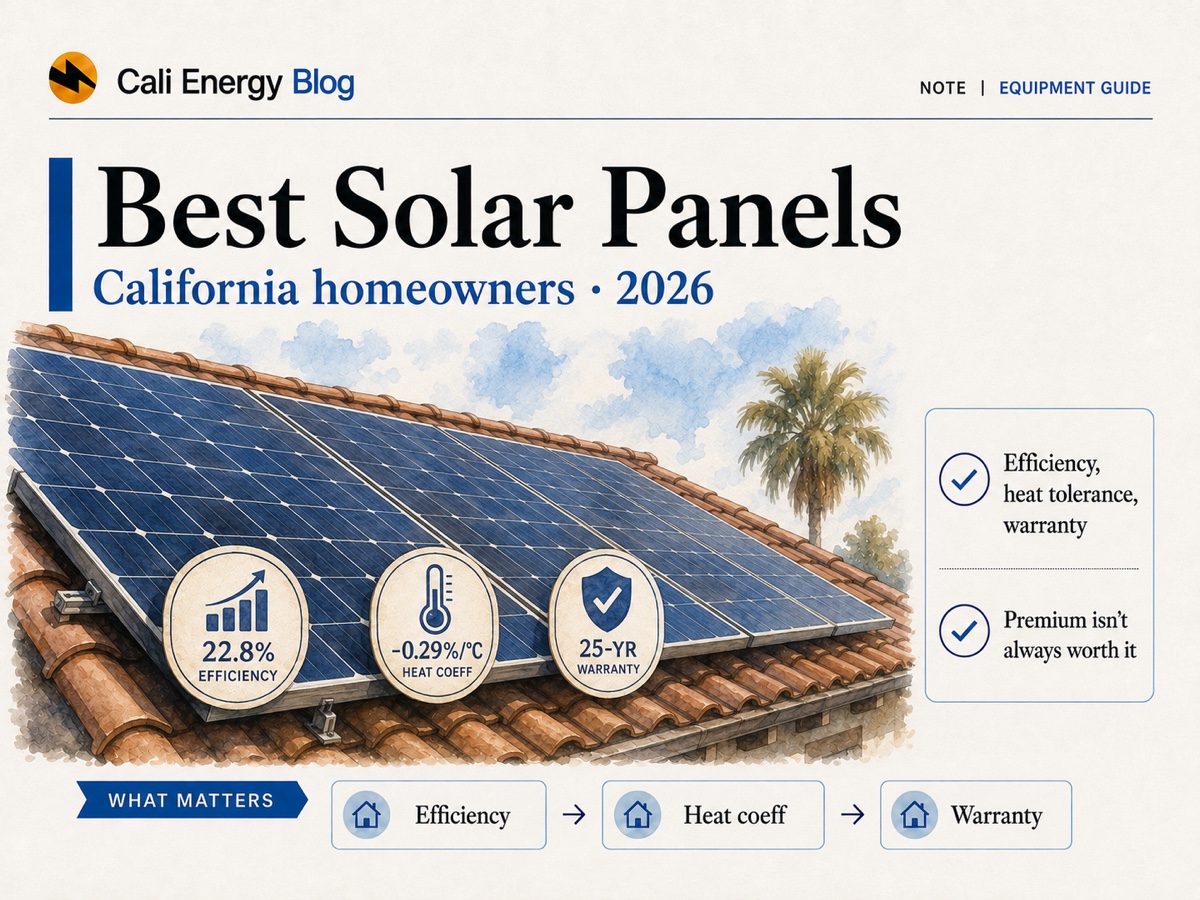
We install solar in Los Angeles and work with several of the brands below, so treat this as a spec comparison rather than a ranking. Every figure is from the manufacturer’s own published material so you can check it against whatever any installer, us included, puts in front of you.
- For a hot, high-rate market like California, four specs matter most: module efficiency, the temperature coefficient, the product & performance warranties, and the annual degradation rate.
- Premium residential panels run about roughly 20–24% efficient, depending on model, lose about 0.24–0.30% of output per °C above the rating in heat, are warranted to fade 0.25–0.4% a year (real systems fade faster than the module spec suggests), and carry long warranties — product terms commonly 12–40 years plus a separate ~25-year (or longer) performance guarantee.
- The “best” panel depends on your roof, budget, and installer support — a premium panel isn’t always worth the premium.
What “best” actually means in California
There is no single best solar panel — there’s the best fit for your roof, your budget, and the installer standing behind it. But California does reward certain traits more than a mild-climate state would: long, hot summers punish panels that fade in heat, and some of the highest electricity rates in the country make every extra kilowatt-hour worth more. So instead of a brand ranking, start with the four numbers that actually predict how a panel behaves on a Los Angeles or Valley roof.
The four specs that matter (in plain terms)
Module efficiency (~20–24%)
How much of the sunlight hitting the panel becomes electricity. Premium residential panels run about 20–24%, depending on model; value panels sit a bit lower. Higher efficiency means more watts per square foot — it mostly matters when your roof space is tight. On a big, open roof, a slightly lower-efficiency panel can be the smarter buy.
Temperature coefficient
Panels are rated at a cool 25 °C, but a California rooftop bakes far hotter. The temperature coefficient tells you how much output you lose for each °C above that — typically about −0.24% to −0.30% per °C on current premium models. A number closer to zero (say −0.24) holds more power on a 100°F afternoon than −0.30. In our climate this spec earns its keep.
Product & performance warranty
Two different promises. The product warranty covers the panel itself against defects — current lines run anywhere from 12 to 40 years, and the long end is usually conditional on who installs the system and on a registration being filed. The separate performance warranty guarantees a minimum output years down the road — 89–92% at year 25 on the models compared below. Check both, check the conditions, and check who is left to honour them.
Annual degradation
Every panel slowly makes a little less each year, and this is the spec most often quoted wrongly. The familiar 0.5% a year is the median for crystalline silicon in the national laboratory’s compendium of degradation measurements — where the mean for the same technology is 0.8–0.9% a year, because the distribution has a long tail. Half the measured population fades faster than the number everyone quotes. Manufacturer datasheets warrant lower still — 0.25% to 0.4% a year on the models below.
A house owns a system, not a module. Measured at system level across a US fleet the median performance loss runs about 0.75% a year, and a study of residential rooftops specifically found 1.3% a year of energy-yield decline — a whole-system figure that takes in tree growth, unwashed soiling and inverter losses rather than panel decline alone. The datasheet number is the panel’s promise about itself; what your roof delivers over the years depends on rather more than the module. Between two of the panels below the difference in warranted degradation is a fraction of a percent a year — real, but smaller than shade or a dirty array.
Degradation figures from the national laboratory formerly known as NREL: the Compendium of Photovoltaic Degradation Rates for the module-level median and the crystalline-silicon mean, the PV Fleet Performance Data Initiative for the system-level median, and the fleet-scale residential analysis for the 1.3% energy-yield figure. The same fleet programme separates recoverable soiling from true degradation, and with soiling excluded the system figure comes back to roughly 0.5% a year — some of what looks like decline is dirt. Warranted rates are from the manufacturer datasheets linked below.
A cool-climate “best panel” list can mislead a California buyer
Most national round-ups rank on efficiency alone. In a hot market, the temperature coefficient and a genuinely honored warranty deserve equal weight, because a panel that looks great at 25 °C in a lab can quietly give back some of that edge at 65 °C cell temperature on a Northridge roof in August. Read the spec sheet for your conditions, not the headline efficiency.
Five reputable panels, side by side
A factual snapshot of one specific current model from each of five well-regarded manufacturers sold in California. Specs vary by exact SKU, wattage, and revision, so always confirm the datasheet for the specific panel in your proposal — the figures below are for the models named.
| Model | Wattage range | Max efficiency | Pmax temp. coeff. (%/°C) | Product warranty | 25-yr performance |
|---|---|---|---|---|---|
| Maxeon 6 (IBC) Maxeon Solar Technologies | 425–440 W | 22.8% | −0.29 | 40 yr — only with an authorised installer and registration 25 yr otherwise; manufacturer under judicial management | 92% |
| REC Alpha Pure-RX (HJT) REC Group | 450–470 W | 22.6% | −0.24 | 20 yr — 25 yr with an REC Certified Solar Professional | ≥92% |
| Q.TRON BLK M-G2+ (TOPCon) Qcells | 415–440 W | 22.5% | −0.29 | 25 yr | ≥90.6% |
| Silfab Prime NTC (N-type) Silfab Solar | 420–440 W | 22.6% | −0.29 | 12 yr — 25 yr with a registered Silfab installer 30-yr power warranty | 90.8% |
| TOPHiKu6 CS6.1-54TM-H (TOPCon) Canadian Solar | 445–470 W | 22.5% | −0.29 | 12 yr — 25 yr for rooftop installs in certain regions 30-yr linear power warranty | 89.4% |
One trap when you check these yourself: a manufacturer’s marketing page usually quotes the best figure across the whole product family, including commercial modules, while a proposal names one residential SKU. Canadian Solar’s TOPHiKu6 page advertises up to 23.0% efficiency and 620 W, but the residential CS6.1-54TM-H in the row above is 445–470 W. Compare SKU to SKU, not brochure to SKU. Specs from manufacturer datasheets: Maxeon 6 · REC Alpha Pure-RX · Qcells Q.TRON BLK M-G2+ · Silfab Prime NTC · Canadian Solar TOPHiKu6. “25-yr performance” is the warranted output near year 25 (some brands warrant to year 30, so that figure is a point on a longer curve); values vary by exact SKU and revision. The temperature coefficients above are the manufacturers’ own datasheet figures; the state equipment list does not always agree with them on the same product, which is worth knowing before you treat a tenth of a percent as decisive — Maxeon’s datasheet prints −0.29%/°C where the Energy Commission lists those same SKUs at −0.276. The product warranty column is the headline term and its condition, because on four of these five the headline term is conditional.
Notice how close the top models are on paper. Max efficiency across these five spans only about two points, and every one carries a long product warranty on paper — anywhere from 12 to 40 years — plus a separate performance guarantee running 25 years or longer, though as the warranty column shows, four of the five headline terms come with a condition attached. For most California roofs, the practical differences come down to how much roof space you have, how hot your roof runs, and the total installed price — not a single hero spec.
On four of these five panels the headline warranty term is conditional — and the condition is your installer
This is the least advertised thing on the page. Maxeon warrants 40 years “from the Warranty Start Date (25 years if no Registration or if not installed by an Authorized Installer)”, with registration due within six months. Silfab warrants 12 years, extended to 25 only where the owner can evidence the start date and the installer was registered and qualified with Silfab. Canadian Solar warrants 12 years, with the 25-year term available only for products installed on rooftops in certain regions. REC gives 20 years, 25 with an REC Certified Solar Professional. Only Qcells publishes a flat 25 years.
So the number a salesperson quotes is frequently the best case, and the thing that decides whether you get it is which company is on your roof and whether somebody files a registration you will never see. Ask for the warranty term you will actually receive, in writing, along with who registers the system and by when.
The one California number the brochures leave out
California’s state incentive programmes draw their eligible equipment from the Energy Commission’s Solar Equipment List, and utilities and cities consult it during Rule 21 interconnection and permit review — though the Commission is explicit that it does not make listing a condition of installing equipment in California. Either way, almost anything a California installer quotes is on it, and the list publishes a rating the manufacturers rarely put in a brochure.
The efficiency and wattage on a datasheet are STC figures: 1,000 W/m² of light with the cell held at a laboratory 25 °C. No California roof is ever at 25 °C in sunlight. The Energy Commission therefore lists a second rating beside it, PTC — PVUSA Test Conditions — measured at 1,000 W/m² in the plane of the array with 20 °C ambient air and 1 m/s of wind. Same light, real air. PTC is always the lower number, and the gap between the two is the honest version of “how does this panel behave when it is warm?”
Here is what the state’s own list says about the five models above, at one comparable SKU each.
| Listed model | Nameplate (STC) | PTC | PTC as % of nameplate | γPmax (%/°C) | Avg. NOCT (°C) |
|---|---|---|---|---|---|
| REC460AA Pure-RX REC Group | 460 W | 438.8 W | 95.4% | −0.248 | 45.2 |
| CS6.1-54TM-460H CSI Solar (Canadian Solar) | 460 W | 436.1 W | 94.8% | −0.308 | 43.6 |
| Q.TRON BLK M-G2+ 440 Qcells North America | 440 W | 416.7 W | 94.7% | −0.276 | 46.1 |
| SPR-MAX6-440 Maxeon Solar Technologies | 440 W | 415.6 W | 94.5% | −0.276 | 47.2 |
| SIL-440QD Silfab Solar | 440 W | 415.5 W | 94.4% | −0.294 | 45.9 |
Nameplate Pmax, PTC, γPmax and Average NOCT as published in the California Energy Commission’s PV Module List. PTC definition from the Energy Commission’s Renewable Energy Program guidebook. Percentages are PTC divided by nameplate.
Two things fall out of that table, and both are more useful than a brand ranking.
The spread is one percentage point. From best to worst, these five modules keep between 95.4% and 94.4% of their nameplate under the state’s real-air test. Whatever separates a flagship from a solid mid-tier panel in California heat, it is not a difference you will notice on a bill.
The temperature coefficient alone does not predict the ranking. Canadian Solar has the worst coefficient of the five at −0.308%/°C, and still places second on PTC — because it also has the lowest NOCT on the list, 43.6 °C, meaning the module simply runs cooler in the first place. Maxeon has a better coefficient and a hotter NOCT, and lands below it. A panel’s heat behaviour is the coefficient and how hot the thing gets, and PTC is the only figure here that combines them.
Note also that the state list is per-SKU, not per-family, and it sometimes disagrees with the marketing sheet for the same product line: Maxeon’s all-black variants are listed at −0.290%/°C where the standard finish is −0.276, and seven entries in the Q.TRON G2+ family are listed at −0.314 against twelve at −0.276. When a proposal quotes a coefficient, it is quoting one revision of one SKU.
One percentage point sounds like nothing until you see where it sits in the whole list. Taking every module on the Energy Commission’s list with a nameplate between 350 and 500 W that was added on or after 1 January 2024 — 2,057 entries — here is how PTC as a share of nameplate is distributed.
| Percentile | 5th | 25th | Median | 75th | 95th |
|---|---|---|---|---|---|
| PTC ÷ nameplate | 92.9% | 94.0% | 94.4% | 94.9% | 95.2% |
Calculated from the Energy Commission’s published PV Module List, September 2026 edition: PTC divided by Nameplate Pmax for every listed entry in that wattage band with a CEC listing date on or after 1 January 2024. The full list holds about 22,000 entries from 287 manufacturers across all wattages and vintages, one row per listing rather than per panel sold, so a manufacturer with a hundred SKUs counts a hundred times.
Which puts the five panels above in their place. The best of them, the REC Alpha Pure-RX at 95.4%, sits above the 95th percentile of everything currently listed. The weakest of them, the Silfab Prime at 94.4%, is the median. A panel most people would call mid-tier and a panel most people would call a flagship are separated by about the distance between the median and the top five percent — and in absolute terms, by one point of nameplate.
Take the full model string off the proposal — not the brand, the whole thing with the wattage and any letters after it — and look it up in the Energy Commission’s PV Module List. Then check three things.
That it is there. The list carries around 22,000 entries from 287 manufacturers, so any panel a California installer is likely to quote should be on it — the lists support utility grid-connection services, Rule 21 interconnection and state and local incentive programmes, and utilities and cities do consult them during interconnection and permit applications. If you cannot find it, search by manufacturer and wattage before concluding anything: model strings on the list often carry suffixes for finish or revision that the proposal leaves off, so an exact-string search misses panels that are in fact listed. If it is genuinely absent, ask the installer why.
That the nameplate matches. The wattage on the list should be the wattage you are being sold and being charged for.
Where the PTC ratio lands — read it next to the listing date. Divide PTC by nameplate, then look at the CEC listing date in the same row, because the two go together. Among entries added since 2024 the middle half sits between 94.0% and 94.9%, only about 7% fall below 93% and under 2% below 92%. Among entries listed before 2024 in the same wattage band the median is 93.1%, and 44% sit below 93%. A 93% ratio on a 2022 listing is therefore ordinary; the same 93% on a 2026 listing is worth a question. Judge the panel against its own vintage, and treat the whole thing as a sanity check on the heat claim in a sales pitch rather than a pass/fail test. One more trap: finish variants of the same model can differ by nearly a full point — all-black panels usually rate lower than the white-backsheet version of the same SKU — so make sure you are reading the row for the finish you are actually buying.
How to actually choose for your home
If roof space is tight — a smaller or shaded roof where you need to fit as many watts as possible — the highest-efficiency models (Maxeon 6, REC Alpha Pure-RX) earn their premium by squeezing more production into limited area. See our companion guide on how many panels you actually need to gauge how tight your fit really is.
If you have a big, open roof, you can hit your production target with a value-to-mid model (Qcells Q.TRON, Silfab Prime, Canadian Solar TOPHiKu6) and put the savings toward a battery or simply a lower total. The extra efficiency you’d pay for wouldn’t change what fits.
If your roof runs very hot — dark shingles, low tilt, inland heat — give extra weight to the temperature coefficient. Over a long Valley summer, a panel at −0.24%/°C gives back less midday output than one at −0.30%/°C.
A premium panel isn’t automatically worth the premium
The gap between a good value panel and a flagship is real but modest — a couple of points of efficiency and a fraction of a percent per °C. If a premium model adds several thousand dollars to your total and you have the roof space to hit the same production with a solid mid-tier panel, the money often does more as a smaller loan or a battery. Match the panel to the constraint you actually have.
Warranty is only as good as who honors it
A 25- or 40-year panel warranty means little if the manufacturer is not around to service it, and in 2026 that is not an abstract worry — it applies to the longest warranty in the table above.
Maxeon Solar Technologies is under judicial management. On 1 April 2026 the company and its operating subsidiary filed a voluntary application with the High Court of Singapore to be placed under judicial management under section 91 of the Insolvency, Restructuring and Dissolution Act 2018. The same two restructuring partners at Deloitte Singapore were appointed interim judicial managers on 9 April 2026, and on 29 May 2026 the court made the orders final, appointing them joint and several judicial managers. The company is not hiding it: a banner on its own website states that its affairs, business and property “are being managed by the Judicial Managers who were appointed by the High Court of Singapore on 29 May 2026,” and the copyright line at the foot of every page now reads “Maxeon Solar Technologies, Ltd., (under Judicial Management).”
The reasons are the company’s own, given to the SEC in the April filing: US Customs continued to deny entry to shipments of its products, which cut off cash flow; customers brought breach-of-contract actions seeking damages “upward of $70M”; development of its next-generation cell technology hit setbacks including a failed collaboration; and talks with investors and lenders were still at an early stage with no visibility on the outcome. The board concluded there were significant doubts about the working capital available to meet short-term obligations. Separately, SunPower — Maxeon’s former parent and principal US sales channel — filed for bankruptcy in 2024.
What that does and does not mean for a buyer. The panel is a real product, still listed by the California Energy Commission and still sold through distribution here, and Maxeon still publishes the 40/40-year warranty — the current revision took effect on 1 May 2026, after the application was filed. Read that warranty closely, though: it gives 40 years only where the system was installed by an authorised installer and registered within six months, and 25 years otherwise. But a forty-year promise is worth whatever the company behind it is worth in year thirty, and that company is currently being run by court-appointed managers.
What that looks like in practice is already on Maxeon’s own warranty page, in the SunPower aftermath: coverage for legacy SunPower panels now extends only to panels installed before 5 August 2024 and self-registered with Maxeon before 31 December 2024. Households that missed a registration deadline they were never told about are outside the warranty on a panel that was sold to them as covered for decades. That is the shape of the risk: not that the panels stop working, but that the paperwork behind them changes hands and narrows.
So if a proposal leads with the 40-year warranty, treat the term as an open question rather than the deciding feature. Ask the installer, in writing, what happens to service and replacement if the manufacturer cannot honour a claim, and whether anything has to be registered and by when. Those are fair questions for any brand; here there is a documented reason to ask them.
The general rule this illustrates: weigh the manufacturer’s solvency alongside its spec sheet, and weigh who installs and stands behind the system locally. A workmanship warranty on the installation — roof penetrations, wiring, labor — is separate from the panel warranty, and it is the one you are most likely to actually use. Ask for both in writing, and ask who pays the labour to swap a panel that fails in year fifteen: many product warranties cover the part and not the crew on the roof.
This is also why the “best panel” question is really a “best proposal” question. Panels are a commodity spread across a narrow quality band; the installer’s design, roof work, and follow-through vary far more. For a fuller picture of value, our guide on whether solar raises home value in California and the real cost of solar in Los Angeles put the equipment choice in context.
Where equipment fits in the total price
The panel is only one part of the installed price — alongside the inverter, racking, wiring, permitting, labor, and any roof or electrical work. So a premium panel does not raise your total system price in proportion to its higher module price; a module that costs, say, 30% more than a value panel doesn’t make the whole system cost 30% more, because the module is a fraction of the job. The clean way to measure the real difference is to ask for two otherwise-identical proposals — same size, same installer, same scope — that differ only in the panel, and compare the all-in prices. Decide the panel on fit and heat performance, then compare the full proposals on price per DC watt rather than on the brand name — and judge that figure against the published price distribution instead of a single round number. Our cost breakdown works through where those figures come from and what the contract price legally includes.
Frequently asked
What are the best solar panels for California in 2026?
There is no single best panel — the right one depends on your roof, your budget and the installer standing behind it. For California's heat and high rates, four specs carry the weight: efficiency (about 20–24% on premium models), the temperature coefficient, the product and performance warranties, and the warranted degradation rate. Current models worth comparing include the REC Alpha Pure-RX, Qcells Q.TRON BLK M-G2+, Canadian Solar TOPHiKu6, Silfab Prime NTC and Maxeon 6. On the California Energy Commission's own PTC ratings these five sit within one percentage point of each other, which is the honest measure of how little the brand choice decides. Two caveats matter more than the ranking: on four of the five the headline product warranty is conditional on who installs the system, and Maxeon has been under court-appointed judicial management in Singapore since 2026.
Does the temperature coefficient really matter in California?
Yes, more than in a mild climate. Panels are rated at a cool 25 °C, but a California rooftop runs much hotter, and the temperature coefficient tells you how much output you lose per °C above that — typically about −0.24% to −0.30% per °C on current premium models. A value closer to zero holds more power on hot afternoons. Over a long, hot Valley summer that difference adds up, so it deserves weight alongside efficiency.
How long do solar panels last, and how fast do they degrade?
Panels are planned around a 25- to 35-year service life, and the fade is the part usually misquoted. The familiar 0.5% a year is the median of module-level measurements in the national laboratory's literature review; the mean for crystalline silicon in the same dataset is nearer 0.8–0.9%. At system level a US fleet study finds about 0.75% a year, and a study of residential rooftops specifically found 1.3% a year of energy-yield decline — a whole-system figure that includes tree growth, soiling and inverter losses, not panel decline alone. What the manufacturer actually promises is on the datasheet: current premium models warrant 0.25% to 0.4% a year, with product warranties from 12 to 40 years and a separate performance warranty often around 87–92% at year 25.
Is a higher-efficiency panel always worth paying more for?
Not always. Higher efficiency mainly helps when roof space is tight — it fits more watts into less area. On a big, open roof you can hit the same production target with a solid mid-tier panel and put the savings toward a battery or a lower total. Match the panel to your actual constraint rather than paying for a spec you don’t need.
What’s the difference between a product warranty and a performance warranty?
The product warranty covers the panel itself against manufacturing defects; the performance warranty guarantees a minimum output years later — 89–92% of rated power at year 25 on the models compared here, with several brands warranting to year 30. The part that is easy to miss is that the product term is usually conditional. Maxeon warrants 40 years, but 25 if the system was not installed by an authorised installer or the registration was not filed within six months. Silfab warrants 12 years, extended to 25 only with a registered Silfab installer. Canadian Solar warrants 12 years, with 25 available only for rooftop installations in certain regions. REC gives 20 years, 25 with an REC Certified Solar Professional. Of the five compared here only Qcells publishes a flat 25 years. Ask for the term you will actually receive, in writing, and remember the installer's own workmanship warranty on the installation is separate — and is the one you are most likely to use.
How much do the panels affect my total solar price?
Less than the module price difference suggests. The panel is one part of the installed price alongside the inverter, racking, wiring, permitting and labour, so a module costing 30% more than a value panel does not make the system cost 30% more. The cleanest way to see the real difference is to ask for two otherwise-identical proposals — same size, same installer, same scope — that differ only in the panel, and compare the all-in prices. Then judge the result against the published price distribution rather than a single number; our cost guide works through where those figures come from.
What is a PTC rating, and where do I find it?
PTC stands for PVUSA Test Conditions. Where the wattage on a datasheet is an STC figure — 1,000 W/m² with the cell held at a laboratory 25 °C — PTC is measured at the same light with 20 °C ambient air and 1 m/s of wind, which is much closer to a roof. The California Energy Commission publishes a PTC value beside the nameplate rating for every module on its Solar Equipment List; state incentive programmes draw on that list and utilities and cities consult it during interconnection and permit review, though the Commission does not itself make listing a condition of installing equipment. Search your proposal's model number in the PV Module List — and if an exact-string search finds nothing, search by manufacturer and wattage, because listed model numbers often carry finish or revision suffixes a proposal leaves off. Then divide PTC by nameplate, and read it against the module's CEC listing date: among entries added since 2024 the middle half sits between 94.0% and 94.9% and only about 7% fall below 93%, but among older listings the median is 93.1%. A 93% ratio on a 2022 listing is ordinary; the same figure on a 2026 listing is worth a question.
Related reading
Sources & methodology
Figures on this page come from the primary sources below and, where noted, from Cali Energy calculations using the stated assumptions. Rates, incentives, and program terms change; each was verified September 17, 2026.
- California Energy Commission — Solar Equipment List: PV Modules (nameplate, PTC, temperature coefficient, NOCT)
- California Energy Commission — Solar Equipment Lists Program (listing requirement and update schedule)
- Maxeon 6 DC 425–440 W — manufacturer datasheet
- Maxeon — warranty terms and legacy SunPower coverage limits
- Maxeon Solar Technologies — Form 6-K, 1 April 2026 (judicial management application under s. 91 IRDA)
- Maxeon Solar Technologies — Form 6-K, May 2026 (High Court of Singapore judicial management orders, 29 May 2026)
- REC Group — Alpha Pure-RX solar panels
- Qcells — Q.TRON BLK M-G2+ module
- Silfab Solar — Prime NTC (SIL-440 QD)
- Canadian Solar — TOPHiKu6 module
- Compendium of Photovoltaic Degradation Rates (Jordan, Kurtz, VanSant, Newmiller)
- Photovoltaic Degradation Rates — An Analytical Review (Jordan & Kurtz, NREL/JA-5200-51664), via OSTI
- National laboratory — PV module reliability and degradation research
- Maxeon — Limited Warranty for PV Modules (document 545700, Rev G, effective 1 May 2026)
- Silfab Solar — Limited Product and Linear Performance Warranty (SIL-CS-WRTY-010, Rev Q)
- Canadian Solar — TOPHiKu6 CS6.1-54TM-H datasheet (445–470 W, all-black)
- Maxeon Solar Technologies — Form 6-K, 10 April 2026 (interim judicial management from 9 April 2026)
- Deceglie, Jordan, Nag, Shinn & Deline — Fleet-Scale Energy-Yield Degradation Analysis Applied to Hundreds of Residential and Nonresidential Photovoltaic Systems
Not sure which panel fits your roof?
Tell us about your roof, your shade, and your recent bill and we'll recommend a panel and system size that fit your home — with the efficiency, heat, and warranty specs explained in plain terms.
Get a free estimatePrepared by Cali Energy, September 17, 2026. This article is for general educational purposes only and is not legal, tax, financial, engineering, or utility advice. Rates, incentives, codes, permit requirements, equipment specifications, prices, and program terms may change; figures and timelines are estimates, not guarantees. Confirm current requirements with the applicable utility, AHJ, program administrator, manufacturer, or a licensed professional. See our Content Disclaimer. Cali Energy · 19201 Parthenia St, Unit E, Northridge, CA 91324 · CSLB #1032379 (B, C-10, C-39)