

How Long Do Solar Panels Last?
Plan on 25 to 35 years for the panels — the range the Department of Energy uses — and many keep working longer. They don’t stop at a date; they lose a little output each year, about 0.5% for a typical module and 0.75% for whole systems in national-lab data. Other parts set the pace sooner: inverters, batteries and the roof under the array usually need attention before the panels do.
Get a free estimate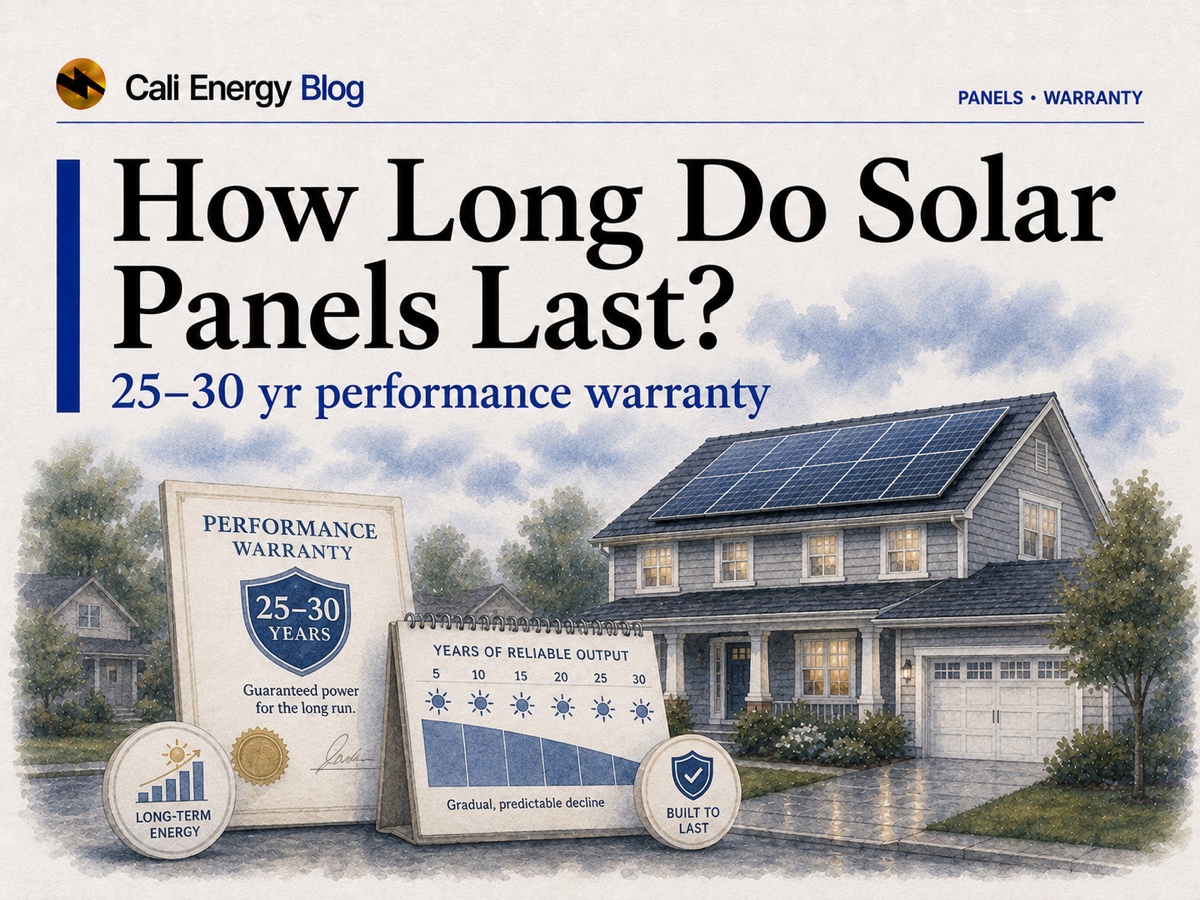
- Panels: 25–35 years of planned life; Berkeley Lab found solar owners’ assumptions rose to about 32.5 years, with most now using 30 or more.
- Output fades slowly: a 7 kW Los Angeles system making 11,900 kWh in its first year still makes about 10,500 kWh at year 25 at the module median rate.
- Electronics go first: string inverters carry 10–12 year warranties, microinverters 25, batteries 10–15.
- The roof often decides: panels come down for a re-roof long before they wear out if the roof is older than the array.
How long panels are expected to last
The Department of Energy puts the operational life of solar panels at 25 to 35 years. That is a planning figure, and it has been rising: in a Berkeley Lab survey of solar developers, owners and consultants, assumed project life grew from about 21.5 years in 2007 to 32.5 years in 2019, and 17 of the 19 organizations used 30 years or more. Those are utility-scale plants, but they use the same kind of modules as a rooftop.
Panels have no moving parts, so they rarely just stop. What changes is how much they make, and whether something around them — an inverter, a battery, the roof — needs work first.
What a Los Angeles system makes in year 10, 25 and 30
National-lab studies measure the decline three ways: about 0.5% a year for individual modules (the median of more than 11,000 measurements in the degradation compendium), about 0.75% for whole systems in the US fleet study, and 1.3% of energy yield on home rooftops, a figure that includes dirt and growing shade. Applied to a 7 kW system in Los Angeles, which NREL’s PVWatts puts at about 11,900 kWh in its first year:
| Measured rate | Year 10 | Year 25 | Year 30 |
|---|---|---|---|
| Module median, 0.5%/yr | 11,320 kWh (95%) | 10,500 kWh (88%) | 10,240 kWh (86%) |
| Whole US systems, 0.75%/yr | 11,040 kWh (93%) | 9,860 kWh (83%) | 9,490 kWh (80%) |
| Home rooftops incl. dirt and shade, 1.3%/yr | 10,440 kWh (88%) | 8,580 kWh (72%) | 8,040 kWh (68%) |
Cali Energy arithmetic: 11,900 kWh × (1 − rate)years; production from NREL PVWatts, Northridge, 20° south. Rates from NREL’s compendium, the PV Fleet report and Deceglie et al.. Estimates, not a forecast for any one system.
Current premium panel warranties promise 89–92% of rated power at year 25, in line with the module median. The bottom row is mostly fixable: cleaning and trimming shade recover much of it. See solar panel degradation for how to tell normal decline from a fault.
How long each part of the system lasts
| Component | Warranty or planning life | What to know |
|---|---|---|
| Panels | Product 12–40 years, performance usually 25; planned life 25–35 | Long terms can depend on registration or a certified installer |
| Microinverters (Enphase) | 25 years | Part covered; on-site labor generally not |
| String inverter (SolarEdge) | 12 years (Nexis: 10) | Often the first major replacement |
| Home battery | 10–15 years | 60–70% of capacity guaranteed at the end |
| Asphalt shingle roof | About 20 years, the most-cited estimate | If it will need replacing while the array is up, the panels come off for the re-roof |
Sources: Enphase and SolarEdge warranties · DOE · panel warranties as compiled in solar warranties explained · roof life as discussed in replace your roof before solar?
The pattern matches what installers see. The CPUC’s consumer guide warns the inverter may need replacing sooner than the rest of the system, and NREL’s residential cost model budgets 1.6% of microinverter capacity a year for out-of-warranty repair or replacement, against 0.2% for panels. See inverter replacement and how long home batteries last.
What actually brings panels down early
A re-roof
The most common reason working panels come off. Check the roof’s age before installing; see removing and reinstalling panels.
Damage
Cracked glass, storm or fire damage, or water at a penetration; see do solar panels damage your roof?
An upgrade
Owners sometimes replace older, lower-wattage panels to fit more output on the same roof, even while the old ones still work.
A failed part
An inverter or connector fault can look like dead panels. Rule it out before replacing modules.
Signs your system needs attention
Compare this year’s production with the same months last year in your monitoring app. A drop well beyond the 1.3% home-rooftop median usually has a cause you can find: dirt, new shade from a growing tree, a failed microinverter or a tripped breaker. Visible damage such as cracked glass or scorch marks calls for a technician. Heat speeds wear, and inland roofs in the Valley run hotter than coastal ones; see heat and solar output in LA.
At the end of their life
Since January 1, 2021 California has let end-of-life panels be managed as universal waste, so they go to a handler or recycler, not the trash; the EPA is still developing a federal rule. Working panels can also be reused. See solar panel recycling in California.
Where to go next
Cali Energy is a licensed Los Angeles solar, roofing and electrical contractor, so the roof under the array is part of the plan. Call +1-323-844-7777 or ask for a system and roof check — lifespan and output figures are estimates, not guarantees.
Frequently asked
How long do solar panels last?
The Department of Energy plans on 25 to 35 years, and many panels work longer at gradually lower output. Solar owners’ own life assumptions rose to about 32.5 years by 2019 in a Berkeley Lab survey.
How much do solar panels degrade each year?
About 0.5% a year for a typical module (the national-lab median) and about 0.75% for whole systems. Home rooftops measured about 1.3% of lost energy yield, which includes dirt and shade you can often fix.
How much will my panels produce after 25 years?
At 0.5% a year, about 88% of the original output; at 0.75%, about 83%. For a 7 kW Los Angeles system that is roughly 10,500 or 9,860 kWh a year instead of 11,900.
What’s the difference between a product warranty and a performance warranty?
The product warranty covers defects in the panel, 12 to 40 years depending on the brand. The performance warranty guarantees a minimum output, usually for 25 years; current premium panels promise 89–92% at year 25. Your installer’s workmanship warranty is separate.
What part of a solar system fails first?
Usually the electronics. String inverters carry 10–12 year warranties and batteries 10–15, and NREL budgets far more for out-of-warranty inverter replacement than for panels.
Do solar panels still work after the warranty ends?
Yes. A warranty is the period the maker guarantees, not an expiry date; panels keep producing at slowly declining output.
Should I replace my roof before installing solar?
If the roof will need replacing during the 25-plus years the panels are up, usually yes; otherwise the array has to come off for the re-roof.
Related reading
Sources & methodology
Figures on this page come from the primary sources below and, where noted, from Cali Energy calculations using the stated assumptions. Rates, incentives, and program terms change; each was verified October 5, 2026.
- U.S. Department of Energy — End-of-Life Management for Solar Photovoltaics (25–35 year operational life)
- Wiser, Bolinger, Seel (Berkeley Lab) — Benchmarking Utility-Scale PV Operational Expenses and Project Lifetimes (2020)
- Compendium of Photovoltaic Degradation Rates (Jordan, Kurtz, VanSant, Newmiller)
- PV Fleet Performance Data Initiative — Final Technical Report (NREL, 2025)
- Deceglie et al. — Fleet-Scale Energy-Yield Degradation Analysis of Residential and Nonresidential PV Systems
- NREL — PVWatts v8 (Los Angeles production per kW)
- Enphase — US Limited Warranty, IQ Microinverters (effective May 2, 2026)
- SolarEdge — Limited Product Warranty (effective January 1, 2026)
- NREL — Q1-2025 Solar PV System Cost Benchmarks, residential model (inverter and module replacement rates)
- CPUC — California Solar Consumer Protection Guide
- US EPA — End-of-Life Solar Panels: Regulations and Management
Get panels built to last — with the warranties to match
Ask about panel quality, real degradation rates and the actual product and performance warranty terms before you choose equipment.
Get a free estimatePrepared by Cali Energy, October 5, 2026. This article is for general educational purposes only and is not legal, tax, financial, engineering, or utility advice. Rates, incentives, codes, permit requirements, equipment specifications, prices, and program terms may change; figures and timelines are estimates, not guarantees. Confirm current requirements with the applicable utility, AHJ, program administrator, manufacturer, or a licensed professional. See our Content Disclaimer. Cali Energy · 19201 Parthenia St, Unit E, Northridge, CA 91324 · CSLB #1032379 (B, C-10, C-39)