

The Solar Installation Process in California, Step by Step
Short version: going solar in California runs through seven stages — site survey, design, contract, permit, installation, inspection and the utility’s Permission to Operate (PTO). Your installer controls most of them; the building department controls the permit and inspection; the utility controls PTO, and a passed inspection does not let you switch on. Only the utility stages have published durations: SCE says a complete, simple solar-only request may get PTO within 10 business days, and LADWP lists 2–5 days for interconnection approval and 1–2 weeks each for verification and meter setting.
Get a free estimate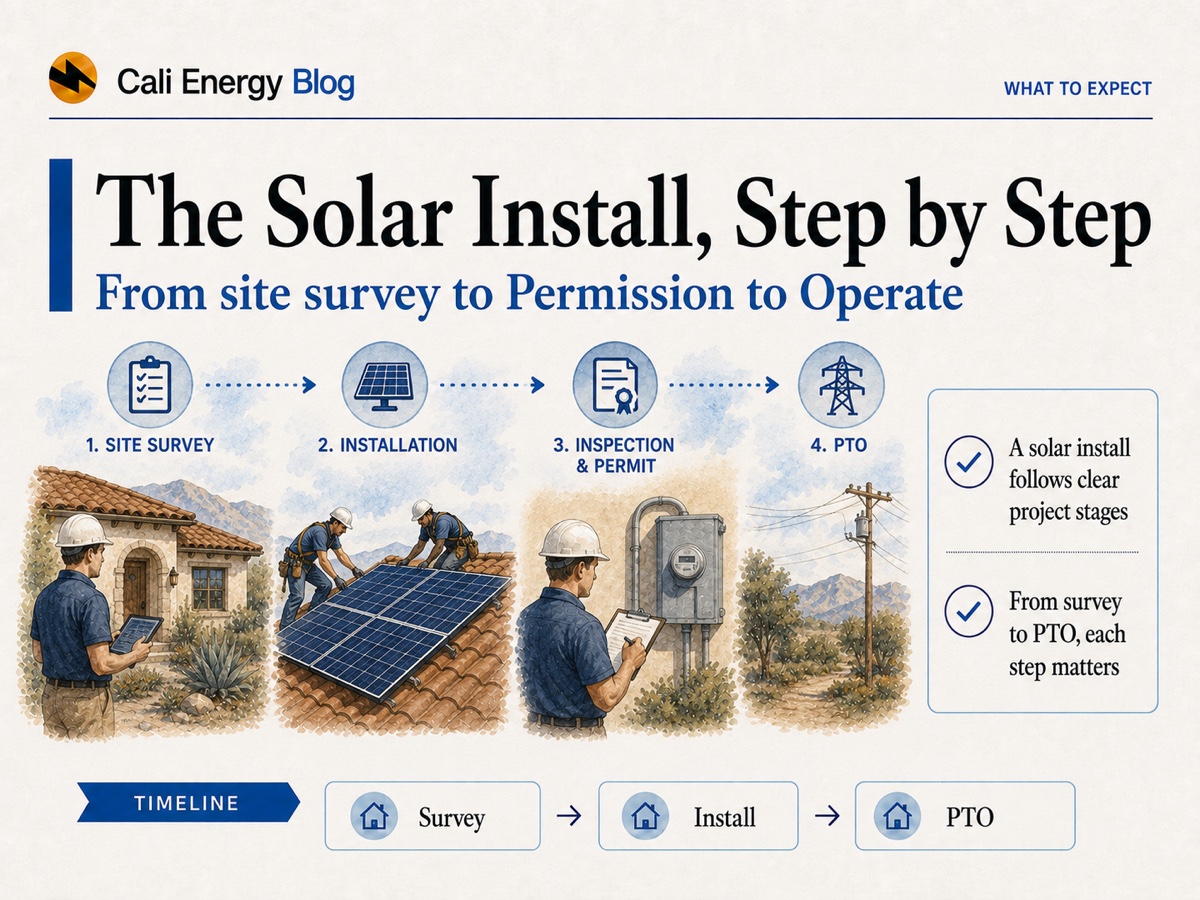
- Seven stages, three owners: the installer (survey, design, contract, installation), the building department (permit, inspection) and the utility (interconnection and PTO).
- At signing California requires a solar disclosure document on the contract’s cover page; in SCE, PG&E and SDG&E territory you also initial and sign the CPUC’s Solar Consumer Protection Guide.
- In the City of Los Angeles, a system of 10 kW or less on a one- or two-family home can get an online express permit with no plan check.
- No agency publishes a contract-to-switch-on total. The published figures cover only the utility’s share — and the system may not be operated until PTO.
The seven stages at a glance
| Stage | Controlled by | What you should get or check | Published timing |
|---|---|---|---|
| 1. Site survey — roof, shading, electrical panel, 12 months of bills | Installer | Written findings on roof condition and panel capacity | None published |
| 2. Design and proposal — layout, equipment, production estimate | Installer | Written proposal with the production estimate and total price | None published |
| 3. Contract | You and the installer | Solar disclosure on the cover page; CPUC guide initialed and signed in SCE, PG&E and SDG&E areas; down payment no more than $1,000 or 10%; completion date; who pulls permits | Cancel within 3 business days of receiving a signed copy, 5 if 65+, when signed away from the seller’s office |
| 4. Permit | City or county building department | City of LA: electrical permit always; building permit only if the array misses the structural exemption | City of LA express permits are issued online, no plan check |
| 5. Installation — mounting, wiring, inverter, battery, any panel upgrade | Installer | Work matching the approved plans | None published |
| 6. Inspection | City or county building department | Final electrical permit approval — SCE asks for it with the interconnection package | None published |
| 7. Interconnection and PTO — review, meter change, authorization | Utility | A written Permission to Operate before the system runs | SCE: within 10 business days for complete, simple solar-only requests. LADWP: 1–3 weeks site visit, 2–5 days approval, 1–2 weeks verification, 1–2 weeks meters |
Sources: SCE Solar Billing Plan FAQs · LADWP Guide to Electric Service, March 2024, pp. 22–23 · B&P §7169 · CPUC Solar Consumer Protection Guide · Civil Code §1689.6 · CSLB · LADBS P/GI 2026-003. LADWP’s durations run from a submission verified as complete and assume no distribution-system upgrade.
Stages 1–2: survey and design
The survey decides two things that can reshape the project. An aging roof is cheaper to replace before the array goes on than to reach later by removing and reinstalling it (replace your roof before solar?). A full or small electrical panel may need an upgrade, depending on the code edition, the utility and the equipment (do you need a main panel upgrade?). The design then depends on your utility: SCE, PG&E and SDG&E customers are on the Net Billing Tariff, where a battery that stores midday solar often pays (NEM 3.0 explained); LADWP runs its own net metering, where a battery is mainly backup.
Stage 3: the contract — what California requires
- Solar disclosure document. Every solar contract must carry the state’s disclosure on its front or cover page, in 16-point bold type: total cost and payments including financing, where to complain, and your cancellation right (B&P §7169).
- CPUC Solar Consumer Protection Guide. In the territories of PG&E, SCE, SDG&E, Bear Valley, PacifiCorp and Liberty, the installer must collect your initials and signature on the guide, and you must be given time to read it (CPUC). LADWP is not on that list.
- Right to cancel. A contract signed away from the seller’s place of business can be cancelled until midnight of the third business day after you receive a signed, dated copy, the fifth if you are 65 or older (Civil Code §1689.6).
- Payments. The down payment is capped at $1,000 or 10% of the price, whichever is less; payments may not run ahead of the work; the contract must name who obtains the permits and give a completion date (CSLB).
- Tax credit. The 30% federal Residential Clean Energy Credit ended for expenditures after December 31, 2025, so a cash or loan purchase in 2026 gets no federal credit (IRS).
For the full list of rights, see your solar consumer rights.
Stages 4–6: permit, installation, inspection
Every city and county runs its own permit counter. In the City of Los Angeles, every PV system needs an electrical permit; a system of 10 kW or less on a one- or two-family home, on a panel of 225 A or less and meeting LADBS’s other express criteria, is issued online as an express permit with no plan check, and a separate building permit is needed only if the array misses LADBS’s structural exemption (P/GI 2026-003, P/GI 2023-027; details in solar permits in Los Angeles). After installation an inspector checks the work against the approved plans; the common reasons it fails are in why solar inspections fail.
Stage 7: why a passed inspection does not switch you on
The utility has its own review. SCE asks for the whole package at once — the application, single-line diagram, signed interconnection agreement and the final electrical permit approval from the building department — arranges any meter change before issuing PTO, and states that PTO is what authorizes you to operate the system; enrollment in the Solar Billing Plan follows within a few billing cycles (SCE). Requests with paired storage or non-standard metering need more review, and SCE publishes no figure for them. LADWP’s published stages — a site visit and location drawing, interconnection approval, verification of the installation, meter setting — add up to roughly three and a half to eight weeks of utility-controlled time, and only once the submission is complete (LADWP). The full breakdown is in permit to PTO in Los Angeles.
Three weeks to install, then the utility
A 6.44 kW LADWP job with a new roof and a main-panel upgrade: contract signed 21 January 2025; three express permits (solar, panel, re-roof) issued 24 January, the third business day; roofing inspection passed 31 January; panels installed 7 February, with the crew back on the 10th to close out. On 25 February the utility put the job with a meter crew, estimating two to four weeks; the meter took about two months. The installer’s part took three weeks; most of the calendar was the utility’s. The full account is in waiting on the meter and PTO.
Frequently asked
How long does the solar installation process take in California?
No agency publishes a contract-to-switch-on total. The utility stages are published: SCE says a complete, simple solar-only request may receive Permission to Operate within 10 business days, with batteries taking longer; LADWP lists 2–5 days for interconnection approval and 1–2 weeks each for verification and meter setting after a complete submission. On one published Los Angeles project, contract to installed system took three weeks and the utility meter about two months more.
What is Permission to Operate (PTO)?
The utility’s written authorization to run your solar system connected to the grid. It comes after the building department’s inspection and the utility’s own review and any meter change. SCE describes PTO as what authorizes you to operate the system.
Can I turn on my solar panels right after installation?
No. The system still needs the building department’s final inspection and then the utility’s Permission to Operate, including any meter change or reprogramming. Operate it only after PTO arrives.
What documents should I get when I sign a solar contract?
The contract itself with the state’s solar disclosure document on its cover page — total cost and payments, where to complain, and your cancellation right — plus, in SCE, PG&E and SDG&E territory, the CPUC Solar Consumer Protection Guide with your initials and signature. The contract must also cap the down payment at $1,000 or 10%, name who obtains the permits and give a completion date.
Can I cancel after signing the solar contract?
If you signed away from the seller’s place of business — at home, for example — you can cancel until midnight of the third business day after you receive a signed, dated copy of the contract, or the fifth if you are 65 or older (Civil Code §1689.6). Use the cancellation notice in the contract and keep proof of sending it.
How does the permit step work in Los Angeles?
In the City of Los Angeles every PV system needs an LADBS electrical permit. Systems of 10 kW or less on a one- or two-family home with a panel of 225 A or less get an online express permit with no plan check; a separate building permit is needed only when the array misses the structural exemption. See solar permits in Los Angeles.
Do I need a new roof or electrical panel to go solar?
Sometimes. The site survey checks both: a roof near the end of its life is cheaper to replace before the panels go on, and whether a panel upgrade is needed depends on the code edition, the utility and your equipment. See replace your roof before solar? and main panel upgrade.
Related reading
Sources & methodology
Figures on this page come from the primary sources below and, where noted, from Cali Energy calculations using the stated assumptions. Rates, incentives, and program terms change; each was verified September 29, 2026.
- SCE — Solar Billing Plan FAQs (PTO within 10 business days for simple solar-only requests; package; meter change; PTO authorizes operation)
- LADWP — Guide to Electric Service, March 2024, pp. 22–23 (solar process under 30 kW, stage durations)
- CPUC — California Solar Consumer Protection Guide (signature requirement in IOU territories)
- Business and Professions Code §7169 — solar energy system disclosure document
- Civil Code §1689.6 — right to cancel a home solicitation contract
- CSLB — Home improvement contracts (down payment, payments, permits, completion date)
- LADBS — Information Bulletin P/GI 2026-003, Express Permits
- LADBS — Information Bulletin P/GI 2023-027, Solar Energy Systems
- IRS — Residential Clean Energy Credit
Ready to start your solar project?
Book a free site survey. We'll check your roof, panel and utility, then put the scope, the permit plan and the completion date in writing — design, roofing and electrical under one license. Call +1-323-844-7777.
Get a free estimatePrepared by Cali Energy, September 29, 2026. This article is for general educational purposes only and is not legal, tax, financial, engineering, or utility advice. Rates, incentives, codes, permit requirements, equipment specifications, prices, and program terms may change; figures and timelines are estimates, not guarantees. Confirm current requirements with the applicable utility, AHJ, program administrator, manufacturer, or a licensed professional. See our Content Disclaimer. Cali Energy · 19201 Parthenia St, Unit E, Northridge, CA 91324 · CSLB #1032379 (B, C-10, C-39)