

Solar permit to PTO in Los Angeles: the official timeline
The utility-controlled stages of a Los Angeles solar project have published durations: LADWP lists 2–5 days for interconnection agreement approval and 1–2 weeks each for verification and meter setting, once your submission is verified complete. SCE targets 10 business days for complete solar-only requests. Your full contract-to-switch-on time is longer — and no utility publishes that number. Here is who controls each stage.
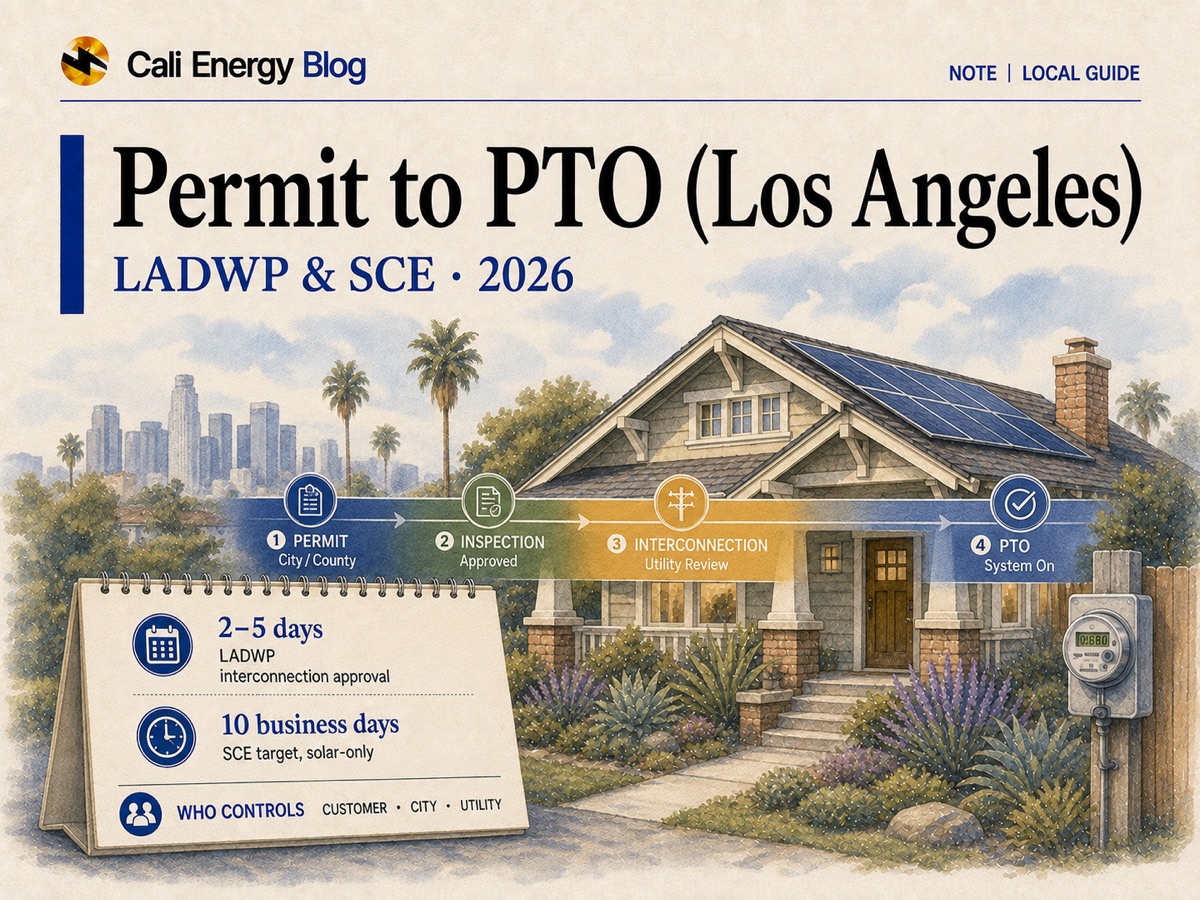
Quick answer
- LADWP interconnection agreement approval: 2–5 days — after the submitted information is verified accurate and complete (LADWP Guide to Electric Service, March 2024).
- SCE permission to operate: within 10 business days for complete, simple solar-only requests. SCE publishes no figure for paired storage, but its own records show a median of 3–5 days from complete application to approval in 2025–2026 — batteries included; batteries take longer to become complete.
- The permit is rarely the wait in LA: small standard systems get an express permit online with no plan check, so inspection, application completeness and utility stages control the timeline.
- Who controls what: LADWP labels every stage customer / city / utility — and seven of the eight common delay causes sit on the applicant’s side.
- No official contract-to-PTO total exists. End-to-end ranges you see online are installer estimates, not utility figures.
Why “how long does solar take?” gets contradictory answers
Because two different clocks get quoted as if they were the same one.
A utility’s published figure and a homeowner’s lived experience can differ by weeks — and both can be accurate, because they measure different things.
The utility processing clock runs from a complete interconnection application to permission to operate. The homeowner’s clock runs from signing a contract to the day the system is switched on, and includes design, permitting, installation, inspection and any corrections along the way. A utility target says nothing about the second. Keeping the two apart is the only way to set honest expectations.
LADWP publishes its own stage-by-stage timelines
And it labels who controls each stage — customer, city, or utility.
This is the most useful public document for Los Angeles homeowners, and almost nobody cites it. In its Guide to Electric Service, LADWP sets out typical timelines for solar projects and colour-codes every step by who controls it. The residential path is the process for systems under 30 kW.
| Stage | Controlled by | Duration |
|---|---|---|
| Solar design and construction activities | Customer | — |
| Applicant completes solar meter application and uploads documents | Customer | — |
| LADWP Solar ESR visits site and provides a location drawing | LADWP | 1–3 weeks |
| Customer obtains permit from LADBS | City | — |
| Customer receives interconnection agreement approval | LADWP | 2–5 days |
| Customer installs the system | Customer | — |
| Inspection and approval from LADBS | City | — |
| LADWP Solar ESR verifies the installation | LADWP | 1–2 weeks |
| LADWP sets meters and authorises energisation | LADWP | 1–2 weeks |
Source: LADWP — Guide to Electric Service, March 2024, pages 22–23. LADWP also publishes a Fast Track process (interconnection approval 2–5 days, meters and energisation 1–2 weeks) and a separate path for systems of 30 kW or more, where engineering approval of the single-line diagram alone is given as 6–8 weeks.
Two of LADWP’s own footnotes carry real weight. The interconnection approval time applies “after information submitted by the customer has been verified to be accurate and complete” — an incomplete submission does not start the clock. And the energisation timing holds “provided no LADWP distribution system upgrade is required”; if a transformer or line work is needed, the picture changes.
Note what these figures are and are not. Added together, the LADWP-controlled stages come to roughly three and a half to eight weeks — but that is only the utility’s share. LADWP publishes no duration for the customer and city stages, and the stages can overlap. This is not a contract-to-switch-on estimate, and anyone presenting it as one is misreading the source.
What SCE publishes
For SCE customers the current guidance is narrower but clear. SCE states that “simple and standard (solar-only) interconnection requests that have all the correct information and required documents, may receive Permission to Operate within 10 business days.” Complex requests — SCE names paired storage or non-standard metering — “will need more time to process as they require additional technical and engineering review.” Source: SCE — Solar Billing Plan FAQs.
SCE does not publish a number for those complex requests, so neither will we. If you see a specific week count for battery projects attributed to SCE, ask where it comes from — in our checking, such figures trace back to installer blogs rather than to the utility.
SCE recommends submitting the whole package at once: the application, single line diagram, signed interconnection agreement, final electrical permit approval issued by the local building department, and any other applicable documentation. That last item is the practical hinge — the review depends on the local authority’s final approval being in hand.
What SCE’s own records show
SCE publishes a target, not results — but its interconnection records are public, with three dates for every system.
The CPUC’s DG Stats data list, for each home system SCE connects, the date the application was received, the date it was deemed complete and the date SCE approved it. For Los Angeles County homes on the current Net Billing Tariff:
| Year approved | System | Systems | Complete → approved | Approved within 10 business days of complete | Received → approved |
|---|---|---|---|---|---|
| 2024 | Solar only | 3,502 | 6 days | 86% | 20 days |
| 2024 | Solar + battery | 7,910 | 6 days | 84% | 14 days |
| 2025 | Solar only | 2,642 | 4 days | 92% | 13 days |
| 2025 | Solar + battery | 12,046 | 5 days | 85% | 41 days |
| 2026 (Jan–Aug) | Solar only | 1,808 | 3 days | 88% | 8 days |
| 2026 (Jan–Aug) | Solar + battery | 8,926 | 3 days | 93% | 24 days |
Source: CPUC California DG Stats, SCE interconnected project sites, data through August 31, 2026 (residential, Los Angeles County, interconnection program “NBT”) · Cali Energy calculation. “Received” is when the installer filed; it can come before the final inspection.
Two findings. First, once an application is complete, SCE now meets its own target for most homes — a median of three to five days in 2025 and 2026, with 85–93% approved within 10 business days, batteries included. Second, a battery adds time before that point, not after it: in 2025 the median battery project took 22 days to go from filed to complete, against 6 for solar only, and one in four took 86 days or more. That is the extra review SCE describes for paired storage, plus the corrections it tends to trigger. These are medians across thousands of homes, not a promise for any one project.
When can the application be filed?
There is a persistent muddle here worth settling. In its guidance on applying for interconnection, SCE has stated that a standard interconnection request for a residential system of 30 kW or less can be submitted after the city or county final permit inspection, or at least 30 days prior to it, while non-standard requests should start at least 30 days before inspection. In other words it is an either/or, not a rule that the application must come first.
One caveat we will state plainly: that wording comes from an SCE fact sheet published in 2019, describing the earlier NEM 2.0 programme, and its stated processing time (two to three business days) no longer matches SCE’s current published target. Treat the 2019 document as a guide to procedure and the current Solar Billing Plan FAQs as the guide to timing — and confirm both with SCE for your own project.
Fast permitting can shorten one part of the timeline
In the City of Los Angeles, LADBS issues an express electrical permit online, with no plan check, for rooftop solar of 10 kW or less on a one- or two-family home with a 120/240 V single-phase service, a panel of 225 A or less and a simple inverter layout. An AC-coupled battery of up to 10 kW AC can use the same route but also needs a Fire Department plan check. Larger or more complex systems — service-panel work, structural questions, hybrid inverters — go to counter or regular plan check. Statewide, SB 379 (2022) requires most cities and counties to offer an automated online permitting platform for residential solar of up to 38.4 kW AC and paired storage. Details and fees are in our guide to solar permits in Los Angeles.
Where the fast route applies, it shifts the pressure elsewhere: inspection, corrections, the completeness of the interconnection package and the utility’s own stages then control the timeline. Where it does not, plan review can still be the constraint. Los Angeles projects also coordinate LAFD where fire access or setbacks are triggered, and then either LADWP or SCE depending on the service territory.
Sources: LADBS — Express Permits · California Energy Commission — SB 379 residential solar permitting · verified October 6, 2026.
How long each stage takes: the published numbers
Grouped by the question people actually type. Where a utility publishes no figure, we say so rather than filling the gap with an estimate.
How long does LADWP interconnection take?
LADWP publishes 2–5 days for interconnection agreement approval, once the information you submitted has been verified as accurate and complete. Around it sit three more LADWP-controlled stages: a Solar ESR site visit at 1–3 weeks, ESR verification of the finished installation at 1–2 weeks, and setting the meters and authorising energisation at 1–2 weeks. Those four stages are the utility’s share of the timeline; LADWP publishes no duration for the customer and city stages between them.
How long does SCE take to grant permission to operate?
SCE states that simple and standard solar-only requests may receive permission to operate within 10 business days — provided the request has all the correct information and required documents. That clock measures a complete application through to PTO, not your project from contract to switch-on.
How long does a battery add?
SCE does not publish a figure. It identifies paired storage and non-standard metering as requests that “will need more time to process as they require additional technical and engineering review,” without stating how much. Its records give a measured answer for Los Angeles County: in 2025 the median battery project took 41 days from filing to approval, against 13 for solar only — and almost all of the difference came before the application was complete. Once complete, both were approved in a median of about five days.
How long does an LADBS solar permit take?
Short answer: for eligible standard residential systems, plan review is largely automated and fast, which is why the permit is rarely the longest wait in Los Angeles. The permit step itself — what is required, which documents, what it costs, and which cities do not use LADBS — is covered in our companion guide to solar permits in Los Angeles. This page stays on durations and where projects stall.
How long does inspection scheduling take?
Neither LADWP nor SCE publishes this, because it is not theirs to publish — inspection is the city’s stage. What LADWP does publish is a related figure worth knowing: an Electric Service Request will schedule a site visit within five to 10 business days. Ask your installer for the current inspection lead time in your specific jurisdiction; it moves with workload.
Where am I in the process?
Find the last thing that happened. The row tells you what is running now and who can move it.
| The last thing that happened | What is happening now | Who can move it |
|---|---|---|
| You signed the contract | Design, engineering and materials | Your installer |
| Design is finished | Permit application to the city | Your installer |
| Permit issued | Installation scheduling | Your installer |
| Panels are on the roof | Waiting for the city inspection | Installer books it; city sets the slot |
| Inspection failed | Corrections, then re-inspection | Your installer |
| Inspection passed | Interconnection package goes to the utility | Your installer submits it |
| Utility has the application | Utility review — the clock only runs on a complete package | Utility, unless documents are missing |
| Utility approved interconnection | Meter set and authorisation to energise | Utility |
| Meter swapped, still off | Waiting on written permission to operate | Utility |
Stage names follow LADWP’s own process diagrams for residential solar; who controls each stage follows its Customer / City / LADWP labelling.
My solar is installed but not turned on. Why?
Because a grid-connected system may not legally operate until the utility issues permission to operate. Installation finishing is not the finish line — it is roughly the halfway point. After the panels are up, the city still has to inspect, the utility still has to receive a complete interconnection package, review it, set or exchange the meter, and issue written authorisation.
If your installer says the job is “done” and the system is dark, the honest translation is that construction is done and the approvals are not.
Can I turn it on early, just to test?
No. Energising a grid-connected system before permission to operate is a violation of the interconnection agreement and can carry consequences from the utility, up to disconnection. It can also complicate your interconnection application. Wait for the written authorisation.
How do I check the status myself?
Most of this process is visible to your installer, not to you. Two things you can check directly: the permit and inspection status with the local building department — for the City of Los Angeles that is LADBS, and the records are public, and your utility account, where a meter exchange and the eventual authorisation will appear. For the interconnection application itself, ask your installer for the submission date and the reference number — if they cannot produce either, that is informative.
What a complete interconnection package contains
This is the single most controllable cause of delay, so it is worth knowing what “complete” means.
SCE asks for the following, and recommends submitting them together rather than piecemeal:
- the interconnection application
- a single line diagram
- the signed interconnection agreement
- final electrical permit approval issued by the local building department
- any other applicable documentation — for example a plot plan where an AC disconnect applies
LADWP frames the same principle differently but to the same effect: its published approval time applies “after information submitted by the customer has been verified to be accurate and complete.” An incomplete package does not start a slow clock — it starts no clock at all.
Why permission to operate stalls
It is often said that this stage is entirely on the utility. That is not accurate, and LADWP’s own customer/city/utility labelling shows why. Ordered roughly from most to least common:
- The application package is incomplete — missing the final permit approval, the signed agreement or the single line diagram. The review clock has not started.
- The installed system does not match the approved design — a different module count, inverter model or panel location than what was submitted.
- The city’s final approval has not been released to the utility yet, even though the inspection passed.
- Panel, service or meter work is outstanding — a service upgrade that has not been signed off holds up the meter.
- Storage or non-standard metering pushes the request into additional technical and engineering review.
- Customer signatures are missing on the interconnection agreement.
- A distribution system upgrade is required. LADWP’s published timings hold only “provided no LADWP distribution system upgrade is required.”
- Genuine utility queue and engineering backlog — the one item on this list nobody can influence.
Seven of those eight are on the applicant’s side of the line. That is the useful news: most of the wait is addressable if someone asks the right question early.
What this page cannot determine
- Your project’s actual total time. The utilities publish stage targets, not an end-to-end clock; customer and city stages carry no published duration and stages can overlap.
- The live status of your own application. That sits with your installer, the building department’s permit records, and your utility account.
- How much time a battery adds to your project. SCE’s records show medians across thousands of homes (above); your own project can be faster or slower, and LADWP publishes no comparable data.
- Whether a distribution system upgrade will be required. LADWP’s published timings explicitly assume none is needed; if one is, the picture changes and only the utility can say by how much.
A note on the numbers you will see elsewhere
Widely-quoted ranges — four to six weeks for solar, eight to twelve with a battery — are not utility figures. We have not published them here because we could not trace them to a utility source. What is on this page is what LADWP and SCE publish, plus SCE’s own interconnection records, with the sample size and period stated.
Frequently asked
Why is my solar installed but not turned on?
Because a grid-connected system may not legally operate until the utility issues permission to operate. After installation the city must still inspect the work, the utility must receive a complete interconnection package, review it, set or exchange the meter, and issue written authorisation. Construction finishing is roughly the halfway point, not the finish line.
How long does LADWP take to approve solar interconnection?
LADWP publishes 2–5 days for interconnection agreement approval, once your submitted information has been verified as accurate and complete. Its other stages are a site visit at 1–3 weeks, verification of the finished installation at 1–2 weeks, and setting meters and authorising energisation at 1–2 weeks.
What is SCE's published timeline for permission to operate?
Within 10 business days for simple and standard solar-only requests that have all the correct information and required documents. That measures a complete application through to PTO. Requests involving paired storage or non-standard metering need additional technical and engineering review, and SCE publishes no figure for those.
Does adding a battery delay permission to operate?
Yes, mostly before the application is complete. SCE says paired storage needs additional technical and engineering review and publishes no figure. Its own records for Los Angeles County homes show the median battery project took 41 days from filing to approval in 2025, against 13 for solar only; once complete, both were approved in a median of about five days. LADWP publishes no comparable data.
Can I use my solar system before permission to operate?
No. Energising a grid-connected system before PTO breaches the interconnection agreement and can lead to consequences from the utility, including disconnection, as well as complicating your application. Wait for the written authorisation.
Who submits the interconnection application — me or my installer?
Normally your installer submits it on your behalf, which is why the status is often invisible to the homeowner. Ask them for the submission date and the reference number. You can independently verify the permit and inspection status with your local building department, and watch your utility account for the meter exchange.
What happens after the final inspection passes?
The city’s approval is released and the interconnection package goes to the utility — the final permit approval is one of the required documents. The utility then reviews the complete package, sets or exchanges the meter, and issues permission to operate. On LADWP’s published stages, verification and meter/authorisation are 1–2 weeks each.
Can I speed up permission to operate?
Partly. What you can influence: a complete application package submitted all at once, an installed system that matches the approved design, and prompt release of the city’s final approval. What you cannot: utility engineering backlog, and any required distribution system upgrade — LADWP’s published timings explicitly assume none is needed.
Do I need the permit before applying for interconnection?
SCE recommends submitting the final electrical permit approval together with the application. Its earlier guidance allowed a standard residential request of 30 kW or less to be filed either after the final inspection or at least 30 days before it. An application can be started earlier, but review of a complete package depends on the city’s final approval being included. Confirm the current requirement with SCE for your project.
Related reading
Sources & methodology
Figures on this page come from the primary sources below and, where noted, from Cali Energy calculations using the stated assumptions. Rates, incentives, and program terms change; each was verified October 6, 2026.
About this reference
Cali Energy is a licensed California contractor (CSLB #1032379) based in Northridge. We publish this page as a reference and date it to the day each figure was checked against its source.
Prepared by Cali Energy, October 6, 2026. This article is for general educational purposes only and is not legal, tax, financial, engineering, or utility advice. Rates, incentives, codes, permit requirements, equipment specifications, prices, and program terms may change; figures and timelines are estimates, not guarantees. Confirm current requirements with the applicable utility, AHJ, program administrator, manufacturer, or a licensed professional. See our Content Disclaimer. Cali Energy · 19201 Parthenia St, Unit E, Northridge, CA 91324 · CSLB #1032379 (B, C-10, C-39)