

Why Solar Inspections Fail — and How to Pass the First Time
Straight answer: between roughly one in four and one in three residential solar projects fail at least one inspection — 29% of conventionally permitted projects across 11 cities and counties in NREL’s 2023 data. Most identified failures were work not installed to code; the rest were missed appointments and installs that did not match the approved plans. Inspectors work from a known list: equipment and layout per the plans, mounting and flashing, wiring, grounding, disconnects, labels and firefighter access. Every correction means a return visit, and the utility will not switch the system on until the final passes.
Get a free estimate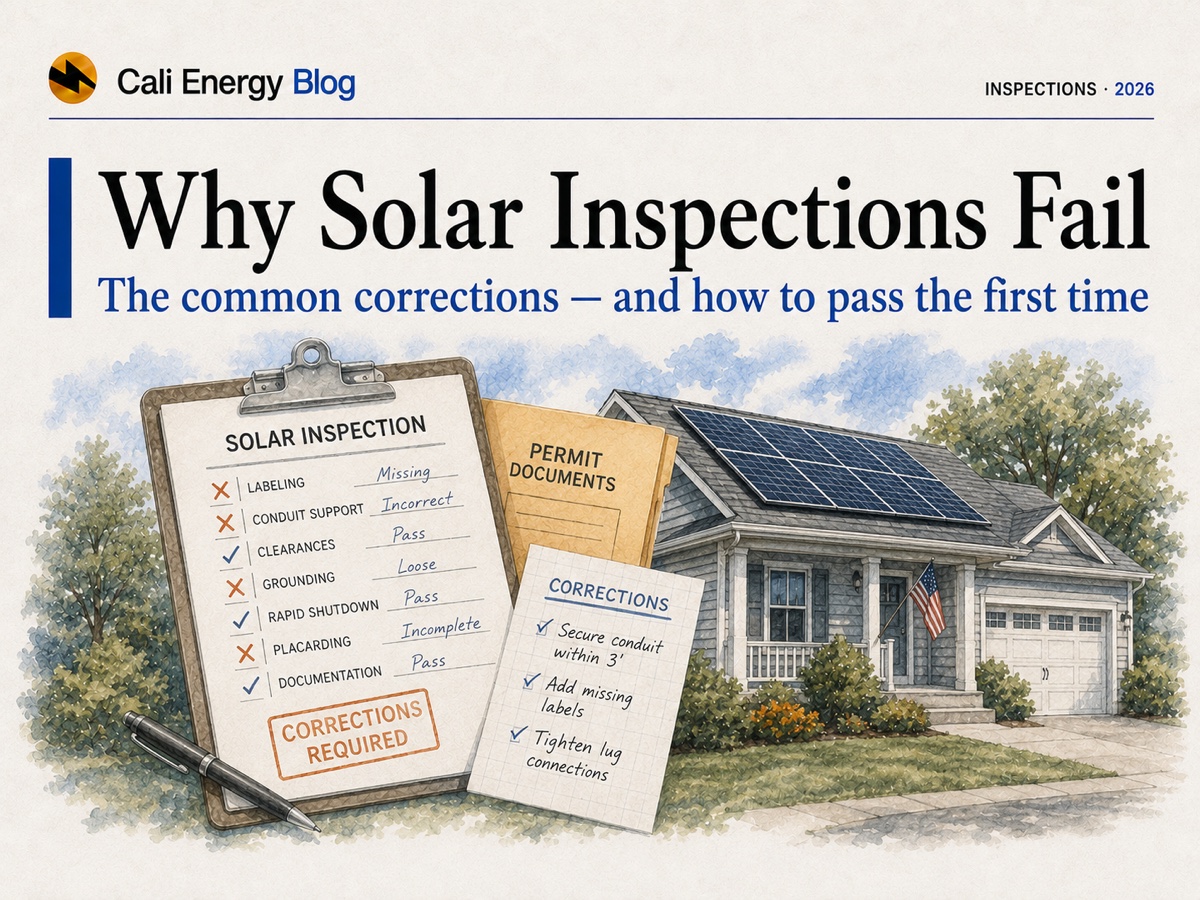
- A failed inspection is a correction list and a return visit, and it holds up permission to operate.
- In NREL’s 2023 data, 29% of conventionally permitted PV-only projects failed at least one inspection; for projects permitted through the automated SolarAPP+ system the figure was 35%, or 23% excluding Phoenix.
- Of the identified failures, 78% were work not installed to code, about 13% were rescheduling because nobody was available, and 17% were installs that did not match the plan or a missing inspection checklist.
- Inspectors check the job against the approved plans. California’s model field guide lists 19 checks, and LADBS’s standard solar plan is based on the same guidebook.
- California’s electrical code has been based on the 2023 NEC since January 1, 2026.
How often solar inspections fail — and why
Detailed public data come from the National Renewable Energy Laboratory’s reviews of SolarAPP+, the automated permitting platform many California cities and counties adopted. NREL counts a project as failed if it failed at least one inspection. Across 11 jurisdictions with complete 2023 records — 10,651 inspections — 29% of conventionally permitted PV-only projects and 35% of SolarAPP+ projects failed at least once; the gap came largely from Phoenix, and without it the rates were 26% and 23%. Among SolarAPP+ projects whose failure reasons were recorded, 78% involved work not installed to code, about 13% were rescheduling because the homeowner or contractor was not available, and 17% were an install that did not match the plan or an inspection checklist missing from the site; some failures had more than one cause (NREL, SolarAPP+ Performance Review, 2023 data).
Those three causes map directly onto prevention: build to code, have someone there to give access, and keep the approved plans and any checklist on site, with a revision filed for anything changed in the field. For the installer each return trip has a real cost — NREL assumed about eight hours of work, roughly $200 per reinspection — and for you it is time before the utility can act.
What the inspector checks
California’s Solar Permitting Guidebook, written for local building departments, includes a one-page field inspection guide for rooftop PV. Its 19 checks, grouped:
| Area | What the inspector verifies |
|---|---|
| Match to the approved plans | Module model, quantity and location; mounting system and structural connections; equipment listed and labeled as shown on the plans; conductor types and sizes; overcurrent devices |
| Roof | Penetrations flashed and sealed per the plan; the roof-mounted system has the required fire classification; firefighter access per the plan |
| Wiring | Exposed array conductors secured, supported and routed to prevent damage; conduit installed to the residential code and the electrical code; work “neat and workmanlike” |
| Grounding and bonding | Racking and modules bonded per the manufacturer’s listed instructions; the system connected to the grounding electrode system per the plan |
| Disconnects and interconnection | Disconnects as planned and located as the code requires; the inverter breaker at the end of the bus opposite the utility supply unless the breakers’ sum stays within the bus rating; a grid-tied inverter marked “utility interactive” |
| Labels and access | PV markings, labels and signs per the plan; working space at inverters, disconnects and panels |
Source: California Solar Permitting Guidebook, 4th edition (2019), Field Inspection Guide. The guide cites code sections from the 2016 edition; section numbers have since moved, but the checks are the same.
The guidebook matters in Los Angeles because LADBS’s Solar PV Standard Plan is based on it. Where a system uses the LADBS building-permit exemption, the roof plan and racking worksheets go to the field inspector, and every PV system needs an electrical permit (LADBS; see solar permits in Los Angeles). Where the breaker math on the panel does not work, the fix is a different connection or a main-panel upgrade, settled on the plans before the install.
The small details behind many corrections
The same guidebook’s comprehensive inspection reference spells out the specifics. A sample of the checkable ones:
| Item | What the reference says |
|---|---|
| Cable support | Cables secured at intervals of no more than 4.5 feet and within 12 inches of each box or termination; conductors not in contact with the roof surface |
| DC wiring indoors | Inside a building, DC conductors in metal raceway, metal-clad cable or metal enclosures |
| Conduit markings | “WARNING: PHOTOVOLTAIC POWER SOURCE,” reflective, weather-resistant, white 3/8-inch letters on red, every 10 feet, within 1 foot of turns and bends, and above and below roof, ceiling and wall penetrations |
| Connections | Pressure terminals tightened to the manufacturer’s torque; crimps made with the listed tool; readily accessible connectors over 30 volts need a tool to open |
| Panel connection | A backfed breaker used as the interconnection is not one marked “line and load”; where the opposite-end method is used, the breaker is labeled not to be relocated |
| Directory | A plaque or directory at the service showing where the service disconnect and the PV disconnect are |
| Modules | No broken glass or cells, no discoloration, frames undamaged |
Source: California Solar Permitting Guidebook, Comprehensive Inspection Reference. Label wording and some section numbers have changed in later code editions; the approved plan set shows the requirements for your job.
Rapid shutdown and its label
Rapid shutdown lets firefighters de-energize rooftop conductors. Since the 2017 NEC, conductors more than one foot outside the array must drop to 30 volts or less within 30 seconds of initiation. Inside that boundary, the 2023 NEC accepts a PV hazard control system listed to UL 3741, or 80 volts or less within 30 seconds (IAEI Magazine). Module-level electronics — microinverters or optimizers — are a common way to meet it. California’s 2025 electrical code, in effect since January 1, 2026, is based on the 2023 NEC (California Building Standards Commission).
The label is checked as closely as the hardware: the guidebook’s standard plan requires the rapid-shutdown initiation device to be labeled under the code’s rapid-shutdown marking rule and its location shown on the site plan (Solar Permitting Guidebook). A label that describes a different method from the one installed is a correction.
In Los Angeles: from inspection to switch-on
After installation an LADBS inspector checks the work against the approved plans. For most City of Los Angeles homes the utility is LADWP, whose guide lists the next steps after the city’s inspection and approval: LADWP verifies the installation (1–2 weeks), then sets meters and authorizes energization (1–2 weeks) (LADWP Guide to Electric Service). A correction pushes that whole chain back by the time it takes to fix and reinspect. The published durations for each stage are in permit to PTO in Los Angeles, and the full sequence in the solar installation process.
Are you inspection-ready? Check your job
Tick each item your installer has confirmed. The list follows the state’s field inspection guide and NREL’s failure causes; it is a pre-flight, not a substitute for the inspector.
Inspection readiness check
Confirm what’s done before you schedule the inspection.
Based on the California Solar Permitting Guidebook’s field inspection guide and the failure causes in NREL’s SolarAPP+ data. Exact requirements follow your AHJ, the adopted code and utility rules, confirmed at plan check and inspection.
How a careful installer passes the first time
Each habit below answers one of the failure causes in the data.
Settle it on the plans
Conductor sizes, breaker placement and the rapid-shutdown method are decided on the engineered plan set, then built as drawn.
Revise, don’t improvise
If the roof forces a change in panel count or layout, a plan revision goes in before inspection day — a mismatch was among the causes NREL recorded.
Labels from the final package
Weather-rated labels and placards printed from the approved plans and checked against the installed equipment.
Licensed trades for each part
Electrical work by the electrical classification, roof penetrations by a roofing crew, so both halves of the inspection are built by the trade licensed for them.
A pre-inspection walkthrough
Torque, bonding and labels checked, rapid shutdown function-tested, plans and checklist left on site.
Be there
About 13% of identified failures were rescheduling. Confirm who will give access, including to the electrical panel.
Electrical and roofing under one license
Cali Energy holds the C-10 electrical and C-39 roofing classifications (CSLB #1032379), so the crew that wires the system and the crew that flashes the penetrations work under the same license and plan set, from the site survey through inspection and the utility’s permission to operate. Questions about a correction on your own job? Call +1-323-844-7777.
Frequently asked
How often do solar inspections fail?
In NREL’s review of 2023 data from 11 cities and counties, 29% of conventionally permitted PV-only projects failed at least one inspection, and 35% of projects permitted through SolarAPP+; excluding Phoenix, the rates were 26% and 23%.
What are the most common reasons a solar inspection fails?
In NREL’s SolarAPP+ data, 78% of identified failures were work not installed to code, about 13% were rescheduling because the homeowner or contractor was not available, and 17% were an install that did not match the plan or a missing inspection checklist. Inspectors check plans, mounting and flashing, wiring, grounding, disconnects, labels and firefighter access.
What happens if my solar inspection fails?
The inspector lists corrections; the installer fixes them and requests a reinspection. The utility waits for the final approval — in Los Angeles, LADWP’s verification and meter setting follow the city’s inspection and approval.
What is rapid shutdown, and why do inspectors check it?
It lets firefighters de-energize rooftop conductors: outside one foot from the array, 30 volts or less within 30 seconds; inside, under the 2023 NEC, a UL 3741 hazard control system or 80 volts or less within 30 seconds. Inspectors check both the equipment and its required label and location.
Do I need to be home for the solar inspection?
Someone has to give the inspector access, often including the electrical panel. About 13% of identified failures in NREL’s data were rescheduling because the homeowner or contractor was not available, so confirm with your installer who will be there.
Can I turn on my solar after it passes inspection?
Not yet. The utility still has to approve the interconnection and give permission to operate; turning the system on before that is not allowed. See permit to PTO in Los Angeles.
Related reading
Sources & methodology
Figures on this page come from the primary sources below and, where noted, from Cali Energy calculations using the stated assumptions. Rates, incentives, and program terms change; each was verified September 29, 2026.
- NREL — SolarAPP+ Performance Review (2023 Data), NREL/TP-6A20-89618, June 2024 (inspection failure rates and causes)
- California Solar Permitting Guidebook, 4th edition (2019) — Field Inspection Guide for Rooftop PV Systems
- IAEI Magazine — NEC rapid shutdown requirements and UL 3741 (Winter 2023)
- California Building Standards Commission — 2025 Title 24 code changes (California Electrical Code based on the 2023 NEC; effective January 1, 2026)
- LADBS — Information Bulletin P/GI 2023-027, Solar Energy Systems
- LADWP — Guide to Electric Service (March 2024), pages 22–23
Get an install that passes the first time
Our licensed electrical (C-10) and roofing (C-39) crews design, label and build to the approved plans — then stand behind the work at inspection. Tell us about your roof and we'll give you a real quote. Call +1-323-844-7777.
Get a free estimatePrepared by Cali Energy, September 29, 2026. This article is for general educational purposes only and is not legal, tax, financial, engineering, or utility advice. Rates, incentives, codes, permit requirements, equipment specifications, prices, and program terms may change; figures and timelines are estimates, not guarantees. Confirm current requirements with the applicable utility, AHJ, program administrator, manufacturer, or a licensed professional. See our Content Disclaimer. Cali Energy · 19201 Parthenia St, Unit E, Northridge, CA 91324 · CSLB #1032379 (B, C-10, C-39)