

Solar Carports & Patio Covers in California
Straight answer: a solar carport or patio cover puts the panels on a new structure instead of your roof — worth it when the roof can’t carry panels or when you want the shade anyway. It costs more per watt: on EnergySage’s marketplace in the first half of 2026, carports averaged $3.62 a watt against $2.60 for rooftop solar. It produces nearly as much: a 10° canopy facing south makes about 96% of what a 20° south roof does in Northridge. In the City of Los Angeles it needs a building permit and plan check, because LADBS issues its online express solar permit only for rooftop systems.
Get a free estimate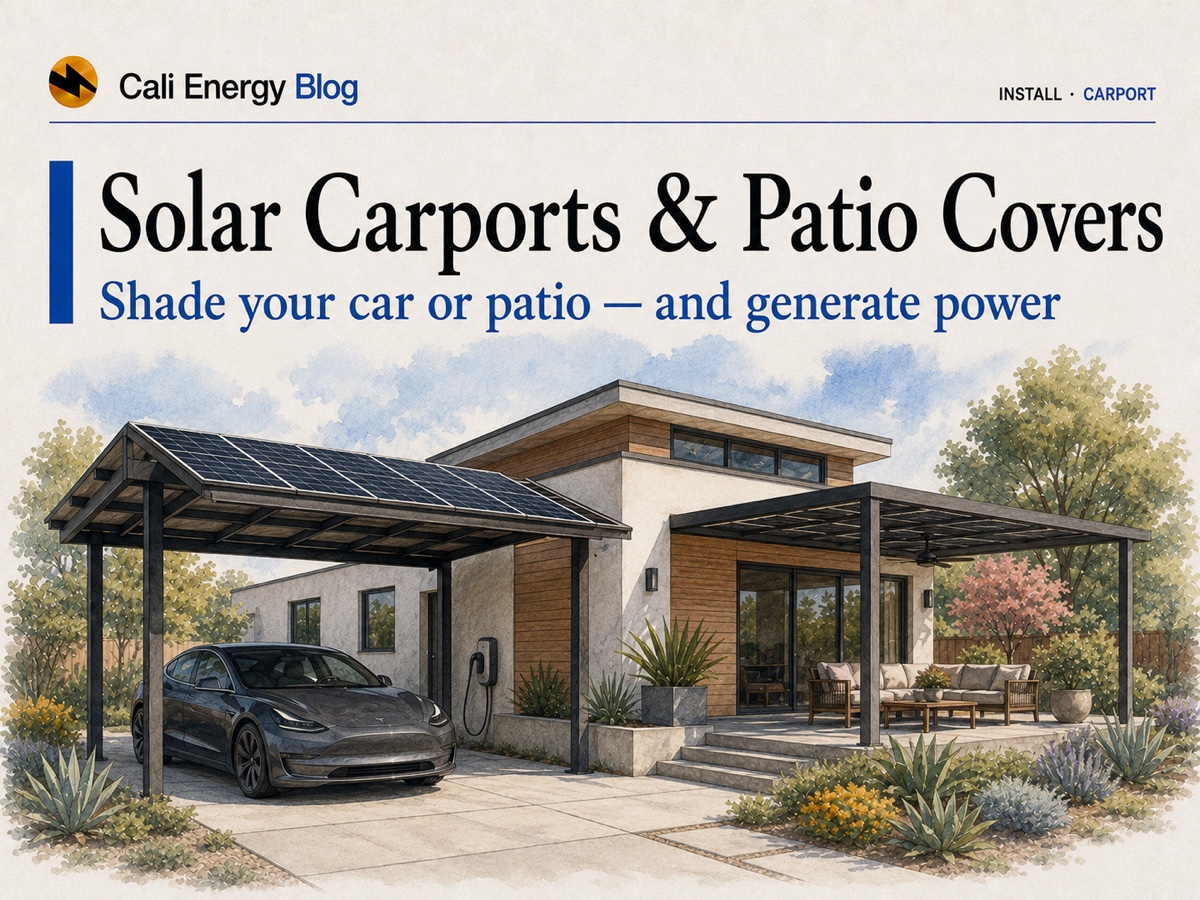
- A solar carport, patio cover or pergola is a new structure with panels as its roof. It makes sense when the roof is shaded, too small, badly oriented or due for replacement — or when you want the shade.
- Cost: EnergySage’s marketplace averaged $3.62 a watt for carports, $2.60 for rooftop and $2.96 for ground mounts in the first half of 2026 — about $1 a watt more for the structure. Records of what Californians actually paid run higher than those marketplace quotes.
- Output: a low canopy gives up little. In NREL’s PVWatts for Northridge, 10° south makes 1,627 kWh per kW a year against 1,700 at 20°; 10° west, 1,512.
- Permits in Los Angeles: a building permit with plan check and engineering, an electrical permit, and the zoning rules for a structure — height, yards, historic and specific-plan areas.
- An HOA can set only reasonable restrictions on a solar system; the federal tax credit is gone for homeowner-bought systems placed in service after 2025.
When a carport or patio cover beats the roof
A structure costs more than a roof mount, so it should solve a problem the roof can’t.
The roof can’t carry panels
Heavy shade, too little usable area, a north-only roof, or a roof you don’t want disturbed. See solar panels and shade and which way panels should face.
The roof is due for replacement
Panels on a roof that needs redoing soon have to come off and go back later — see removing and reinstalling solar. A structure avoids that.
You want the shade
A covered driveway or patio in a Valley summer is worth something on its own; the panels are its roof.
An EV parks under it
The structure already carries power. Running a Level 2 circuit to a detached structure with a trench has been a $1,500–$3,000+ job in Cali Energy’s 2026 work, permit included, plus the charger — a typical range, not a quote. See Level 2 charger cost in Los Angeles.
What it costs against a roof or ground mount
The panels cost the same. The frame, footings and engineering are the difference.
| Measure | Solar carport | Rooftop | Ground mount |
|---|---|---|---|
| Price per watt | $3.62 | $2.60 | $2.96 |
| Average system size | 9.7 kW | 12 kW | 14.7 kW |
| Average system cost | $34,998 | $31,042 | $43,571 |
| Share of the household’s electricity need covered | 82.8% | 91.9% | 96.2% |
Source: EnergySage — solar carports, citing its marketplace data for the first half of 2026. Marketplace quotes, not installed-price records; your project can fall well outside them.
Two things stand out. Per watt, carports ran about $1 more than rooftop systems — roughly 40% — and EnergySage puts a one-car, 5 kW carport at about $18,100 before incentives. And carports were smaller: 9.7 kW on average, covering 83% of the household’s need against 92% for rooftop systems, because a parking space or patio limits how many panels fit.
Records of what Californians actually paid run higher than those marketplace quotes: Berkeley Lab’s median for a homeowner-bought California system installed in 2024 was $4.00 a watt before incentives (Berkeley Lab; more in what solar costs in Los Angeles). The useful way to price a carport is as a roof quote plus the structure: frame, footings, engineering, the trench back to the house, and permits. The federal Residential Clean Energy Credit is not available for property placed in service after December 31, 2025, so that premium is now paid in full (IRS).
How much a carport produces
A canopy built at a low pitch gives up less output than most people expect.
| Array | kWh per kW a year | vs a 20° south roof |
|---|---|---|
| Best tilt, about 30°, facing south | 1,729 | 102% |
| Typical roof, 20°, facing south | 1,700 | 100% |
| Low canopy, 10°, facing south | 1,627 | 96% |
| Low canopy, 10°, facing west | 1,512 | 89% |
| Roof, 20°, facing west | 1,487 | 87% |
Our runs of NREL PVWatts version 8 for Northridge: fixed mount, standard module, default 14% losses, typical-year weather — the same runs as which way solar panels should face. Shade from the house or trees is not included.
Because you design the structure, you can often point it south even when the house roof faces another way — within what the lot, the setbacks and the height limit allow. A low canopy facing west still makes about 89% of a south roof, and on SCE’s Solar Billing Plan west-facing output lands more of its energy in the valuable late afternoon.
Permits in Los Angeles: a structure, not just panels
This is where carports and patio covers differ most from a roof mount.
A building permit with plan check. LADBS requires a building permit for the structural support of every solar energy system; the only exemptions are for roof-mounted arrays that meet a list of weight and attachment limits (LADBS IB P/GI 2023-027). Its online express solar permit, with no plan check, covers only a rooftop system on a one- or two-family home (LADBS IB P/GI 2026-003), so a carport or patio cover goes through plan check. The plans need design calculations for member sizes, connections and loads, including wind on the panels. An electrical permit is required either way.
Zoning as for a building. LADBS treats a structure with a permitted use underneath — parking, a patio — that supports solar panels like any other building or structure: height limits, required yards, historic-preservation overlay zones, specific plans and other overlays all apply (LADBS). Check the lot before you design.
Not the fast track. California’s expedited review is written for small solar systems installed on a single-family or duplex home (Gov. Code §65850.5); a detached carport should be planned as a regular permit. Glendale, Burbank, Pasadena and unincorporated Los Angeles County run their own building departments — see solar permits in Los Angeles.
Can an HOA stop a solar carport or patio cover?
Not outright. California’s Solar Rights Act voids rules that effectively prohibit or restrict a solar energy system; an association may set only reasonable restrictions, and for a PV system those may not add more than $1,000 to the system as originally specified and proposed or cut its efficiency by more than 10% (Civil Code §714). It must answer in writing, and an application not denied in writing within 45 days is deemed approved. In a condominium or other common-interest development, the association may not adopt a general policy against solar on the building you live in or on a garage or carport assigned to you (§714.1). City zoning still applies. More in HOA solar rights in California.
- Engineering: who stamps the structural calculations, and what the footings assume about your soil.
- Rain: whether the canopy will be watertight — panels mounted with gaps between them let rain through unless the design adds a sealed layer.
- Height and setbacks: checked against zoning before the design is final, not at plan check.
- The path to the panel: where the trench runs and whether an EV circuit shares it.
- An itemized price: structure, solar and electrical work as separate lines, so you can compare it with a roof quote.
Carport or ground mount?
A ground mount is a rack in open yard with nothing underneath; a carport or patio cover is a roof you use. In EnergySage’s data ground mounts ran cheaper per watt ($2.96) and were built larger, and LADBS exempts free-standing ground arrays with no use underneath from the setback requirements, while requiring a 10-foot brush-free area around them (LADBS). Berkeley Lab notes ground mounting is rarely used for homes (Berkeley Lab). If you have open land and don’t need the shade, see ground-mount solar in California.
Where Cali Energy fits. We design and permit solar on roofs and structures across Los Angeles and the San Fernando Valley and run the circuits for EV chargers. Tell us about the parking or patio, the roof and a recent bill, and we’ll price the structure against a roof mount, line by line — call +1-323-844-7777 or get a free estimate.
Frequently asked
What is a solar carport or solar patio cover?
A new structure whose roof is solar panels: over parking it’s a carport, over a patio a patio cover, and a lighter open frame a pergola. It shades the space below and makes electricity above, instead of putting the panels on your house roof.
How much does a solar carport cost?
On EnergySage’s marketplace in the first half of 2026, carports averaged $3.62 a watt against $2.60 for rooftop solar, and a one-car 5 kW carport about $18,100 before incentives. Records of what Californians actually paid run higher than marketplace quotes. Price yours as a roof quote plus the structure, trench and permits.
Does a solar carport produce as much as a roof system?
Nearly. In NREL’s PVWatts for Northridge, a 10° canopy facing south makes 1,627 kWh per kW a year, about 96% of a 20° south roof’s 1,700; facing west at 10°, 1,512. Shade from the house or trees comes off those numbers.
Do I need a permit for a solar patio cover in Los Angeles?
Yes. LADBS requires a building permit for the structural support of solar systems unless a roof-mounted array meets its exemption limits, and its online express solar permit covers only rooftop systems, so a patio cover or carport goes through plan check with engineering, plus an electrical permit. Zoning rules on height and yards apply as for any structure.
Can my HOA stop me from building a solar carport or patio cover?
Not outright. Under Civil Code §714 an HOA may set only reasonable restrictions on a solar energy system — for PV, nothing that adds more than $1,000 to the system as proposed or cuts its efficiency by more than 10% — and must answer in writing within 45 days. City zoning still applies. See HOA solar rights.
Can I charge my EV under a solar carport?
Yes, and the structure already carries power. Running a Level 2 circuit to a detached structure with a trench has typically been $1,500–$3,000+ in Cali Energy’s 2026 work, permit included, plus the charger — a typical range, not a quote. The charger is a load on your service, so check panel capacity first.
Should I choose a solar carport or a ground mount?
It depends on whether you use the space underneath. A carport or patio cover gives you shade plus power; a ground mount is a rack in open yard and ran cheaper per watt in EnergySage’s 2026 data ($2.96 against $3.62). See ground-mount solar.
Related reading
Sources & methodology
Figures on this page come from the primary sources below and, where noted, from Cali Energy calculations using the stated assumptions. Rates, incentives, and program terms change; each was verified October 1, 2026.
- EnergySage — Solar carports (marketplace data, first half of 2026)
- Berkeley Lab — Distributed Solar & Storage: 2025 Data Update
- NREL — PVWatts Calculator (version 8)
- LADBS — Information Bulletin P/GI 2023-027, plan check and permit requirements for solar energy systems
- LADBS — Information Bulletin P/GI 2026-003, Express Permits (photovoltaic systems)
- California Government Code §65850.5 — expedited permitting for small residential rooftop solar
- California Civil Code §714 — Solar Rights Act
- California Civil Code §714.1 — solar in common-interest developments
- IRS — Residential Clean Energy Credit
Thinking about a solar carport or patio cover?
Tell us about your parking or patio, your roof and a recent bill, and we’ll price the structure against a roof mount line by line — estimates, not guarantees.
Get a free estimatePrepared by Cali Energy, October 1, 2026. This article is for general educational purposes only and is not legal, tax, financial, engineering, or utility advice. Rates, incentives, codes, permit requirements, equipment specifications, prices, and program terms may change; figures and timelines are estimates, not guarantees. Confirm current requirements with the applicable utility, AHJ, program administrator, manufacturer, or a licensed professional. See our Content Disclaimer. Cali Energy · 19201 Parthenia St, Unit E, Northridge, CA 91324 · CSLB #1032379 (B, C-10, C-39)