

Ground-Mount Solar in California: When the Yard Beats the Roof
Straight answer: a ground mount puts the panels on a rack in the yard instead of the roof. It pays off when the roof is a poor host — old, shaded, small or facing the wrong way — and you have open, sunny ground. It costs more: on EnergySage’s marketplace in the first half of 2026, ground mounts averaged $2.96 a watt against $2.60 for rooftop solar. In return you choose the angle and direction: a rack tilted 30° to the south makes about 1,727 kWh per kW a year in Northridge, 16% more than a 20° west-facing roof. In the City of Los Angeles it needs a building permit, and LADBS requires a 10-foot clear, brush-free area around the array.
Get a free estimate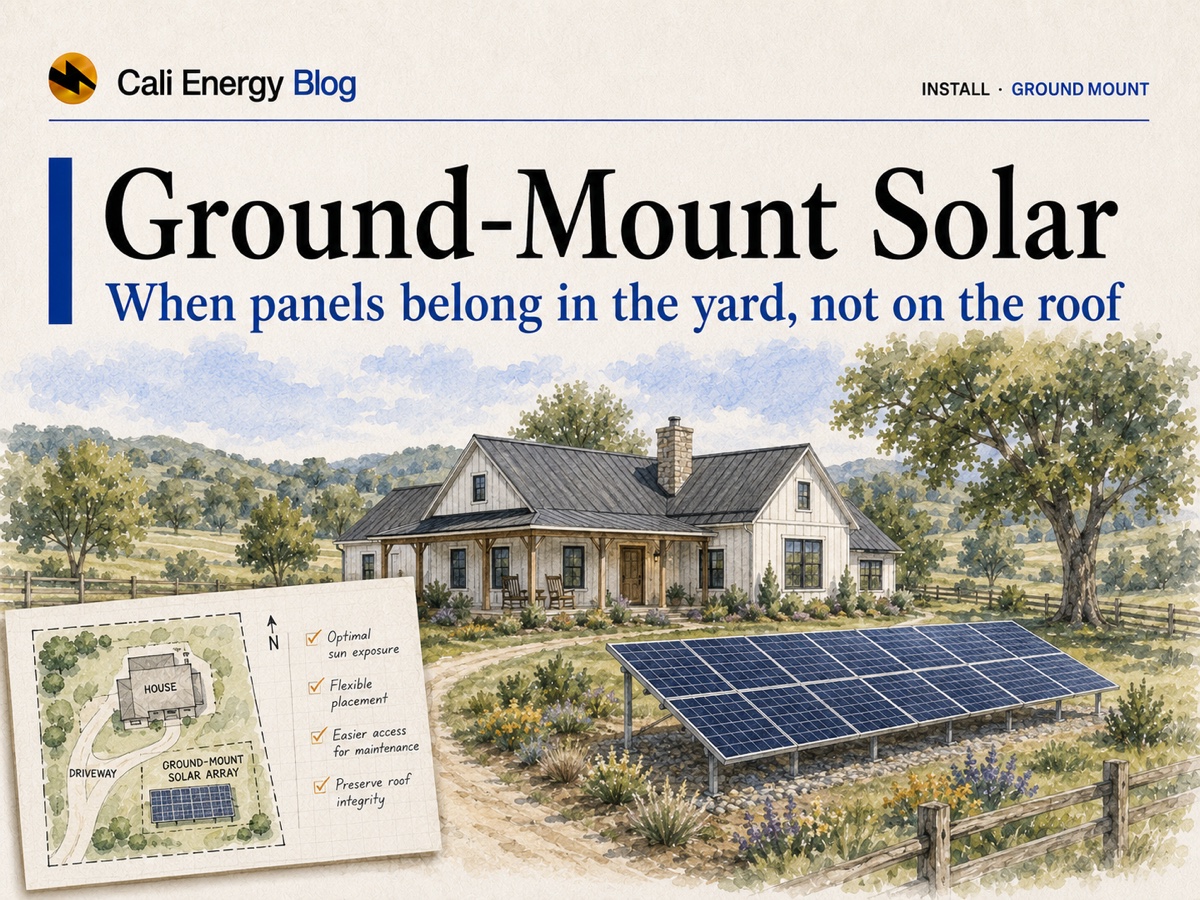
- A ground mount is a freestanding rack with nothing underneath. It makes sense when the roof is old, shaded, small or wrong-facing and you have open, sunny land.
- Cost: EnergySage’s marketplace averaged $2.96 a watt for ground mounts and $2.60 for rooftop in the first half of 2026. Ground systems were also bigger, so their average total ran about 40% higher. Records of what Californians actually paid run higher than these quotes.
- Output: at the same angle a ground rack makes what a roof makes; the gain comes from tilting it 30° to the south when the roof can’t. Trackers add 17% (single-axis) or 41% (dual-axis) in PVWatts, but homes almost never use them.
- Permits in Los Angeles: a building permit with plan check; no setbacks for a free-standing array but a 10-foot brush-free area, a height check above fence height, Fire Department review in yards and a grading inspection on hillside sites.
- The federal tax credit is gone for homeowner-bought systems placed in service after 2025.
When a ground mount beats the roof
Most homes still go on the roof: it is cheaper and uses space you aren’t using. A ground mount earns its premium in specific cases.
The roof is due for replacement
Panels on a roof that needs redoing soon have to come off and go back later. See should you replace the roof before solar?
The roof is shaded or faces the wrong way
A north-only slope, dormers or a big tree can leave too little good roof. On the ground you point the array at the sun — see which way panels should face.
The roof is small or complicated
Tile, many planes and steep pitches cut usable area and add labor. A simple rack can hold more panels with less fuss.
You have the land
Open, flat, sunny yard is the one thing a ground mount needs, and the roof stays untouched: no penetrations and panels you can reach without a ladder.
What a ground mount costs against a roof
On a roof the house is the structure. On the ground you build one.
| Measure | Ground mount | Rooftop |
|---|---|---|
| Price per watt | $2.96 | $2.60 |
| Average system size | 14.7 kW | 12 kW |
| Average system cost | $43,571 | $31,042 |
Source: EnergySage — ground-mounted solar panels, citing its 2026 marketplace data. Marketplace quotes, not installed-price records; your project can fall well outside them.
Per watt, ground mounts ran $0.36 more than rooftop systems. On whole systems the gap looked larger — EnergySage puts it at about 41% — mostly because homes that build in the yard install bigger systems: 14.7 kW on average against 12. The premium pays for the steel rack, the foundations (driven piers, helical piles or concrete footings sized for wind), the trench and buried conduit back to the house, and the engineering and permit a freestanding structure needs.
Records of what Californians actually paid run higher than marketplace quotes: Berkeley Lab’s median for a homeowner-bought California system installed in 2024 was $4.00 a watt before incentives (Berkeley Lab; more in what solar costs in Los Angeles). Price a ground mount as a roof quote plus the structure and the trench. The federal Residential Clean Energy Credit is not available for property placed in service after December 31, 2025 (IRS).
How much a ground array produces
The rack itself adds nothing. Choosing the angle and direction does.
| Array | kWh per kW a year | vs a 30° south ground rack |
|---|---|---|
| Ground rack, 30°, facing south | 1,727 | 100% |
| Roof, 30°, facing south | 1,729 | 100% |
| Ground rack, 20°, facing south | 1,708 | 99% |
| Roof, 20°, facing south | 1,700 | 98% |
| Roof, 20°, facing west | 1,487 | 86% |
| Single-axis tracker | 2,022 | 117% |
| Dual-axis tracker | 2,440 | 141% |
Our runs of NREL PVWatts version 8 for Northridge: standard module, default 14% losses, typical-year weather; ground racks as PVWatts’s open-rack array with its default row spacing, roofs as its roof mount (the same roof runs as which way solar panels should face). Shade is not included.
At the same angle, PVWatts puts a rack in the yard and a roof within a few kilowatt-hours of each other. The gain is in the choices — a south-facing 30° rack makes 16% more than a 20° west-facing roof. On LADWP’s net metering, south for the most energy is the right call; on SCE’s Solar Billing Plan, a southwest tilt puts more output into the costly late afternoon.
Trackers. A single-axis tracker adds about 17%, the same as adding one fixed panel for every six; a dual-axis tracker about 41%, roughly two for every five. With cheap panels and motors to maintain, the extra fixed panels usually win, and Berkeley Lab finds tracking almost never used on homes (Berkeley Lab).
How much yard it takes
Less than people expect for the panels, more for the clearance around them.
A 400-watt panel is about 19.5 sq ft (our sizing guide). Tilted to 30°, panels cover about 42 sq ft of ground per kilowatt, so a 7.2 kW array of eighteen panels covers about 300 sq ft. More than one row needs space between rows so the front row doesn’t shade the back in winter. In the City of Los Angeles, LADBS also requires a clear, brush-free area of 10 feet around a ground-mounted array (LADBS). Slope, soil and the trench route all matter; a site visit settles what fits.
The three kinds of ground mount
| Type | How it works | Best for |
|---|---|---|
| Fixed rack | Panels at a set angle on a steel frame over driven piers, helical piles or concrete footings | Almost every home ground mount |
| Pole mount | The array on one or more central poles, higher off the ground | Sloped or uneven ground, clearance underneath |
| Tracker | A motorized frame that follows the sun | Rarely homes — extra fixed panels usually cost less |
Permits in Los Angeles
A ground array is a structure, and the City of Los Angeles has specific rules for one in a yard.
A building permit with plan check. LADBS requires a building permit for the structural support of every solar energy system unless a roof-mounted array meets its exemption limits, and its online express solar permit covers only rooftop systems (LADBS IB P/GI 2023-027, IB P/GI 2026-003). Plans show the structure, its calculations and where the panels sit; the support structure must meet the building code’s fire-rating rules. California’s expedited review is written for small systems installed on a single-family or duplex home (Gov. Code §65850.5), so plan on a regular permit.
Zoning and fire. A ground array with no use underneath is allowed as an accessory in residential zones. Setback requirements don’t apply to a free-standing array, but it needs a clear, brush-free area of 10 feet; if it stands taller than a fence wall may, LADBS checks that the height is needed; and panels in a yard are reviewed by the Fire Department for life safety (LADBS).
Hillsides. On sites in the city’s Grading Hillside Area, or where grading or the drainage pattern changes, a grading pre-inspection is required and the plans must show the panels relative to the slopes; ZIMAS tells you whether a lot is in that area (LADBS). Other cities and counties — Glendale, Burbank, Pasadena, unincorporated Los Angeles County, or Sonoma and Monterey farther north — apply their own building departments’ rules; see solar permits in Los Angeles.
Ground mount or carport?
A ground mount is a rack whose only job is holding panels; a solar carport or patio cover is a roof you park or sit under, and LADBS treats it as a structure subject to zoning like any building. It cost more per watt in EnergySage’s data ($3.62). If you would rather cover the driveway than give up lawn, see solar carports and patio covers.
Roof or yard: getting a straight answer
Lot size usually decides it. On small Los Angeles lots the roof is the obvious host; on larger Valley and foothill lots with a tile, shaded or aging roof, the yard often wins. Cali Energy designs and permits both. Send us the roof, the lot and a recent bill and we’ll price a roof mount against a ground mount, line by line — call +1-323-844-7777 or get a ground-mount vs roof estimate.
Frequently asked
Is ground-mount solar more expensive than rooftop?
Yes. On EnergySage’s marketplace in 2026 ground mounts averaged $2.96 a watt against $2.60 for rooftop solar, and their average total was about 40% higher because ground systems were bigger. The extra pays for the rack, foundations, trench and engineering. Records of what Californians paid run higher than these quotes.
When does a ground mount make more sense than a roof?
When the roof is a poor host — due for replacement, shaded, small, complicated or facing the wrong way — and you have open, sunny ground. A 30° south-facing rack makes about 16% more a year than a 20° west-facing roof in Northridge. If the roof is sound and the lot is tight, the roof is usually cheaper.
How much land does a ground-mount solar system need?
Tilted to 30°, panels cover about 42 sq ft of ground per kilowatt, so a 7.2 kW array of eighteen 400 W panels covers about 300 sq ft. Add space between rows, and in the City of Los Angeles a clear, brush-free area of 10 feet around the array.
Are solar trackers worth it for a home?
Usually not. In NREL’s PVWatts for Northridge a single-axis tracker adds about 17% a year over a fixed 30° rack and a dual-axis tracker about 41% — the same as one extra fixed panel per six, or two per five. Extra panels have no motors to maintain, and Berkeley Lab finds trackers almost never used on homes.
Does a ground mount need a permit in Los Angeles?
Yes. LADBS requires a building permit with plan check for the support structure, and its online express solar permit covers only rooftop systems. A free-standing array needs no setback from property lines but must have a 10-foot brush-free area around it; taller-than-fence arrays get a height check, yard installations a Fire Department review, and hillside sites a grading pre-inspection.
Is a ground mount the same as a solar carport?
No. A ground mount is a rack whose only job is holding panels; a carport or patio cover is a roof you use, treated as a structure under zoning, and it cost more per watt in EnergySage’s 2026 data ($3.62 against $2.96). See solar carports and patio covers.
Related reading
Sources & methodology
Figures on this page come from the primary sources below and, where noted, from Cali Energy calculations using the stated assumptions. Rates, incentives, and program terms change; each was verified October 2, 2026.
- EnergySage — Ground-mounted solar panels (marketplace data, 2026)
- Berkeley Lab — Distributed Solar & Storage: 2025 Data Update
- NREL — PVWatts Calculator (version 8)
- LADBS — Information Bulletin P/GI 2023-027, plan check and permit requirements for solar energy systems
- LADBS — Information Bulletin P/GI 2026-003, Express Permits (photovoltaic systems)
- California Government Code §65850.5 — expedited permitting for small residential rooftop solar
- IRS — Residential Clean Energy Credit
Roof or yard? Get an honest recommendation
Send us your roof, your lot and a recent bill, and we’ll price a rooftop system against a ground mount line by line — estimates, not guarantees.
Get a free estimatePrepared by Cali Energy, October 2, 2026. This article is for general educational purposes only and is not legal, tax, financial, engineering, or utility advice. Rates, incentives, codes, permit requirements, equipment specifications, prices, and program terms may change; figures and timelines are estimates, not guarantees. Confirm current requirements with the applicable utility, AHJ, program administrator, manufacturer, or a licensed professional. See our Content Disclaimer. Cali Energy · 19201 Parthenia St, Unit E, Northridge, CA 91324 · CSLB #1032379 (B, C-10, C-39)