

How Much Does a Level 2 EV Charger Cost to Install in Los Angeles?
A Level 2 home charger costs about $380–$690 for the unit, according to the U.S. Department of Energy’s Alternative Fuels Data Center. Installation is the part that moves: in Cali Energy’s 2026 work it typically runs about $800–$1,200, permit included, when the panel is close and has room, and more for a long run, a subpanel or a panel upgrade. In the City of Los Angeles the job is an express permit, LADWP customers can get up to $1,000 back on the charger and its installation, and the federal 30C credit ended for chargers placed in service after June 30, 2026.
Get a free estimate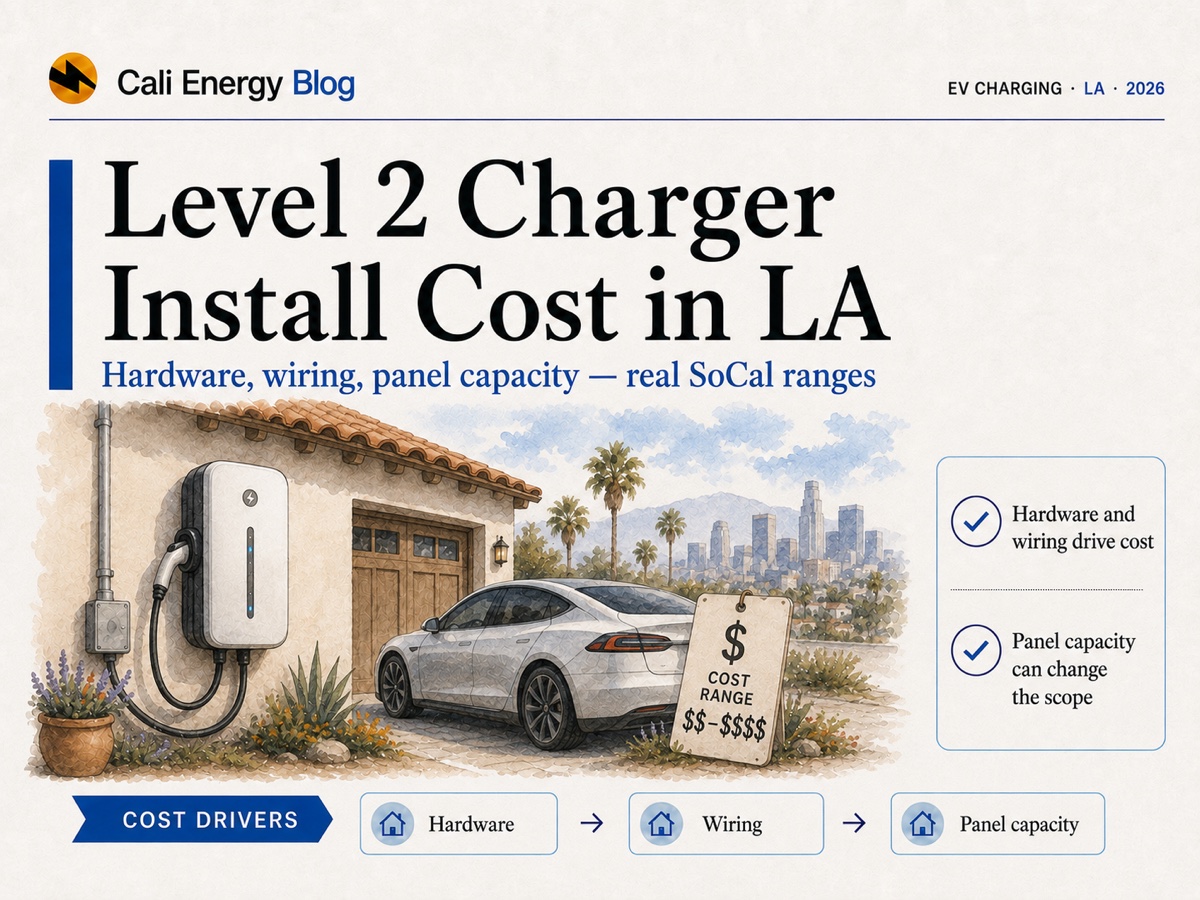
- Budget in two parts: the charger, about $380–$690 per the Department of Energy, and the installation, which is where prices move.
- A short run from a panel with room is the cheap case; a long run, a subpanel or a main panel upgrade is a separate, larger cost.
- The NEC sizes the breaker at 125% of the charger’s current: 32 A needs 40 A, 40 A needs 50 A, 48 A needs 60 A and a hardwired connection.
- In the City of Los Angeles an EV charger circuit is an express permit, even with a service upgrade up to 400 A.
- Money back in 2026: LADWP pays up to $1,000 toward the charger and installation; SCE’s panel rebate is income- or area-qualified; the federal 30C credit ended with chargers placed in service after June 30, 2026.
Cost by scenario
Your total is the charger plus the electrical work to feed it. The unit price is narrow; the installation depends almost entirely on your panel and how far the charger sits from it.
| Line item / scenario | Cost | Basis | Notes |
|---|---|---|---|
| Charger hardware (Level 2 unit) | $380 – $690 | DOE Alternative Fuels Data Center | Networked, higher-amp units sit toward the top |
| Installation — short run, panel nearby with room | $800 – $1,200 | Cali Energy typical range | The common case: a garage panel a few feet away |
| Installation — longer run, conduit across the garage or a wall | $1,000 – $2,000 | Cali Energy typical range | Finished walls and exterior runs add labor |
| Detached garage — trench and outdoor-rated run | $1,500 – $3,000+ | Cali Energy typical range | Before any panel work |
| Add a subpanel (main panel out of spaces) | +$1,000 – $2,000 | Cali Energy typical range | When the service has capacity but the panel has no spaces |
| Main panel upgrade | +$3,000 – $4,500, with or without a new meter and mast; $6,000 – $15,000+ with trenching or relocation | Cali Energy typical ranges | See panel upgrade cost |
Hardware: DOE Alternative Fuels Data Center, citing a Rocky Mountain Institute report; it notes labor is the largest part of a typical installation. Installation ranges are typical of Cali Energy’s 2026 work, permit included — not a published statistic, a quote or a fixed price; a written quote after a site visit sets your price.
What the code requires, and why it sets your circuit size
The NEC requires every charger to have its own dedicated circuit, and the breaker must be rated at least 125% of the charger’s maximum current — the same rule people call the 80% rule, seen from the other side. A Level 2 unit needs a two-pole breaker on 240 V (DOE FEMP). Most residential Level 2 chargers draw up to about 30 A, or 7.2 kW, and need a dedicated 40 A circuit; that adds roughly 25 miles of range per hour of charging (DOE AFDC).
| Charger output | Minimum breaker | Approx. power | Connection |
|---|---|---|---|
| 32 A (common) | 40 A | 7.7 kW | Hardwired or NEMA 14-50 |
| 40 A | 50 A | 9.6 kW | Hardwired or NEMA 14-50 (the receptacle’s limit) |
| 48 A | 60 A | 11.5 kW | Hardwired |
Wire size follows the breaker and depends on the wiring method and run length; the electrician sizes it. Faster is not always useful: at about 25 miles of range per hour, a charger on a 40 A circuit adds some 250 miles over a 10-hour night, while a 48 A unit uses more of your panel’s capacity.
Hardwired or plug-in? A NEMA 14-50 receptacle is rated 50 A, so it can feed at most a 40 A charger, and a 48 A unit has to be hardwired. The current NEC (625.54) also requires GFCI protection for receptacles installed for EV charging, which adds the cost of a GFCI breaker; California left that rule out of its 2019 code and picked it up in later editions (CBSC Bulletin 20-01, NFPA 70). A hardwired charger avoids both the receptacle and the GFCI breaker.
Does your panel have room?
A 40–60 A circuit is a real load. If your panel is full, or an older 100 A service already carries central air, an oven and a dryer, you may need a subpanel or a main panel upgrade before the charger goes in — the biggest swing in the quote. A load calculation decides which case you’re in. Before paying for an upgrade, ask about load management: power-management devices, smart panels and circuit sharing can let a charger fit on the service you have (Berkeley Lab, 2026). More in do you need a main panel upgrade? and main panel upgrade cost in Los Angeles.
Permit and inspection in Los Angeles
In the City of Los Angeles, the electrical installation for EV charging in a home with up to 400 A of service — including the charger, any needed service upgrade, the receptacle and the wiring — qualifies as an express permit, with no plan check (LADBS Information Bulletin P/GI 2020-003). Nationally, building departments report EV charger permit fees with medians near $100 (Berkeley Lab). The finaled permit matters twice: it documents the code review for insurance and resale, and LADWP requires it, with installation by a licensed electrician, to pay its rebate.
Rebates and credits in 2026
LADWP charger rebate
Up to $1,000 toward buying and installing a qualifying Level 2 charger, $1,500 for Lifeline and EZ-SAVE customers, plus $250 for a dedicated EV meter. Eligible costs include labor, panels, breakers, meter sockets, conduit, wiring and permit fees; apply within 12 months of buying the charger (LADWP rebate FAQ).
SCE
Charge Ready Home pays up to $4,200 toward a panel upgrade for a Level 2 charger for income-qualified households, or up to $2,100 in designated disadvantaged communities (SCE). SCE customers can also take $100 off professional installation through SCE’s Home Electrification Marketplace (SCE EV rebates).
Federal 30C: ended
The credit paid 30% of a home charger’s cost, up to $1,000, in eligible low-income or non-urban census tracts, for property placed in service from January 1, 2023 through June 30, 2026 (IRS). A charger installed after that date does not qualify.
On LADWP: the separate EV meter
LADWP offers an EV discount of $0.025 per kWh on base period charges, but only when the charger is on its own meter on a time-of-use rate, with a $10 monthly minimum charge for that meter. LADWP pays $250 toward the dedicated meter and suggests pricing the meter installation and comparing the discount before you install (LADWP EV program). For most homes the decision turns on how much you drive; SCE customers can compare its EV time-of-use rates on SCE’s rate pages. What charging costs per mile is covered in home EV charging in California.
What drives your installation price
Two homes on the same street can get very different quotes. These are the things that move the number.
Distance to the panel
A charger a few feet from the panel is the cheap case. Every extra foot of wire and conduit, especially through finished walls or to a detached garage, adds labor and material.
Panel capacity and spaces
A 200 A panel with open spaces keeps it simple. A full panel may need a subpanel; an under-capacity service may need an upgrade or load management.
Charger amperage
A 48 A unit needs a 60 A circuit, heavier wire and hardwiring; a 32 A unit on a 40 A circuit is cheaper to feed and enough for most overnight charging.
Indoor or outdoor
An outdoor or detached-garage location needs weather-rated equipment and sometimes trenching.
Hardwired or plug-in
A NEMA 14-50 receptacle for EV charging needs GFCI protection; hardwiring avoids the receptacle and the GFCI breaker.
Second meter
A dedicated EV meter for LADWP’s EV discount adds meter-socket work to the job, partly offset by LADWP’s $250 meter rebate.
A licensed electrician, with the permit
Cali Energy is a licensed C-10 electrical contractor (CSLB #1032379). We check the panel and the load calculation first, pull the LADBS permit, install the charger and schedule the inspection — the finaled permit LADWP asks for with the rebate. Get a free EV charger installation estimate.
Frequently asked
How much does it cost to install a Level 2 EV charger in Los Angeles?
The charger itself runs about $380–$690, per the U.S. Department of Energy’s Alternative Fuels Data Center. Installation in Cali Energy’s 2026 work, with the permit, typically runs about $800–$1,200 when the panel is close and has room, $1,000–$2,000 for a longer run, $1,500–$3,000+ to a detached garage, and more with a subpanel (+$1,000–$2,000) or a main panel upgrade. These are typical ranges, not a quote. LADWP customers can get up to $1,000 back on the charger and installation.
Do I need a permit for a home EV charger in Los Angeles?
Yes. In the City of Los Angeles, EV charging work in a home with up to 400 A of service — including the charger, any service upgrade, the receptacle and the wiring — qualifies as an express permit with no plan check. LADWP also requires a finaled LADBS permit and a licensed electrician’s installation to pay its charger rebate.
What size breaker does a Level 2 charger need?
At least 125% of the charger’s maximum current, on its own dedicated circuit: a 32 A charger needs a 40 A breaker, a 40 A charger a 50 A breaker, and a 48 A charger a 60 A breaker. Wire size follows the breaker and the wiring method, and the electrician sets it.
Should I get a hardwired charger or a NEMA 14-50 plug-in?
A NEMA 14-50 receptacle can feed a charger of up to 40 A, and under the current NEC a receptacle installed for EV charging needs GFCI protection, which adds a GFCI breaker. A 48 A charger has to be hardwired. Hardwiring skips the receptacle and GFCI breaker; a plug-in makes sense if you want to unplug or swap units.
Are there rebates for EV chargers in Los Angeles in 2026?
LADWP pays up to $1,000 toward buying and installing a qualifying charger ($1,500 for Lifeline and EZ-SAVE customers), plus $250 for a dedicated EV meter. SCE offers $100 off professional installation through its marketplace, and up to $4,200 toward a panel upgrade for income-qualified households under Charge Ready Home. The federal 30C credit covered only chargers placed in service by June 30, 2026.
Do I need to upgrade my electrical panel for an EV charger?
Not always. If the panel has spaces and spare capacity, you add a circuit. If it is full, a subpanel may do; if the service is under-capacity, you may need an upgrade — or load management that lets the charger share capacity. A load calculation decides. See our panel upgrade cost guide.
Does LADWP have a special rate for EV charging?
Yes: an EV discount of $0.025 per kWh on base period charges, available only when the charger is on its own time-of-use meter, with a $10 monthly minimum for that meter. LADWP pays $250 toward the dedicated meter and suggests comparing the savings with the cost of installing it before you decide.
Related reading
Sources & methodology
Figures on this page come from the primary sources below and, where noted, from Cali Energy calculations using the stated assumptions. Rates, incentives, and program terms change; each was verified September 28, 2026.
- U.S. DOE Alternative Fuels Data Center — procurement and installation for EV charging (hardware cost, labor)
- U.S. DOE Alternative Fuels Data Center — charging stations (Level 2 power, circuit and range per hour)
- U.S. DOE FEMP — EV supply equipment infrastructure (NEC 625 dedicated circuit, 125% breaker sizing)
- LADBS — Information Bulletin P/GI 2020-003, Express Permits (rev. May 28, 2024)
- LADWP — Residential EV Charger Rebate Program (rebates, EV discount)
- LADWP — Residential EV Charger Rebate Program FAQs (eligible costs, deadlines, permit)
- SCE — EV rebates and incentives
- SCE Charge Ready Home — rebate levels and eligibility
- IRS — Alternative Fuel Vehicle Refueling Property Credit (30C)
- California Building Standards Commission — Information Bulletin 20-01 (EV receptacle GFCI, 2020)
- NFPA 70 (National Electrical Code) — free read-only access
- Lawrence Berkeley National Laboratory — Costs and Barriers of Residential Electrical Panel and Service Upgrades (August 2026)
Get a straight EV charger quote
Licensed Los Angeles electricians (CSLB #1032379). We check your panel and the load calculation, pull the LADBS permit, and install your Level 2 charger. Call +1-323-844-7777 for a free estimate.
Get a free estimatePrepared by Cali Energy, September 28, 2026. This article is for general educational purposes only and is not legal, tax, financial, engineering, or utility advice. Rates, incentives, codes, permit requirements, equipment specifications, prices, and program terms may change; figures and timelines are estimates, not guarantees. Confirm current requirements with the applicable utility, AHJ, program administrator, manufacturer, or a licensed professional. See our Content Disclaimer. Cali Energy · 19201 Parthenia St, Unit E, Northridge, CA 91324 · CSLB #1032379 (B, C-10, C-39)