

What is my SCE baseline region, and how big is my allowance?
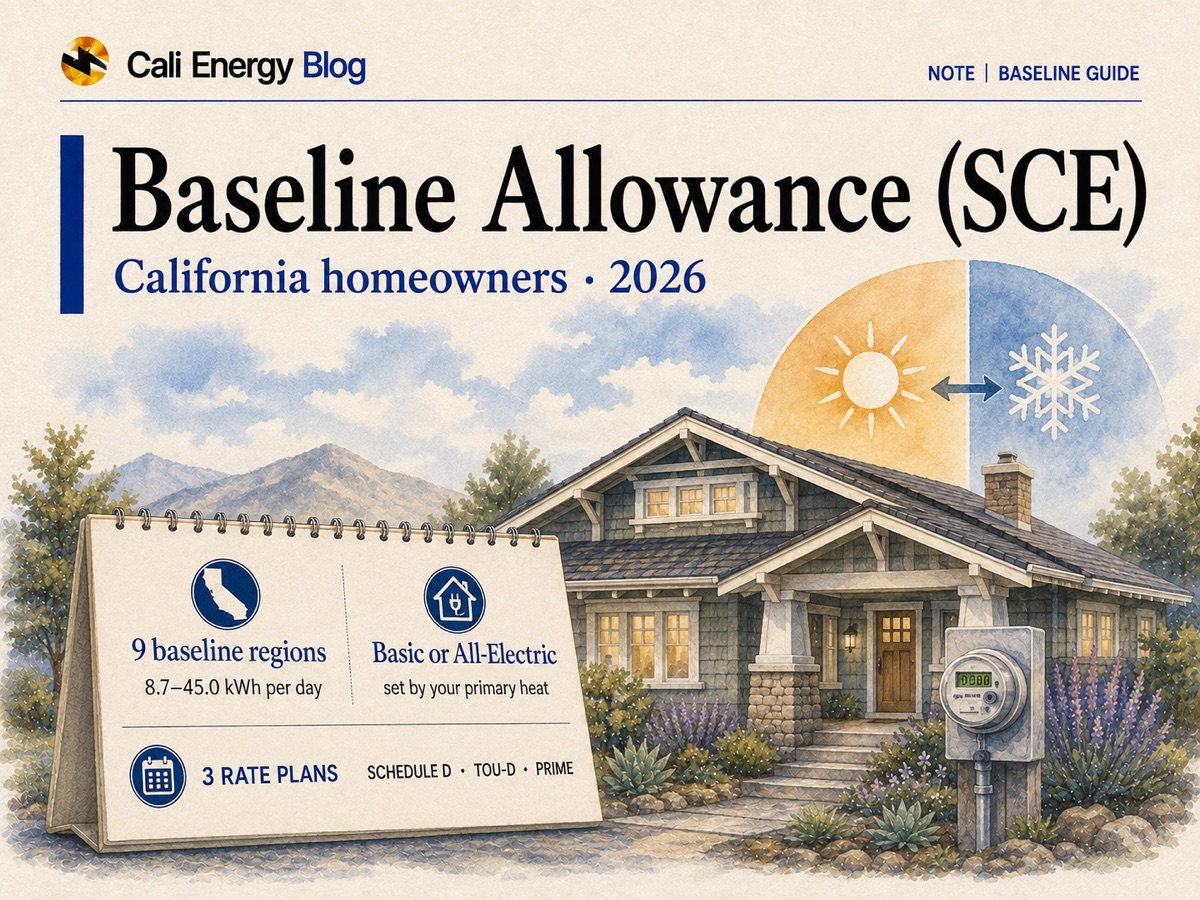
Your SCE baseline allowance is a daily block of electricity the tariff prices most favorably — and on TOU-D-4-9PM and TOU-D-5-8PM it earns a baseline credit of 9¢ per kWh from October 1, 2026. Its size depends on your baseline region, the season and the billing days, and whether you get the Basic or All-Electric allowance turns on one thing most guides get wrong: whether your home’s primary source of heat is electric.
What a baseline allowance actually is
It is a quantity of electricity, not a discount rate — and what it does to your bill depends on which rate plan you are on.
Southern California Edison gives every residential account a baseline allowance: a block of kilowatt-hours, measured per day, that the tariff treats more favorably than everything above it. Two separate things set the number.
The first is which of SCE’s nine baseline regions your service address falls in. The regions are climate zones, so a home in the low desert receives a far larger summer allowance than one on the coast. The second is whether your home’s primary source of heat is electric, which decides whether you get the Basic or the All-Electric allowance.
SCE states that the allowance depends on the days in the billing period, the season, the climate, and whether your primary source of heat is electric. Broadly, a Basic allowance covers about 50–60% of average residential consumption; an All-Electric allowance covers roughly 60–70% during the winter heating season — the season when electric heating actually runs (SCE rate FAQs). The CPUC reviews the quantities about every three to five years in SCE’s rate cases, and in most cases an individual account cannot have its allowance raised; Medical Baseline is the main exception.
The 2026 allowance tables
SCE’s published seasonal quantities, in kilowatt-hours per day, for all nine baseline regions.
| Baseline region | Summer (kWh/day) | Winter (kWh/day) |
|---|---|---|
| Region 5 | 17.0 | 18.4 |
| Region 6 — cool coastal | 11.4 | 11.0 |
| Region 8 | 12.8 | 10.3 |
| Region 9 | 16.9 | 12.0 |
| Region 10 — moderate inland | 19.3 | 12.1 |
| Region 13 | 22.2 | 12.2 |
| Region 14 | 19.2 | 11.9 |
| Region 15 — hot desert | 45.0 | 9.7 |
| Region 16 — mountain | 14.7 | 12.4 |
| Baseline region | Summer (kWh/day) | Winter (kWh/day) |
|---|---|---|
| Region 5 | 16.8 | 27.0 |
| Region 6 | 8.7 | 12.6 |
| Region 8 | 9.9 | 12.3 |
| Region 9 | 12.5 | 13.9 |
| Region 10 | 15.9 | 16.4 |
| Region 13 | 24.2 | 23.0 |
| Region 14 | 18.5 | 21.1 |
| Region 15 | 24.0 | 17.4 |
| Region 16 | 13.5 | 23.2 |
Source: SCE — Tiered Rate Plan, verified October 6, 2026. Allowances are set by tariff and can be revised; the allocation printed on your bill governs.
Two patterns are worth reading off these tables. First, Basic allowances collapse in winter almost everywhere — Region 10 falls from 19.3 to 12.1 kWh per day. Second, All-Electric is not simply larger: in Region 10 it is lower than Basic in summer (15.9 against 19.3) and higher in winter (16.4 against 12.1). The all-electric allowance is shifted toward the heating season, not enlarged across the year.
SCE itself groups the regions by climate: hot 13, 14 and 15; moderate 5, 9 and 10; cool 6, 8 and 16 — with Region 10 classed as moderate despite its hot summers. Region 15’s outsized summer figure dates from SCE’s 1985 rate case, when the CPUC adopted a Coachella Valley proposal to reflect the desert heat (SCE; SCE rate FAQs).
Look up your allowance
Pick your region, heating type and the days on your bill. The tool shows the allowance and, separately, what it does under each of the three rate-plan structures.
Not sure? Your baseline region is tied to your service address, not your ZIP code — neighbouring ZIPs can fall in different regions. The reliable check is the baseline allocation printed on your SCE bill, or SCE’s Index of Communities. Treat the descriptions above as an estimate only.
This is what decides Basic vs All-Electric baseline — not whether you happen to own electric appliances. An all-electric allowance is larger in winter, when electric heating runs.
Summer runs June 1 to October 1.
Take the exact figure from your bill — the allowance is daily, so the period length changes the total.
Estimated baseline allowance
—
Allowances are SCE’s published seasonal quantities in kWh per day. Estimate only — not a bill, quote or tariff determination.
What is the baseline credit on an SCE bill?
A fixed amount off every kilowatt-hour up to your allowance — on two of the three time-of-use plans.
On TOU-D-4-9PM and TOU-D-5-8PM, SCE subtracts $0.09 per kWh for usage up to your baseline allocation for the billing period. SCE’s own example: a 200 kWh allocation earns an $18 credit. The credit applies whatever the hour, so SCE publishes each price twice — before and after the credit. TOU-D-PRIME lists “Baseline Credit: None” (SCE time-of-use plans, rates from October 1, 2026).
| Plan and period | Price | After credit (within allowance) |
|---|---|---|
| TOU-D-4-9PM, summer weekday 4–9 p.m. | 59 | 50 |
| TOU-D-4-9PM, summer off-peak | 33 | 24 |
| TOU-D-4-9PM, winter 4–9 p.m. | 50 | 41 |
| TOU-D-4-9PM, winter 8 a.m.–4 p.m. | 32 | 23 |
| TOU-D-5-8PM, summer weekday 5–8 p.m. | 72 | 63 |
| TOU-D-5-8PM, summer off-peak | 34 | 25 |
| TOU-D-PRIME, any period | plan price | no credit |
| Schedule D (tiered) | Tier 1: 30 up to the allowance; Tier 2: 39 above | no separate credit |
Sources: SCE time-of-use plans · SCE tiered rate plan. Bundled SCE prices; customers of Clean Power Alliance or another CCA pay a different generation price. All plans also carry SCE’s $0.79 daily Base Services Charge.
What your allowance does on each rate plan
Here is where most explanations blur three different mechanisms into one.
Schedule D (tiered). The allowance is your Tier 1 block. Electricity up to it is billed at the Tier 1 rate; anything beyond moves to the higher Tier 2 rate. The allowance sets a price boundary.
TOU-D-4-9PM and TOU-D-5-8PM. These plans price by time of day and have no tiers. The allowance instead earns a baseline credit of 9¢/kWh on usage up to the allowance — a subtraction from the bill, not a cheaper tier.
TOU-D-PRIME. No baseline credit at all. Your allowance has no effect on a PRIME bill. PRIME trades the credit away for lower per-kWh rates, which is why it suits higher-usage electrified homes and why comparing plans on headline rates alone is misleading.
Worked examples
Every figure below comes from the tables above, so each one can be reproduced.
1. Inland home, Basic, summer. Region 10, gas heat, 30-day billing period: 19.3 × 30 = 579 kWh. On Schedule D that is the Tier 1 block. On TOU-D-4-9PM the same 579 kWh earns about $52 in baseline credit at 9¢. On PRIME it is worth nothing.
2. The same home in winter. 12.1 × 30 = 363 kWh, so the credit falls to about $33. This seasonal drop is the most-missed detail on a Basic account.
3. Electric heat changes winter. Region 10 with electric heat: winter rises to 16.4 kWh/day (492 kWh over 30 days) while summer falls to 15.9.
4. Billing periods are not all 30 days. Region 10, Basic, summer, 33 days: 19.3 × 33 = 637 kWh rather than 579. Use the day count printed on your bill.
Medical Baseline is separate, and never automatic
Households approved by SCE for a qualifying medical need receive an additional 16.5 kWh per day, year-round, on top of the standard allowance. Per SCE’s rate plan FAQs, it applies where a full-time resident requires an electrically-operated life-support device essential to a vital function, or mechanical equipment relied on for mobility.
It requires a separate application. It is not granted because a household owns medical equipment, and it is never added by default.
Two more ways the allowance changes
A heat-pump water heater adds allowance. Since October 1, 2022, customers who own a heat-pump water heater and are on TOU-D-4-9PM or TOU-D-5-8PM can get extra baseline: 1.9 kWh a day in summer and 2.6 in winter on a Basic allowance, and an incremental amount on All-Electric. It is not automatic — SCE asks existing TOU customers to call and have it enabled (SCE). At the 9¢ credit that is roughly $5 a month in summer and $7 in winter on a 30-day bill. More in heat-pump water heaters with solar.
Solar on the Solar Billing Plan ends the credit. SCE requires Solar Billing Plan (NEM 3.0) customers to be on TOU-D-PRIME, which pays no baseline credit, while NEM 2.0 customers must be on a time-of-use plan and can keep a plan that has one. Once you switch to time-of-use, SCE holds you there for twelve months before another switch (SCE).
What each baseline region tells you
The region number is a climate zone. Its two numbers — summer and winter — describe the climate more honestly than any label.
What is SCE Region 15?
Region 15 has the largest summer allowance in the entire SCE system: 45.0 kWh per day on the Basic baseline — more than double the next-highest region. It also has the smallest winter allowance at 9.7 kWh per day. That combination is the signature of the low desert: brutal cooling load in summer, almost none in winter.
What is SCE Region 10?
Region 10 runs 19.3 kWh per day in summer and 12.1 in winter on the Basic baseline, which puts it in the middle of the range — the profile of inland valleys with real summer heat but a mild winter. On the All-Electric baseline the same region gives 15.9 in summer and 16.4 in winter.
What is SCE Region 6?
Region 6 has the smallest allowances in the system — 11.4 kWh per day in summer and 11.0 in winter on Basic, and just 8.7 in summer on All-Electric. The near-flat seasonal profile is the coastal signature: little cooling, little heating. If your allowance barely changes between summer and winter, you are almost certainly in a coastal region.
What is SCE Region 16?
Region 16 is the only region where the All-Electric winter allowance (23.2 kWh per day) is well above its summer figure (13.5) — the mountain profile, where electric heating dominates the year. Its Basic numbers are 14.7 summer and 12.4 winter.
Which regions get the biggest seasonal swing?
On the Basic baseline the swing between summer and winter is largest in Region 15 (45.0 down to 9.7 — a fall of over 78%) and smallest in Region 6 (11.4 to 11.0, essentially flat). The bigger your swing, the more your bill structure changes with the season, and the more a winter bill can surprise you.
Where the allowance appears on your bill
Your SCE statement prints the baseline allocation applied to your account for that billing period. That printed figure is authoritative — it beats any lookup, including this page. What to look for:
- A daily quantity, not a monthly one. The tariff is expressed in kWh per day; the period total is that number multiplied by the days billed.
- The number of days in the billing period, which is also printed and is rarely exactly 30.
- Your baseline region or the allocation figure that implies it — compare it against the tables above.
- Whether a baseline credit line appears. On the standard time-of-use plans it does; on TOU-D-PRIME it does not, because PRIME earns no credit.
If you want a line-by-line walkthrough of everything else on the statement, that is a separate subject — see our guide to reading a California electric bill.
Common mistakes about the baseline
- Assuming the allowance is monthly. It is daily. A 33-day period yields materially more allowance than a 28-day one.
- Assuming all-electric always means more. In Region 10 the All-Electric summer allowance is lower than Basic (15.9 against 19.3). The all-electric figure is weighted toward winter.
- Assuming electric appliances qualify you as all-electric. The deciding factor is whether the home’s primary source of heat is electric.
- Assuming baseline electricity is free. It is the most favorably priced block, not a free one.
- Assuming the allowance helps on every plan. On TOU-D-PRIME it does nothing at all.
- Assuming your ZIP code decides your region. The region follows the service address, and ZIP boundaries do not align with region boundaries.
Find your region by city
From SCE’s own Index of Communities — 85 of Los Angeles County’s 88 cities are listed.
SCE’s tariff book lists every community it serves with its baseline region. The useful surprise is how many are split: 37 of the 85 Los Angeles County cities in the index sit in two or three regions, so for them only the address — or your bill — settles it.
| Region | Los Angeles County cities | Nearby cities |
|---|---|---|
| Region 6 | Avalon, El Segundo, Hermosa Beach, Lomita, Malibu, Manhattan Beach, Palos Verdes Estates, Rancho Palos Verdes, Redondo Beach, Rolling Hills, Rolling Hills Estates | Huntington Beach, Oxnard |
| Region 8 | Artesia, Bell, Bell Gardens, Bellflower, Cerritos, Compton, Cudahy, Hawaiian Gardens, Huntington Park, Lakewood, Lynwood, Maywood, Paramount, South Gate | Anaheim, Fullerton, Orange |
| Region 9 | Alhambra, Baldwin Park, Beverly Hills, Bradbury, Covina, El Monte, Industry, Irwindale, La Puente, Montebello, Monterey Park, Pico Rivera, Rosemead, San Dimas, San Gabriel, San Marino, Sierra Madre, South El Monte, South Pasadena, Temple City, Walnut, West Covina | Simi Valley |
| Region 10 | — | Chino, Corona, Fontana, Moreno Valley, Ontario, Redlands, Rialto |
| Region 14 | — | Victorville |
| Region 15 | — | Palm Springs |
| Region 16 | Glendale | — |
| Regions | Cities |
|---|---|
| 6 or 8 | Carson, Costa Mesa, Gardena, Hawthorne, Inglewood, Irvine, Lawndale, Long Beach, Santa Ana, Signal Hill, Torrance |
| 6 or 9 | Agoura Hills, Calabasas, Santa Monica, Thousand Oaks, Ventura, West Hollywood, Westlake Village |
| 8 or 9 | Commerce, Downey, La Habra Heights, La Mirada, Norwalk, Santa Fe Springs, Whittier |
| 9 or 10 | Diamond Bar, Pomona |
| 9 or 16 | Arcadia, Azusa, Duarte, Glendora, La Canada Flintridge, La Verne, Monrovia, Pasadena, San Fernando |
| 10 or 16 | Hemet, Rancho Cucamonga, San Bernardino, Upland |
| 14 or 16 | Lancaster, Palmdale |
| 6 or 8 or 9 | Culver City, Los Angeles |
| 9 or 10 or 16 | Claremont |
| 9 or 14 or 16 | Santa Clarita |
| 10 or 15 or 16 | Riverside |
Source: SCE Index of Communities (tariff sheets, effective 2009–2014) · SCE baseline regions map. Burbank, Hidden Hills and Vernon are not listed. A listed city may be served mostly by a municipal utility — LADWP in most of the City of Los Angeles, Glendale Water & Power, Pasadena Water and Power, Anaheim and Riverside public utilities — with SCE only in parts; if your bill is not from SCE, no SCE baseline applies (see LADWP rates).
How to find your region — and why a ZIP code does not settle it
Your baseline region attaches to your service address, not your ZIP code. Neighboring ZIPs can sit in different regions and a single ZIP can straddle a boundary, so any ZIP-based lookup is an estimate.
There are two authoritative answers. The first is your SCE bill, which prints the allocation applied to your account. The second is SCE’s Index of Communities, which lists communities against their baseline region; the baseline regions map shows the same boundaries geographically. If your bill disagrees with this page, the bill governs.
What this page does not tell you
It shows the allowance and what the allowance does. It is not a bill estimate: it does not model tier rates, time-of-use periods, the daily service charge, taxes, the California Climate Credit, CCA or Direct Access generation, or solar export. It does not determine your baseline region — only SCE does.
Frequently asked
What is the baseline credit on my SCE bill?
A subtraction of $0.09 per kWh for usage up to your baseline allocation, on TOU-D-4-9PM and TOU-D-5-8PM from October 1, 2026. A 200 kWh allocation earns $18. TOU-D-PRIME has no baseline credit, and on the tiered Schedule D the allowance works as the cheaper Tier 1 instead.
How do I find my SCE baseline region?
Two reliable ways: read the baseline allocation printed on your SCE bill, or find your community in SCE’s Index of Communities. Because the region follows your service address rather than your ZIP code, a ZIP-based guess can land in the wrong region near a boundary.
Why is my winter baseline so much smaller?
On a Basic account it usually is. In Region 10 the allowance drops from 19.3 kWh per day in summer to 12.1 in winter. All-Electric accounts move the other way, because the larger allowance is aimed at the winter heating season.
What makes a home “all-electric” for baseline purposes?
Whether the home’s primary source of heat is electric. Owning some electric appliances does not qualify a home; electric heating is the deciding characteristic.
Does the baseline allowance make that electricity free?
No. It is the block priced most favorably, not a free block. On Schedule D it is billed at the Tier 1 rate (30¢ from October 1, 2026); on TOU-D-4-9PM and TOU-D-5-8PM it earns a credit of 9¢/kWh.
Why does my allowance change from bill to bill?
Because it is a daily quantity multiplied by the days in the billing period, and periods vary in length. A 33-day period yields more allowance than a 28-day one at the same daily rate.
Can a heat-pump water heater increase my SCE baseline?
Yes, on TOU-D-4-9PM or TOU-D-5-8PM: 1.9 kWh a day extra in summer and 2.6 in winter on a Basic allowance, with an incremental amount on All-Electric. It is not automatic — existing customers ask SCE to enable it.
Do I get the baseline credit on TOU-D-PRIME?
No. PRIME earns no baseline credit at all. That is a deliberate trade for lower per-kWh rates, so PRIME generally makes sense only once usage is high enough that the lower rates outweigh the missing credit.
What is the largest SCE baseline allowance?
Region 15 on the Basic baseline, at 45.0 kWh per day in summer — more than double any other region. The same region has the smallest winter allowance in the system at 9.7 kWh per day.
Which SCE region has the smallest allowance?
Region 6, the cool coastal region: 11.4 kWh per day in summer and 11.0 in winter on the Basic baseline, and 8.7 in summer on All-Electric — the lowest single figure in the table.
Where do I find the baseline allocation on my SCE bill?
SCE prints the allocation applied to your account for that billing period, expressed as a daily quantity, alongside the number of days billed. That printed figure is authoritative and overrides any lookup. On the standard time-of-use plans a baseline credit line will also appear; on TOU-D-PRIME it will not.
Is the baseline allowance monthly or daily?
Daily. The tariff sets a kWh-per-day quantity; your allowance for the period is that figure multiplied by the days billed. This is why the same home sees a different allowance on a 28-day bill and a 33-day bill.
Does the baseline change if I install solar?
The allowance itself is set by your region, season and baseline type, so solar does not change it. What changes is whether it pays: SCE puts Solar Billing Plan (NEM 3.0) customers on TOU-D-PRIME, which has no baseline credit. NEM 2.0 customers stay on a time-of-use plan and can keep one that has the credit.
Related reading
Sources & methodology
Figures on this page come from the primary sources below and, where noted, from Cali Energy calculations using the stated assumptions. Rates, incentives, and program terms change; each was verified October 6, 2026.
- SCE — Tiered Rate Plan (allowances by region, climate groups, HPWH allowance, Medical Baseline, Tier 1/2 rates)
- SCE — Rate Plan FAQs (50–70% of average use, Region 15 history, review cycle)
- SCE — Index of Communities
- SCE — Index of Communities (tariff sheets, community by baseline region)
- SCE — Baseline Regions Map (PDF)
- SCE — Time-of-Use Residential Rate Plans (baseline credit $0.09/kWh; prices before and after credit, from Oct 1, 2026)
About this reference
Cali Energy is a licensed California contractor (CSLB #1032379) based in Northridge. We publish this page as a reference and date it to the day each figure was checked against its source.
Prepared by Cali Energy, October 6, 2026. This article is for general educational purposes only and is not legal, tax, financial, engineering, or utility advice. Rates, incentives, codes, permit requirements, equipment specifications, prices, and program terms may change; figures and timelines are estimates, not guarantees. Confirm current requirements with the applicable utility, AHJ, program administrator, manufacturer, or a licensed professional. See our Content Disclaimer. Cali Energy · 19201 Parthenia St, Unit E, Northridge, CA 91324 · CSLB #1032379 (B, C-10, C-39)