

LADWP Electric Rates Explained
LADWP is the city-owned utility that serves most of Los Angeles, and its residential rates work differently from the investor-owned utilities around it. This guide gives the 2026 prices for both plans, the R-1B peak hours, the climate zones, and the adjustment factors that drove this year’s increase — with a calculator that compares a LADWP and an SCE bill.
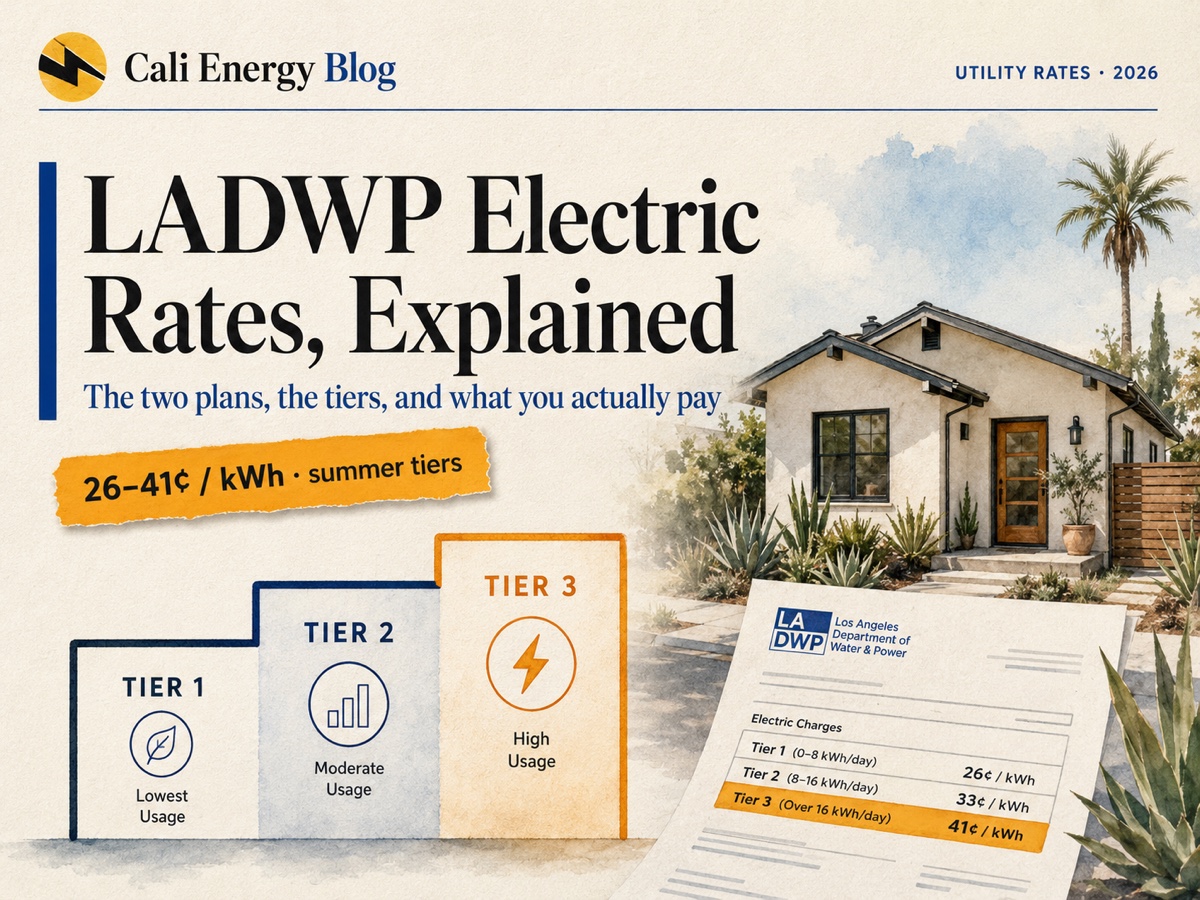
- LADWP has two main residential plans: the standard tiered R-1A (the default) and the opt-in time-of-use R-1B, whose priciest hours are 1–5 p.m. on weekdays.
- From October 1, 2026, R-1A costs 27.29¢/kWh in Tier 1 and 33.15¢ above it, before the 10% city tax — about 11% more than the same quarter of 2025.
- The base rates have not changed since July 1, 2019. The increases come from quarterly adjustment factors, now 20.15¢/kWh — and more than half of the past year’s rise is one of them, the reliability-program charge (IRCA).
- In our model, SCE’s TOU-D-4-9PM costs 7–24% more than LADWP for 750 kWh in summer, depending on the SCE baseline region.
- LADWP nets solar at full retail prices; surplus credit is banked with no time limit but never paid out.
The two rate plans
LADWP offers two primary rate choices for typical residential customers. (Special variants, riders, low-income programs, and a separate schedule for large homes on a dedicated transformer also exist, but these two cover most households.)
- R-1A — Standard Residential (default): a three-tier plan with no time-of-day pricing. A fixed monthly Power Access Charge of $2.30 / $7.90 / $22.70, set by the highest tier your usage reached in the past 12 months and reset every October 1; a $10 monthly minimum charge plus adjustment factors.
- R-1B — Time-of-Use (opt-in): no tiers; the price depends on the hour. A flat $12/month service charge. High Peak is 1:00–4:59 p.m. on weekdays; Low Peak is 10:00 a.m.–12:59 p.m. and 5:00–7:59 p.m. on weekdays; Base is 8:00 p.m.–9:59 a.m. on weekdays and all day Saturday and Sunday.
One distinction from SCE: SCE moved most eligible residential customers to default time-of-use starting in 2020 while keeping an optional tiered rate; LADWP keeps tiered R-1A as the default and TOU as opt-in. (LADWP is not regulated by the CPUC.) LADWP’s peak is also earlier: 1–5 p.m., against SCE’s 4–9 p.m.
Source: LADWP — Residential electric rates (zones, PAC, R-1B hours) · verified October 6, 2026.
2026 rates by season, and how much they rose
LADWP’s schedule splits the year precisely — June already carries the summer Tier 3 premium — and the adjustment factors reset every quarter. Standard R-1A prices per kWh, including adjustment factors, before the 10% City of Los Angeles Electricity Users Tax:
| 2026 period | Tier 1 | Tier 2 | Tier 3 | Tier 1 in 2025 | Change |
|---|---|---|---|---|---|
| Jan–Mar | 24.77¢ | 30.63¢ | 30.63¢ | 22.30¢ | +11.1% |
| Apr–May | 24.36¢ | 30.22¢ | 30.22¢ | 22.77¢ | +7.0% |
| June | 24.36¢ | 30.22¢ | 38.92¢ | 22.77¢ | +7.0% |
| Jul–Sep | 26.41¢ | 32.27¢ | 40.97¢ | 24.31¢ | +8.6% |
| Oct–Dec | 27.29¢ | 33.15¢ | 33.15¢ | 24.60¢ | +10.9% |
High Season is June–September; Low Season is October–May. In Low Season, Tier 2 and Tier 3 cost the same — the Tier 3 premium only applies in summer, as a conservation signal. Year over year, every 2026 period is 7–11% higher than the same period of 2025.
The time-of-use plan, R-1B, has no tiers. Its 2026 prices per kWh:
| 2026 period | High Peak (1–5 p.m. weekdays) | Low Peak | Base (nights, weekends) |
|---|---|---|---|
| Jan–Mar | 27.65¢ | 27.65¢ | 25.29¢ |
| Apr–May | 27.24¢ | 27.24¢ | 24.88¢ |
| June | 33.08¢ | 27.24¢ | 24.49¢ |
| Jul–Sep | 35.12¢ | 29.28¢ | 26.54¢ |
| Oct–Dec | 30.17¢ | 30.17¢ | 27.81¢ |
Which plan is cheaper? Compare the cheapest R-1B hour with R-1A Tier 1. From October to December 2026 the R-1B Base price, 27.81¢, is slightly above R-1A’s Tier 1 price of 27.29¢, and R-1B adds a $12 service charge. R-1B pays off for homes whose usage regularly reaches Tier 2 or Tier 3 and can keep most of it out of the 10 a.m.–8 p.m. weekday window — LADWP itself suggests it for customers with steady Tier 3 usage or solar customers who keep banking credits.
Source: LADWP residential rate schedules (R-1A, R-1B, 2025 and 2026) · verified October 6, 2026.
Zone 1 vs Zone 2
LADWP splits the city into two temperature zones. The per-kWh prices are the same in both; only the tier thresholds differ, giving hotter inland areas a larger low-cost allowance. On a two-month bill the thresholds double:
| Tier | Zone 1, monthly | Zone 1, two months | Zone 2, monthly | Zone 2, two months |
|---|---|---|---|---|
| Tier 1 | First 350 kWh | First 700 kWh | First 500 kWh | First 1,000 kWh |
| Tier 2 | Next 700 kWh | Next 1,400 kWh | Next 1,000 kWh | Next 2,000 kWh |
| Tier 3 | Above 1,050 kWh | Above 2,100 kWh | Above 1,500 kWh | Above 3,000 kWh |
Your zone is set by service address and appears on your bill. The Power Access Charge uses the same tiers, applied to your highest month of the past year.
Source: LADWP — Residential electric rates.
How the rate is actually built: adjustment factors
Each R-1A price is a base rate plus adjustment factors. The base rates — 7.14¢ in Tier 1, 13.00¢ in Tiers 2 and 3, and 21.70¢ for Tier 3 in summer — have been in effect since July 1, 2019. The adjustment factors are pass-through charges that LADWP resets in January, April, July and October; they are now larger than the base rate itself. Here is what they were in the last quarter of 2025 and what they are now:
| Factor | What it recovers | Oct–Dec 2025 | Oct–Dec 2026 | Change |
|---|---|---|---|---|
| ECA — Energy Cost Adjustment | fuel, purchased power and energy-efficiency programs | 5.69¢ | 5.69¢ | +0.00¢ |
| ESA — Electric Subsidy Adjustment | discount and subsidy programs | 0.15¢ | 0.15¢ | +0.00¢ |
| RCA — Reliability Cost Adjustment | reliability spending | 0.30¢ | 0.30¢ | +0.00¢ |
| IRCA — Incremental Reliability Cost Adjustment | operations, maintenance and debt service of the Power Reliability Program | 5.50¢ | 6.93¢ | +1.43¢ |
| VEA — Variable Energy Adjustment | fuel and non-renewable power purchases | 0.74¢ | 1.59¢ | +0.85¢ |
| CRPSEA — Capped Renewable Portfolio Standard Energy Adjustment | renewable-energy costs under a cap | 1.87¢ | 1.97¢ | +0.11¢ |
| VRPSEA — Variable Renewable Portfolio Standard Energy Adjustment | renewable market purchases | 3.21¢ | 3.52¢ | +0.31¢ |
| Total adjustment factors | 17.46¢ | 20.15¢ | +2.69¢ |
The year’s 2.69¢ rise is almost entirely two factors: the Incremental Reliability Cost Adjustment, which pays for the Power Reliability Program’s upkeep and debt, up 1.43¢ (it was 4.21¢ at the start of 2025), and the Variable Energy Adjustment, up 0.85¢. The fuel-and-power ECA has stayed at 5.69¢ throughout. That is why a “7¢ base rate” tells you little about a bill: the Tier 1 price is 7.14¢ of base plus 20.15¢ of adjustments.
Source: LADWP residential adjustment billing factors (2025 and 2026) · verified October 6, 2026.
Estimate and compare: LADWP vs SCE
Use the tool to estimate a LADWP bill and compare it with a modeled SCE bill. The comparison is shown before local taxes so the two utilities are measured the same way.
LADWP vs SCE bill estimator
Cali Energy calculation · LADWP 2026 and SCE October 2026 tariffs, verified Oct 6, 2026 · illustrative, not a quote
Power Access Charge: LADWP sets this from the highest usage tier you reached in the prior 12 months and resets it every October 1, not from this month’s usage — check the figure printed on your current LADWP bill and pick the matching tier above. Comparison is shown before local taxes for parity (the LADWP card also shows its 10% City of LA tax in its own line). SCE model: baseline allocation = region daily × billing days (credited at 9¢/kWh); Base Services Charge $0.79/day. Summer 4–9 p.m. uses a weekday/weekend blended rate — 59¢ weekday On-Peak and 44¢ weekend Mid-Peak — with the rest at 33¢ Off-Peak. In winter, 4–9 p.m. is 50¢ Mid-Peak and the remaining usage is split between 36¢ Off-Peak and 32¢ Super-Off-Peak by the hours in each period. Excludes the semiannual California Climate Credit ($36 in Aug & Sep 2026 for eligible SCE customers), one-time adjustments, arrears, and local Utility Users Tax (which some SCE cities levy and some don’t). Estimates are not quotes or guarantees; tariffs change — verify current rates with the utility.
Benchmark bills (static reference)
For a non-interactive reference, here is the monthly energy charge (the usage-dependent part) computed from the R-1A prices above, for summer and for the current low-season quarter. The full bill is: Total = (energy charge + your Power Access Charge) × 1.10 (city tax), minimum $10.
| Monthly kWh | Zone 1, Jul–Sep 2026 | Zone 2, Jul–Sep 2026 | Zone 1, Oct–Dec 2026 | Zone 2, Oct–Dec 2026 |
|---|---|---|---|---|
| 300 | $79.22 | $79.22 | $81.88 | $81.88 |
| 500 | $140.83 | $132.04 | $145.25 | $136.46 |
| 750 | $221.50 | $212.71 | $228.13 | $219.34 |
| 1,000 | $302.16 | $293.38 | $311.00 | $302.22 |
| 1,500 | $502.65 | $454.71 | $476.76 | $467.97 |
A two-month bill, worked through: a Zone 2 home that uses 1,400 kWh over a two-month billing period in October–December 2026 pays Tier 1 on the first 1,000 kWh (27.29¢) and Tier 2 on the other 400 (33.15¢): $405.52 of energy. Add two months of a Tier 2 Power Access Charge ($15.80) and the 10% city tax, and the electric portion comes to about $463 — before water, sewer and trash on the same bill.
Cali Energy calculation from LADWP R-1A rates · verified October 6, 2026.
Billing cycle
Many LADWP residential customers are billed every two months, and the tier thresholds double for a two-month bill (a Zone 1 Tier 1 allowance is 700 kWh over two months). If a billing period crosses a price change, LADWP splits the usage across the two prices by billing days. Power, water, sewer and trash appear on one combined bill, which is part of why a summer bill can look like a jump: you see roughly two months of charges at once.
LADWP vs SCE: what the numbers actually show
LADWP is generally cheaper than SCE, but by how much depends heavily on the details. In the calculator above, with SCE’s rates from October 1, 2026, a 750 kWh summer month — 31 billing days, bundled TOU-D-4-9PM service, 20% of usage in the 4–9 p.m. window, a Tier 2 Power Access Charge of $7.90, figures before local taxes — comes to about $221 on LADWP Zone 2:
| SCE baseline region | SCE TOU-D-4-9PM | LADWP R-1A | SCE costs more by |
|---|---|---|---|
| Region 6 (cool coastal) | $272.76 | $220.63 | 24% |
| Region 9 | $257.41 | $220.63 | 17% |
| Region 10 (moderate) | $250.71 | $220.63 | 14% |
| Region 14 | $250.99 | $220.63 | 14% |
| Region 15 (hot desert) | $237.06 | $220.63 | 7% |
A single “X% cheaper” figure isn’t meaningful without stating the region, load shape, tax treatment and Power Access Charge — a Tier 1 or Tier 3 PAC would move the LADWP side. To check which utility serves an address, see LA-area electric utilities by city; for SCE’s plans, SCE time-of-use plans compared.
The structural reasons LADWP tends to be lower: it is a publicly owned municipal utility with no shareholder-return obligation, it finances infrastructure with tax-exempt municipal bonds, and it is not subject to the CPUC regulatory process or the wildfire-liability cost recovery that appears in SCE’s rates. (For a deeper treatment, see the UCLA Law analysis in our sources.)
Cali Energy calculation from LADWP rates and SCE time-of-use rates · verified October 6, 2026.
Net metering: LADWP’s solar advantage
For solar customers, LADWP’s biggest difference from SCE is net metering. LADWP nets exported and imported energy kWh for kWh over each billing period at your plan’s retail prices; a period with more export than use leaves a credit that is banked with no time limit but never paid out. Projects under 10 kW AC without a service upgrade or battery may qualify for a fast-tracked review. SCE, by contrast, is on the CPUC’s Net Billing Tariff (“NEM 3.0”), where exports are credited at hourly values far below retail.
Because of that, retail-rate netting may improve solar economics for some LADWP customers compared with net-billing scenarios — but payback still depends on system price, production, consumption, financing, and tariff details. Under SCE’s Net Billing Tariff, a battery often improves economics by shifting exports away from low-value midday hours. See our LADWP net metering guide for the mechanics.
Sources: LADWP rate schedules (NEM rider listed there) · CPUC Net Billing Tariff (SCE) · verified October 6, 2026.
Discounts, rebates and incentives in 2026
- Bill discounts: LADWP’s EZ-SAVE program lowers bills for income-qualified households (from July 1, 2026, up to $66,000 a year for a family of four), and its Lifeline program, for customers 62 or older or with a disability, carries LADWP’s biggest discounts.
- Solar: in Cali Energy’s review, there is no generally available LADWP rebate for a typical market-rate home solar system, and the federal residential solar credit (Section 25D) ended for systems placed in service after December 31, 2025.
- Batteries: LADWP is an administrator of the state’s SGIP; its income-qualified budget was waitlisted on October 5, 2026 (see California solar incentives).
- EV chargers: LADWP pays up to $1,000 toward a qualifying Level 2 charger and installation (see Level 2 charger costs).
Program status changes — confirm current offerings with LADWP before relying on any incentive.
Sources: LADWP EZ-SAVE · SGIP program metrics · IRS Residential Clean Energy Credit (§25D) · verified October 6, 2026.
Frequently asked
What are LADWP’s residential electric rates in 2026?
What are LADWP peak hours in 2026?
Did LADWP rates go up in 2026?
What is the difference between LADWP R-1A and R-1B?
Is LADWP cheaper than SCE?
What is Zone 1 vs Zone 2 on my LADWP bill?
Why is my LADWP bill so high in summer?
Does LADWP have net metering for solar?
Related reading
Sources & methodology
Figures on this page come from the primary sources below and, where noted, from Cali Energy calculations using the stated assumptions. Rates, incentives, and program terms change; each was verified October 6, 2026.
- LADWP — Residential rate schedules (R-1A, R-1B, 2025–2026 prices, base rates)
- LADWP — Residential electric rates (zones, Power Access Charge, R-1B hours)
- LADWP — Residential adjustment billing factors (2025 and 2026)
- LADWP — EZ-SAVE program (income limits from July 1, 2026)
- SCE — Time-of-Use residential rate plans (rates from October 1, 2026)
- CPUC — Net Energy Metering and Net Billing
- SGIP — Program metrics
- IRS — Residential Clean Energy Credit (§25D)
- UCLA Law — Cost & Carbon of Competing Utility Models
About this guide
This reference is maintained by the Cali Energy research team to explain how LADWP residential rates work. Bill figures are illustrative calculations that depend on the stated assumptions, not quotes. Tariffs and adjustment factors change quarterly — confirm current rates with LADWP.
Prepared by Cali Energy, October 6, 2026. This article is for general educational purposes only and is not legal, tax, financial, engineering, or utility advice. Rates, incentives, codes, permit requirements, equipment specifications, prices, and program terms may change; figures and timelines are estimates, not guarantees. Confirm current requirements with the applicable utility, AHJ, program administrator, manufacturer, or a licensed professional. See our Content Disclaimer. Cali Energy · 19201 Parthenia St, Unit E, Northridge, CA 91324 · CSLB #1032379 (B, C-10, C-39)