

How the NEM 3.0 export rate is set
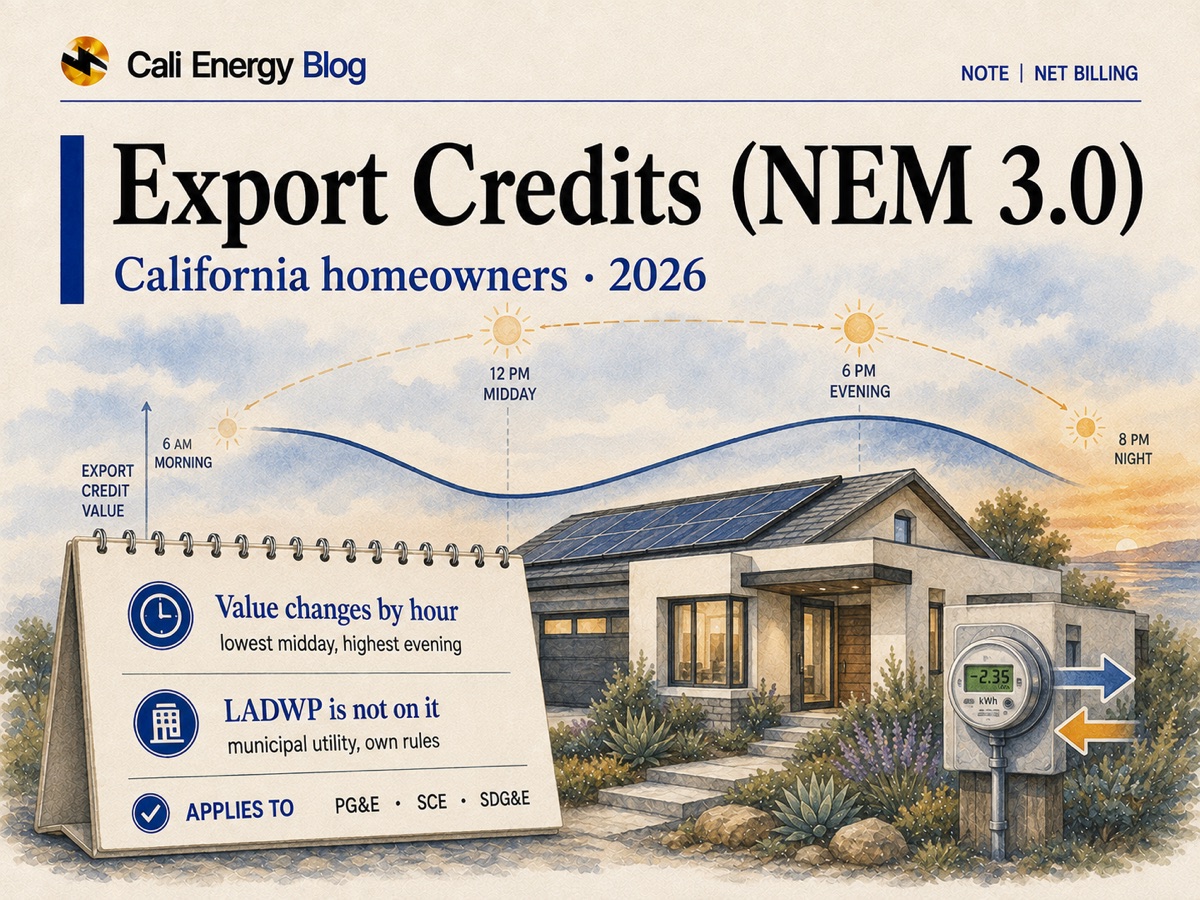
California’s Net Billing Tariff credits each exported kilowatt-hour at one of 576 hourly prices a year, drawn from the CPUC’s Avoided Cost Calculator and, for systems started through 2027, locked for nine years. Which prices you get depends on your utility, the year your system started and, in much of Los Angeles County, who supplies your power. If LADWP bills you, none of it applies.
What this page covers
Narrowly: the mechanics that set the number, not the program in general.
If you want the broad picture of the Net Billing Tariff — what it is, who it applies to, how it compares with NEM 2.0 and what it does to payback — start with our main guide to NEM 3.0 explained for California homeowners. For what an SCE solar bill looks like month to month, see how SCE solar billing works. This page goes one level down: what actually determines the number you are credited for an exported kilowatt-hour.
Three things decide it: the hourly avoided-cost price for your start year, the ACC Plus adder, and — in much of Los Angeles County — who supplies your generation, SCE or a community choice aggregator such as Clean Power Alliance.
How an exported kilowatt-hour is priced
Exports are not credited at the retail rate. SCE’s tariff sets an Energy Export Credit price from the CPUC’s Avoided Cost Calculator (ACC) — the version approved as of January 1 of the year that defines your vintage. For each vintage it averages the calculator’s values into one price for every month, hour and weekday or weekend/holiday across a nine-year horizon: 12 × 24 × 2 = 576 prices for each year, each split into a generation part and a delivery part (SCE Schedule NBT). PG&E’s tariff uses the same build: generation and delivery components summed for each hour and day type (PG&E Schedule NBT).
The result is a price that is lowest at midday, when the grid is saturated with solar, and highest in high-demand evening hours. That shape, rather than any single headline number, is what changed the economics of residential solar in investor-owned utility territory — and it is the whole argument for pairing solar with storage.
| Part | What it represents | Who pays it if Clean Power Alliance supplies your power |
|---|---|---|
| Generation export price | Energy, cap-and-trade and generation capacity | Clean Power Alliance, on its part of the bill |
| Delivery export price | Transmission, distribution, greenhouse-gas adder and methane leakage | SCE |
| ACC Plus adder (“Energy Export Bonus Credit”) | A fixed ¢/kWh bonus by start year, not a grid value | SCE, on the delivery side |
Sources: SCE Schedule NBT (Energy Export Credits; ACC Plus Adder) · Clean Power Alliance Net Billing Tariff, approved July 6, 2023. Other community choice aggregators and energy service providers set their own generation credits.
The nine-year lock-in, and how your start year is set
“Locked” means the schedule is fixed in advance, not that the price is flat: the nine-year horizon has its own 576 prices for each year, taken from the calculator’s forecast. The utilities differ on what fixes your vintage.
| Rule | SCE | PG&E |
|---|---|---|
| Your vintage is the calendar year of | your Original PTO date | your completed interconnection application |
| Prices come from | the ACC adopted as of January 1 of that year | the ACC adopted as of January 1 of that year |
| Who gets the lock-in | Original PTO April 15, 2023 – December 31, 2027 | customers enrolling in the tariff’s first five years |
| How long | nine years from the Original PTO date | nine years from PTO |
| Leaving it | opt out on written request | allowed, but you cannot re-enter |
| After the lock-in, or a later start | prices change every year with the current ACC | prices change every year with the current ACC |
| Buying a home that already has solar | no lock-in and no ACC Plus; current-year prices | no ACC Plus |
Sources: SCE Schedule NBT, Sheets 6–7 · PG&E Schedule NBT (revised August 28, 2026), citing CPUC Decision 22-12-056, section 8.5.1.
SCE’s help pages describe vintages by the year a customer “applied”; its tariff ties the lock-in and the adder to the Original PTO date, which is on your permission-to-operate notice. If your system was approved around a New Year, check that date before you compare yourself with a published table. For how long PTO itself takes, see solar permit to PTO in Los Angeles.
Which calculator sets which start year
Why SCE’s published averages move in pairs.
| Start year | Calculator in force on January 1 | Summer day / evening / overnight | Winter day / evening / overnight |
|---|---|---|---|
| 2023 | edition before the 2024 update | 5 / 23 / 7 | 3 / 5 / 4 |
| 2024 | same edition | 5 / 23 / 7 | 3 / 5 / 4 |
| 2025 | 2024 ACC (adopted November 13, 2024) | 6 / 21 / 12 | 3 / 9 / 10 |
| 2026 | 2024 ACC | 6 / 21 / 12 | 3 / 10 / 10 |
| 2027 | 2026 ACC (adopted September 3, 2026) | not yet published | not yet published |
Averages: SCE Solar Billing Plan (summer June–September; day 6 a.m.–4 p.m., evening 4–9 p.m., overnight 9 p.m.–6 a.m.) · adoption dates: CPUC DER cost-effectiveness · calculator-to-year mapping: Cali Energy reading of SCE Schedule NBT (“ACC approved as of January 1”). Adder not included.
That is why SCE’s averages for 2023 and 2024 match exactly, and 2025 and 2026 nearly so — the nine-year window moves by a year, nudging winter evenings from 9¢ to 10¢. The 2024 update moved value away from summer evenings (23¢ to 21¢) toward overnight hours (7¢ to 12¢ in summer, 4¢ to 10¢ in winter), which matters if a battery discharges after 9 p.m.
The next step is already decided. At the CPUC’s September 9, 2026 workshop, the comparison of the 2026 and 2024 calculators showed avoided costs up overall, driven by much higher greenhouse-gas values and more value in early mornings and overnight, with energy value down; for solar and solar-plus-storage the two roughly offset (CPUC workshop slides, example for PG&E climate zone 12). SCE had not published 2027 averages when we checked, so treat any 2027 export figure you see as an estimate.
The ACC Plus adder by start year
On top of the hourly price, residential customers of PG&E and SCE receive an adder, fixed for nine years and shown as its own line — SCE and PG&E call it the Energy Export Bonus Credit. Each new start year gets less: the step is 20% of the first-year adder, a fixed amount rather than a compounding percentage, so the adder reaches zero after five years. SDG&E residential customers do not receive it.
| Start year | PG&E standard | PG&E low income | SCE standard | SCE equity |
|---|---|---|---|---|
| 2023 | 2.20 | 9.00 | 4.0 | 9.3 |
| 2024 | 1.76 | 7.20 | 3.2 | 7.4 |
| 2025 | 1.32 | 5.40 | 2.4 | 5.6 |
| 2026 | 0.88 | 3.60 | 1.6 | 3.7 |
| 2027 | 0.44 | 1.80 | 0.8 | 1.9 |
| 2028 and later | 0 | 0 | 0 | 0 |
Sources: PG&E Schedule NBT (start year = completed interconnection application) · SCE Schedule NBT, Sheet 7 (start year = Original PTO date; equity = qualifying low-income and disadvantaged-community customers).
Unlike the hourly credit, SCE’s adder can pay non-bypassable and fixed charges, and an unused balance rolls forward, even past the nine years. This vintage structure explains most of the contradictory figures online: a guide quoting 4¢ and one quoting 1.6¢ can both be right for SCE. Any export figure without a stated start year is meaningless.
What happens at the end of the year
Credits are applied monthly, but SCE settles once a year. If your panels exported more than the home used over the twelve months, SCE calculates an Energy Export Credit Adjustment: the surplus kilowatt-hours times its posted average retail export rate, taken back from credits you already used. SCE’s own example is a home that drew 900 kWh and exported 1,000 — the credits for the extra 100 kWh are adjusted on the settlement bill. Unused export credits left after the settlement are forfeited. The surplus itself is paid at the Net Surplus Compensation rate, an average of SCE’s 7 a.m.–5 p.m. wholesale prices over the year — about 2¢ a kWh, by SCE’s estimate (Schedule NBT; SCE).
Clean Power Alliance settles its generation side separately, in the April billing cycle. Under its 2023 tariff it applies the same surplus adjustment, refunds remaining generation credits up to the CPA energy charges you paid that year, zeroes the rest, and pays surplus at its own Net Surplus Compensation rate, up to $10,000 (CPA Net Billing Tariff). Check CPA’s current terms before relying on them.
The design is deliberate: a system sized to the home’s own use gets the most from its credits.
Reading your export credit
Why is my export credit so much lower than my rate?
Because they are two different prices. What you pay for imported electricity is a retail rate that carries generation, delivery and program costs. What you are credited for an export is an avoided-cost value — an estimate of what the grid saved by not having to supply that kilowatt-hour at that hour. The gap is the design of the tariff, not an error.
Does the export rate change during the day?
Yes, every hour, and it differs by month and between weekdays and weekends or holidays. Exporting at midday and importing in the evening is the worst pattern for a solar owner under this tariff.
Which start year am I?
On SCE, the calendar year of your Original PTO date; on PG&E, the year your interconnection application was completed. A system SCE approved to operate in 2026 is on 2026 prices and the 1.6¢ adder for nine years from that date.
Where are the exact hourly numbers?
SCE posts a downloadable file of hourly prices for each vintage — NBT23 to NBT26, plus NBT00 for customers without fixed prices — with times in UTC, eight hours ahead of Pacific Standard Time, and separate rows for the delivery and generation parts (SCE: understanding export pricing). PG&E posts its values at pge.com/energyexportcredit, and Clean Power Alliance posts its generation prices on its own site. We do not publish a single blended “export rate”: what you earn depends on when your system exports.
What LADWP does instead
LADWP is a municipal utility and not on the Net Billing Tariff. It nets what you import against what you export over each billing period — usually two months — at your own rate’s retail prices. A surplus becomes a dollar credit that carries forward with no time limit, but it is never paid out, cannot cover taxes or the standard rate’s minimum charge, and is zeroed when the account closes. Details and current prices are in LADWP net metering in 2026; confirm terms against LADWP’s residential rates.
Frequently asked
How is the NEM 3.0 export rate calculated?
From the CPUC’s Avoided Cost Calculator. For each start year the utility averages the calculator’s values into one price for every month, hour and weekday or weekend — 576 prices a year across a nine-year horizon — each made of a generation part and a delivery part. On PG&E and SCE, residential customers who started before 2028 add a fixed ACC Plus adder.
What are SCE’s NEM 3.0 export rates in 2026?
For a 2026 start year SCE publishes averages of about 6¢ per kWh on summer days, 21¢ on summer evenings (4–9 p.m.) and 12¢ overnight; in winter about 3¢, 10¢ and 10¢. Residential customers also get the 1.6¢ adder (3.7¢ for equity customers). The actual credit is hour by hour.
Why are my exports worth less at midday?
Because export value follows an avoided-cost model that varies by month and hour. Midday is when the grid has the most solar and the least need for more, so an exported kilowatt-hour is valued lowest then and higher in the evening.
Is my export rate locked for nine years?
On SCE, yes if your Original PTO date falls between April 15, 2023 and December 31, 2027; PG&E locks customers who enrolled in the tariff’s first five years. The schedule is fixed, not flat — each year has its own prices. You can opt out, but on PG&E you cannot return, and a buyer of a home with existing solar does not inherit the lock-in or the adder.
What is the ACC Plus adder worth in 2026?
For a 2026 start year: 0.88¢/kWh on PG&E (3.6¢ low income) and 1.6¢ on SCE (3.7¢ for equity customers), fixed for nine years. It falls to 0.44¢ and 0.8¢ for 2027 and to zero from 2028. SDG&E residential customers do not receive it.
How do I know which NBT vintage I am on?
On SCE it is the calendar year of your Original PTO date, shown on your permission-to-operate notice; on PG&E, the year your interconnection application was completed. Vintages are labeled NBT23, NBT24 and so on.
I’m with Clean Power Alliance. Who pays for my exports?
Both. SCE credits the delivery part of each hourly export price and pays the ACC Plus adder; Clean Power Alliance credits the generation part on its share of the bill and settles it in the April billing cycle. Other community choice aggregators set their own generation credits.
What happens to extra credits at the end of the year?
SCE settles annually. If you exported more than you used, credits for the surplus kilowatt-hours are adjusted down at a posted average rate, unused export credits are forfeited, and the surplus is paid at the Net Surplus Compensation rate — about 2¢ a kWh, by SCE’s estimate.
Why do different articles quote completely different export rates?
Usually because they describe different start years or a different utility. SCE’s adder is 4¢ for 2023 and 1.6¢ for 2026, and its hourly averages changed when the 2024 calculator took over in 2025. Any export figure quoted without its start year cannot be checked.
Does the ACC Plus adder show on my bill?
Yes — as a separate line, usually called the Energy Export Bonus Credit, rather than folded into the export credit. On SCE it can also pay non-bypassable and fixed charges that ordinary export credits cannot.
Related reading
Sources & methodology
Figures on this page come from the primary sources below and, where noted, from Cali Energy calculations using the stated assumptions. Rates, incentives, and program terms change; each was verified October 6, 2026.
- CPUC — Net Billing Tariff
- CPUC — Net Energy Metering and Net Billing Tariff
- SCE — Schedule NBT, Net Billing Tariff (Energy Export Credits, lock-in, ACC Plus Adder, annual settlement)
- SCE — Understanding Solar Export Pricing (hourly price file, vintages, delivery and generation parts)
- SCE — How Solar Billing Plans Work (average export values by start year, EEC Adjustment, NSC)
- PG&E — Electric Schedule NBT (revised August 28, 2026)
- PG&E — Energy Export Credit values
- Clean Power Alliance — Net Billing Tariff (approved July 6, 2023)
- CPUC — DER Cost-Effectiveness and the Avoided Cost Calculator (2024 and 2026 updates)
- CPUC — 2026 Draft Avoided Cost Calculator workshop slides (September 9, 2026)
- LADWP — Residential electric rates
About this reference
Cali Energy is a licensed California contractor (CSLB #1032379) based in Northridge. We publish this page as a reference and date it to the day each figure was checked against its source.
Prepared by Cali Energy, October 6, 2026. This article is for general educational purposes only and is not legal, tax, financial, engineering, or utility advice. Rates, incentives, codes, permit requirements, equipment specifications, prices, and program terms may change; figures and timelines are estimates, not guarantees. Confirm current requirements with the applicable utility, AHJ, program administrator, manufacturer, or a licensed professional. See our Content Disclaimer. Cali Energy · 19201 Parthenia St, Unit E, Northridge, CA 91324 · CSLB #1032379 (B, C-10, C-39)