

How Long Do Home Batteries Last?
Plan on 10 to 15 years — that is the warranty term on the batteries most Californians install, and by its end the maker promises only 60–70% of the original capacity. A battery keeps working after that, holding less each year. What can end the warranty sooner is in the fine print: a cap on cycles or megawatt-hours, an internet connection rule, and how the battery is used.
Get a free estimate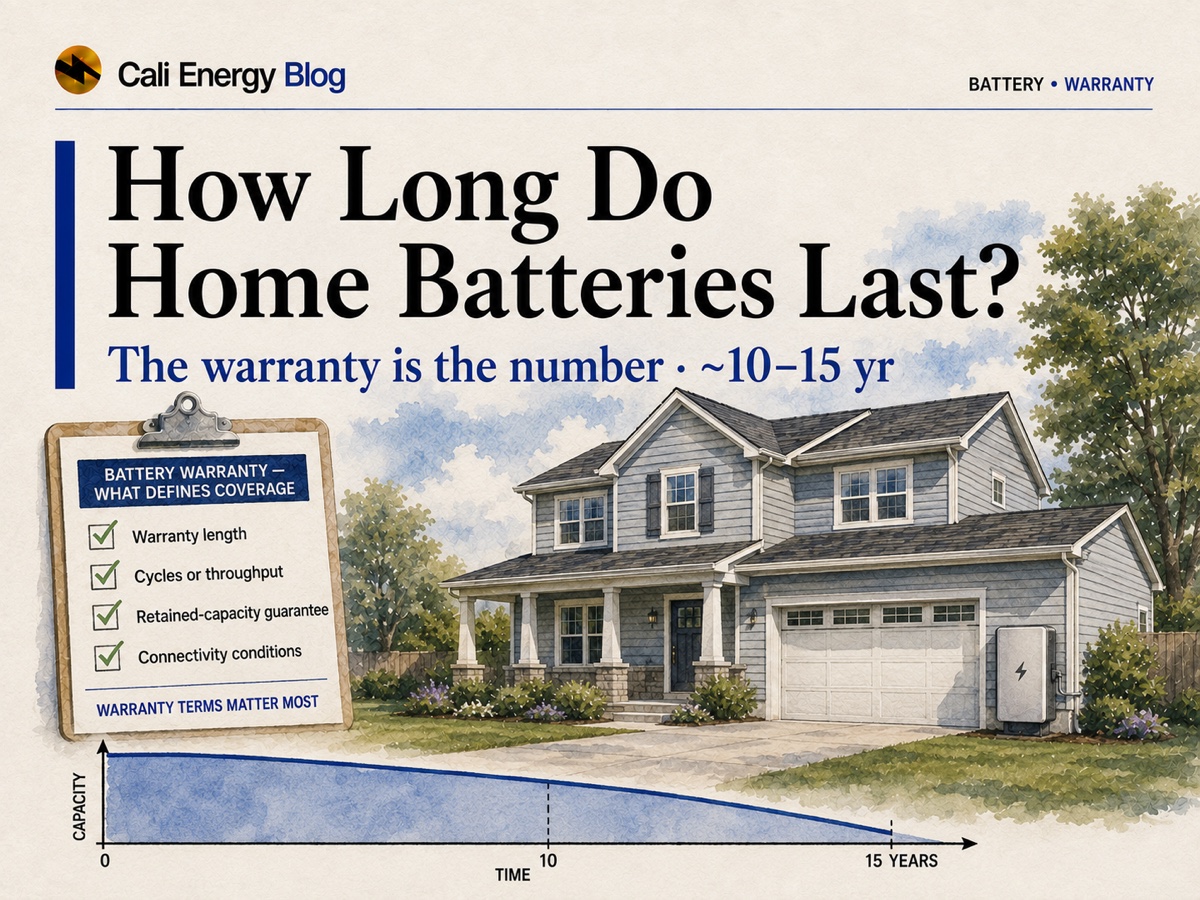
- Warranties are 10–15 years and promise a capacity floor, not full capacity: a 13.5 kWh Powerwall 3 is guaranteed 9.45 kWh at year 10.
- Usage caps can end cover early: at one full cycle a day FranklinWH’s 60 MWh cap arrives in about 11 years; Tesla’s 37.8 MWh cap applies only to uses outside self-consumption, load shifting and backup, such as a virtual power plant.
- Keep it online: without a reliable internet connection Tesla may cut the 10-year warranty to 4.
- Your utility sets the pace: SCE batteries cycle daily under the Solar Billing Plan; LADWP batteries mostly sit charged for backup and age by the calendar.
The batteries Californians actually install
Lifespan claims are easier to check for real products. In the state’s SGIP incentive records for the general residential storage budget, program years 2024–2025, three brands account for 82% of installations:
| Manufacturer | Projects | Share |
|---|---|---|
| Tesla | 2,704 | 56.5% |
| Enphase | 795 | 16.6% |
| FranklinWH | 427 | 8.9% |
| SunPower | 375 | 7.8% |
| SolarEdge | 203 | 4.2% |
| LG Energy Solution | 79 | 1.6% |
Source: SGIP Weekly Statewide Report, September 27, 2026 (selfgenca.com), Small Residential Storage budget, 4,788 non-cancelled projects; Cali Energy count. Other brands make up the rest.
What the warranties actually promise
Each warranty combines three limits: a term in years, a cap on use, and a floor under the capacity the battery must still hold. Whichever arrives first ends the cover.
| Battery | Term | Cap on use | Capacity guaranteed | Cap reached at one full cycle a day |
|---|---|---|---|---|
| Tesla Powerwall 3 (13.5 kWh) | 10 years | None for self-consumption, load shifting, backup; 37.8 MWh for any other use | 70% at year 10 | Never; 7.7 yr if the cap applies |
| Enphase IQ Battery 5P / 10C | 15 years | 6,000 discharged cycles | 70% at year 10, 60% at the end | 16.4 yr — the term ends first |
| FranklinWH aPower 2 (15 kWh) | 15 years | 60 MWh | 70% at the end | 11.0 yr |
| FranklinWH aPower X (13.6 kWh, earlier model) | 12 years | 43 MWh | 70% at the end | 8.7 yr |
Sources: Tesla Powerwall Limited Warranty (USA), Rev. 2.6 · Enphase IQ Battery 5P warranty · Enphase 10C warranty · FranklinWH limited warranty. Last column: Cali Energy arithmetic from each maker’s published limits (e.g. 60 MWh ÷ 15 kWh ÷ 365 = 11.0 years).
Two conditions are easy to miss. Tesla needs the battery reliably connected to the internet for firmware updates; if it isn’t and Tesla can’t reach you, the warranty may be limited to 4 years. And Tesla’s unlimited-cycle promise covers solar self-consumption, time-of-use shifting and backup only; add any other use — enrolling in a virtual power plant is the usual one — and the 37.8 MWh cap applies. For a side-by-side of power, capacity and warranty, see Powerwall 3 vs Enphase vs FranklinWH.
What 70% means in an outage
Batteries lose capacity gradually; the warranty only promises how far it can fall. Take essential loads — fridge, lights, Wi-Fi, a furnace fan — at about 7.2 kWh a day. A new 13.5 kWh battery covers them for about 1.9 days without sun; at the 70% floor, 9.45 kWh, about 1.3 days. A real battery at year 10 may hold more than the floor, but plan backup on the guaranteed number. See solar and batteries in outages and the battery sizing calculator.
How you use it: SCE vs LADWP
SCE: daily cycling
Under the Solar Billing Plan a battery usually charges from midday solar and discharges every evening — about one cycle a day, or 4.9 MWh a year for 13.5 kWh. That is where megawatt-hour caps start to matter. See SCE solar billing.
LADWP: mostly standby
LADWP nets exports at retail prices, so a battery there is mostly for backup and may cycle far less. Use caps then matter less; the calendar term does. See LADWP solar and battery incentives.
Virtual power plants
Paid grid events add discharges and, on some warranties, change which cap applies. Check before enrolling; see what a VPP pays.
Deep or shallow
Megawatt-hour caps count energy, so two half cycles equal one full one; Enphase caps discharged cycles without saying how a partial one counts, so frequent shallow discharges may use it up faster.
Heat and placement
Heat is the other thing that shortens battery life. Tesla rates the Powerwall 3 to operate from −4°F to 122°F and says performance may be reduced above 104°F (datasheet); FranklinWH lists the same −4°F to 122°F range for the aPower 2 (datasheet). Even NREL’s typical-weather year for Northridge reaches 100°F in the shade, and a battery on a west wall in afternoon sun or in a closed garage sits hotter than the air. A shaded north or east wall, or a ventilated garage, is the better spot.
Planning for replacement
Solar panels usually carry 25-year or longer warranties, so a battery bought with them will most likely be replaced once in the life of the array. When it nears the end of its term, compare its remaining capacity with what you need for outages; a battery at 70% may still be enough. See how long solar panels last and adding a battery to existing solar.
Read the current edition
Warranties are revised; the one in force on your install date is the one that applies. Keep a copy.
Register it
Some makers tie the full term to registration or an internet connection.
Match the cap to your use
If you will cycle daily, compare megawatt-hour and cycle caps in years, as in the table above.
Ask who services it
A warranty is only as useful as the company that honors it and the installer who files the claim.
Where to go next
Cali Energy installs home batteries in Los Angeles and can walk you through the warranty for the exact model on your quote. Call +1-323-844-7777 or ask about a battery — lifespan figures are estimates, and only the written warranty is a promise.
Frequently asked
How long do home solar batteries last?
Warranties on the batteries most Californians install run 10 years (Tesla) to 15 years (Enphase, FranklinWH aPower 2), with 60–70% of the original capacity guaranteed. Batteries keep working after that with less capacity, so the real service life can be longer.
Is the warranty the same as the battery’s lifespan?
No. The warranty is the period and conditions the maker stands behind; the battery may run longer. But the warranty is the only number you can hold anyone to, so plan on it.
How much capacity does a home battery lose?
Makers promise a floor: Tesla 70% of 13.5 kWh at year 10, Enphase 70% at year 10 and 60% at year 15, FranklinWH 70% at the end of its term. A real battery usually stays above its floor.
Can using my battery a lot void the warranty?
It can end it sooner. FranklinWH caps throughput at 60 MWh (about 11 years of daily full cycles) and Enphase at 6,000 cycles. Tesla has no cap for self-consumption, load shifting and backup, but 37.8 MWh applies if you add another use such as a virtual power plant.
Do I have to keep my battery connected to the internet?
For a Powerwall, yes: Tesla needs it reliably online for firmware updates to give the full 10 years, and may limit the warranty to 4 years otherwise. Check the terms for any other brand.
Does heat shorten battery life in Los Angeles?
Heat is hard on lithium batteries. Tesla and FranklinWH rate their batteries to 122°F, and Tesla may reduce performance above 104°F. Install in shade or a ventilated space, away from afternoon sun.
Will I need to replace my battery before my solar panels?
Most likely. Panels usually carry 25-year or longer warranties, battery warranties 10–15 years, so plan for one battery replacement over the life of the array.
Related reading
Sources & methodology
Figures on this page come from the primary sources below and, where noted, from Cali Energy calculations using the stated assumptions. Rates, incentives, and program terms change; each was verified October 5, 2026.
- Tesla — Powerwall Limited Warranty (USA), Rev. 2.6, effective May 6, 2026
- Tesla — Powerwall 3 Owner’s Manual: Warranty (internet connection, 4-year minimum)
- Tesla — Powerwall 3 datasheet (operating −4°F to 122°F, derating above 104°F)
- Enphase — limited warranty, US/Canada, effective May 2, 2026 (IQ Battery 5P)
- Enphase — limited warranty, storage systems, effective March 15, 2025 (IQ Battery 10C)
- FranklinWH — aPower 2 datasheet (LFP, 15 years or 60 MWh, −4°F to 122°F)
- FranklinWH — system limited warranty for end users (aPower X, aPower 2)
- SGIP — Weekly Statewide Report, September 27, 2026 (Small Residential Storage records)
Compare battery warranties before you buy
Get help reading the actual warranty for the batteries you are considering: term, cycle and throughput caps, retained capacity and connection conditions.
Get a free estimatePrepared by Cali Energy, October 5, 2026. This article is for general educational purposes only and is not legal, tax, financial, engineering, or utility advice. Rates, incentives, codes, permit requirements, equipment specifications, prices, and program terms may change; figures and timelines are estimates, not guarantees. Confirm current requirements with the applicable utility, AHJ, program administrator, manufacturer, or a licensed professional. See our Content Disclaimer. Cali Energy · 19201 Parthenia St, Unit E, Northridge, CA 91324 · CSLB #1032379 (B, C-10, C-39)