

Do Solar Panels Damage Your Roof?
Straight answer: not when the job is done right. A typical flush-mounted array weighs no more than 4 pounds per square foot under California’s structural screening criteria — less than the 10 a shingle roof assembly is assumed to weigh — and the roof is checked before and after. The real risk is the holes: every mount is a penetration that has to be flashed and sealed, and when things go wrong it is usually workmanship — the leading cause in the state contractor board’s solar complaints.
Get a free estimate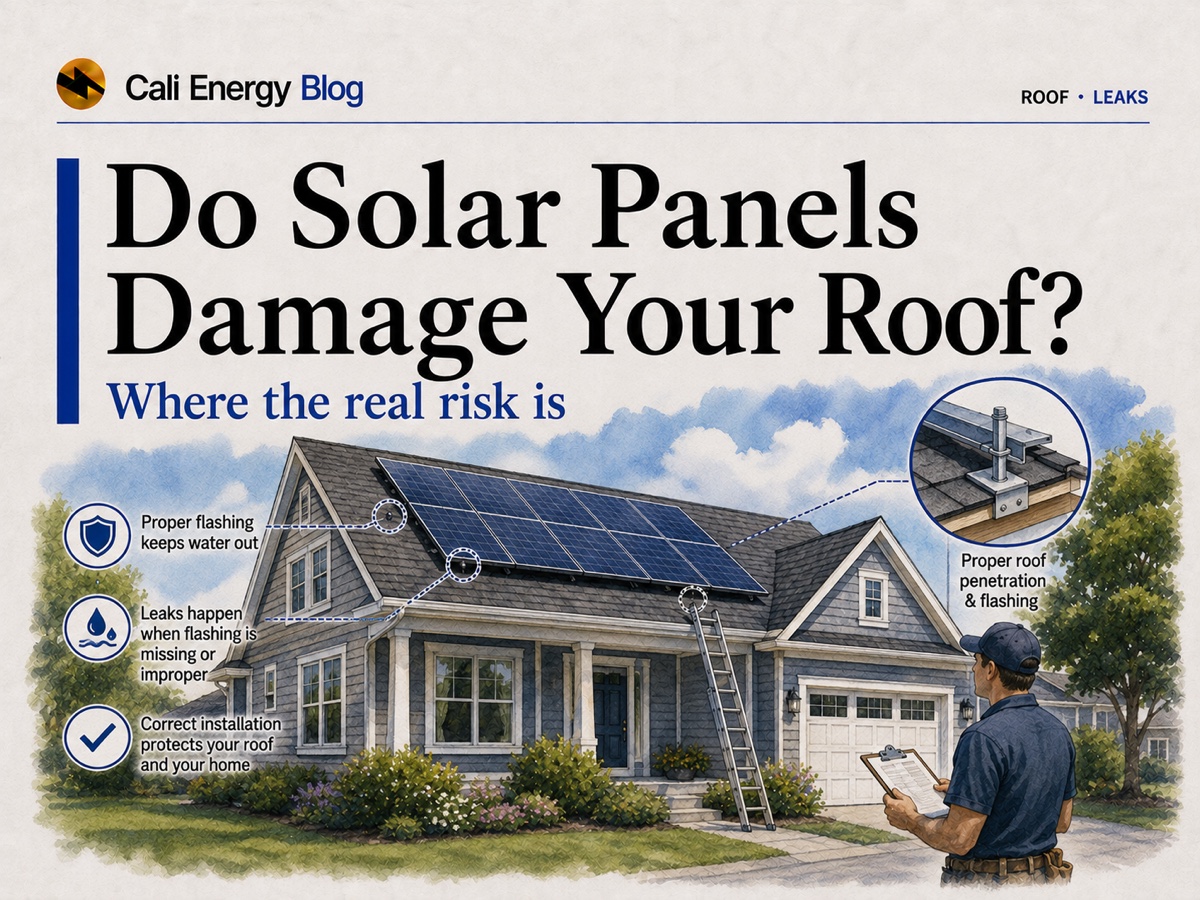
- Weight is rarely the issue: the state’s screening checklist allows up to 4 psf for a flush-mounted array covering no more than half the roof; beyond that, an engineer signs off.
- Penetrations are: each mount is lagged into a rafter and must be flashed and sealed to the approved plan — an inspector checks it.
- Workmanship drives complaints: 1,232 of 1,625 investigated CSLB solar complaints in 2022–23 were about workmanship or abandonment.
- Old roofs and overlays: the fast-track criteria assume a single roof layer in sound condition; an aging roof is better replaced first.
- A leak near an array isn’t automatically the array: check every penetration and flashing above the stain.
What California checks before panels go on
The state’s screening checklist for a typical rooftop array.
| Check | What passes without extra engineering |
|---|---|
| Roof | A single roof without a re-roof overlay, structurally sound, no sagging or deterioration |
| Array position | Panels parallel to the roof, 2–10 inches above it, not overhanging edges |
| Weight | Modules plus supports no more than 4 psf (5 for solar thermal) |
| Coverage | No more than half of the total roof area, all planes counted |
| Anchors | Spacing within the guide’s table; 5/16-inch lag screws with 2.5 inches of embedment into the rafter, or the manufacturer’s specification |
| Any “no” | Drawings and calculations stamped by a California-licensed civil or structural engineer |
Source: California Solar Permitting Guidebook, 4th edition, Part 3. The guide assumes a shingle or shake roof assembly weighs 10 psf and a tile roof 20 psf; local building departments apply their own versions. Details: can my roof support solar panels.
At the final inspection the same guide lists what the inspector verifies: the mounting system and structural connections as approved, roof penetrations flashed and sealed according to the approved plan, the required fire classification for roof-mounted systems, and work done “in a neat and workmanlike manner” (Field Inspection Guide).
Why roofs leak after solar
Almost always at a penetration, and almost always workmanship.
Every rail mount is screwed through the roofing into a rafter, so a system has a penetration at each mount. Each needs flashing that sheds water around the fastener and a seal that lasts as long as the system. Leaks start when a mount misses the rafter, flashing is skipped or installed backwards, sealant is used in place of flashing, or shingles or tiles are cracked while crews walk the roof. How a penetration is done right is in solar mount flashing.
California’s contractor board sees the pattern. Between July 1, 2022 and June 30, 2023 it received 2,263 solar complaints; of the 1,625 investigated by August 30, 2023, 1,232 were about workmanship or abandonment, 323 about misrepresentation or fraud and 33 about unlicensed contractors (CSLB Solar Smart). The panels are rarely the problem; the installation is.
More care, same principle
Clay and concrete tile are heavier — the state guide assumes 20 psf against 10 for shingles — and brittle underfoot. Mounts are usually set by removing tiles, flashing the hook to the underlayment and replacing or modifying tiles around it. See solar on a clay tile roof.
Roof age: the decision before solar
The Department of Energy advises considering your roof’s age and how long until it will need replacement before you go solar (DOE). The state’s fast-track criteria also assume a single roof layer without an overlay. If the roof will need replacing within the life of the system, it is usually cheaper to do it first than to remove and reinstall the panels later; see replace your roof before solar? and removing and reinstalling panels for a re-roof.
How to protect your roof
Check the license
Solar work needs a C-46 Solar or C-10 Electrical license; roofing work, a C-39. Verify at CSLB.
Ask how mounts are flashed
Ask for the attachment detail on the plan and what flashing is used on your roof type, not just “we seal it.”
Get warranties in writing
Who covers a leak at a mount, and for how long? See roof warranty vs solar warranty.
Keep the inspection record
The signed final inspection shows the penetrations were checked; keep it with the permit.
Water coming in now?
If a storm is pushing water through the ceiling, deal with the leak first and the cause later; see what to do about a roof leak in a storm.
Where to go next
Cali Energy is a licensed Los Angeles solar, roofing and electrical contractor (CSLB #1032379, B, C-10, C-39), so one crew is responsible for the roof and the array. Call +1-323-844-7777 or ask for a roof and solar check.
Frequently asked
Do solar panels damage your roof?
Not when installed correctly on a sound roof. A typical flush-mounted array weighs no more than 4 psf under California’s structural screening criteria, and each mount is lagged into a rafter and flashed. Problems come from workmanship at the penetrations, not from the panels.
Why would solar panels cause a roof leak?
Because each mount is a penetration through the roof. If flashing is missing or wrong, a screw misses the rafter, or roofing is cracked during installation, water can get in. A leak near an array isn’t automatically the array, though: every penetration and flashing under and uphill of the stain should be checked, older ones included.
Can my roof handle the weight of solar panels?
Usually. California’s screening criteria allow up to 4 psf for a flush-mounted PV array covering no more than half the roof, on a single-layer roof in sound condition; anything outside those limits needs an engineer’s stamped calculations.
How common are roof problems with solar?
There is no statewide leak rate, but complaints point to the cause: of 1,625 solar complaints CSLB investigated in 2022–23, 1,232 were about workmanship or abandonment.
Should I replace my roof before installing solar?
If it will need replacing within the life of the system, usually yes — otherwise the panels have to be removed and reinstalled later. The Department of Energy advises weighing roof age before going solar.
Does installing solar void my roof warranty?
It can, depending on the roofing manufacturer’s and roofer’s terms. Confirm the allowed attachment method and who is responsible for leaks at penetrations in writing before installation.
Related reading
Sources & methodology
Figures on this page come from the primary sources below and, where noted, from Cali Energy calculations using the stated assumptions. Rates, incentives, and program terms change; each was verified October 5, 2026.
- California Solar Permitting Guidebook, 4th Edition (2019) — Part 3: structural criteria for residential flush-mounted arrays; field inspection guide
- CSLB — Solar Smart: Solar Complaints Report FY 2022/2023
- U.S. Department of Energy — Homeowner’s Guide to Going Solar (roof age)
- CSLB — C-39 Roofing classification
- CSLB — Check a License
A watertight roof is part of the job
Tell us about your roof — age, material, any past leaks — and we’ll check it before designing solar, with roofing and solar under one license. Estimates, not guarantees.
Get a free estimatePrepared by Cali Energy, October 5, 2026. This article is for general educational purposes only and is not legal, tax, financial, engineering, or utility advice. Rates, incentives, codes, permit requirements, equipment specifications, prices, and program terms may change; figures and timelines are estimates, not guarantees. Confirm current requirements with the applicable utility, AHJ, program administrator, manufacturer, or a licensed professional. See our Content Disclaimer. Cali Energy · 19201 Parthenia St, Unit E, Northridge, CA 91324 · CSLB #1032379 (B, C-10, C-39)