

Virtual Power Plants in California: Can Your Home Battery Earn Money?
Yes, but in 2026 the money is smaller and harder to reach than the ads suggest. The state’s DSGS program pays battery aggregators about $81–$108 per kW of proven discharge for the May–October season, and Tesla passes $64.55 per kW on to Powerwall owners — about $284 in its own one-Powerwall example. But the state’s 2026 budget for these payments is capped at $19.5 million, Tesla stopped new DSGS sign-ups in March 2026, and the utilities’ emergency program (ELRP, $2 per kWh) is open only to PG&E, SCE and SDG&E customers — not LADWP.
Get a free estimate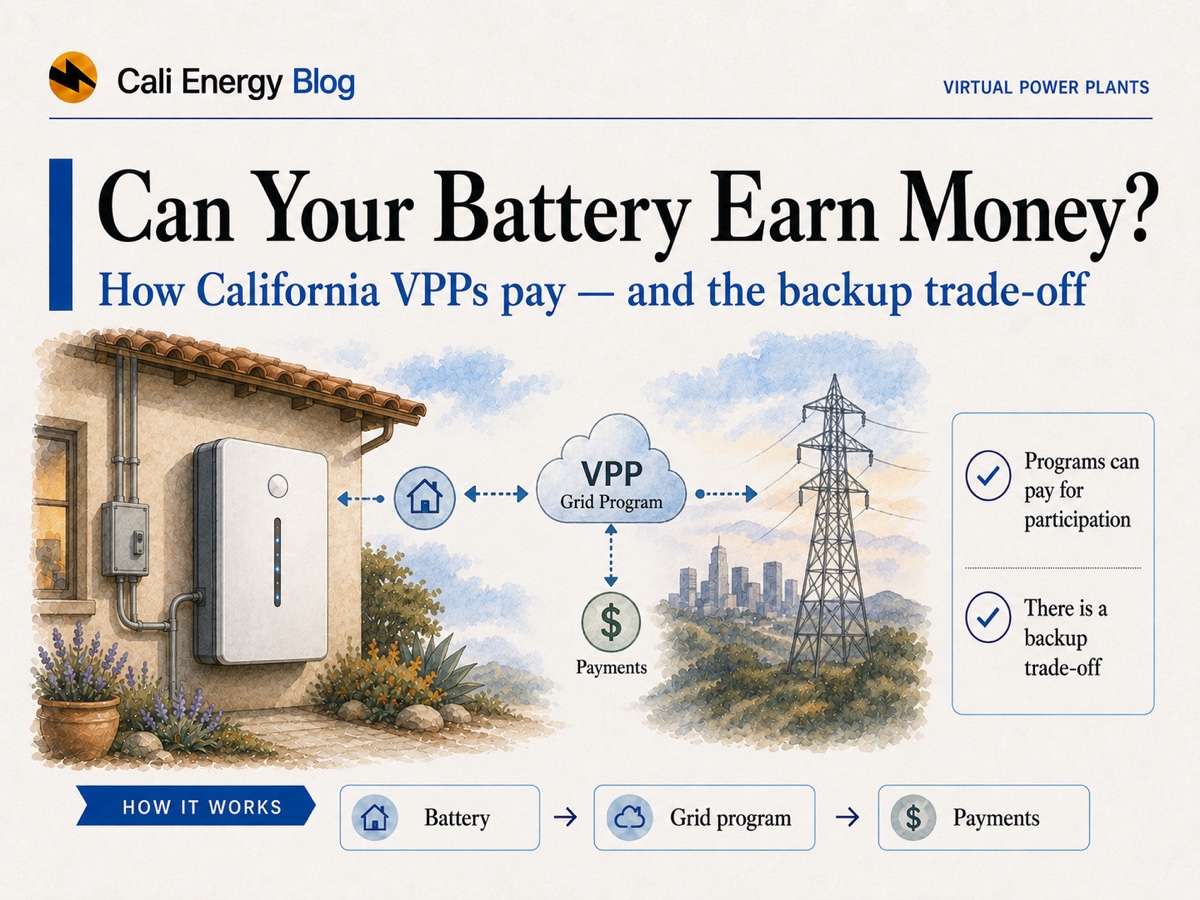
DSGS rules for 2026 are the Fifth Edition guidelines approved on April 27, 2026. Tesla stopped taking new DSGS enrollments in March 2026. ELRP runs through 2027, but its residential Power Saver Rewards track ended after 2025. These programs change every season; confirm terms before you enroll.
- A virtual power plant (VPP) pays you for letting a program discharge your home battery on hot summer evenings. In California most VPP apps run on one of two public programs: the state’s DSGS or the utilities’ ELRP.
- DSGS pays aggregators by the kW a battery proves it can deliver; ELRP pays $2 per kWh delivered during grid emergencies. Your share comes through the company that enrolls you: Tesla pays $64.55/kW for the 2026 season, and Sunrun pays $50–$150 per battery.
- 2026 is a budget-capped year: $19.5 million for all DSGS battery payments, which works out to roughly $156 per battery enrolled in 2025, before the aggregator’s share.
- LADWP customers cannot use ELRP; their route is DSGS through an aggregator that LADWP has approved, and Tesla’s DSGS door closed to new sign-ups in March 2026.
- SGIP has no VPP bonus. The 30% bonus you may have read about belongs to DSGS’s 2025–26 capacity prices.
The two public programs behind most California VPP apps
Tesla, Sunrun and other companies are aggregators: they enroll batteries, dispatch them, and get paid by a public program — in most cases one of these two. What the program pays, and who may join, sets the ceiling on what reaches you.
| Program | Who can join | How it pays | When events run | 2026 status |
|---|---|---|---|---|
| DSGS storage VPP (CEC, Option 3) | Customers of PG&E, SCE, SDG&E, community choice aggregators and municipal utilities, including LADWP, through an approved aggregator | Capacity payment per kW of demonstrated discharge: $62.10–$82.80/kW for the season (2- to 4-hour), plus a 30% bonus in 2025–26, or $80.73–$107.64/kW; $1/kWh extra for discharge in a same-day emergency. Paid to the aggregator, which shares it. | May–October, 4–9 p.m., when the day-ahead wholesale price reaches $200/MWh or an emergency watch is called; at least one full event or test a month | $19.5M budget; only aggregators that took part in October 2025 (plus bidirectional-EV aggregators) |
| ELRP (CPUC, through the utility) | Customers of PG&E, SCE and SDG&E, including through VPP aggregators; not LADWP | Per kWh delivered during events: $2/kWh through Tesla’s VPP | May–October, 4–9 p.m., only on grid emergency alerts; 1–5 hour events, up to 60 hours a year | Pilot runs through 2027; residential Power Saver Rewards ended after 2025 |
Sources: CEC DSGS Guidelines, Fifth Edition (April 2026), Table 2 · CPUC ELRP · Tesla VPP terms. A resource paid by ELRP cannot be paid by DSGS for the same performance.
What homeowners actually get paid in 2026
| Program | Who | Your pay | Backup | Paid | Enrollment |
|---|---|---|---|---|---|
| Tesla VPP with DSGS | Powerwall owners in PG&E, SCE, SDG&E and LADWP territory | $7.00–$14.97/kW a month, $64.55/kW for May–October; “up to $280” per Powerwall | You set an Event Backup Reserve and can skip an event | After the season, cashed out in the Tesla app | Closed to new enrollments since March 2026 |
| Tesla VPP with ELRP | Powerwall owners in PG&E, SCE and SDG&E territory | $2 per kWh delivered in events; Tesla estimates $100–$450 per Powerwall a year, depending on how many emergencies occur | Same reserve and opt-out controls | Through Tesla | Where Tesla now sends new California sign-ups |
| Sunrun CalReady | Sunrun solar-and-storage customers only | $50–$150 per battery a year, plus normal export credit on your bill | At least 20% kept in reserve; no export during an outage | Announced after the October 31 season end; available spring 2027 | Sunrun enrolls eligible customers by email; leaving mid-season forfeits the reward |
Sources: Tesla VPP with DSGS · Sunrun CalReady. Rates are the companies’ own 2026 terms.
The two sets of numbers line up. Tesla’s events last no more than two hours, and the state’s 2-hour price with the bonus comes to $80.73/kW for the season; Tesla’s $64.55 is about 80% of it, month by month. In Tesla’s own example, one Powerwall with a 20% event reserve delivers 10.8 kWh over a two-hour event, or 5.4 kW; minus the 1 kW it would have discharged anyway, that is 4.4 kW, and 4.4 × $64.55 = $284 for the season. A lower reserve, or a battery that starts the event less than full, changes the result.
Why 2026 payouts may come in lower than the rate card
The capacity rates above are the most the state will pay per kW. The money behind them is fixed. For 2026 the CEC set aside $19.5 million for all DSGS battery-VPP payments, up to $42.7 million if the 2026–27 budget adds funds, and it will divide that pot among aggregators after the season in proportion to their October 2025 performance (DSGS Guidelines, Appendix A). In 2025 the storage option had 124,771 enrolled participants and an estimated 768 MW (CEC status report, December 2025). Spread across that many batteries, $19.5 million is about $156 each — before the aggregator keeps its share; with the full $42.7 million, about $342. For comparison, 2024 payments for this option totaled $8.34 million across 37,650 participants, about $222 each.
Two more things to know. Tesla’s terms say its payment depends on Tesla being paid by the program and may be delayed until it is. And 2025 had no price- or emergency-triggered DSGS events at all; batteries proved their capacity in required monthly test events. A calm summer does not mean zero pay under DSGS, but it does mean ELRP, which pays only for emergency events, may pay very little. Before 2020, the CPUC counts eight grid emergency declarations in ten years that would have triggered ELRP (CPUC).
What is open in Los Angeles, by utility
LADWP
ELRP is not available. DSGS is: LADWP accepts battery aggregators that apply for its permission, report enrollments monthly and respond only to LADWP-originated events (LADWP DSGS). Tesla lists LADWP as eligible, but closed new DSGS sign-ups in March 2026, and 2026 DSGS storage slots are limited to aggregators already in the program. LADWP’s own Power Savers program pays up to $145 for smart thermostats, not batteries (LADWP Power Savers).
SCE
Both paths exist. New Powerwall owners go to ELRP through Tesla, at $2 per kWh during emergencies. DSGS runs through aggregators that already took part in 2025, and Sunrun enrolls its own solar-and-storage customers in CalReady. SCE-area customers of a community choice aggregator such as Clean Power Alliance can join DSGS the same way; Tesla lists them as eligible.
How many are in
About 13,200 sites in Los Angeles County were enrolled in the DSGS storage option for at least one month of 2025, with roughly 114 MW of battery nameplate power (CEC county table). The table does not split LADWP from SCE.
The program can drain the battery you bought for backup
During an event your battery sends stored energy to the grid, so you have less left if an outage or PSPS shutoff follows. Tesla lets you set an Event Backup Reserve, skip a single event or suspend participation; a lower reserve earns more. Sunrun keeps at least 20% in reserve and stops exporting during an outage, but a customer who opts out after the season starts gets no reward. If backup is the reason you own the battery, set the reserve first and treat the payment as a bonus.
SGIP and NEM: what VPPs do and don’t change
SGIP has no VPP bonus. Its 2025 handbook lists a resiliency adder and a California-manufacturer adder, and says SGIP-funded storage may take part in demand response programs (SGIP Handbook 2025). The 30% bonus often quoted is DSGS’s bonus on its 2025–26 capacity prices. Individual aggregators can still set their own limits: Tesla’s DSGS terms ask you to confirm you have not received SGIP for a system with permission to operate after July 1, 2023. How SGIP itself works is covered in our SGIP guide.
NEM credits keep working. Energy exported during an event is still exported: Sunrun tells CalReady customers they also receive NEM credit on the utility bill, and Tesla notes that events shift exports later into the evening, where NEM credit values differ by hour. On NEM 3.0, compare that with the export value of your own evening discharge before you lower your reserve.
Should you enroll?
If the battery is already installed and enrollment is open to you, joining usually costs nothing but some stored energy on a few summer evenings, and pays tens to a few hundred dollars a season. Ask three things first: which program the aggregator will enroll you in this season and how it pays; what backup reserve it keeps and whether you can skip an event; and how and when you can leave without losing the season’s pay. Do not buy a battery for VPP income; size it for backup and bill savings with our battery sizing calculator, and compare ecosystems in Powerwall vs Enphase vs FranklinWH.
Get the season’s terms in writing
Cali Energy (CSLB #1032379) installs and configures batteries across Los Angeles and the San Fernando Valley. We can check which programs are open at your address this season and set the backup reserve for how you actually use the battery. Request a free estimate.
Frequently asked
How much can a home battery earn in a California VPP in 2026?
Tens to a few hundred dollars a season, depending on the program and the battery. Tesla pays Powerwall owners $64.55 per kW of demonstrated discharge for the May–October DSGS season, about $284 in its one-Powerwall example; Sunrun pays $50–$150 per battery. The state’s 2026 budget for DSGS battery payments is capped at $19.5 million, about $156 per battery enrolled in 2025 before the aggregator’s share, so actual payouts may come in below the rate card.
What are DSGS and ELRP?
They are the two public programs behind most California battery VPPs. DSGS, run by the California Energy Commission, pays aggregators per kW of discharge a battery proves it can deliver, at $80.73–$107.64/kW for the 2026 season including a 30% bonus. ELRP, a CPUC pilot run by PG&E, SCE and SDG&E through 2027, pays per kWh delivered during grid emergencies — $2/kWh through Tesla’s VPP. A battery cannot be paid by both for the same performance.
Can LADWP customers join a virtual power plant?
Only through DSGS, and only via an aggregator LADWP has approved; ELRP is limited to PG&E, SCE and SDG&E customers. Tesla lists LADWP as eligible for its DSGS VPP but stopped taking new DSGS enrollments in March 2026, and 2026 DSGS storage participation is limited to aggregators that took part in October 2025. LADWP’s own Power Savers program covers smart thermostats, not batteries.
What is Sunrun CalReady and when does it pay?
CalReady is Sunrun’s program for its own solar-and-storage customers in California, run under DSGS and ELRP terms. It pays $50–$150 per battery a year plus normal NEM export credit, keeps at least 20% of the battery in reserve, and runs May 1 to October 31 with events of 1–3 hours between 4 and 9 p.m. For the 2026 season, Sunrun says the reward will be available in spring 2027; opting out after the season starts forfeits it.
Is Tesla's virtual power plant still open in California?
Partly. Tesla stopped accepting new enrollments in its DSGS VPP in March 2026 and now sends eligible Powerwall owners to ELRP, which pays $2 per kWh delivered during grid emergencies and is open only to PG&E, SCE and SDG&E customers. Owners already enrolled in the DSGS VPP are paid $7.00–$14.97 per kW a month for 2026.
Will a VPP drain the battery I keep for backup?
Partly, by design: during an event the battery exports stored energy. Tesla lets you set an Event Backup Reserve and skip events; Sunrun keeps at least 20% in reserve and does not export during an outage. If backup is your main reason for owning the battery, set the reserve before enrolling and accept a smaller payment.
Does SGIP pay a bonus for joining a VPP?
No. SGIP’s 2025 handbook has no VPP bonus; it says SGIP-funded storage may take part in demand response programs. The 30% bonus often mentioned is DSGS’s bonus on its 2025–26 capacity prices. Some aggregators add their own limits — Tesla’s DSGS terms exclude systems that received SGIP with permission to operate after July 1, 2023.
Related reading
Sources & methodology
Figures on this page come from the primary sources below and, where noted, from Cali Energy calculations using the stated assumptions. Rates, incentives, and program terms change; each was verified September 28, 2026.
- California Energy Commission — Demand Side Grid Support (DSGS) Program
- CEC — DSGS Program Guidelines, Fifth Edition (approved April 27, 2026)
- CEC — DSGS and DEBA Status Report (December 2025)
- CEC — DSGS 2025 Option 3 and 4 enrolled capacity by county (spreadsheet)
- CEC — Update on DSGS Program budget (October 1, 2025)
- CPUC — Emergency Load Reduction Program (ELRP)
- Tesla — Virtual Power Plant with DSGS (2026 terms, ELRP)
- Sunrun — CalReady (2026 season terms)
- LADWP — Demand Side Grid Support program requirements for aggregators
- LADWP — Demand Response: Power Savers
- CPUC — Self-Generation Incentive Program Handbook (2025)
Not sure if a VPP is worth it for your battery?
We'll check which California VPP programs are open to your battery this season, how they pay, and what backup reserve makes sense for how you use it. Call +1-323-844-7777.
Get a free estimatePrepared by Cali Energy, September 28, 2026. This article is for general educational purposes only and is not legal, tax, financial, engineering, or utility advice. Rates, incentives, codes, permit requirements, equipment specifications, prices, and program terms may change; figures and timelines are estimates, not guarantees. Confirm current requirements with the applicable utility, AHJ, program administrator, manufacturer, or a licensed professional. See our Content Disclaimer. Cali Energy · 19201 Parthenia St, Unit E, Northridge, CA 91324 · CSLB #1032379 (B, C-10, C-39)