

Adding a Battery to Existing Solar in California
Yes, you can, usually without touching the panels — and it need not cost you a NEM 1.0 or 2.0 tariff: SCE’s NEM schedule provides for storage added after the solar was switched on, though SCE’s FAQ applies its 10%-or-1 kW expansion limit to added storage too, so the application has to be filed the right way. What changes the project is the battery’s size (above 10 kW the rules tighten), your inverter, and your goal. On NEM 2.0 or LADWP a battery is mostly backup; on the newer Solar Billing Plan it is also bill savings.
Get a free estimate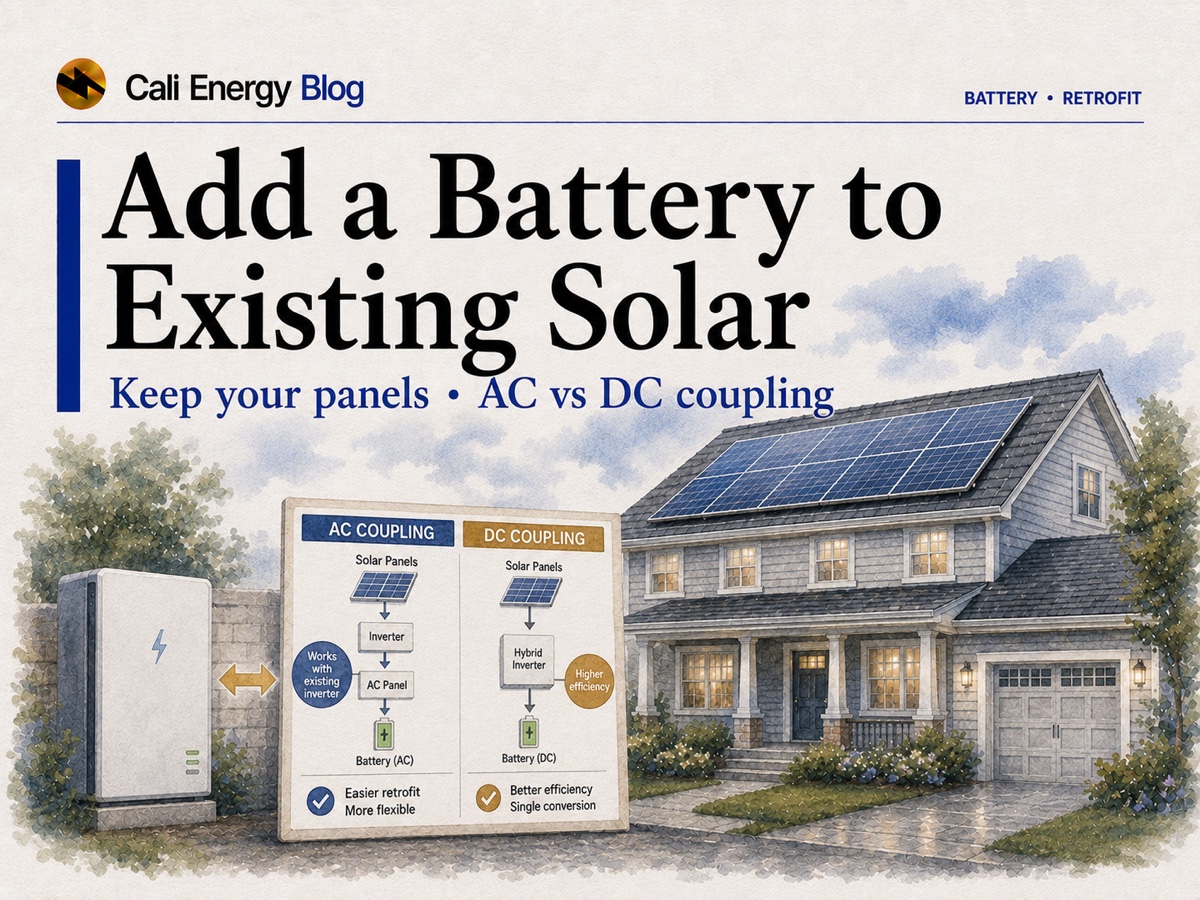
- Your NEM status can stay — check how SCE counts the battery: the CPUC ruled that adding storage does not alter NEM 2.0 status, but SCE’s NEM FAQ says its 10%-or-1 kW expansion limit also applies when storage is added, and the request must be filed as a “NEM 1.0/2.0 Expansion.” A battery with an SGIP reservation on or after June 4, 2024 outside the equity budgets ends legacy status.
- Mind the 10 kW line: at 10 kW AC or less there are no size limits or extra meters; above it, the battery may not exceed 150% of the solar’s output and needs metering or certified controls.
- What it earns depends on the tariff: on the Solar Billing Plan a shifted kWh is worth about 27–47¢; on NEM 2.0 and LADWP, exports already earn near retail, so the case is mostly backup.
- No federal credit, little SGIP: the 30% credit ended with 2025, and SGIP money is income-qualified and waitlisted.
Who this applies to in Los Angeles
Most solar homes in LA were built without storage. In SCE’s territory within Los Angeles County, CPUC interconnection data list 153,269 residential systems still without a battery — 87,116 on NEM 2.0, 55,948 on NEM 1.0 and 9,061 on the Net Billing Tariff. New systems have flipped the other way:
| Year approved | With a battery |
|---|---|
| 2019 | 9.7% |
| 2021 | 15.4% |
| 2023 | 15.2% |
| 2024 | 56.1% |
| 2025 | 79.1% |
| 2026 (Jan–Aug) | 82.1% |
Source: California DG Stats, Interconnected Project Sites, data through August 31, 2026; residential SCE sites in Los Angeles County by approval year; Cali Energy count. Sites that later added a battery show it in the current record. LADWP customers are not in this dataset.
What SCE’s NEM tariff allows
SCE’s Schedule NEM-ST treats a battery added to solar as “NEM-paired storage” and explicitly covers storage added after the solar received permission to operate. The 20-year NEM term runs from the original PTO date either way. The rules depend on the battery’s AC rating:
| Battery AC rating | Size limit | Metering | Export credits |
|---|---|---|---|
| 10 kW or less | None relative to the solar | No extra meter | NEM credits capped at an estimate of what your solar could produce that month |
| Over 10 kW | Battery output no more than 150% of the solar’s | Extra metering (tariff caps the cost at $600 unless complex) or certified controls that block battery export or grid charging | Measured |
| DC-coupled (shared inverter) | Rated as the lesser of the shared inverter’s nameplate and the battery’s continuous output | As above for that rating | As above for that rating |
Source: SCE Schedule NEM-ST, Special Conditions 6 and 8.
The 10 kW line matters with today’s batteries: a Tesla Powerwall 3 can be set to 5.8, 7.6, 10 or 11.5 kW of output (datasheet), and a FranklinWH aPower 2 delivers 10 kW continuous (datasheet). What is capped for certain is growing the solar: more than the greater of 10% or 1 kW and the additions must be non-export or the whole system moves to the Net Billing Tariff. One more catch: a battery that took an SGIP reservation on or after June 4, 2024 outside the equity budgets does not keep the legacy status. And SCE’s NEM FAQ says the same capacity limits “also apply” when storage is added to an existing system, and that an expansion meant to stay on NEM must be filed as a “NEM 1.0/2.0 Expansion” — otherwise the account moves to the Solar Billing Plan, which SCE says it cannot guarantee reversing. Have the installer confirm with SCE how your battery will be counted before you sign. See NEM 2.0 grandfathering and adding panels to an existing system.
What the battery earns on your tariff
| Your solar is on | Bill value of storing midday solar | Main reason to add one |
|---|---|---|
| SCE NEM 1.0 or 2.0 | Small: exports are already credited at close to the retail price for that hour, so the battery earns only the gap between midday and evening prices | Backup |
| SCE Solar Billing Plan | Large: a summer midday export earns about 6¢, the 4–9 p.m. price on TOU-D-PRIME is 61¢; about 27–47¢ per kWh shifted after losses | Savings and backup |
| LADWP net metering | Little: exports net at retail | Backup |
Sources: SCE Solar Billing Plan · LADWP NEM · rates and loss math as worked out in do you need a battery under NEM 3.0?
For a NEM 2.0 home, then, a battery is mainly about keeping power on in an outage — a grid-tied inverter without one shuts down when the grid does. See NEM 2.0 vs NEM 3.0 and solar in a power outage.
AC or DC coupling, and what else changes
AC coupling
The battery has its own inverter and connects on the household side, so the existing solar inverter stays. FranklinWH, for example, sells the aPower 2 as an AC-coupled battery. The usual retrofit.
DC coupling
Panels and battery share one hybrid inverter. Only possible if you already have a battery-ready inverter or replace yours, and only with batteries on its approved list (DOE).
Backup equipment
Running the house in an outage needs a gateway or transfer switch and a decision on which circuits stay on. Check the battery’s motor-start rating against your AC; the Powerwall 3 is rated for loads up to 185 LRA.
Main panel
The battery needs breaker space and bus capacity; older LA panels sometimes need an upgrade. See do you need a panel upgrade?
For brand-by-brand power, capacity and warranty, see Powerwall 3 vs Enphase vs FranklinWH; for sizing, the battery sizing calculator and whole-home vs critical-loads backup.
Incentives in 2026
The federal credit that covered batteries is not available for property placed in service after December 31, 2025. SGIP’s general battery rebate closed at the end of 2025; its income-qualified budget was waitlisted for SCE, LADWP and SoCalGas-assigned customers on October 5, 2026 (SGIP). See California solar incentives in 2026. On LADWP, permits go through the city and interconnection through LADWP; see LADWP solar and battery incentives.
Before you get quotes
Find your tariff and PTO date
Your bill shows NEM 1.0, 2.0 or the Solar Billing Plan; the PTO letter shows when the 20 years started.
Note your inverter
Brand and model decide AC or DC coupling and which batteries are supported.
Leased or PPA solar?
The panels belong to the provider; read the contract and get its consent before anything is connected to the system.
Ask about the 10 kW line
On SCE, ask the installer how the battery’s output is set and whether metering or controls are needed.
Where to go next
Cali Energy adds batteries to existing solar systems in Los Angeles for SCE and LADWP customers. Call +1-323-844-7777 or ask about a battery retrofit — savings and backup figures are estimates, not guarantees.
Frequently asked
Can I add a battery to my existing solar system?
Usually yes, without replacing the panels. Most retrofits are AC-coupled, so the existing inverter stays; the installer also checks main-panel capacity and the backup equipment you need.
Will adding a battery affect my NEM 2.0 status?
It shouldn’t, if filed correctly: the CPUC ruled that adding storage does not alter NEM 2.0 status, and SCE’s tariff provides for storage added after PTO. But SCE’s FAQ says its 10%-or-1 kW expansion limit also applies to added storage and requires the “NEM 1.0/2.0 Expansion” application, so confirm with SCE how your battery will be counted. A battery with an SGIP reservation on or after June 4, 2024 outside the equity budgets moves the system to the Net Billing Tariff.
Is there a size limit for a battery added to NEM solar?
On SCE, not at 10 kW AC or below. Above 10 kW the battery’s output may be no more than 150% of the solar’s, and it needs extra metering or certified controls that stop it exporting or charging from the grid.
Do I need a new inverter to add a battery?
Not for an AC-coupled battery, which brings its own inverter. DC coupling needs a hybrid inverter and a battery on its approved list.
Is it worth adding a battery if I’m on NEM 2.0?
Mostly for backup. On NEM 2.0 your exports already earn close to the retail price for the hour, so a battery adds only the gap between midday and evening prices. On the Solar Billing Plan the gap is much larger, about 27–47¢ per kWh shifted.
Can I get a rebate or tax credit for adding a battery in 2026?
Not federally: the 30% credit ended for property placed in service after 2025. SGIP is limited to income-qualified households and was waitlisted for SCE, LADWP and SoCalGas-assigned customers on October 5, 2026.
Will a battery keep my house running during a blackout?
Yes, with backup equipment installed: a gateway or transfer switch isolates the house and the battery runs the backed-up circuits, recharged by the panels during the day.
Related reading
Sources & methodology
Figures on this page come from the primary sources below and, where noted, from Cali Energy calculations using the stated assumptions. Rates, incentives, and program terms change; each was verified October 5, 2026.
- California DG Stats — Interconnected Project Sites (SCE, data through August 31, 2026; Cali Energy count for Los Angeles County)
- SCE — Schedule NEM-ST, Special Condition 6 (NEM-paired storage) and 8 (20-year term, modifications)
- SCE — How the Solar Billing Plan works
- LADWP — Service Rider NEM, Net Energy Metering
- Tesla — Powerwall 3 datasheet (output settings, 185 LRA)
- FranklinWH — aPower 2 datasheet (AC-coupled, 10 kW continuous)
- IRS — Residential Clean Energy Credit
- SGIP — Program Metrics (status October 5, 2026)
- U.S. Department of Energy — Solar-Plus-Storage 101
- SCE — Net Energy Metering FAQ (expansion limits also apply to added storage; “NEM 1.0/2.0 Expansion” application)
Add storage to the solar you already own
Get a battery retrofit checked against your inverter, your electrical panel, your tariff and your backup goals. Estimates, not guarantees.
Get a free estimatePrepared by Cali Energy, October 5, 2026. This article is for general educational purposes only and is not legal, tax, financial, engineering, or utility advice. Rates, incentives, codes, permit requirements, equipment specifications, prices, and program terms may change; figures and timelines are estimates, not guarantees. Confirm current requirements with the applicable utility, AHJ, program administrator, manufacturer, or a licensed professional. See our Content Disclaimer. Cali Energy · 19201 Parthenia St, Unit E, Northridge, CA 91324 · CSLB #1032379 (B, C-10, C-39)