

Whole-House Fan or Attic Fan in Los Angeles?
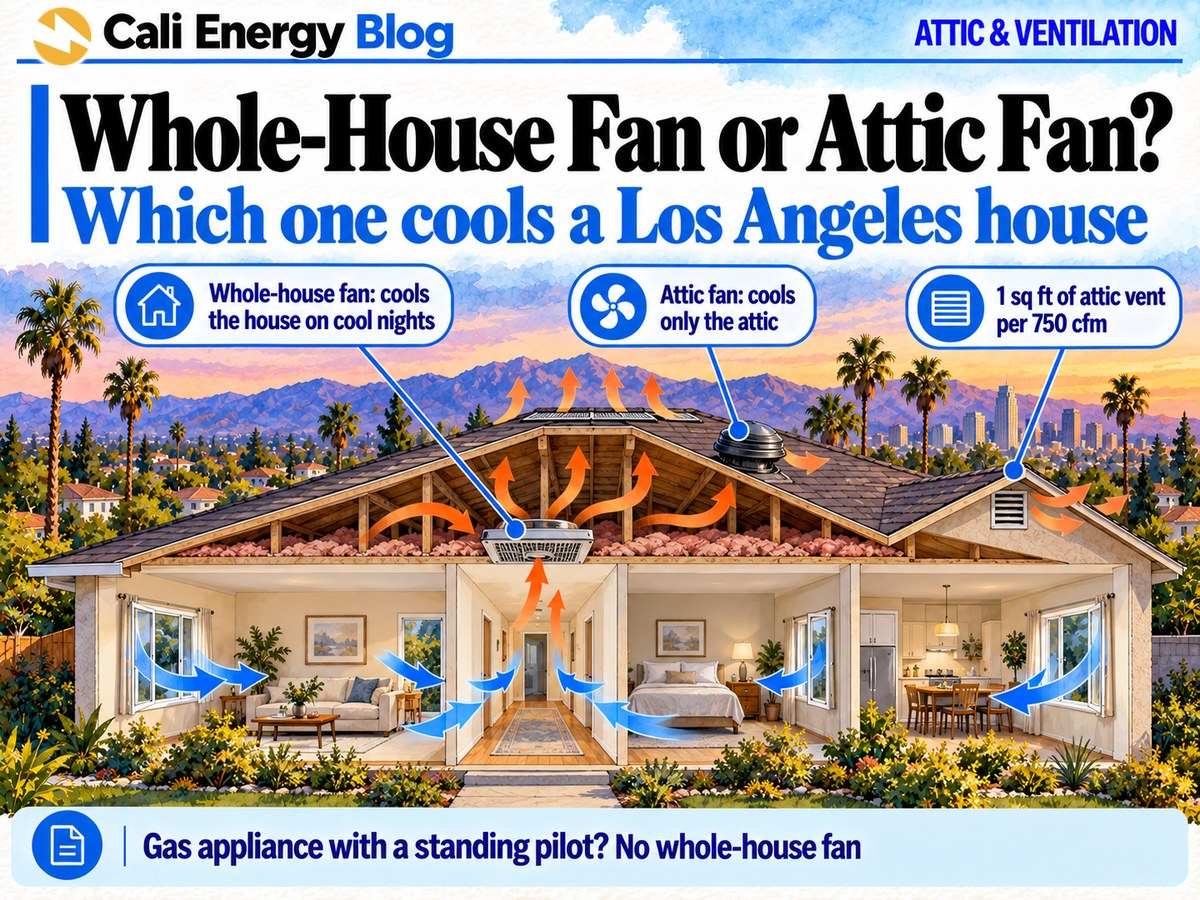
A whole-house fan cools the house; an attic fan cools only the attic. A whole-house fan pulls outdoor air in through open windows and pushes the house's warm air into the attic and out through its vents, so it works best where summer nights are cool, as in much of the San Fernando Valley; near the coast, where the day-night swing is small, it does much less. An attic fan exhausts hot attic air, but studies found it saves little where the attic is insulated, and it can pull cooled air out of the house through gaps in the ceiling; the Department of Energy's Building America program recommends passive vents instead. For the roof, the whole-house fan is the one that matters: its air has to leave through the attic vents, at least 1 square foot of net free vent area for every 750 cfm of fan. This page covers houses in Los Angeles as of October 2026.
How much passive vent area an attic needs is in attic ventilation requirements.
Two different fans
People call both of them "attic fans", which causes most of the confusion.
| Whole-house fan | Attic fan (powered attic ventilator) | |
|---|---|---|
| Where it sits | In the ceiling of the house, usually a hallway, or on the roof and ducted | In the roof or a gable wall of the attic |
| What it moves | House air out, outdoor air in through open windows | Attic air out, replacement air in through attic vents and ceiling gaps |
| What it cools | The living space and the house's mass, overnight | The attic |
| Pressure in the attic | Raises it; the air has to leave through the vents | Lowers it; it can pull air from the house |
| When it runs | Evenings and nights, when it's cooler outside, with the AC off | Daytime, by thermostat |
| What the studies say | Effective where nights are cool and the day-night swing is large | Little or no net saving where the attic is insulated |
A whole-house fan is also different from the small continuous fan the Energy Code calls whole-dwelling mechanical ventilation, which is there for indoor air quality, not cooling.
Where in Los Angeles a whole-house fan fits
The Building America Solution Center says whole-house fans suit places where summer nights fall below about 67°F and the day-night swing is more than about 25°F; a California-written Building America guide uses nights at or below 65°F and a swing of 20°F or more. NOAA's 1991–2020 normals for July give a clear split:
| Station | High | Low | Swing |
|---|---|---|---|
| Woodland Hills (Pierce College) | 95.1°F | 60.8°F | 34°F |
| Palmdale airport | 97.6°F | 67.4°F | 30°F |
| Burbank airport | 86.7°F | 64.5°F | 22°F |
| Downtown Los Angeles (USC) | 82.0°F | 64.7°F | 17°F |
| Los Angeles airport | 75.1°F | 64.0°F | 11°F |
By those thresholds, the west Valley fits well, though the Pierce College station sits on the valley floor and hillside homes can run warmer at night; Burbank and the eastern Valley pass the California guide's test but not the Solution Center's 25°F swing; the Antelope Valley has the swing but warmer nights; downtown and the coast fall short. A whole-house fan doesn't filter or dry the air, so it's no help on smoky or humid nights; it can't cool when the night stays hot, as in a heat wave or a Santa Ana event; and it means windows open at night.
California's Energy Code draws a coarser line: for new single-family homes on the prescriptive path, it lists a whole-house fan in climate zones 8 to 14, which take in downtown and South Los Angeles as well as the Valley and the Antelope Valley, and not coastal zone 6 (Energy Code §150.1(c)12, Table 150.1-A). Your own nights matter more than the zone. It isn't required on the performance path, on additions of 1,000 sq ft or less, on new homes of 500 sq ft or less, or for existing homes, and a re-roof never triggers it.
Sizing a whole-house fan and its attic vents
- Airflow. The Energy Code's prescriptive rule for new homes is at least 1.5 cfm per square foot of conditioned floor area, using the airflow listed by the Home Ventilating Institute, not a number from the box; a 2,000 sq ft house needs about 3,000 cfm. That's a minimum: the Building America Solution Center's range works out to about 1.5 to 3 cfm per square foot with 8-foot ceilings, sized by the house's volume, and most recommendations sit at the higher end.
- Attic vents. At least 1 square foot of attic net free vent area for every 750 cfm of fan, or more if the fan's maker specifies more, unless the fan is ducted straight outdoors (§150.1(c)12B). For 3,000 cfm that's 4 sq ft, or 576 square inches. Size the vents from the fan you actually buy. Too little vent area cuts the airflow and can push hot attic air back into the house.
- Net free area, not vent size. Screens and louvers block part of every vent; the Energy Commission's compliance manual counts an insect-screened vent at half its open area. Use the net free area the vent's maker lists.
- Windows. Building America recommends opening at least 4 square feet of screened window for every 1,000 cfm, counting only the part of the window that opens; on a sliding window that's typically a third to a half of it.
- Winter. The fan is a hole in the ceiling. If it doesn't come with an insulated cover or damper, the Solution Center recommends adding one to cut heat loss when the fan is off.
On a one-story house the attic venting the code already requires often covers the fan; on a two-story house with a small attic it may not. A 2,500 sq ft two-story house with a 1,250 sq ft attic needs 4.2 sq ft of vent area if it's vented at the residential code's 1/300 option, which requires 40 to 50 percent of the vents high, but a 3,750 cfm fan needs 5 sq ft. A re-roof is the time to add vents if the numbers come up short; add low and high vents together so the high share stays at 40 to 50 percent. A house with no attic, under a cathedral or flat ceiling, can't use an attic fan, and a ceiling whole-house fan has nowhere to exhaust; Building America calls such homes very difficult or expensive to fit, and the options are a fan mounted in an exterior wall or one ducted straight outdoors.
Why attic fans rarely pay off
Most of the heat that reaches the attic floor comes off the hot roof deck as radiation rather than through the air, which limits what an attic fan can do, according to the Building America Solution Center. In the studies:
- Little saving. Researchers at the Florida Solar Energy Center measured about a 6% cut in cooling, about 460 kWh a year, from two solar-powered attic fans in a Florida home that already had a radiant barrier; attic air peaked more than 20°F cooler, but at Florida's 2000 electricity prices the saving was worth about $37 a year against about $850 installed, a payback of over 20 years. They noted the saving could be larger without a radiant barrier, with less ceiling insulation or with the air handler in the attic. Older studies of line-powered attic fans that they reviewed found the fan used more electricity than it saved unless the attic was uninsulated.
- Cooled air pulled out. A 1994 field study of houses in North Carolina measured attic fans drawing an average of 231 cfm of air from the living space into the attic.
- What works better. Attic insulation and air sealing, a radiant barrier, or a cooler roof surface; see attic insulation when you replace the roof and radiant barriers in Los Angeles attics.
Gas appliances
Both fans can pull flue gases back into the house. A whole-house fan run with too few windows open can depressurize the house and backdraft a gas water heater or furnace; an attic fan can depressurize the rooms below the attic. Building America's guide says a whole-house fan should never go into a house where a gas appliance with a standing pilot light is in the house or the attic, or where a gas appliance takes its combustion air from the house or the attic, as an atmospherically vented furnace in the attic does. The Solution Center accepts a furnace without a standing pilot light if it's interlocked so it can't run while the fan does; that exception is for furnaces only. Close fireplace doors and dampers before running the fan. If an atmospherically vented water heater or furnace is in the garage, weatherstrip the door to the house and have a combustion-safety test done with the fan running. For whole-house fans installed to meet the Energy Code, the Energy Commission's manual also requires backdrafting to be considered where such appliances are inside the pressure boundary.
Fire zones
In a fire hazard severity zone, any new attic vent added for a fan has to meet California's Wildland-Urban Interface Code: a vent on a sloped roof needs noncombustible, corrosion-resistant mesh between 1/16 and 1/8 inch, and a gable or eave vent has to be listed by the State Fire Marshal or tested to ASTM E2886 (§504.10). Gable-end vents also have to sit at least 10 feet from lot lines (§504.10.3), and fine ember mesh roughly halves a vent's net free area, so plan more vent area. Check the parcel on the State Fire Marshal's fire hazard severity zone map. The Building America Solution Center warns that attic fans can draw embers into the attic, and a whole-house fan pulls in outdoor smoke. Whether a powered fan unit itself can meet those rules is a question for the building department. Ember-resistant vents are covered in ember-resistant roof vents.
Before you buy
Five steps come before the purchase.
- Check the nights. A whole-house fan works best where summer nights are cool and the swing is large; on the coast it does much less.
- Size it from the listing. Use the HVI-listed airflow; 1.5 cfm per sq ft of floor area is the code minimum for new homes, and many retrofit fans are larger.
- Count the vents. Add up the attic's net free vent area and compare it with 1 sq ft per 750 cfm of the fan you buy, or the maker's figure if it's higher; plan new vents with the roof.
- Check gas appliances. If any gas appliance is in the attic or inside the house, or has a standing pilot light, have a combustion-safety check before you buy; it can rule out a whole-house fan.
- Ask about permits and rebates. It's electrical work and a ceiling opening: in the City of Los Angeles, ask LADBS which permit applies; Burbank, Glendale, Pasadena, Santa Clarita, Palmdale, Lancaster and unincorporated LA County each have their own building department. If LADWP is your utility, its October 2025 program summary lists a $200 rebate per whole-house fan; other utilities set their own programs, so check the current terms before you buy.
Frequently asked
What's the difference between a whole-house fan and an attic fan?
Does a whole-house fan work in Los Angeles?
Are attic fans worth it?
How many attic vents does a whole-house fan need?
Does California require a whole-house fan?
Related reading
Sources & methodology
Code sections, rules and figures on this page come from the primary sources below. Codes, local requirements and product terms change; each was verified October 15, 2026.
- California Energy Commission, 2025 Building Energy Efficiency Standards (Title 24, Part 6), CEC-400-2025-010, sections 100.1, 150.1(b),…
- California Energy Commission, 2025 Single-Family Residential Compliance Manual, CEC-400-2025-005
- California Energy Commission, 2022 Single-Family Residential Compliance Manual, Chapter 4, section 4.7.10
- California Energy Commission, Building Climate Zones by ZIP Code
- California State Fire Marshal, Fire Hazard Severity Zones
- California Residential Code 2025, Section R806 (UpCodes)
- California Wildland-Urban Interface Code 2025, Section 504.10 (UpCodes)
- Building America Solution Center, Attic Ventilation Fans (updated September 21, 2022)
- Building America Solution Center, Whole-House Fans (updated September 29, 2022)
- Building America, Measure Guideline: Ventilation Cooling (2012)
- U.S. Department of Energy, Whole House Fan technology fact sheet (1999)
- Parker and Sherwin, Performance Assessment of Photovoltaic Attic Ventilator Fans, FSEC-GP-171-00
- Parker, Literature Review of the Impact and Need for Attic Ventilation in Florida Homes, FSEC-CR-1496-05
- Tooley and Davis, Powered Attic Ventilators, ACEEE Summer Study 1994
- NOAA NCEI, U.S. Climate Normals 1991–2020
- LADWP program summary with electrification measures (October 2025), hosted by LADBS
We check the attic vents when we price the roof
Call (323) 844-7777. Before a re-roof we look at how much net free vent area the attic has, whether it's enough for a whole-house fan you're planning, and which vents your address calls for in a fire zone. We don't install the fan itself; that's an electrician or HVAC contractor. Vent area and the fire-zone vent type are confirmed on site. Have ready the address, the fan's rated airflow if you've picked one, and photos of the attic vents.
Prepared by Cali Energy, October 15, 2026. This article is for general educational purposes only and is not legal, tax, financial, engineering, or utility advice. Rates, incentives, codes, permit requirements, equipment specifications, prices, and program terms may change; figures and timelines are estimates, not guarantees. Confirm current requirements with the applicable utility, AHJ, program administrator, manufacturer, or a licensed professional. See our Content Disclaimer. Cali Energy · 19201 Parthenia St, Unit E, Northridge, CA 91324 · CSLB #1032379 (B, C-10, C-39)