

Solar on Composition Shingle Roofs in California
Composition shingle is the default roof of Los Angeles, and it is the default roof under solar. Of the 365 completed installations where we recorded the roof covering, 239 — just under two-thirds — are composition shingle. They sit on both sides of the utility line: 137 in LADWP territory, 89 in SCE's, with the remainder in Glendale and Burbank.
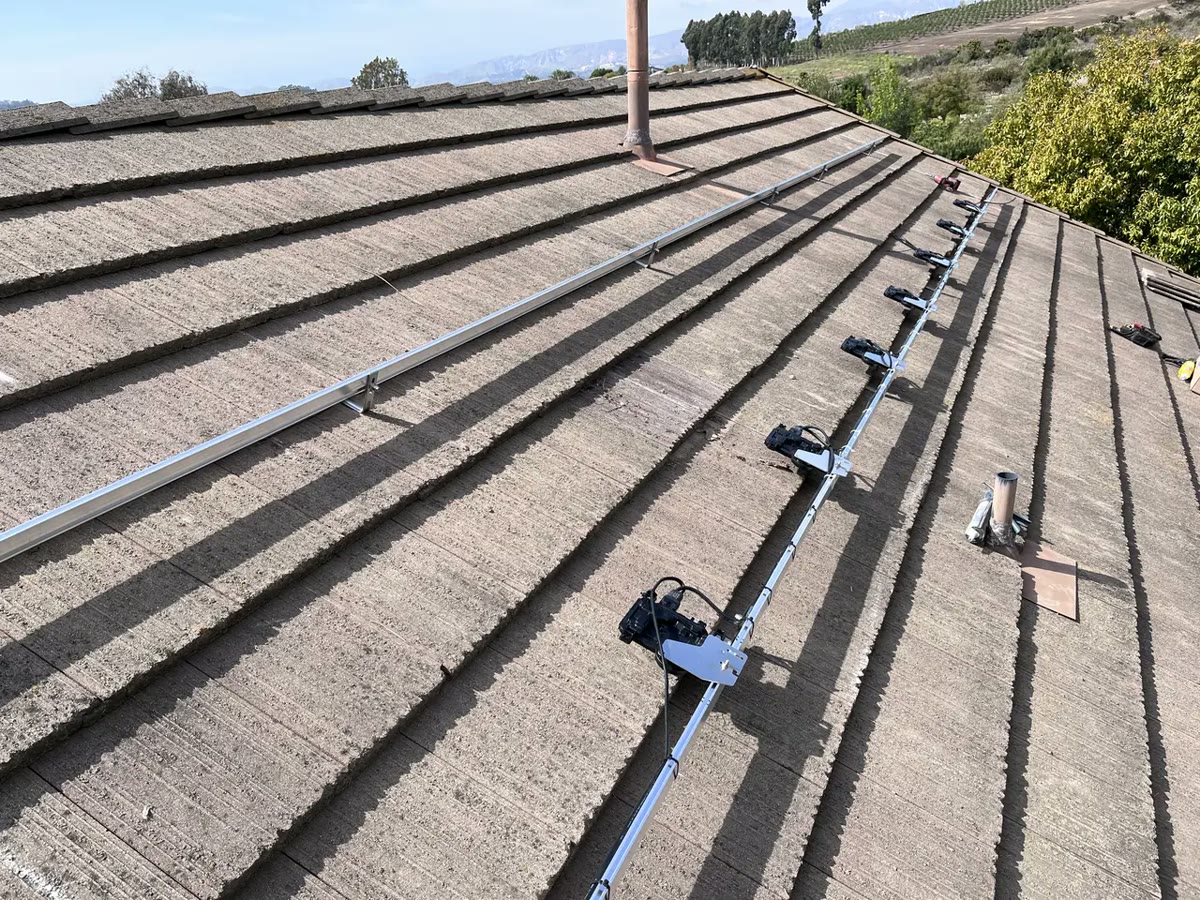
That makes it the best-documented case in our own records and, oddly, one of the least specifically written-about. There is a great deal of published material on solar and tile, and on solar and flat roofs, because those are the awkward cases. The ordinary case gets treated as though it needs no explanation.
It does, because three things about a shingle roof decide how a solar project goes: what the code requires of the roof itself, how the mounts are sealed, and — the one that costs people real money — how the roof's remaining life lines up with the array's.
What the code requires of the roof itself
California Residential Code 2025, Section R905.2.2 sets the floor: asphalt shingles may be used only on roof slopes of 2:12 or greater.
There is a second clause in that section that matters more often than the first, and that many homeowners have never heard:
For roof slopes from 2 units vertical in 12 units horizontal (17-percent slope) up to 4 units vertical in 12 units horizontal (33-percent slope), double underlayment application is required.
A large share of post-war Los Angeles tract housing sits in exactly that 2:12–4:12 band. If your roof is in it, the code requires two layers of underlayment beneath the shingles, applied in the specific overlapping pattern set out in Table R905.1.1(2) — half-width starter course at the eaves, then full-width sheets overlapping by half a sheet plus two inches, with four-inch end laps offset by six feet. Alternatively, a single layer of self-adhering polymer-modified bitumen underlayment complying with ASTM D1970 may be used.
This is not a solar requirement. It is a roofing requirement — but it becomes a solar conversation the moment a re-roof and an array are being planned together, because the underlayment specification is decided at that point and cannot easily be revisited afterwards.
The permitted underlayment materials themselves are listed in Table R905.1.1(1): ASTM D226 Type I or II, ASTM D1970, ASTM D4869 Types I–IV, ASTM D6757 or ASTM D8257 — with the requirements tightening to Type II and Types III/IV in areas where wind design is required. Shingles must comply with ASTM D3462, and be tested for wind resistance to ASTM D7158 with packaging labeled accordingly (R905.2.4, R905.2.4.1).
How a mount lands on a shingle roof
Under R329.4.3, roof penetrations must be flashed and sealed in accordance with Chapter 9. On a shingle roof the standard approach is a metal flashing plate worked under the course above the penetration, so water sheds over it the way it sheds over every other layer, with the lag driven into the rafter through a pre-sealed pilot hole.
The detail that separates a mount lasting the life of the array from one that becomes a warranty argument is that word under. Flashing surface-mounted on top of a shingle and sealed at its edges is relying on the sealant as the primary barrier — and sealant is a consumable exposed to ultraviolet light and thermal movement.
The fastener matters as much as the flashing. The state's model expedited checklist uses rafter embedment as its default prescriptive route — 5/16-inch lag screws with 2.5-inch embedment into the rafter — or the mount manufacturer's own published equivalent. Some listed mounting systems instead permit engineered direct-to-deck attachment when installed to their tested specification and instructions. Either way the attachment must be the one the system was listed for, and on the rafter route the embedment is measured into the framing rather than the sheathing.
The full treatment, including the three generations of sealing practice and what to ask an installer, is on How a Solar Mount Is Sealed. The structural side — anchor spacing, rafter spans, when an engineer becomes mandatory — is on Can Your Roof Carry Solar Panels?.
The timing question, which is the expensive one
Here are two service lives, and where they cross is the whole decision.
A solar array is warranted and expected to operate for around 25 years, often longer. An asphalt shingle roof, by industry accounts, lasts 15 to 30 years — most landing in the 20 to 25 range, with architectural shingles reaching 25 to 30 and premium products beyond that. Those are trade and manufacturer ranges rather than code figures, and real-world life in Los Angeles depends heavily on ventilation, sun exposure and installation quality.
The arithmetic is worth doing before signing. A twelve-year-old shingle roof may well reach the end of its service life while a new array is still producing — or it may not, depending on the product, the installation and how it has weathered. That is a question for an inspection of the covering's actual condition and remaining service life, not for its age alone. What is certain is the consequence if the roof does need replacing under the array: the system comes off and goes back on, at a cost nobody budgeted at the time of the solar quote.
This is a decision with a genuine answer for each house rather than a rule of thumb, and we have treated it separately in Replace Your Roof Before Installing Solar? and Solar Panel Removal and Reinstall for a Re-Roof. What belongs here is the framing: the roof's remaining life, not its age, is the number that matters, and it is established by inspection — granule loss, cupping, cracking, the condition of the flashings — not by a date.
What a re-roof under an existing array involves
If the roof does get replaced later, the code sets the baseline. R908.3 requires that roof replacement include the removal of existing layers of roof coverings down to the roof deck, with narrow exceptions permitting an existing adhered ice-barrier membrane or self-adhered underlayment to remain where the sheathing is sound and both manufacturers allow it.
R908.4 permits a roof recover — a new covering over the existing one — in defined circumstances, but explicitly not where:
- the existing roof or covering is water-soaked or deteriorated past being an adequate base;
- the existing covering is slate, clay, cement or asbestos-cement tile;
- the existing roof already carries two or more applications of any covering.
That last point is worth holding onto, because it also appears at the front of the state's structural screening: the very first check asks whether the roof is a single roof without a re-roof overlay. A house that has been given a second layer of shingles at some point in its history fails that check, and the solar project moves from over-the-counter permitting to an engineered submittal.
The cool-roof trigger most owners do not expect
This is the part of a shingle re-roof that surprises people, and it has nothing to do with solar.
California's Energy Code sets prescriptive cool-roof requirements — minimum aged solar reflectance, thermal emittance and Solar Reflectance Index. For new construction, steep-slope single-family roofs are covered in climate zones 10–15 under §150.1(c)11.
For a re-roof, the trigger comes in two parts. Section 150.2(b)1I applies where more than 50 percent of the roof is being replaced — which covers a full tear-off or a full overlay, but not a partial repair below that share. Where it applies, §150.2(b)1Ii requires, in climate zones 4 and 8–15, an aged solar reflectance of 0.20 and thermal emittance of 0.75, or SRI 16.
The re-roofing rule reaches more climate zones than the new-construction rule. A homeowner replacing a roof can be held to a standard that never applied to their house when it was built.
We ran the numbers on our own installed base against the California Energy Commission's official ZIP-to-climate-zone file. Of 320 roofs we could match to a zone, 91 percent of the steep-slope roofs sit in a climate zone where this requirement can apply. Most of Los Angeles — the San Fernando Valley, Glendale, Burbank, Whittier, Covina — is climate zone 9, squarely inside that range. The roofs outside it are in the coastal CZ 6 strip and mountain CZ 16. Inside the City of Los Angeles there is also a city cool-roof rule, set out below, that applies in every zone, CZ 6 included.
That figure describes geography, not obligation: whether the state rule binds a particular job also depends on how much of the roof is being replaced, and on the alternatives below.
There are, however, four compliant alternatives for a steep-slope re-roof, and under the state rule they are the reason nobody has to accept a pale roof they dislike. Any one of them satisfies the state requirement:
- a ceiling assembly with a U-factor of 0.025 or lower, or R-38 or greater ceiling insulation;
- a radiant barrier in the attic, not directly above spaced sheathing;
- in Climate Zones 2, 4, 9, 10, 12 and 14 — a building with no ducts in the attic;
- R-2 or greater continuous insulation above or below the roof deck.
The third is worth checking first, because most of Los Angeles is Climate Zone 9 — 76 percent of our own matched roofs. A house in that zone with no HVAC ducts running through the attic already complies with the state rule, with no reflective product and no added insulation. Ducted attics are common here, so it will not apply to every home, but it costs nothing to check.
Inside the City of Los Angeles, these alternatives settle only the state rule. The city's own cool-roof rule (LAMC 99.04.106.5) applies to replacing more than half the roof in every climate zone and asks a steep roof for an aged solar reflectance of 0.25 with a thermal emittance of 0.85, or SRI 20. It has no insulation, radiant-barrier or no-duct alternative. Its exceptions include a re-roof where solar is being installed, which lifts the city's rule but not the state's; whether reinstalling an existing array counts is for LADBS to decide, and LADBS's express re-roof permit asks for a CRRC-labeled cool roof product on any residential replacement over half the roof without mentioning that exception, so confirm with LADBS first. In practice, a shingle re-roof in the city usually needs a color rated to the city's minimum.
Under the state rule there is also a weight exemption: roof assemblies weighing 25 lb/ft² or more are exempt from the reflectance requirements entirely. That threshold is about the assembly, not the material — it is relevant to heavy tile, not to composition shingle, and we cover it on The Cool-Roof Rule Most Homeowners Meet Only When They Re-Roof.
Products must be rated and labeled by the Cool Roof Rating Council, and the values in the code are aged values — measured after three years of field exposure, or computed under the CRRC aged-value protocol — because real roofs collect dirt and lose reflectance.
Warranties: three of them, and none covers the others
Briefly, because it deserves its own page. A shingle roof under solar involves three separate warranty instruments held by three different parties: the module warranty, the installer's workmanship warranty on the attachment, and the shingle manufacturer's warranty on the covering.
The interaction that costs money is removal. GAF's technical bulletin R-131 states that solar panels do not impact coverage under GAF's limited warranties — but that should there be an issue with the shingles, no matter the cause, removing the panels is the owner's responsibility at the owner's sole expense so GAF can address the underlying issue. Owens Corning takes a different route with its Solar PROtect™ program, which covers workmanship on the roof and the solar mounts and includes removal and reinstallation of panels where required to service a claim — subject to certified-contractor and system requirements, and never covering the panels themselves.
The full comparison is on Three Warranties, One Leak.
What this adds up to
For the most common roof in Los Angeles, four things decide whether a solar project goes smoothly:
- Is there already a second layer? It fails the state's first structural check and forbids a further recover.
- What is the remaining life of the covering — established by inspection, not by age?
- Is the pitch between 2:12 and 4:12? Then double underlayment is required at the next re-roof, and that is a decision to make deliberately.
- If a re-roof is coming, is the cool-roof requirement in play — and which of the compliance routes suits this house?
Answer those before the array is designed, and the sequencing takes care of itself. Answer them afterwards and at least one of them turns into an avoidable cost.
Code references
Sections cited above, for readers who want to verify them directly in the code text.
- California Residential Code 2025 (Title 24, Part 2.5), R905.2.2 — minimum slope 2:12; double underlayment required from 2:12 to 4:12.
- California Residential Code 2025, R905.1.1 and Tables R905.1.1(1)–(3) — underlayment types, application and attachment (ASTM D226, D1970, D4869, D6757, D8257).
- California Residential Code 2025, R905.2.4, R905.2.4.1 — ASTM D3462 shingles; ASTM D7158 wind resistance.
- California Residential Code 2025, R329.4.3 — penetrations flashed and sealed per Chapter 9.
- California Residential Code 2025, R908.3, R908.4 — replacement down to deck; conditions barring a recover.
- GAF Technical Bulletin R-131, Installation of Solar PV Panels Over A GAF Shingle Roof.
- Shingle and underlayment service-life ranges are industry and manufacturer figures, not code values.
Frequently asked
Can solar panels go on an old shingle roof?
Does the installer remove shingles to install solar?
Will I need a cool roof when I replace my shingles?
How many holes go into a shingle roof?
Is composition shingle a good roof for solar?
Related reading
Sources & methodology
Figures on this page come from the primary sources below and, where noted, from Cali Energy calculations using the stated assumptions. Rates, incentives, and program terms change; each was verified October 14, 2026.
- California Energy Code (Title 24, Part 6) 2025 — §150.1(c)11 new construction, §150.2(b)1Ii re-roofing: climate zones, aged solar reflectance 0.20…
- California Energy Commission — Building Climate Zones by ZIP Code
- Los Angeles Municipal Code, Section 99.04.106.5, Cool Roof for Reduction of Heat Island Effect (as amended by Ordinance 187,208)
- California Solar Permitting Guidebook, 4th Edition, Part 3 — structural screening criteria and fastener specification
- Owens Corning — Solar PROtect™ program
Not sure whether to re-roof first?
The answer comes from remaining covering life and layer count, not from the roof's age. We can assess both before an array is designed, so the roofing and solar decisions are sequenced together rather than separately.
Prepared by Cali Energy, October 14, 2026. This article is for general educational purposes only and is not legal, tax, financial, engineering, or utility advice. Rates, incentives, codes, permit requirements, equipment specifications, prices, and program terms may change; figures and timelines are estimates, not guarantees. Confirm current requirements with the applicable utility, AHJ, program administrator, manufacturer, or a licensed professional. See our Content Disclaimer. Cali Energy · 19201 Parthenia St, Unit E, Northridge, CA 91324 · CSLB #1032379 (B, C-10, C-39)