

What 23 Santa Clarita Tile-Roof Projects Show
Santa Clarita is a tile town, and that single fact changes how a solar project here is designed, screened and permitted.
For our service in the city — pricing, current projects, what we install — see the Santa Clarita page.
A tile town
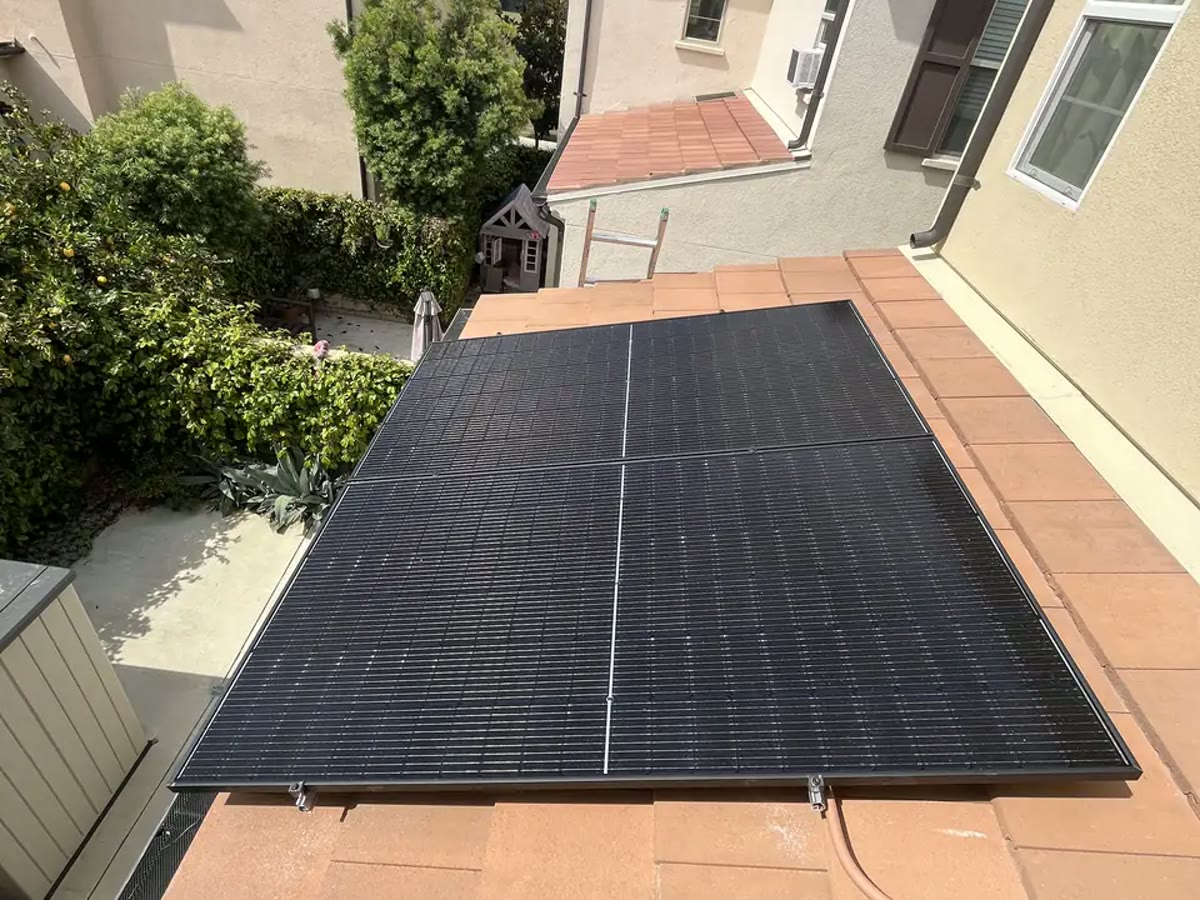
Tile accounts for close to a quarter of the roofs we install on. Santa Clarita does not follow that ratio at all.
| Projects | |
|---|---|
| Our completed projects in Santa Clarita | 34 |
| Of those, tile roofs | 23 |
More than two thirds of our Santa Clarita roofs are tile. The city is our single largest concentration of tile roofs anywhere — the next city is Los Angeles with ten, then Palmdale with eight.
Here tile is the default, not the special case.
Tile is not one product either. In this city we work on flat concrete tile, concrete tile in a shake profile, terracotta clay tile, and red clay S-tile — four profiles with different mounting hardware, different fragility and different reinstatement behavior when they come off and go back on.
Two climate zones, one city — and a gap in the state's table
California's energy code — including the cool-roof requirements that attach to a re-roof — depends on which of the state's sixteen building climate zones a property is in. Santa Clarita straddles two of them. By the Energy Commission's ZIP-code list, addresses here fall into Climate Zone 9 and Climate Zone 16 — and which one applies changes what a re-roof has to meet.
That list is not the final word, and homeowners are regularly caught out by treating it as one. The Energy Commission sets a building's zone by geographic boundaries; the ZIP list exists "for the convenience of local jurisdictions" that choose to apply a single zone across a whole ZIP code where that ZIP spans more than one climate region. Santa Clarita is exactly such a place.
There is also a gap in the list that matters if you live in Canyon Country. ZIP 91387 does not appear in the Energy Commission's ZIP-code table at all. 91386 is listed as Climate Zone 9, the next entry is 91388, also Climate Zone 9 — and there is no 91387 between them.
So a Canyon Country homeowner cannot look their zone up in the state's table, because their ZIP is not in it. Nor should they assume the neighboring ZIPs' zone applies to their address: that is not how the zone is determined. The answer comes from the Commission's address-level climate zone tool. The ZIP file itself is still the April 2020 edition, with no newer version issued alongside the 2025 energy code.
What tile changes in the structural screening
The California Solar Permitting Guidebook gives building departments an optional screening path for existing roofs, and it treats tile differently from everything else — not because tile is fragile, but because of what it weighs.
The Guidebook's rafter span table assumes a roof assembly weight of 10 psf for a non-tile roof (asphalt shingle, wood shingle, wood shake) and 20 psf for a tile roof of clay or cement. Doubling the assumed dead load shortens the span a given rafter can carry:
| Rafter (post-1960) | Spacing | Non-tile max span | Tile max span |
|---|---|---|---|
| 2x4 | 24″ o.c. | 8′-0″ | 6′-11″ |
| 2x6 | 24″ o.c. | 11′-9″ | 10′-2″ |
| 2x8 | 24″ o.c. | 14′-10″ | 12′-10″ |
Across the table, the same rafter at the same spacing carries roughly 13 to 14 percent less span under tile. On a house whose rafters were sized close to the limit, that difference is what decides whether the screening comes back clean.
This table is a screening tool, not a verdict, and not a mandatory 2025 requirement. The Guidebook describes it as an optional table that a building official may elect to use. Its numbers rest on stated assumptions — a span-to-deflection ratio of at least 180, and Douglas Fir-Larch No. 2 for post-1960 construction and No. 1 for pre-1960 — and for post-1960 buildings the spans match the rafter tables in the 2016 editions of the California Building and Residential codes. A roof that does not clear the screening has not been condemned; it has been referred for an engineer's calculation, which may end in a different mounting layout, additional attachment points, blocking, reinforcement, or a finding that nothing needs to change at all.
The Guidebook's companion table for anchor spacing — the one that limits how far apart the mounts can sit for an array of 4 psf or less — makes no distinction between tile and non-tile roofs. The assembly weight is accounted for in the span table, not in the anchor table. It is a common misreading in the other direction.
What the code says about the tile itself
California Residential Code 2025, Section R905.3.2 requires clay and concrete roof tile to be installed on slopes of 2½ units vertical in 12 units horizontal (25 percent) or greater. On slopes between 2½:12 and 4:12, a double layer of underlayment is required in accordance with R905.3.3.
Clay tile must comply with ASTM C1167 and concrete tile with ASTM C1492.
This matters most for a re-roof under or before an array. The required underlayment assembly may affect the scope and cost of the work, and the pricing follows from the existing assembly and the roofing system specified.
What this means for a tile roof here
Three things hold consistently across tile work in this city:
- Tile is the working assumption in Santa Clarita, not the exception, and the profile matters — flat concrete, shake-profile concrete, terracotta and S-tile do not take the same hardware.
- The structural screening starts from a harsher assumption on tile, and a marginal rafter is more likely to be referred to an engineer than the same rafter under shingle.
- The climate zone question is genuinely unresolved for part of the city, and for Canyon Country it cannot be answered from the state's convenience table at all.
Code references
Sections cited above, for readers who want to verify them directly in the code text.
- Cali Energy installation record — 34 completed projects in Santa Clarita, 23 of them on tile; 85 tile roofs across all completed installations. As of September 2026.
- California Energy Commission, Building Climate Zones by ZIP Code (published file, April 2020 edition) — ZIP-to-zone assignments; 91387 absent between 91386 and 91388.
- California Solar Permitting Guidebook, 4th Edition, Part 3, Table 1 — maximum horizontal anchor spacing for photovoltaic arrays of 4 psf or less; no tile/non-tile distinction.
- California Residential Code 2025 (Title 24, Part 2.5), R905.3.2 — minimum slope 2½:12, double underlayment between 2½:12 and 4:12; R905.3.3 underlayment; R905.3.4 ASTM C1167; R905.3.5 ASTM C1492.
Frequently asked
Are most Santa Clarita roofs tile?
Does a tile roof mean my rafters will fail the check?
What climate zone is Santa Clarita in?
Why isn't my Canyon Country ZIP in the state table?
Can my tile be reused after solar work?
Related reading
Sources & methodology
Figures on this page come from the primary sources below and, where noted, from Cali Energy calculations using the stated assumptions. Rates, incentives, and program terms change; each was verified September 1, 2026.
Prepared by Cali Energy, September 1, 2026. This article is for general educational purposes only and is not legal, tax, financial, engineering, or utility advice. Rates, incentives, codes, permit requirements, equipment specifications, prices, and program terms may change; figures and timelines are estimates, not guarantees. Confirm current requirements with the applicable utility, AHJ, program administrator, manufacturer, or a licensed professional. See our Content Disclaimer. Cali Energy · 19201 Parthenia St, Unit E, Northridge, CA 91324 · CSLB #1032379 (B, C-10, C-39)