

Simi Valley, CA · March 2021 – April 2021 · Southern California Edison / City of Simi Valley
Somebody comes out, looks, and leaves a sticker on your panel.
A Simi Valley solar project that needed a service upgrade, and the step in front of it: the utility's own review of where the equipment can go and what it can be.
A panel upgrade changes the utility's equipment as well as the homeowner's, so the utility reviews it first. Its local planning office looks at the existing service, the position of the meter, the clearances around it and the way the supply arrives, and returns a decision on whether an upgrade can stay where it is or has to move. The outcome arrives two ways: a written approval, and a yellow sticker left on the panel itself with the conditions written on it. Allow seven to ten business days. For Simi Valley that review runs out of the utility's Thousand Oaks planning office.
At a glance
- Utility review
- Requested at design stage, ahead of the permit
- Reviewed by
- The utility's local planning office
- Turnaround quoted
- 7 to 10 business days
- Outcome delivered
- Written approval and a sticker left on the panel
- Decides
- Whether the upgrade stays in place or the service must move
- Modules considered
- REC Alpha black-on-black and Q CELLS 340 W
- Modules selected
- REC Alpha 365 W, all black
- Utility / AHJ
- Southern California Edison / City of Simi Valley
The story
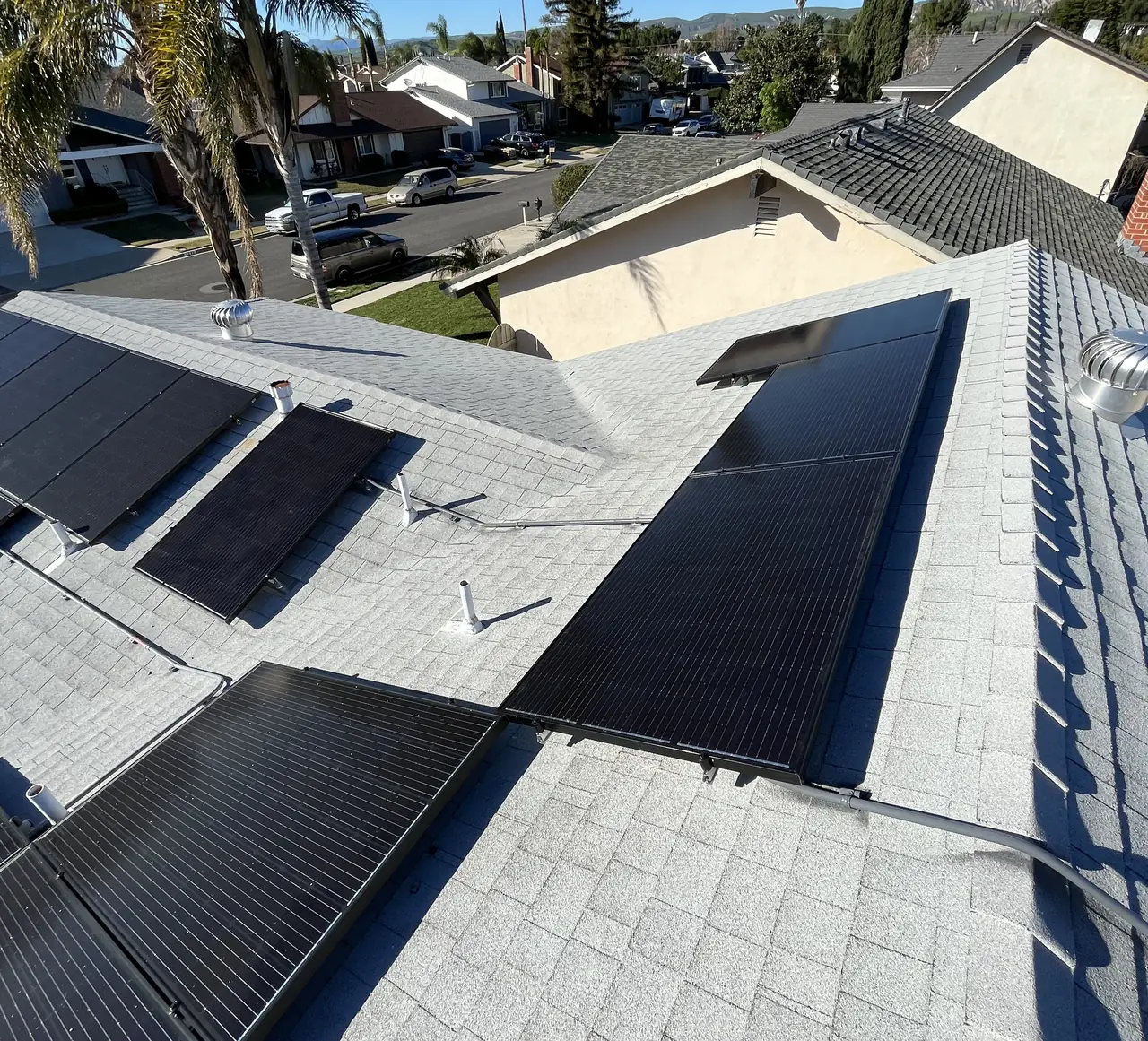
The homeowner wanted all-black modules, which is a purely visual decision and a legitimate one, and Cali Energy priced two of them. Two options were put forward, an all-black REC Alpha and a Q CELLS at three hundred and forty watts, with the spec sheets for both. The choice landed on the REC Alpha at three hundred and sixty-five watts, for a difference in price that was named up front.
That part of the project took two days. The part that took longer, and that had to happen before anything could be drawn, was the utility looking at the electrical panel.
A service upgrade is not only the homeowner's equipment. The meter is the utility's, the supply to it is the utility's, and the clearances around both are set by the utility's own service requirements rather than by the building code alone. So the utility reviews the site before a designer commits to anything.
What that looks like in practice is straightforward. A request goes in. The local planning office schedules a visit, quoted at seven to ten business days. Somebody comes out, looks at the panel, the meter position, the clearances and how the supply arrives, and leaves a yellow sticker on the main panel with the recommendations written on it. The formal answer follows by email.
The decision that matters is binary and expensive to get wrong: can the upgraded service stay where the existing one is, or does it have to move. Staying in place is a panel swap. Moving means new conduit, possibly trenching, possibly a different point of attachment, and a different conversation about cost entirely.
Doing this first is the whole argument. A design drawn before the utility has looked is a design that might be redrawn, and a homeowner quoted before the utility has looked is a homeowner who might be re-quoted. Neither is a catastrophe; both are avoidable by making one request early and waiting ten business days.
How it ran
| 29 March 2021 | System design and quote issued |
|---|---|
| 29 March 2021 | All-black module options compared with spec sheets |
| 30 March 2021 | Module selected; revised quote issued |
| 30 March 2021 | Utility asked to review the main service panel |
| 31 March 2021 | Turnaround confirmed at 7 to 10 business days |
| April 2021 | Utility review completed; conditions left on the panel |
| April 2021 | Design finalized against the utility's written conditions |
Ten business days quoted for the utility review, in front of everything else. This timeline reflects this project.
What we did
- Presented two all-black module options with spec sheets and a named price difference rather than one take-it-or-leave-it choice (C-10).
- Requested the utility's panel review at design stage rather than after the drawings were done.
- Set the homeowner's expectation at seven to ten business days for that review.
- Finalized the design against the utility's written conditions.
System specifications
| Modules considered | REC Alpha all-black and Q CELLS 340 W |
|---|---|
| Modules selected | REC Alpha 365 W, all black |
| Service | Main service panel upgrade |
| Utility review | Local planning office, on site |
| Review outcome | Written approval plus conditions left on the panel |
| Quoted turnaround | 7 to 10 business days |
| Utility / AHJ | Southern California Edison / City of Simi Valley |
Is your project like this one?
- Your project needs a service upgrade and nobody has mentioned a utility visit.
- You have a sticker on your panel and do not know what it means.
- You are choosing between module options and want the difference explained.
- You want to know why a design cannot be finalized yet.
Cali Energy in Simi Valley
Simi Valley is a city in Ventura County: permits run through the City of Simi Valley Building & Safety Division, interconnection through Southern California Edison.
In Simi Valley the utility's local planning office reviews service equipment before a panel upgrade is designed. It is a real visit with a real outcome, and it sits in front of the permit rather than after it.
This installation is on the Simi Valley projects page alongside the others, and what the work covers is set out on the Simi Valley service area page.
- License and classifications: CSLB #1032379
- Official reference for this process: Southern California Edison — generating your own power
- Official reference for this process: California Energy Commission — solar equipment lists
Frequently asked questions
Why does the utility have to look at my panel?
Because a service upgrade changes the utility's equipment as well as yours. The meter, the supply and the clearances around them are governed by the utility's own service requirements. Its local planning office reviews the site and decides whether the upgraded service can stay where it is or has to move, which is the single most expensive variable in the job.
Does Cali Energy arrange the utility panel review in Simi Valley?
Yes. Cali Energy requests the review at design stage so the drawings are made against the utility's conditions rather than revised afterwards, and sets the expectation at seven to ten business days. Fifteen completed Simi Valley projects are on our projects page. Our license is CSLB #1032379.
What is the sticker on my electrical panel?
It is how the utility's field representative leaves the outcome of the review on site. The conditions for the upgrade are written on it: where the equipment may sit, what clearances apply and anything specific to that property. A formal written approval normally follows by email, and the two should say the same thing.
How long does the review take?
Seven to ten business days is the figure quoted for the visit, and it is worth treating as real rather than optimistic. It sits in front of the design, the permit and the installation, so a request made late moves everything behind it. Making it early costs nothing, because the rest of the project has its own preparation to be getting on with.
What this would look like on your roof
Planning solar in Simi Valley? Tell us your utility, your roof and what your bill looks like now, and we will model what a system like this would do on your house before you commit to anything.
Or call +1 (323) 844-7777 · Cali Energy, Northridge · CSLB #1032379 (B, C-10, C-39) — design, permits, install and electrical under one licensed contractor.
Related
This timeline reflects this property and this permitting path. Updated September 2026.