

Simi Valley, CA · August 2022 · Southern California Edison / City of Simi Valley
Two hundred amps of service. Twenty-five amps of headroom.
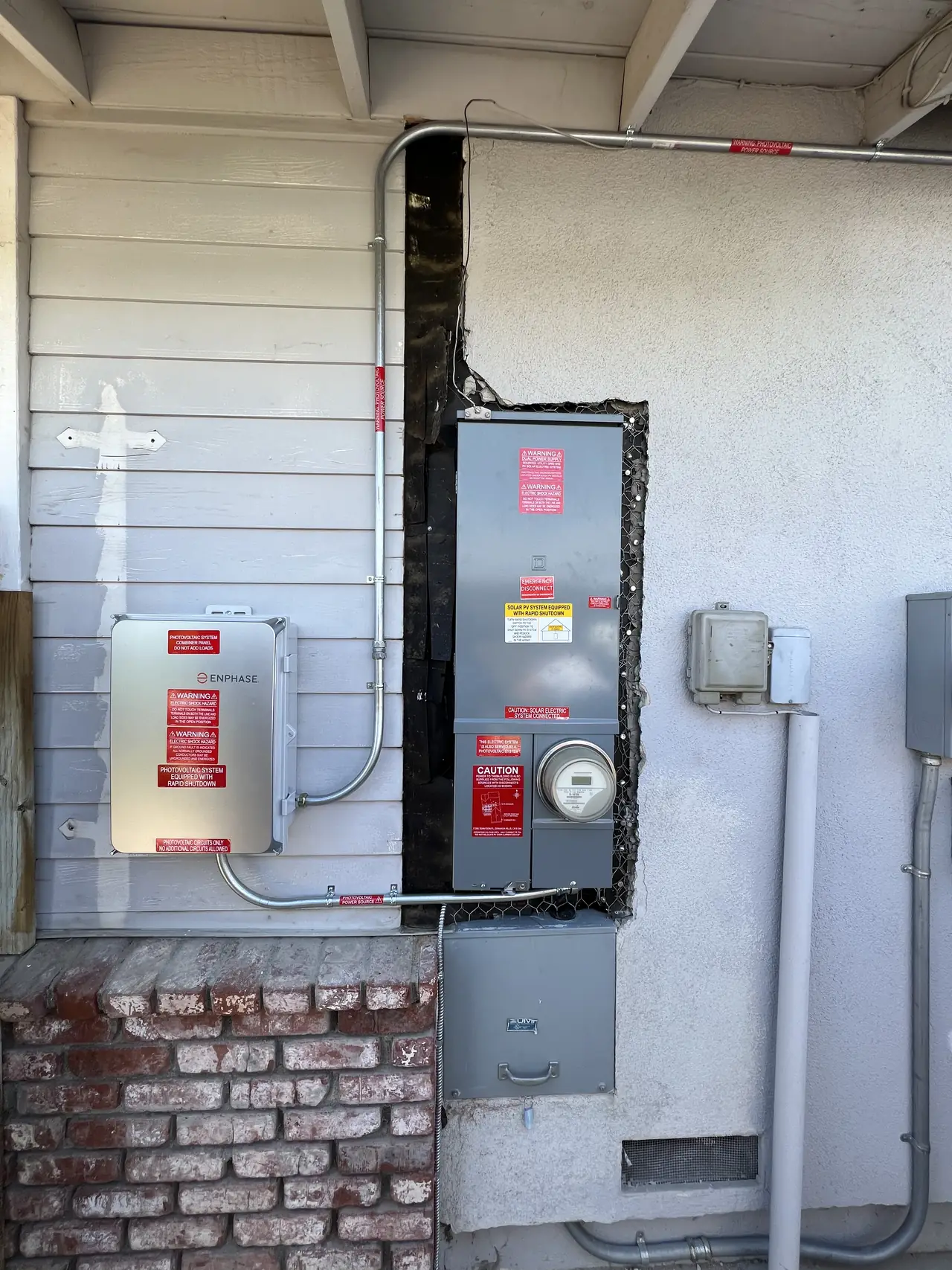
A main service panel upgrade on a Simi Valley house with an underground supply, specified as a 225 A busbar with a 200 A main. The inspector's note explains why that combination is the useful one.
A panel has two ratings that matter and homeowners usually hear about one. The main breaker sets the service size; the busbar sets what the panel can carry, and the interconnection rule compares the main breaker plus the solar breaker against the busbar rating with a defined allowance. Put a 200 A main in a 200 A panel and the solar breaker is fighting for room. Put it in a 225 A panel and there is headroom by design. On this Simi Valley upgrade Cali Energy specified the larger busbar, which cost nothing extra while the panel was being replaced anyway.
At a glance
- Work
- Main service panel upgrade
- Busbar rating
- 225 A
- Main breaker
- 200 A
- Service supply
- Underground
- Final inspection
- 18 August 2022 — approved
- Inspector action
- Meter released to the utility
- Utility / AHJ
- Southern California Edison / City of Simi Valley
The story
The inspector's note on this Cali Energy job is the clearest short statement of the idea there is: final approved for main service panel, two hundred and twenty-five amp bus with a two hundred amp main, underground supplied, meter released to the utility.
Four facts in one sentence, and the first two are the ones worth unpacking.
A service panel has a main breaker and a busbar. The main breaker is the number everybody quotes: a two hundred amp service means a two hundred amp main. The busbar is the copper or aluminum spine the breakers clamp onto, and it has its own rating, which is frequently the same number and does not have to be.
Solar cares about the busbar. The interconnection rule compares the main breaker plus the solar breaker against the busbar rating, with a defined allowance above it. When the main and the busbar are the same size, a solar breaker of any consequence pushes against that limit immediately, and the usual escapes are derating the main breaker, using a line-side connection, or replacing the panel again.
When the busbar is a size larger than the main, the arithmetic simply works. Two hundred and twenty-five amps of busbar behind a two hundred amp main is twenty-five amps of headroom that cost nothing extra at the moment the panel was being replaced anyway. It is the cheapest future-proofing available on a service upgrade, and it is invisible unless somebody specifies it.
The other two facts in the note each need a line. Underground supplied means the service comes in below grade rather than overhead, which removes the clearance questions that decide so many upgrades and adds trenching and conduit questions instead. And released meter to the utility is the handover: the city signs off the panel, and only then will the utility reconnect and set the meter. Those are two separate organizations and two separate queues, and the second one cannot start until the first finishes.
How it ran
| Before installation | 225 A busbar specified behind a 200 A main breaker |
|---|---|
| August 2022 | Main service panel upgrade installed |
| 18 August 2022 | Final inspection approved |
| 18 August 2022 | Inspector releases the meter to the utility |
| Late August 2022 | Utility reconnection and meter set |
Inspection and release on the same day. This timeline reflects this property.
What we did
- Specified a 225 A busbar behind a 200 A main so a future solar breaker would fit without derating (C-10).
- Installed the replacement service panel on an underground supply.
- Completed bonding, grounding and labeling for inspection.
- Presented the work for final inspection and obtained approval.
- Coordinated the release of the meter to the utility for reconnection.
System specifications
| Scope | Main service panel replacement |
|---|---|
| Busbar | 225 A |
| Main breaker | 200 A |
| Headroom for solar | 25 A by design, before any allowance is applied |
| Supply | Underground |
| Sign-off | City final, then meter released to the utility |
| Utility / AHJ | Southern California Edison / City of Simi Valley |
Is your project like this one?
- You are replacing a service panel and solar is on the horizon.
- You have been told your panel has no room for a solar breaker.
- Somebody has proposed derating your main breaker and you want the alternatives.
- Your service comes in underground and you want to know what that changes.
Cali Energy in Simi Valley
Simi Valley is a city in Ventura County: permits run through the City of Simi Valley Building & Safety Division, interconnection through Southern California Edison.
Most panel upgrades in Simi Valley are specified by the size of the main breaker, because that is the number people know. The number that decides whether solar fits is the busbar behind it.
This installation is on the Simi Valley projects page alongside the others, and what the work covers is set out on the Simi Valley service area page.
- License and classifications: CSLB #1032379
- Official reference for this process: City of Simi Valley — Building & Safety Division
- Official reference for this process: Southern California Edison — generating your own power
Frequently asked questions
Why does the busbar rating matter more than the main breaker?
Because the interconnection rule compares the main breaker plus the solar breaker against the busbar rating, with a defined allowance. The main breaker describes the service; the busbar describes what the panel can carry. A panel whose busbar is a size larger than its main has headroom built in, which is exactly where a solar breaker goes.
Does Cali Energy do service panel upgrades in Simi Valley?
Yes, as its own scope and as part of solar projects. Cali Energy specifies the busbar as well as the main breaker, because that is the number that decides whether solar fits later without derating or a line-side connection. Fifteen completed Simi Valley projects are on our projects page. Our license is CSLB #1032379.
What is the alternative to a larger busbar?
Derating the main breaker, which permanently reduces the service capacity; a line-side or supply-side connection, which is more work and more cost; or replacing the panel a second time. All three are legitimate and all three are more expensive than specifying the right panel once, while it is being replaced anyway.
What does releasing the meter to the utility mean?
It is the handover between two organizations. The city inspects the new service equipment and signs the permit off, and that sign-off is what allows the utility to reconnect and set the meter. They are separate queues: nothing the utility does can start before the city finishes, which is worth knowing when a house is without power.
What this would look like on your roof
Planning solar in Simi Valley? Tell us your utility, your roof and what your bill looks like now, and we will model what a system like this would do on your house before you commit to anything.
Or call +1 (323) 844-7777 · Cali Energy, Northridge · CSLB #1032379 (B, C-10, C-39) — design, permits, install and electrical under one licensed contractor.
Related
This timeline reflects this property and this permitting path. Updated September 2026.