

How to Read a Solar Panel Spec Sheet: The Numbers That Matter
A solar panel spec sheet is long, but six numbers carry most of the meaning: power at standard test conditions (the watts in the name), efficiency (how much power per square foot of roof), the temperature coefficient (how much power a hot roof costs), yearly degradation (how much output it loses each year), the warranty (and what output it guarantees in year 25) and its ratings for fire and load. On the panel pages of Cali-Graf, the free equipment directory built by Cali Energy, a Los Angeles solar and roofing contractor, each number names its source — the California Energy Commission list, the manufacturer's datasheet, or a value Cali-Graf calculated, marked as such — and two numbers sit next to each other when they differ: the datasheet's and the CEC's own test.
The six numbers
| Spec | What it means | Example: Q.TRON BLK M-G2+ |
|---|---|---|
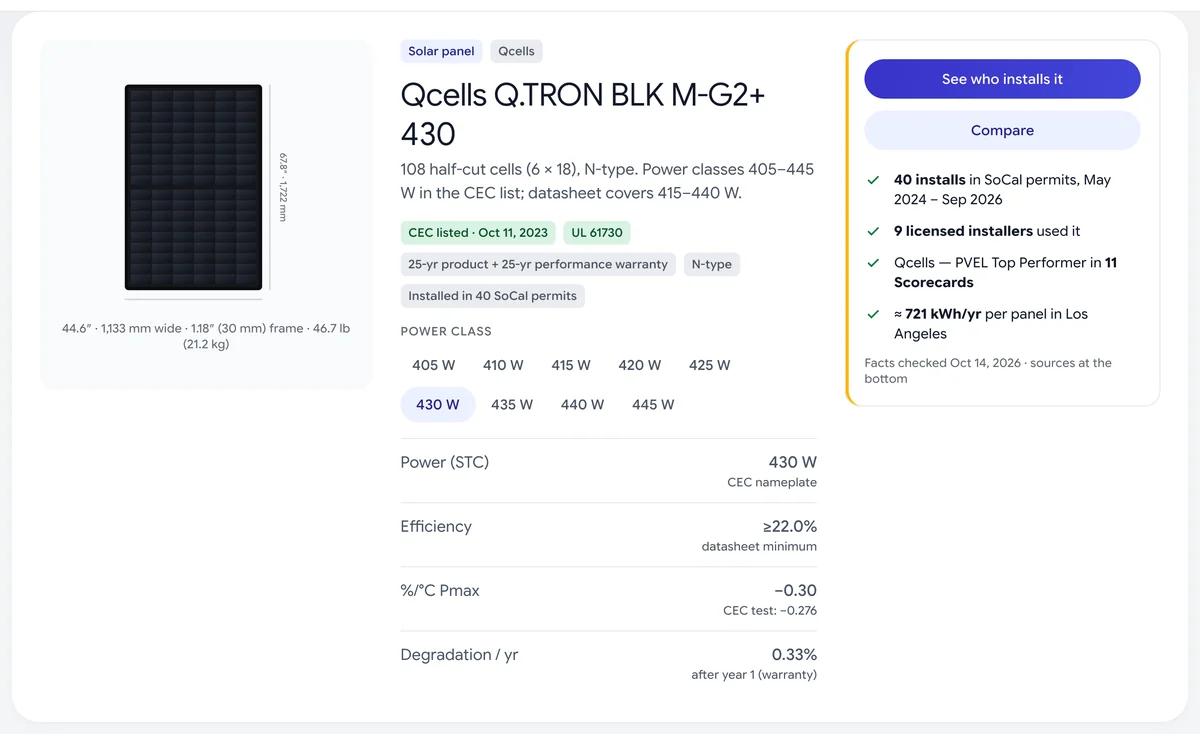
| Power (STC) | Watts at a lab's standard test conditions | 430 W (classes 405–445 W) |
| Efficiency | Share of sunlight on the panel's area turned into power — more watts per square foot | ≥ 22.0% |
| Temperature coefficient | Power lost per °C above 25 °C | −0.30%/°C (datasheet); −0.276 in the CEC test |
| Degradation | Output lost per year after year one | 0.33% a year |
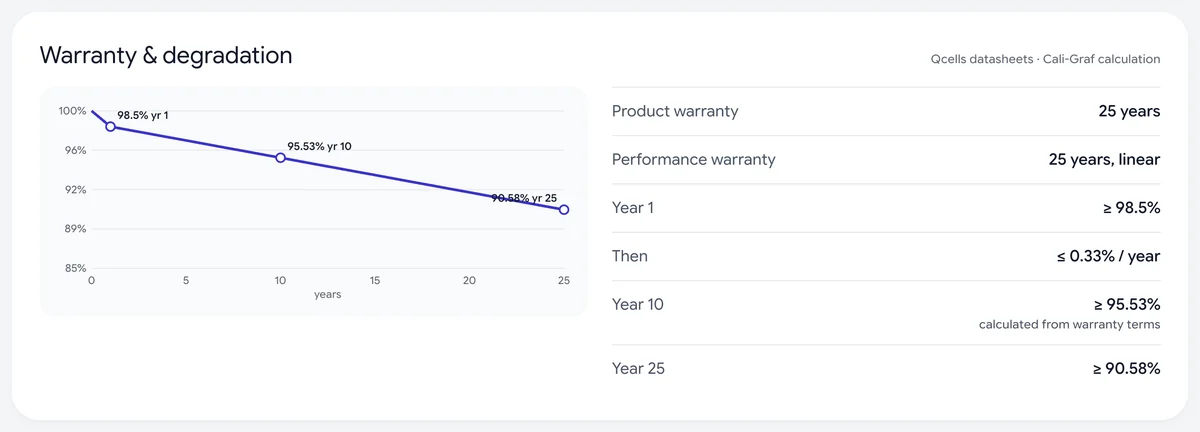
| Warranty | Product years, performance years and the output guaranteed | 25 + 25 years; ≥ 95.53% in year 10, ≥ 90.58% in year 25 |
| Ratings | Fire class and the snow/wind loads it's tested to | Type 2 fire rating; 113 / 50 psf design load |
What they mean on a Los Angeles roof
- STC isn't the roof. Standard test conditions are a cool panel in bright light. A real panel runs hotter, so pages also show performance at normal operating temperature and in low light — and a PTC rating, closer to outdoor output.
- Heat costs power. On a summer roof a panel can run 40 °C above the test temperature; at −0.30%/°C that's roughly 12% less power at that moment. A smaller (less negative) coefficient helps most in hot inland valleys.
- Efficiency matters when roof space is short. On a small or broken-up roof, a more efficient panel fits more watts into the same faces; on a large simple roof it matters less than price.
- Degradation compounds. The warranty curve on the page turns a yearly rate into the output guaranteed in year 10 and year 25 — the numbers to compare between brands.
- Size sets the layout. Panel dimensions decide how many fit between fire setbacks and vents; see designing a solar layout on satellite imagery.
Comparing panels: filters that help
The panel list covers 2,003 current series on the CEC list, 184 of them named in Southern California building permits, as of October 2026. Filters narrow it to what you care about:
| Filter | Use it for |
|---|---|
| Installed in SoCal | Panels local installers actually use |
| All-black | Black frame and backsheet — the look many homeowners want on a street-facing roof |
| Bifacial | Panels that also use light reflected onto their back |
| AC modules | Panels sold with a factory-mounted microinverter |
| 400 W+ | Higher-power panels |
| PVEL Top Performer | Manufacturers recognized in Kiwa PVEL's scorecards |
Sort by Most installed, Most complete (datasheet, tests and installs on file) or Newest. All-black panels often carry a slightly lower rating than the same model with a silver frame and white backsheet; compare the classes on each page.
Independent tests
Where Kiwa PVEL or RETC has published results, the page shows them — and says plainly when the result is for the manufacturer rather than the exact series. What those scorecards measure is in PVEL and RETC results explained.
Is the model in your quote listed?
The top of each page shows CEC listed with the date. The model number in your quote should appear among the series' models — see verifying solar equipment model numbers on the CEC list. And to see who installs it near you, each page lists the licensed installers whose permits name it; see what equipment does my installer actually install?. The brands named most often across Southern California permits are counted in solar brands in building permits, and the directory as a whole is explained in checking the equipment in a solar quote.
Check the panel model in your quote against the CEC list and its tests now.
Frequently asked
What is a good temperature coefficient for solar panels?
What does STC mean on a solar panel?
How much do solar panels degrade per year?
Are all-black solar panels less efficient?
How do I find panels installers actually use in Southern California?
Related reading
Sources & methodology
Product facts on this page come from Cali-Graf's own help center and the pages linked below; figures in examples come from the stated inputs. Features, limits and supported utilities change; each was verified October 16, 2026.
Look up the panel in your quote
Find the model in Cali-Graf's equipment directory for its CEC listing, datasheet numbers, independent tests and who installs it near you. Planning solar in Los Angeles? Cali Energy (CSLB #1032379), which develops Cali-Graf, can design with it on your roof. Example figures here come from the Qcells Q.TRON BLK M-G2+ page, built from the CEC list and Qcells' datasheet.
Prepared by Cali Energy, October 16, 2026. This article is for general educational purposes only and is not legal, tax, financial, engineering, or utility advice. Rates, incentives, codes, permit requirements, equipment specifications, prices, and program terms may change; figures and timelines are estimates, not guarantees. Confirm current requirements with the applicable utility, AHJ, program administrator, manufacturer, or a licensed professional. See our Content Disclaimer. Cali Energy · 19201 Parthenia St, Unit E, Northridge, CA 91324 · CSLB #1032379 (B, C-10, C-39)