

PVEL "Top Performer" and RETC "Highest Achiever": What Solar Panel Test Results Really Mean
Two independent labs publish the panel test results solar quotes cite most. Kiwa PVEL's PV Module Reliability Scorecard names Top Performers in each of its tests — thermal cycling, damp heat, mechanical stress, hail, potential-induced degradation and others — and RETC's PV Module Index names high achievers in reliability, performance and quality, with an Overall Highest Achiever title for manufacturers that do well across them. Both are real, demanding programs. But a Top Performer result belongs to a specific model built from a specific bill of materials, in a specific test — not to everything a brand sells. So the useful question about a quote isn't "is the brand a Top Performer?" but "was this panel model tested, and in which tests?" The panel pages of Cali-Graf, the free equipment directory built by Cali Energy, a Los Angeles solar and roofing contractor, make that distinction explicit.
Kiwa PVEL Scorecard
PVEL tests panels in its Product Qualification Program and publishes the results once a year; the 2026 Scorecard is its 12th edition. Its tests include:
| Test | What it stresses |
|---|---|
| Thermal cycling | Repeated hot–cold swings that crack solder joints and cells |
| Damp heat | Long exposure to heat and humidity |
| Mechanical stress sequence | Loads that mimic wind and snow, plus cycling |
| Hail stress sequence | Ice-ball impacts |
| Potential-induced degradation (PID) | Power loss from voltage stress |
| UV-induced degradation (UVID) | Power loss from ultraviolet exposure |
| LID + LETID | Light- and heat-induced degradation in the first months |
| PAN performance, incidence angle | How the panel performs in energy models |
How Top Performer works: a model type built from a unique bill of materials (BOM) earns Top Performer status in a test when it meets PVEL's criteria for that test. In 2026, 43 manufacturers had at least one Top Performer result — and PVEL noted that no single BOM was a Top Performer in all eight tests, while its test failure rate reached a record high.
RETC PV Module Index
RETC runs its Thresher Test — eight sequences, six for reliability (damp heat, thermal cycling, mechanical load, PID, backsheet UV durability, UV-induced degradation) and two for performance — plus a hail durability test. It recognizes manufacturers as high achievers in individual tests and categories, and as Overall Highest Achiever when they meet its standards across reliability and performance. In the 2026 Index, 13 manufacturers were named Overall Highest Achievers and 19 were recognized for high achievement in at least one test, according to pv magazine's summary of the report.
Brand badge vs. tested model
| A quote says | What it may mean | What to ask |
|---|---|---|
| "PVEL Top Performer brand" | The manufacturer had a Top Performer result for some model, in some test | "Which model, and which tests?" |
| "Top Performer panel" | The quoted model may or may not be the one tested | "Is this exact model and build in the Scorecard?" |
| "RETC Highest Achiever" | A manufacturer-level recognition in a given year | "For which year, and does it cover this product?" |
A brand's results are a reasonable sign of its manufacturing discipline, but a new model, a different factory or a changed bill of materials can behave differently.
How Cali-Graf shows it
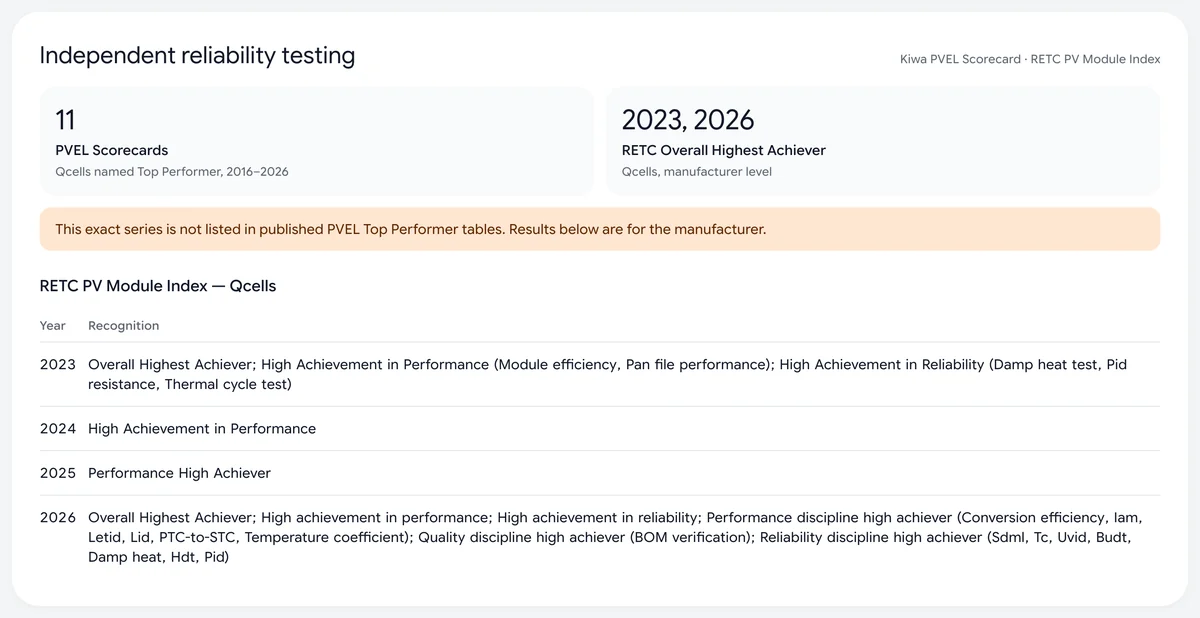
Each panel page in Cali-Graf's equipment directory has an Independent reliability testing section that lists Kiwa PVEL and RETC recognitions with their years — and says plainly when the result is for the manufacturer rather than the exact series: "This exact series is not listed in published PVEL Top Performer tables. Results below are for the manufacturer." The panel list can be filtered to PVEL Top Performer manufacturers. Specs, warranty and the CEC listing sit on the same page — see how to read a solar panel spec sheet.
Look up your panel's PVEL and RETC record on its equipment page.
How much weight to give test results
Test results are one input, alongside the warranty (and the output guaranteed in year 25), the installer's experience with the product, and price. A panel without PVEL or RETC results isn't necessarily worse — testing costs manufacturers money and not every model is submitted. A panel with them, from a manufacturer that publishes them year after year, gives you more evidence. Who installs a given panel locally is on its page; see what equipment does my installer actually install?.
Frequently asked
What does PVEL Top Performer mean?
Is a PVEL Top Performer panel better?
What is RETC's Overall Highest Achiever?
How do I check whether my panel was tested?
Should I avoid panels without independent test results?
Related reading
Sources & methodology
Product facts on this page come from Cali-Graf's own help center and the pages linked below; figures in examples come from the stated inputs. Features, limits and supported utilities change; each was verified October 16, 2026.
Check the test record of the panel in your quote
Each panel page in Cali-Graf's equipment directory shows its PVEL and RETC recognitions, says when they are for the manufacturer rather than the series, and lists who installs it locally. Planning solar in Los Angeles? Cali Energy (CSLB #1032379), which develops Cali-Graf, can quote it on your roof. Results are summarized from PVEL's 2026 Scorecard and RETC's 2026 PV Module Index.
Prepared by Cali Energy, October 16, 2026. This article is for general educational purposes only and is not legal, tax, financial, engineering, or utility advice. Rates, incentives, codes, permit requirements, equipment specifications, prices, and program terms may change; figures and timelines are estimates, not guarantees. Confirm current requirements with the applicable utility, AHJ, program administrator, manufacturer, or a licensed professional. See our Content Disclaimer. Cali Energy · 19201 Parthenia St, Unit E, Northridge, CA 91324 · CSLB #1032379 (B, C-10, C-39)