

Does Your Solar Quote Still Subtract the 30% Tax Credit? (2026 Checklist)
The 30% federal Residential Clean Energy Credit (Section 25D) covered home solar installed from 2022 through December 31, 2025, and, in the IRS's words, it is "not available for any property placed in service after December 31, 2025." A system installed in 2026 gets no federal credit. Yet a quote can still count it — openly, as a "net cost", or quietly, inside the payback, the 25-year savings or a loan payment that assumes a big "tax refund" prepayment. The quick test: if a number on the quote is about 70% of the price, or assumes money coming back in your first year, ask for the quote to be redone without the credit. This page covers systems you buy with cash or a loan; leases and PPAs work differently. Its example is a sample proposal from Cali-Graf, the free design and proposal app built by Cali Energy, a Los Angeles solar and roofing contractor, which subtracts no federal credit.
Five places the credit can hide
| Where | What it looks like | The quick check |
|---|---|---|
| "Net cost" or "cost after incentives" | A second, lower price under the real one | Is it about 70% of the price? That's the 30% credit |
| Payback period | A payback of a few years that seems too good | Ask whether it's calculated on the full price or the "net" price |
| 25-year savings | A savings total that adds the credit back as money you get | Does the math subtract the full price, or the price minus 30%? |
| Monthly loan payment | A low payment that rises unless you "prepay with your tax refund" | Ask for the payment if you don't prepay, in writing |
| Cost per watt or per kWh | A "$/W after incentives" or a low cost per kWh | Recalculate from the full price |
The loan case is the costliest to miss. Many solar loans were built so that the payment goes up after about a year and a half unless the borrower prepays roughly 30% of the principal — the size of the credit the pitch assumed. Without the credit, that prepayment comes from your own pocket, or the higher payment stays. How those loans and their dealer fees work is in solar loan dealer fees.
What to ask the seller
1. "Is any federal tax credit included anywhere in these numbers?" A straight yes or no.
- "Please send the same quote without it." Price, payback, savings and the monthly payment.
- For a loan: "What is my payment if I make no prepayment?" In writing.
- "Are any other rebates included, and are they confirmed for my home?" A battery rebate or a local program has its own rules and may not apply.
A seller who simply forgot to update their template will fix it in minutes. One who insists the 30% credit still applies to a 2026 installation is a reason to read the rest of the quote closely. More warning signs are collected in solar quote red flags.
What a 2026 quote looks like without it
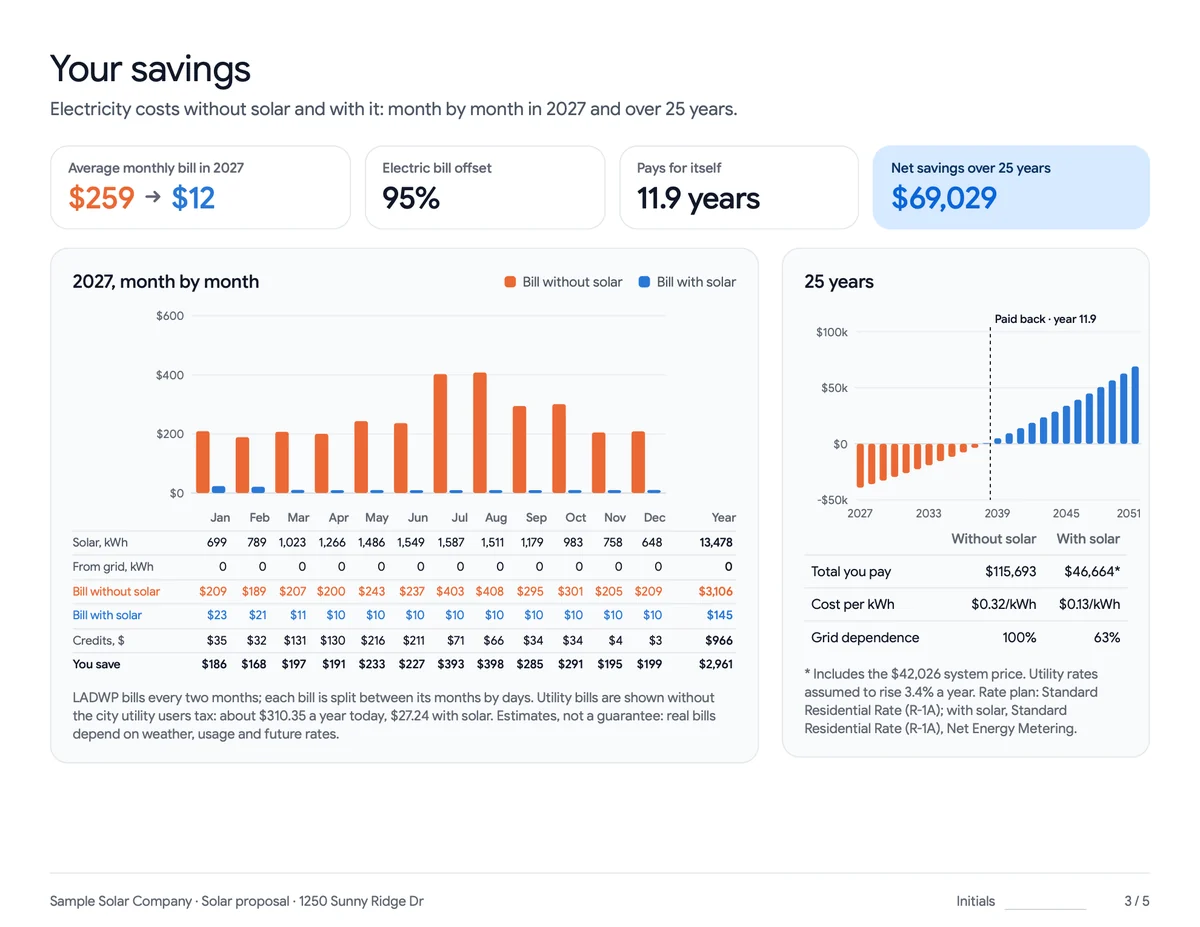
Quotes made in Cali-Graf, the design and proposal software Cali Energy built for installers in Los Angeles, are a useful reference because the software takes the credit out entirely: it subtracts no federal tax credit from the price, the payback or the 25-year savings, and the proposal doesn't mention one, so the customer isn't promised money they can't get. Other rebates aren't added either. The numbers are defined plainly:
| Number on the proposal | How it's calculated |
|---|---|
| Net savings over 25 years | 25 years of bills without solar, minus bills with solar, minus what you pay for the system — the price for cash, all the payments for a loan |
| Pays for itself | When bill savings add up to what you paid upfront; "From year 1" when nothing is paid upfront; "Not within 25 years" when they never do |
| Cost per kWh with solar | What you pay for the system divided by the kWh it makes over 25 years |
| Total you pay | All bills over 25 years, without and with solar; for cash, the price is included and marked |
You can see the whole layout in Cali-Graf's public sample proposal for a made-up demo home — a reference for what a clean set of 2026 numbers contains, not a price for your home. A page-by-page guide is in how to read a solar proposal.
Does solar still make sense without the credit?
Often, yes — the credit made a good deal better, and losing it makes the payback slower rather than the system pointless. In Los Angeles, high utility rates are what make solar pay; the credit's end, and what changed for each kind of ownership, is explained in the 30% solar tax credit ended. The fair way to decide is to compare quotes on the same footing — full price, same system size, same usage and the same assumed rate increase — which is the approach in the solar quote comparison checklist.
Holding a quote that still counts the credit? Ask Cali Energy for a second one on 2026 numbers.
Frequently asked
Is the 30% solar tax credit still available in 2026?
My quote shows a "net cost" after incentives. What does that mean?
My solar loan expects a prepayment from my tax refund. What happens now?
How do I know a quote doesn't include the credit?
Does Cali-Graf include the tax credit in its proposals?
Is this tax advice?
Related reading
Sources & methodology
Product facts on this page come from Cali-Graf's own help center and the pages linked below; figures in examples come from the stated inputs. Features, limits and supported utilities change; each was verified October 16, 2026.
Want a 2026 quote with nothing expired in it?
Cali Energy (CSLB #1032379), a Los Angeles solar installer, prices the full system with no federal credit subtracted and models your LADWP or SCE bill from your own usage. Whoever you hire, check their license first. This page is general information, not tax advice.
Prepared by Cali Energy, October 16, 2026. This article is for general educational purposes only and is not legal, tax, financial, engineering, or utility advice. Rates, incentives, codes, permit requirements, equipment specifications, prices, and program terms may change; figures and timelines are estimates, not guarantees. Confirm current requirements with the applicable utility, AHJ, program administrator, manufacturer, or a licensed professional. See our Content Disclaimer. Cali Energy · 19201 Parthenia St, Unit E, Northridge, CA 91324 · CSLB #1032379 (B, C-10, C-39)