

Your solar installer went out of business. What happens now?
A closure does not switch off a working system — but it does remove the one warranty layer that covers your installer’s own labor. It is not rare: of about 600 companies that installed home solar in Los Angeles County’s SCE territory in 2022, at least 170 had no system approved in 2025–2026. Here is what survives, what California’s license bond and complaint routes can actually do, and why the state’s solar restitution fund is no longer an option.
First: what an installer’s closure does and does not change
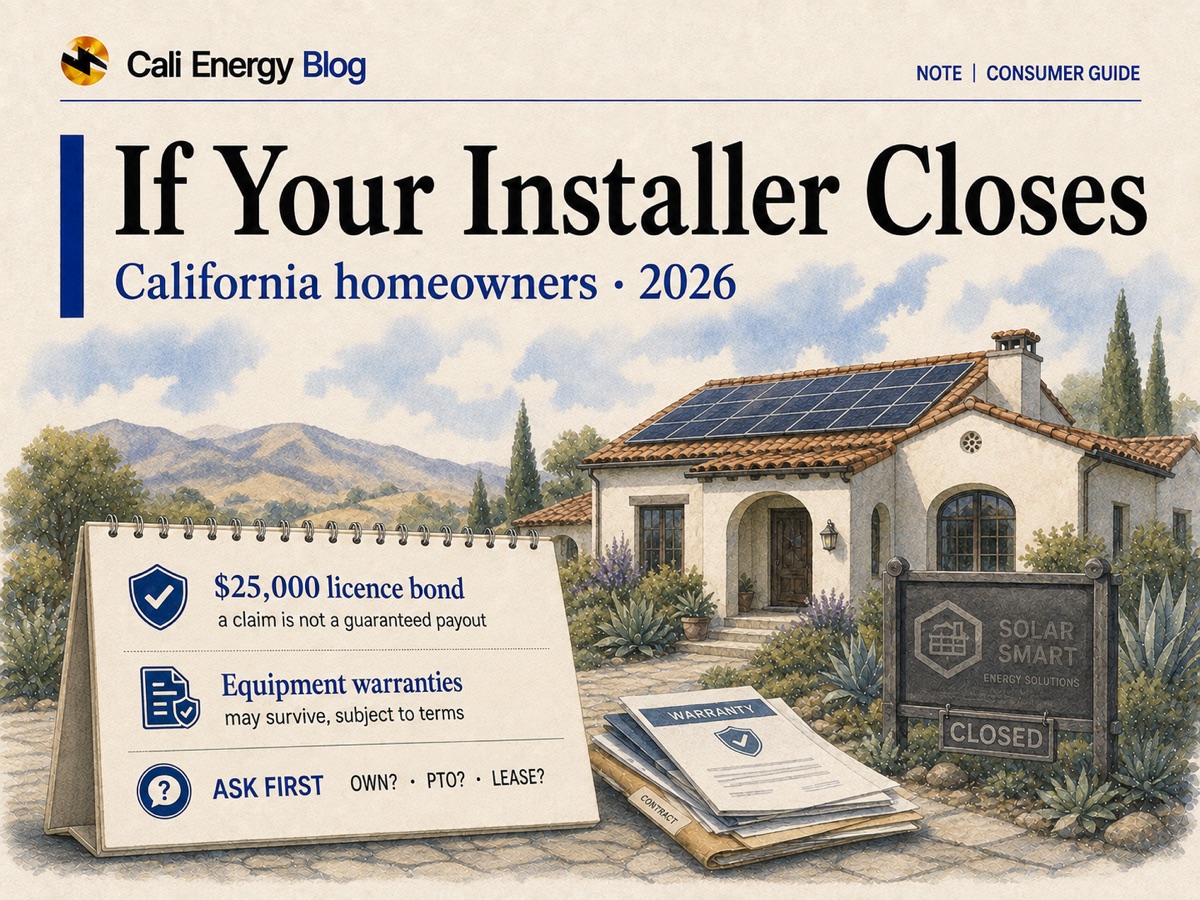
A closure does not flip a switch on your roof — but it does remove one specific layer of protection.
An installer going out of business does not by itself stop a system that is already operating. The equipment keeps running, and the utility interconnection stays in place. But that is only true for a finished, commissioned, energized system. A project that was never completed, never inspected, never granted permission to operate, or that has a failed inverter or dead monitoring, may well need a replacement contractor before it works again.
The layer most at risk is the workmanship warranty — the installer’s own promise to stand behind their labor. In practice it often becomes effectively unavailable once the company is gone, though not always: it may sit with a third-party warranty administrator or insurer, or be assumed by an acquiring company or a successor in bankruptcy. Check who, if anyone, now holds it before assuming it is gone. Manufacturer warranties on the hardware sit with the manufacturers and are a different matter.
How often installers disappear: Los Angeles County data
Public interconnection records show how many companies stop working here.
Every rooftop system interconnected by SCE is listed in the CPUC’s DG Stats data with the name of the company that installed it. Of the roughly 600 companies that installed home solar in Los Angeles County’s SCE territory in 2022, at least 170 — 28% — had no system approved anywhere in that data from January 2025 through August 2026.
| Year installed | Companies | No approvals in 2025–Aug 2026 | Their share of that year’s systems |
|---|---|---|---|
| 2021 | 598 | 195 (33%) | 1,367 of 13,646 (10.0%) |
| 2022 | 598 | 170 (28%) | 1,236 of 21,726 (5.7%) |
| 2023 | 709 | 191 (27%) | 1,155 of 27,441 (4.2%) |
Source: CPUC California DG Stats, SCE interconnected project sites through August 31, 2026 (residential, Los Angeles County, by year of approval; self-installs excluded) · Cali Energy calculation. A company is counted only if no installer active in 2025–2026 shares a distinctive word of its name, so renamed firms are left out; by exact name alone the 2022 figure would be 46%. Leaving the data does not prove a company closed — it may have stopped home solar here, merged, or changed its name.
The share of homes affected is smaller than the share of companies, because the firms that vanish are mostly small: about one 2022 system in 18. But those homeowners are exactly the ones this page is for, and the count does not include large companies that kept their name while going through bankruptcy.
The warranty layers, and which one is most at risk
| Layer | Backed by | Term (2026 documents) | Labor to swap a failed part |
|---|---|---|---|
| Panels | Panel manufacturer | Commonly 25 years; longer terms often need registration or a certified installer | Varies by brand |
| Microinverters | Enphase | 25 years | Not covered; Enphase reimburses installers only in the first two years |
| String inverter | SolarEdge | 12 years on the Home Hub inverter (extendable), 25 on optimizers | Not covered unless SolarEdge agrees in writing |
| Battery | Tesla / Enphase / FranklinWH | Powerwall 3: 10 years; IQ Battery 5P and aPower 2: 15 years | Tesla pays certified installers for approved work |
| Workmanship | The installer | Set by your contract; SGIP-funded solar needs at least 10 years | The installer — the layer that disappears |
Sources: Enphase microinverter warranty and labor reimbursement policy · SolarEdge limited warranty · Tesla Powerwall warranty · Enphase IQ Battery 5P warranty · FranklinWH warranty. Details by brand in solar warranties explained.
Manufacturer warranties may remain available, subject to their terms. Those terms vary by manufacturer and commonly require product registration, may limit transferability, and may require an authorized installer. Read them before assuming coverage.
The gap that surprises people: manufacturer warranties frequently cover the part only. Diagnosis and troubleshooting labor, removal and reinstallation, shipping, and any roof repair are often excluded — and those are exactly the costs the installer’s workmanship warranty would have absorbed.
Find your situation
The right next step depends entirely on where the project stopped.
1. Signed, nothing installed. This is a deposit and contract-recovery question. If you signed within the last three business days — five if you are 65 or older — you can cancel in writing without penalty (CSLB; AB 2471). Otherwise contact the lender if financed, file a CSLB complaint, and consider a bond claim.
2. Partially installed. A new licensed contractor completes the work; expect a scope and pricing dispute over what was already paid for.
3. Installed, but no inspection or permission to operate. The most urgent case. A replacement contractor must take over the permit and interconnection — the system cannot lawfully operate until that is finished.
4. Operating, monitoring lost. Usually recoverable. Installer-branded portals go dark, but the manufacturer’s own app (Enphase Enlighten, mySolarEdge, Tesla) generally persists.
5. Operating, equipment failure. Manufacturer warranty path — a replacement installer can usually file the claim, but expect diagnosis and labor to be out of pocket.
6. Roof leak or workmanship defect. The workmanship layer is gone, so this is where a bond claim and a CSLB complaint matter most.
7. Lease or PPA. You do not own the system. Your agreement may be assigned to another company, and your service contact and payment instructions may change. Read the agreement and confirm in writing who now holds it before changing any payments or hiring anyone. This case is common: in 2025–2026, 47% of new home systems in Los Angeles County’s SCE territory were third-party owned, and the owner in the CPUC data is often a financing company — GoodLeap, LightReach, Enfin or EverBright — rather than the firm that put the panels on the roof (DG Stats, Cali Energy calculation). The owner, not the installer, is the one responsible under the agreement.
What to do first: a 10-step checklist
In order. The early steps cost nothing and protect every option that comes later.
- Do not energize an unfinished system. If it never received permission to operate, leave it off — running it breaches the interconnection agreement.
- Collect the paperwork — signed contract, change orders, every payment receipt, permit documents, inspection records, warranty certificates.
- Establish what you own. Cash, loan, lease or PPA. This single fact decides which of the routes below are open to you.
- Check the permit status with your local building department — in the City of Los Angeles, LADBS’s online Permit Status and Inspection Status tools (ladbs.org). It is public, and it tells you whether the job was ever finaled.
- Check the interconnection and PTO status with your utility. An unfinished interconnection is the most urgent case.
- Secure the monitoring. Record the inverter and battery serial numbers and register the equipment in the manufacturer’s own app before installer-branded access lapses.
- Check the license and bond. CSLB’s license lookup shows the license status and the bond carrier for the contractor. Mind the clock: CSLB’s jurisdiction runs four years from the act for obvious defects and ten for latent structural ones (CSLB).
- Notify the lender or lessor in writing, and ask them to confirm who now services the agreement.
- Get an inspection from a replacement contractor — a written condition report is what a surety, a lender or a court will ask for.
- Choose your route: manufacturer warranty, CSLB complaint, bond claim, lender dispute, bankruptcy claim, or a lawyer — depending on what steps 3 to 9 revealed.
The questions people actually ask
My installer closed before the system was turned on
This is the most urgent case, because an uncommissioned system is not just idle — it may be unpermitted or uninspected. A replacement licensed contractor has to take over the open permit and the interconnection application. Start with the building department to find out exactly which stage the job stopped at, then get a written scope from the new contractor before agreeing any price.
My installer closed after taking a deposit
Nothing was built, so this is a contract and money-recovery question rather than a technical one. The routes are the license bond, a CSLB complaint, small claims for smaller amounts, and — if the company filed for bankruptcy — a proof of claim in that case. If you paid by card or through a lender, raise it with them promptly; time limits apply.
How do I move monitoring into my own name?
Installer-branded portals often disappear, but the manufacturer’s own platform usually survives — Enphase Enlighten, mySolarEdge, or the Tesla app. Each manufacturer runs its own ownership-transfer process, and each will want proof: the system serial numbers, the site address, and evidence you own the equipment. Do this early, while you can still read the serial numbers off the equipment and any old paperwork.
Can another company take over my system?
Yes, if you own it. Any appropriately licensed contractor can service, repair or extend a system they did not install. Expect two things: a paid inspection before anyone warrants anything, and a workmanship warranty that covers their work only, not the original installation.
I have a roof leak and the installer is gone
This is the case where the missing workmanship warranty bites hardest, because roof penetrations are exactly what it covered. Document the leak immediately with photographs and dates, get a written assessment from a roofer or a licensed solar contractor, and use that report for a bond claim or a CSLB complaint. Do not wait for the next rainy season — delay weakens both the claim and the roof.
What each route can and cannot do
| Route | Best for | Main limitation |
|---|---|---|
| Manufacturer warranty | Failed panel, inverter or battery | Often covers the part only, not labor or roof work |
| Contractor license bond | Abandonment, defective workmanship | Filing does not guarantee payment; competing claims share one bond |
| CSLB complaint | Creating a record; arbitration referral | CSLB states it cannot guarantee you get money back |
| Small claims court | Smaller sums, no lawyer needed | CSLB often directs damages under $12,500 here |
| Arbitration via CSLB | Disputes up to $50,000 | Mandatory only up to $25,000; above that it is voluntary |
| Lender or card dispute | Deposits, unfinished work | Time limits apply; act early |
| Claim against the loan holder (FTC Holder notice) | Seller-arranged loans for a job that was never finished | Only if your loan contract carries the notice; have a lawyer confirm |
| Bankruptcy claim | Formal insolvency cases | Unsecured claims are frequently paid at cents on the dollar |
California remedies, and their limits
The contractor license bond. Every licensed California contractor must carry a bond, currently $25,000 — raised from $15,000 by Senate Bill 607, effective January 1, 2023, and unchanged since. It applies to all license classifications, not just solar. A homeowner may submit a claim to the surety for covered violations such as abandonment or poor workmanship. The surety investigates; filing does not guarantee payment, the claim must fall within the bond’s terms and time limits, and a single bond can face competing claims from other customers. See CSLB — Bond Requirements.
A CSLB complaint. Filing creates a documented record and can route the dispute to arbitration or the courts. Per CSLB’s complaint process: damages under $12,500 without repeated violations are often directed to small claims court; disputes of $25,000 or less qualify for mandatory arbitration; disputes between $25,000 and $50,000 qualify for voluntary arbitration. CSLB is explicit about the limits of what it can achieve — it states that it “cannot guarantee that you will get any money back.”
The Solar Energy System Restitution Program is closed. This California-specific fund, created by Assembly Bill 137 in July 2021, paid restitution to consumers financially harmed by solar contractors. It is no longer open. CSLB states: “To ensure availability of remaining funds for claims received, CSLB is no longer accepting new claims for the Solar Energy System Restitution Program (SESRP).” Payments were only ever available while appropriated money remained, under Business and Professions Code section 7086.6. Check current status at CSLB Solar Smart before relying on it.
If a solar company goes out of business, do you still have to pay?
Almost always, yes. The loan is a separate agreement with a separate lender, and the installer’s closure does not by itself cancel it; a lease or PPA moves to whoever now owns the agreement. Do not stop paying on the assumption that it does. Contact the lender, tell them what happened, and take legal advice if the system you contracted for was never completed or never activated — that is a materially different situation from a finished system whose installer later closed.
Two things can help in that harder case. Many seller-arranged consumer loans carry the FTC Holder notice, which preserves your right to raise the same claims and defenses against whoever holds the loan as you had against the seller (FTC Holder Rule); look for the notice in your loan contract. And lenders fail too: Solar Mosaic filed for Chapter 11 in June 2025, and said it would keep servicing loans through the case, with Forbright Bank backing that servicing (KBRA, June 11, 2025). A lender’s bankruptcy changes who collects, not what you owe — check each statement for the current servicer.
Context: this has happened to large companies
Two of the larger recent failures are a matter of public record, and both show up in the Los Angeles County data. SunPower filed for Chapter 11 on August 5, 2024, agreeing to sell part of its business to Complete Solaria (CNBC), which later took the SunPower name. Systems approved under “SunPower Systems” in the county’s SCE territory fell from 2,569 in 2023 to 374 in 2025 and 23 in January–August 2026, while a new “SunPower” name appears from 2025 — so the same logo on two roofs can mean two different companies.
Sunnova filed for Chapter 11 on June 9, 2025; its county approvals went from 747 in 2024 to 2 in January–August 2026. Solaris Assets completed its acquisition in September 2025, with SunStrong Management named asset manager for the portfolio of residential leases, loans and PPAs (Hart Energy, September 4, 2025). If your agreement was with Sunnova, confirm in writing who services it now.
What to gather before you call anyone
Your signed contract; all warranty certificates and product registrations; monitoring logins; the permit and interconnection paperwork; and your loan, lease or PPA documents. Confirm from those documents whether you own the system before you engage anyone. Then verify any replacement contractor’s license and classification on CSLB’s license lookup.
A note on what this page is
This is general information about California consumer remedies, not legal advice. Outcomes turn on your specific contract, the bankruptcy or sale structure, and who holds your agreement. If real money is at stake, take advice from a professional who can read your documents.
Frequently asked
Will my solar panels stop working if the installer closes?
Not by itself. A finished, energized system keeps producing and stays interconnected. But a system that was never completed, never inspected, never granted permission to operate, or that has a failed inverter or dead monitoring, may need a replacement contractor before it works again.
If a solar company goes out of business, do I still have to pay?
Almost always. A loan is a separate agreement with a separate lender, and a lease or PPA moves to whoever now owns it; the installer’s closure does not cancel either. Do not stop paying on that assumption. If the system was never completed or activated, take legal advice and check whether your loan contract carries the FTC Holder notice.
How common is it for solar installers to go out of business?
Common enough to plan for. In CPUC interconnection data, at least 170 of about 600 companies that installed home solar in Los Angeles County’s SCE territory in 2022 — 28% — had no system approved there in 2025 or the first eight months of 2026. They were mostly small firms and built about one 2022 system in 18. Leaving the data does not prove a company closed.
Are my manufacturer warranties still valid?
They may remain available, subject to their terms — for example 25 years on Enphase microinverters, 12 on a SolarEdge Home Hub inverter, 10 on a Powerwall 3 and 15 on an Enphase IQ Battery 5P. Terms commonly require registration and may require a certified installer. Many cover the part only — not diagnosis, labor, shipping or roof repair.
Can I claim against the contractor’s bond?
You may submit a claim to the surety. Every licensed California contractor carries a bond, currently $25,000, covering violations such as abandonment or poor workmanship. The surety investigates each claim — filing does not guarantee payment, and a single bond can face competing claims. See CSLB bond requirements.
How long do I have to file a complaint with CSLB?
CSLB has jurisdiction for up to four years from the act for obvious defects and up to ten years for latent structural defects. Filing early also helps a bond claim, since one $25,000 bond is shared by everyone who claims against it.
Is the Solar Energy System Restitution Program still open?
No. CSLB states it is “no longer accepting new claims” in order to reserve remaining funds for claims already received. Check current status at CSLB Solar Smart.
What if I have a lease or PPA rather than owning the system?
Then you do not own it, and the playbook is different. The agreement may be assigned to another company, and your service contact and payment instructions may change. Read the agreement and confirm in writing who holds it before changing payments or hiring anyone.
My solar installer closed before PTO — what happens now?
A replacement licensed contractor must take over the open permit and the interconnection application before the system can legally operate. Start with your local building department to establish exactly which stage the job stopped at, then get a written scope from the new contractor. Do not energize the system in the meantime.
How do I transfer solar monitoring to my own account?
Use the manufacturer’s own platform rather than the installer’s branded portal — Enphase Enlighten, mySolarEdge or the Tesla app typically survive the installer’s closure. Each runs its own ownership-transfer process and will ask for the system serial numbers, the site address and proof you own the equipment.
Can another solar company service a system they did not install?
Yes, if you own the system. Any appropriately licensed contractor can take it on. Expect a paid inspection first, and note that their workmanship warranty will cover their own work only — not the original installation.
I have a roof leak and the solar company is gone. What now?
Document it immediately with photographs and dates, then get a written assessment from a roofer or licensed solar contractor. That report is what supports a bond claim or a CSLB complaint. Roof penetrations were covered by the workmanship warranty, which is the layer most at risk when a company closes — so act before the next wet season rather than after it.
Related reading
Sources & methodology
Figures on this page come from the primary sources below and, where noted, from Cali Energy calculations using the stated assumptions. Rates, incentives, and program terms change; each was verified October 6, 2026.
- CPUC — California DG Stats, SCE interconnected project sites (data through August 31, 2026)
- CSLB — Complaint process against licensed contractors
- CSLB — Building Official Information Guide (complaint time limits, B&P 7091)
- CSLB — Solar Smart (SESRP status, right to cancel, Solar Energy System Disclosure)
- CSLB — Contractor license bond requirements
- California Legislature — AB 2471 (2020), five-day right to cancel for seniors
- FTC — Holder in Due Course Rule (16 CFR Part 433)
- KBRA — Comments on Chapter 11 filing of Solar Mosaic (June 11, 2025)
- Hart Energy via Yahoo Finance — Solaris completes acquisition of Sunnova (September 4, 2025)
- CNBC — SunPower files for bankruptcy (August 5, 2024)
- Enphase — US limited warranty, IQ microinverters
- Enphase — Labor reimbursement for warranty service, North America (February 2026)
- SolarEdge — Limited product warranty (January 2026)
- Tesla — Powerwall limited warranty
- Enphase — US limited warranty, IQ Battery 5P
- FranklinWH — limited warranty for end users
- LADBS — permit and inspection status
About this reference
Cali Energy is a licensed California contractor (CSLB #1032379) based in Northridge. We publish this page as a reference and date it to the day each figure was checked against its source.
Prepared by Cali Energy, October 6, 2026. This article is for general educational purposes only and is not legal, tax, financial, engineering, or utility advice. Rates, incentives, codes, permit requirements, equipment specifications, prices, and program terms may change; figures and timelines are estimates, not guarantees. Confirm current requirements with the applicable utility, AHJ, program administrator, manufacturer, or a licensed professional. See our Content Disclaimer. Cali Energy · 19201 Parthenia St, Unit E, Northridge, CA 91324 · CSLB #1032379 (B, C-10, C-39)