

Do Solar Panels Need Maintenance in California?
Straight answer: very little. In a UC San Diego study of 186 California installations, panels that went 145 days of summer drought without rain or cleaning lost only 7.4% of their output — cleaning a typical 5 kW home system at that point would have been worth about $20. Clean when dirt is visible or production drops, from the ground, with water at air temperature and never a pressure washer. The parts that deserve attention are the inverter and the monitoring feed.
Get a free estimate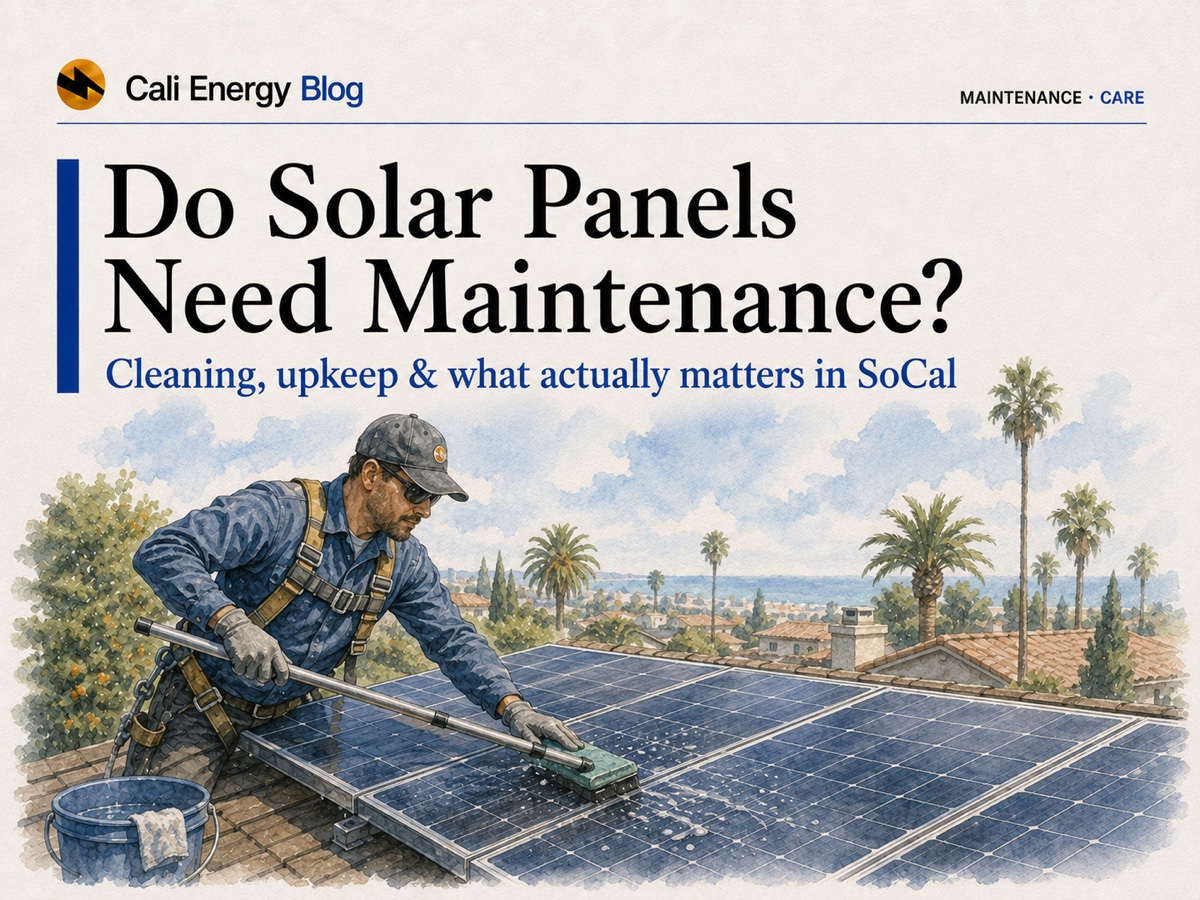
- Panels need little upkeep, and normal rain cleans panels installed at a sufficient tilt (REC).
- Dirt costs less than most people think: 7.4% after 145 dry days across 186 California systems, about $20 of energy for a typical 5 kW home (UC San Diego).
- Clean when dirt is visible or output drops — sooner for bird droppings or panels near highways, factories or fields.
- Clean cool panels in the early morning with water at air temperature and a soft sponge or brush. REC says pressure or steam cleaners, blades and metal sponges void its warranty; never stand on panels.
- The inverter is the part most likely to need replacing, and some warranties require the system to stay online.
Do solar panels need maintenance?
Not much. A fixed rooftop array has no moving parts, and REC, for one, designs its panels so that normal rainfall cleans them when they are installed at a sufficient angle; the flatter the panels, the more cleaning they need (REC installation manual). What remains is a short list: keep an eye on production, clear heavy soiling when it appears, have the hardware checked now and then, and plan for the inverter. Who does it depends on ownership. The CPUC’s consumer guide notes that unless you buy a maintenance plan or your system comes with one, maintenance and repairs are yours; on a lease or power purchase agreement, the provider is responsible for monitoring, maintenance and repairs (CPUC).
Maintenance is also different from two things it cannot fix: panel degradation, the slow permanent aging of the cells, and the midday dip from heat.
What dirties panels in Southern California
Dry-season dust
Months without rain let a film build up, and windy stretches add more.
Spring pollen
A yellow film that trims output until the next good rain or rinse.
Bird droppings and sap
Opaque and concentrated, so they shade the cells beneath them — the case the UC San Diego study singled out as worth cleaning.
Wildfire ash
Settles on every outdoor surface in fire season; the first rains take most of it.
Leaves and debris
Collect along the bottom edge and under the array; clear them from the ground after wind.
How much dirt costs you
The most directly relevant California data come from a UC San Diego study published in Solar Energy in 2013. Its engineers compared 186 residential and commercial installations across the state after rainfall and during a 145-day summer drought in 2010. Panels that went the whole stretch without rain or cleaning lost only 7.4% of their efficiency — a little under 0.05% a day — and cleaning a typical 5 kW residential system would have gained about $20 of electricity before the drought ended. “Most homeowners won’t get their money back for hiring someone to wash their rooftop panels,” the principal investigator said. The exceptions were panels heavily soiled with bird droppings and those near highways, factories or agricultural fields (UC San Diego).
Soiling does vary by place. The national laboratory’s PV Fleet program puts typical annual soiling losses at 2–3%, and up to 15% at dirtier sites (PV Fleet final report, 2025); its soiling map, built from data at 255 U.S. sites, expresses the loss as a ratio — 0.95 means 5% of a year’s energy (NREL soiling map). For most Los Angeles roofs the practical rule stands: the rainy season does most of the cleaning, and hand-cleaning pays mainly after heavy ash, near a dust source, or when droppings sit on the glass.
Your realistic maintenance list
| Task | When | Who | Watch-out |
|---|---|---|---|
| Check the monitoring app | Monthly habit | You | A sudden step-down is a service call, not a cleaning |
| Rinse dust, pollen or ash | When dirt is visible or output drops | You, from the ground, or a pro | Cool panels, water at air temperature, no pressure washer |
| Remove bird droppings or sap | As they appear | You with a soft pole brush, or a pro | No blades, metal sponges or acid or alkali cleaners |
| Clear leaves and debris | After wind | You from the ground, or a pro | Do not climb onto the array |
| Trim overhanging branches | As they grow | Arborist | New shade costs more than dust |
| Inspect fasteners, connections, cables and grounding | Periodically, and when output drops | Licensed contractor | Rooftop electrical work is not a DIY job |
Sources: REC cleaning guide · REC installation manual · UC San Diego.
How to clean panels safely
REC’s cleaning guide and installation manual set out the method; other manufacturers’ manuals are similar, and yours is the one that counts for your warranty.
Clean cool panels
In the sun, panels run about 20°C above the air. Water colder or hotter than the glass can crack it, so clean in the early morning with water at ambient temperature.
Use gentle water
A garden hose at household pressure is fine. Deionized water is ideal; rainwater or tap water will do.
Soft tools only
A sponge, microfiber cloth or soft brush on an extension pole; a mild biodegradable washing-up liquid for stubborn dirt; isopropyl alcohol under 10% for stains.
Stay off the panels
Never stand, walk or lean on them — it can cause damage you cannot see. Working at height needs fall protection; if in doubt, call a professional.
Pressure washers void the warranty
REC does not permit pressure or steam cleaners, high-pressure hoses, knives, blades or metallic sponges on its panels, and says their use will invalidate the warranty; acid or alkali detergents must not be used (REC). Check your own panel maker’s manual before cleaning. More on warranty conditions in solar warranties explained.
The inverter is the part that wears
The CPUC’s consumer guide tells owners to keep the equipment warranties, “particularly for the inverter, which may need to be replaced sooner than other equipment” (CPUC). Warranty terms differ by type: Enphase covers its IQ microinverters for 25 years (Enphase); SolarEdge covers its power optimizers for 25 years and its inverters for 12, with paid extensions for some models (SolarEdge). Replacement options and costs are in solar inverter replacement cost, and the two architectures are compared in Enphase vs SolarEdge.
Monitoring catches what cleaning can’t
The production app is how you spot what a rinse will not fix: a failed inverter, a tripped breaker, a panel-level fault or new shade. A slow drift through a dry season usually means dirt; a sudden step-down, a panel or string at zero, or an error code means a service call. Keep the system online, too: SolarEdge says it cannot honor its warranty if the equipment stays disconnected from its monitoring platform, beyond temporary outages, and Enphase asks for a continuous connection (SolarEdge; Enphase). If output has dropped and a rinse did not bring it back, work through the solar-not-producing checklist.
What an inspection checks
REC’s manual asks for regular inspection of four things; a licensed crew adds the rest.
Fasteners
Secure, tight and free from corrosion.
Electrical connections
Secure, tight, clean and free of corrosion.
Cables
Mechanical integrity intact — no chafing, cracking or rodent damage.
Grounding
Bonding points tight and free from corrosion, so the panels stay connected to ground.
Inverter
Error logs, fault codes and remaining warranty.
Production vs expectation
Measured output against the design estimate, to find a panel or string that is quietly dragging.
Source for the first four: REC installation manual, System Inspection.
- Fall: after fire-season ash or heavy dust, a gentle rinse if output has dropped; the first rains do the rest.
- Winter: let the rain clean; check the app after storms for dropouts.
- Spring: pollen season — rinse only if you see a film and production dips.
- Summer: the long dry stretch — watch for droppings and slow soiling; rinse only if output falls.
- Any time: a sudden drop in the app means service, not soap.
Dirt, aging and heat are different problems
Soiling is reversible: rain or a rinse brings the output back. Degradation is the panel’s slow, permanent aging — about 0.5% a year at the module median — and no cleaning reverses it. The midday heat dip is temporary physics on hot afternoons. Only the first one is fixed with water.
Low-maintenance, not no-attention. If production has slipped and a rinse did not fix it, Cali Energy (CSLB #1032379) can find the cause — a connection, an inverter, new shade — and tell you plainly whether it needs work. Call +1-323-844-7777.
Book a system checkFrequently asked
Do solar panels need maintenance in California?
Very little. Panels have no moving parts and rain cleans panels installed at a sufficient tilt. Watch production, clear heavy soiling when it appears, have fasteners, connections, cables and grounding inspected periodically, and plan for the inverter.
How often should I clean my solar panels?
Only when dirt is visible or output drops. A UC San Diego study of 186 California installations found 7.4% lost after 145 days without rain or cleaning; cleaning a typical 5 kW home system then would have gained about $20. Bird droppings and sites near highways, factories or fields are the exceptions.
Can I use a pressure washer on solar panels?
No. REC does not permit pressure or steam cleaners, high-pressure hoses, blades or metal sponges on its panels and says their use invalidates the warranty. Use a hose at household pressure, water at air temperature and a soft sponge or brush, in the cool early morning.
Who is responsible for maintaining my solar system?
If you own it, you are, unless you bought a maintenance plan or the system came with one. On a lease or power purchase agreement, the provider is responsible for monitoring, maintenance and repairs, according to the CPUC’s consumer guide.
Which part of a solar system is most likely to need replacing?
The inverter. The CPUC’s guide notes it may need replacing sooner than other equipment. Enphase covers its microinverters for 25 years; SolarEdge covers its inverters for 12 and its optimizers for 25.
Is it worth paying for professional panel cleaning?
Rarely for a typical home: the UC San Diego researchers concluded most homeowners would not get their money back. It can pay after heavy ash, near a dust source, when droppings cover part of a panel, or when the roof is unsafe to reach from the ground.
Related reading
Sources & methodology
Figures on this page come from the primary sources below and, where noted, from Cali Energy calculations using the stated assumptions. Rates, incentives, and program terms change; each was verified September 30, 2026.
- UC San Diego — Cleaning solar panels often not worth the cost (Solar Energy, July 2013; 186 installations, 145-day drought)
- NREL (now NLR) — Photovoltaic module soiling map (255 U.S. sites)
- PV Fleet Performance Data Initiative — Final Technical Report (NREL/TP-5K00-92444, 2025): typical soiling losses
- REC — Quick guide to cleaning
- REC — Alpha Pure panels installation manual (rev. 18, 2026): cleaning instructions and system inspection
- CPUC — California Solar Consumer Protection Guide
- Enphase — US Limited Warranty, IQ Microinverters
- SolarEdge — Limited Product Warranty (effective January 1, 2026)
Panels not producing like they used to?
If a rinse didn't bring your output back, we'll check the inverter, wiring, and monitoring and tell you what's really going on — no upsell.
Get a free estimatePrepared by Cali Energy, September 30, 2026. This article is for general educational purposes only and is not legal, tax, financial, engineering, or utility advice. Rates, incentives, codes, permit requirements, equipment specifications, prices, and program terms may change; figures and timelines are estimates, not guarantees. Confirm current requirements with the applicable utility, AHJ, program administrator, manufacturer, or a licensed professional. See our Content Disclaimer. Cali Energy · 19201 Parthenia St, Unit E, Northridge, CA 91324 · CSLB #1032379 (B, C-10, C-39)