

How Durable Are Solar Panels? Hail, Wind & Storms
Straight answer: very, for Los Angeles weather. Every certified panel passes a test of 11 one-inch ice balls fired at 51 mph and must keep at least 95% of its power, and when a severe hailstorm hit the Denver area in 2017, one of NREL’s more than 3,000 panels broke. In 71 years of NOAA severe-hail records, Los Angeles County has 18 reports and none since 2006, so here the real tests are wind — which the 2025 California Residential Code puts on the racking and roof attachments — debris and ash. Storm damage is usually an insurance question, not a warranty one.
Get a free estimate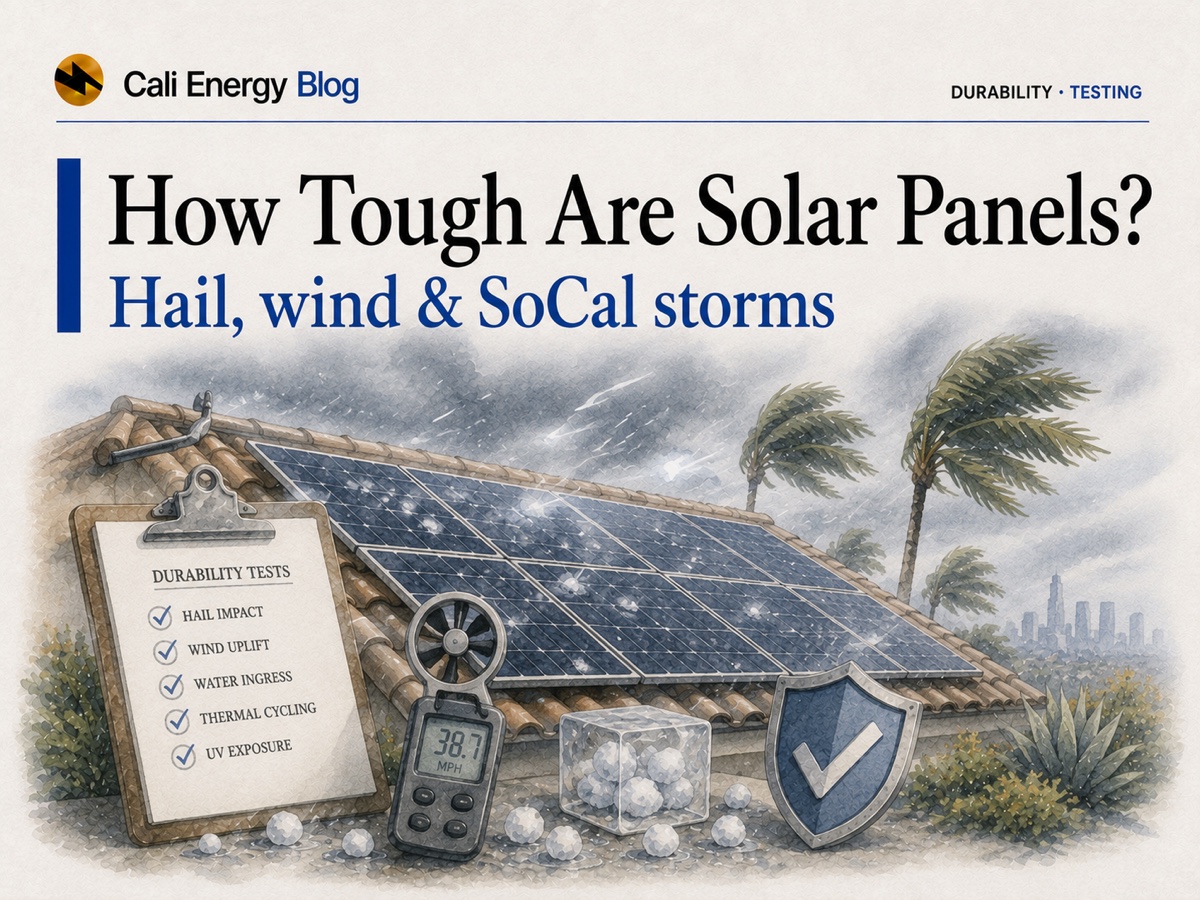
- Hail test: to be certified, a panel takes 11 strikes of 25 mm (1-inch) ice balls at 51 mph, must look undamaged and lose under 5% of its power. Larger classes up to 76 mm are optional and rarely published.
- Real world: one of NREL’s 3,000-plus panels broke in the 2017 Denver-area hailstorm. Los Angeles County has 18 severe-hail reports in 71 years of NOAA records, 8 of them an inch or larger and none since 2006; Colorado logged 4,156 reports of inch-plus hail in 2015–2025 alone.
- Wind is a design item: California’s 2025 Residential Code requires rooftop PV and its supports to be designed for the code’s wind loads, with UL-listed modules and any UL 2703 racking installed per its listing.
- Who pays: module warranties cover defects, and Maxeon’s, for one, excludes hail, lightning, fire, flood and impact. Panels on the house fall under the dwelling part of a homeowners policy, where earthquake and flood are usually excluded.
- In LA wind-thrown debris and wildfire ash are likelier than hail. A production check after a storm finds the damage you can’t see from the ground.
What a panel is certified to survive
Two standards stand behind a panel, and California’s code requires one of them by name.
A panel is a sealed sandwich of tempered front glass, encapsulant, cells and a backsheet in an aluminum frame. IEC 61215 is the design-qualification standard, and its hail test is the one quoted for durability; UL 61730 is the safety standard. The 2025 California Residential Code requires rooftop panels to be listed to UL 61730-1 and -2 or the older UL 1703 and inverters to UL 1741, and racking listed to UL 2703 must be installed according to its listing (CRC §R329.3.1). Certification is a minimum, not a guarantee against everything: large hail, flying debris and careless handling still cause damage.
Hail: what the test simulates, and what LA actually gets
The certification test is modest; Los Angeles weather is milder still.
| Ice ball | Mass | Speed | Status |
|---|---|---|---|
| 25 mm (1.0 in) | 7.54 g | 23 m/s (51 mph) | Required for certification |
| 35 mm (1.4 in) | 20.7 g | 27.2 m/s (61 mph) | Optional, rarely published |
| 45 mm (1.8 in) | 43.9 g | 30.7 m/s (69 mph) | Optional, rarely published |
| 55 mm (2.2 in) | 80.2 g | 33.9 m/s (76 mph) | Optional, rarely published |
| 65 mm (2.6 in) | 132 g | 36.7 m/s (82 mph) | Optional, rarely published |
| 76 mm (3.0 in) | 203 g | 39.5 m/s (88 mph) | Optional, rarely published |
Source: U.S. Department of Energy, FEMP — Hail damage mitigation for PV. To pass, a module must be visually undamaged and lose under 5% of its power after 11 strikes. Advanced tests include RETC’s Hail Durability Test, PVEL’s Hail Stress Sequence with 50 mm ice balls and FM Global 4478.
The base test is a fair stand-in for moderate hail. When a severe storm hit the Denver area on May 8, 2017, leaving golf-ball-sized dents in car roofs, NREL inspected the more than 3,000 panels on and around its Research Support Facility and found one broken — a module struck by several hailstones in almost the same place (DOE). Hail can also crack cells without breaking the glass, and those cracks can cut output over time; finding them takes electroluminescence imaging rather than a look from the ground (DOE FEMP).
Los Angeles rarely gets that kind of hail. We counted the National Weather Service’s severe-hail reports for Los Angeles County in NOAA’s Storm Prediction Center database: 18 reports from 1955 through 2025, 8 of them an inch or larger, the largest 1.75 inches in August 1984, and none since December 2006. California as a whole logged 354 reports of hail an inch or larger in those 71 years; Colorado logged 10,687, including 4,156 in 2015–2025 alone (NOAA SPC). Reports depend on someone measuring the stones, so the counts are a floor, but the contrast is the point. In hail country a module that has passed a larger-class or advanced hail test is worth asking for; in LA, where no hail of an inch or more has been reported since 2006, it is rarely the deciding spec.
Above the baseline: FM hail classes
What “Class 4” on a spec sheet means.
| Rating | Ice ball | Target impact energy |
|---|---|---|
| Class 1 | 1¼ in (31.8 mm) | 5.0 J |
| Class 2 | 1½ in (38.1 mm) | 10.4 J |
| Class 3 | 1¾ in (44.5 mm) | 20.3 J |
| Class 4 | 2 in (50.8 mm) | 36.4 J |
| VSH (Very Severe Hail) | 2 in (50.8 mm), faster | 72–79 J |
Sources: ANSI/FM 4473 (classes 1–4) · FM 4478 (rooftop PV modules, VSH).
Beyond the one-inch test every certified panel passes, some manufacturers have modules rated by FM Approvals. FM’s standard for rooftop PV modules tests hail resistance with the ice balls of ANSI/FM 4473, requires at least Class 2 for certification and offers Class 2, 3, 4 or Very Severe Hail ratings; VSH fires a Class 4 two-inch ball fast enough to deliver 72–79 joules per impact, and the module must show no cracking, splitting or rupture under 10× magnification (FM 4478). The rating is on the module, so ask for the certificate for the exact model. In Los Angeles, with no inch-plus hail reported since 2006, it matters most in the high desert and mountains or when an insurer asks for it.
Wind: the racking and roof attachments carry it
A panel does not get a wind rating on its own; the whole system is designed for the site.
The 2025 California Residential Code requires rooftop PV panels and their supports to be designed and installed to resist the code’s component-and-cladding wind loads, adjusted for the building’s height and exposure (CRC §R329.4.1.2). The design wind speed comes from the code map, which corresponds to roughly a 7% chance of being exceeded in 50 years; where the map reaches 140 mph or a special wind region applies, the code’s simple tables no longer apply and an engineering method such as ASCE 7 is used (§R301.2.1.1). In practice the number and spacing of roof attachments, the rail spans and the fasteners into the framing are checked at plan review, and UL 2703 racking must be installed per the manufacturer’s instructions and its listing.
For Southern California the wind that matters is the Santa Ana: dry, gusty offshore events that also throw branches and debris. A correctly attached array rides them out; failures trace to too few or misplaced attachments, weak roof framing or workmanship. Tile roofs need the most care at each attachment — see solar on clay-tile roofs. Fire-weather winds can also bring planned power shutoffs, a grid issue rather than panel damage; see solar and batteries for PSPS shutoffs.
What actually damages panels
When a certified panel is hurt, it is usually one of these, and most are avoidable.
Large or repeated hail
Stones above the test size, or several in one spot, crack glass or cells. Rare in LA; the reason hail-country buyers ask for higher test classes.
Flying debris
A wind-thrown limb hits harder than hail. Trimming trees near the array is the cheapest protection there is.
Installation
Too few attachments, long spans or anchors into weak framing turn a normal wind event into a failure. This is what plan review and inspection check.
People
Stepping on panels during roof work can crack cells you can’t see, and warranties exclude damage caused by persons (Maxeon).
Moisture at the edges
A broken seal or cracked backsheet lets water in over time, causing corrosion or hot spots — usually the after-effect of an impact or a bad install.
Ash and dust
They don’t break glass; they cut output until rinsed. Normal rain cleans tilted panels, and 145 dry summer days cost California systems 7.4% in a UC San Diego study (see solar maintenance).
Here, wind, debris and ash outrank hail
With severe hail almost absent from the record, durability in LA comes down to a properly engineered, well-attached array, trees kept clear of it, and a look at production after a big wind or ash event. The slow wear is aging, not weather: modules lose about 0.5% a year at the median and whole systems about 0.75% (solar panel degradation); heat effects are in heat and solar output in LA.
Warranty or insurance: who pays for storm damage
They cover different things, and storm damage usually lands on the insurance side.
A module warranty covers defects in materials and workmanship and the power the panel keeps over time. It is not storm cover. Maxeon’s U.S. module warranty, for example, excludes damage from lightning, flood, fire, hail or other acts of nature, damage from impact or from persons, and conditions beyond the panel’s rated wind and snow loads (Maxeon); other makers’ terms are in solar warranties explained.
Homeowners insurance is where storm damage is claimed. In the California Department of Insurance’s description, dwelling coverage protects the house and attached structures when they are damaged by a covered peril, and earthquake, flood, earth movement and wear and tear are perils usually excluded. Structures not attached to the house, such as a detached garage, fall under other-structures coverage, normally limited to 10% of the dwelling limit (CDI). So ask your insurer three things before you install: whether the panels are covered as part of the dwelling, what the deductible is for wind or hail, and how a ground-mounted or carport array would be treated.
- Your panels’ datasheet shows UL 61730 (or UL 1703) and IEC 61215.
- The permit set shows the attachment layout designed for your site’s wind load.
- You have read your module warranty’s exclusions.
- Your insurer has confirmed the panels are covered and told you the deductible.
- After a big storm, compare production with the same week last year before looking for damage on the roof.
Where to go next
Cali Energy is a licensed Los Angeles solar, battery and electrical contractor (CSLB #1032379); we install listed panels and racking on permit, with the attachment layout on the plan set. This is general information, not engineering or insurance advice. Call +1-323-844-7777 or ask about an install built for the weather.
Frequently asked
Can solar panels survive hail?
Ordinary hail, yes. Every certified panel passes 11 strikes of 1-inch ice balls at 51 mph with under 5% power loss, and in the 2017 Denver-area hailstorm one of NREL’s more than 3,000 panels broke. Larger hail can crack glass or cells, so after a severe storm check your production.
How often does Los Angeles get hail big enough to damage solar panels?
Rarely. NOAA’s Storm Prediction Center database has 18 severe-hail reports for Los Angeles County from 1955 through 2025, 8 of them an inch or larger, the largest 1.75 inches in 1984, and none since 2006. Colorado logged 4,156 reports of inch-plus hail in 2015–2025 alone.
Can Santa Ana winds blow solar panels off the roof?
A permitted array is designed not to. California’s 2025 Residential Code requires rooftop panels and their supports to resist the code’s wind loads for the site, and racking listed to UL 2703 must be installed per its listing. When arrays fail in wind, attachment layout, roof framing and workmanship are the usual causes.
Does my solar warranty cover hail or storm damage?
Usually not. Module warranties cover manufacturing defects and power output; Maxeon’s, for example, excludes lightning, flood, fire, hail and other acts of nature, impact, and loads beyond the panel’s ratings. Read your own warranty and treat storm damage as a possible insurance claim.
Does homeowners insurance cover solar panels?
Panels attached to the house generally fall under dwelling coverage, which the California Department of Insurance describes as protecting the house and attached structures from covered perils; earthquake and flood are usually excluded. Confirm with your insurer and ask about the wind and hail deductible. This is general information, not insurance advice.
Does wildfire ash damage solar panels?
Ash doesn’t break glass; it cuts output until it is rinsed off. Normal rain cleans tilted panels, and after heavy ashfall a gentle rinse with cool panels restores production; our maintenance guide covers doing it safely.
Related reading
Sources & methodology
Figures on this page come from the primary sources below and, where noted, from Cali Energy calculations using the stated assumptions. Rates, incentives, and program terms change; each was verified October 5, 2026.
- U.S. Department of Energy, FEMP — Hail damage mitigation for solar PV systems (IEC 61215 hail test classes)
- U.S. Department of Energy — “Hail No! National Lab’s Solar Panels Survive Severe Storm” (May 15, 2017)
- NOAA Storm Prediction Center — severe weather database, hail reports 1955–2025
- 2025 California Residential Code (Title 24, Part 2.5) — Sections R329 (solar energy systems) and R301.2 (wind)
- Maxeon — Limited Warranty for PV Modules (United States)
- California Department of Insurance — Residential insurance: homeowners and renters
- ANSI/FM Approvals 4473 — impact resistance testing with freezer ice balls (classes 1–4)
- FM Approvals 4478 — roof-mounted rigid photovoltaic modules (hail rating Class 2–4, VSH)
Want an install built to ride out the weather?
We use listed panels and racking and lay out the attachments for your roof and site wind load on the permit set. Tell us about your roof for a straight answer.
Get a free estimatePrepared by Cali Energy, October 5, 2026. This article is for general educational purposes only and is not legal, tax, financial, engineering, or utility advice. Rates, incentives, codes, permit requirements, equipment specifications, prices, and program terms may change; figures and timelines are estimates, not guarantees. Confirm current requirements with the applicable utility, AHJ, program administrator, manufacturer, or a licensed professional. See our Content Disclaimer. Cali Energy · 19201 Parthenia St, Unit E, Northridge, CA 91324 · CSLB #1032379 (B, C-10, C-39)