

Solar Panel Certifications & Testing Standards Explained
Panel spec sheets are full of standards — IEC 61215, IEC 61730, UL 61730, “Tier 1.” This guide explains what each one actually tells you, what it does not, and why the most-quoted label — Tier 1 — is a measure of bank financing, not panel quality.
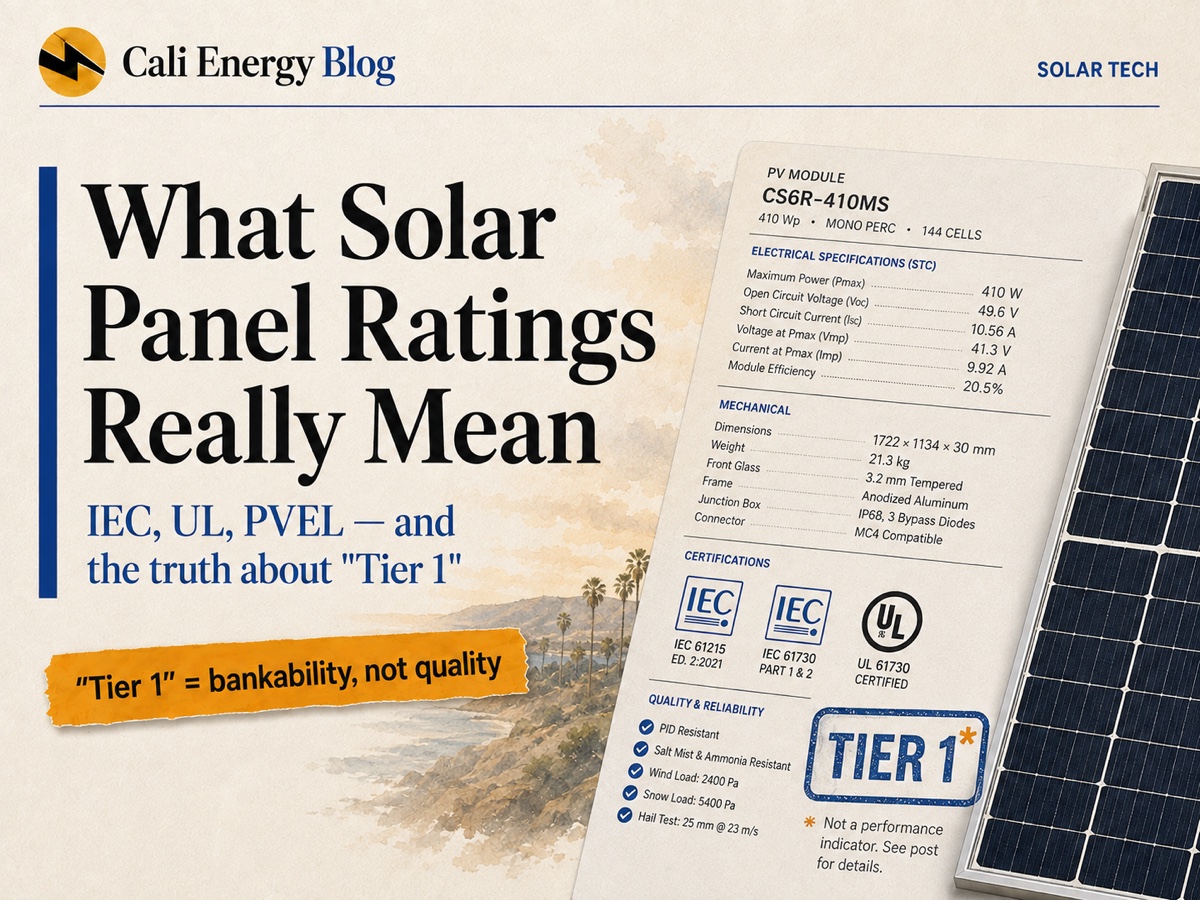
- IEC 61215 = design qualification; IEC 61730 / UL 61730 = safety. Passing them is a baseline, not a performance forecast.
- California’s official module list requires a safety listing but not IEC 61215: only 6% of the 22,358 listed models have an IEC 61215 certificate on file. The datasheet is where to look.
- The PVEL Reliability Scorecard tests beyond the IEC minimums — and in 2026, 87% of manufacturers tested had at least one failure. Only 5 of 246 Top Performer model types topped every reliability test.
- “Tier 1” is a BANKABILITY rating from BloombergNEF, not a quality or technical rating. BNEF says so explicitly, and only its latest quarterly list counts.
- For real quality, read the certifications, the PVEL results for the specific model, and the warranty — not just “Tier 1.”
The standards at a glance
| Standard | What it covers | Why it matters |
|---|---|---|
| IEC 61215 | Design qualification & type approval (accelerated stress) | Baseline: the design survived a standardized test sequence |
| IEC 61730 | Safety (construction + testing) | Electrical, mechanical, thermal, fire safety |
| UL 61730 | North American safety (US national differences, NEC) | What US installers/AHJs look for on a listing |
| PVEL Scorecard | Independent reliability testing beyond IEC | Empirical, model-level quality signal |
| BNEF “Tier 1” | Bank financeability of the manufacturer | NOT a quality rating — a lender-track-record label |
IEC 61215 — design qualification
IEC 61215 is a design-qualification and type-approval test sequence that puts a module design through accelerated environmental stresses — thermal cycling, damp heat, humidity-freeze, mechanical load, and hail impact. It confirms a design can survive a standardized battery of stresses.
What it is not: passing IEC 61215 does not guarantee a module’s real-world field life or predict its future degradation rate. It’s a qualification test, not a 25-year warranty of performance.
The current edition is IEC 61215:2021, in several parts; a spec sheet citing it, or the 2016 edition, tells you which test sequence the design passed.
Source: IEC 61215-1:2021 (IEC Webstore) · verified October 6, 2026.
IEC 61730 and UL 61730 — safety
IEC 61730 covers module safety in two parts: 61730-1 (construction requirements) and 61730-2 (testing). It assesses electrical, mechanical, thermal, and fire safety — that the panel won’t cause shock or fire.
UL 61730 is the North American version: it harmonizes IEC 61730 with US national differences (superseding the legacy UL 1703) and ties to National Electrical Code requirements. It is a module safety qualification — not a certification of an entire grid-interconnection system.
Source: UL Solutions — UL 61730 transition · verified October 6, 2026.
What California’s equipment list actually checks
The California Energy Commission keeps the state’s official PV Module List, the list installers and utilities check equipment against. Every listed model has a safety certification; the design-qualification test is optional. In the list dated October 1, 2026:
- 22,358 module models are listed. 62% are listed to UL 61730 and 36% to the legacy UL 1703 (older models certified before the switch).
- The CEC states that design-qualification certification and performance-evaluation testing are not required to be listed. An IEC 61215 certificate date is on file for only 1,427 models (6%).
What homes around Los Angeles actually get: in SCE’s interconnection data for home systems approved in Los Angeles County in 2025, 13,154 systems name a module we could match to the CEC list. 96% used modules listed to UL 61730. The five most common models:
| Module | Systems | Share | Safety listing (CEC) | IEC 61215 on the CEC list |
|---|---|---|---|---|
| Qcells Q.PEAK DUO BLK ML-G10 410 | 1,588 | 12.1% | UL 61730 | Not submitted |
| JA Solar JAM54S31-405/MR | 1,533 | 11.7% | UL 61730 | Not submitted |
| LONGi LR5-54HABB-400M | 1,293 | 9.8% | UL 61730 | Not submitted |
| Qcells Q.PEAK DUO BLK ML-G10 405 | 1,088 | 8.3% | UL 61730 | Not submitted |
| REC460AA Pure-RX | 419 | 3.2% | UL 61730 | Not submitted |
“Not submitted” does not mean the module lacks IEC 61215 — manufacturers simply don’t have to file it with the CEC. Check the module’s datasheet or certificate instead; the state list confirms safety, not durability.
Sources: CEC Solar Equipment Lists — PV Module List (data as of October 1, 2026) · CPUC California DG Stats, SCE interconnected project sites (data through August 31, 2026) · Cali Energy match by model number.
The PVEL Reliability Scorecard — where quality actually shows
Published annually by Kiwa PVEL, the PV Module Reliability Scorecard tests modules beyond the IEC minimums through its Product Qualification Program (PQP). The 2026 edition, the twelfth, names 43 manufacturers and 246 model types as Top Performers in at least one test. The rest of the picture is less flattering:
- 87% of manufacturers had at least one module fail a PQP test, a record high.
- Module breakage in the mechanical and hail sequences was again the leading failure, and 45% of manufacturers had at least one delamination failure.
- Only 5 of the 246 Top Performer model types topped every reliability test (thermal cycling, damp heat, mechanical stress, hail, PID, UVID and LID+LETID).
Those modules had all been certified to the IEC standards — which is exactly why the Scorecard exists. A module earns “Top Performer” status test by test, by clearing that test’s threshold without a wet-leakage failure, a major visual defect or a diode failure:
| Test | Top Performer threshold |
|---|---|
| Thermal cycling (TC), damp heat (DH), mechanical stress (MSS), UV-induced degradation (UVID) | Under 2% power loss |
| Potential-induced degradation (PID) | Under 2% power loss in both PID(+) and PID(−) |
| Light-induced + LeTID (LID/LeTID) | Under 1% power loss, combined |
| Hail Stress Sequence (HSS) | No glass breakage with hail of 40 mm or larger |
| PAN performance | Top quartile for modeled energy yield |
Read it carefully: PVEL evaluates a specific model type and bill-of-materials (BOM) combination, not an entire brand. A strong result for one BOM does not mean everything the manufacturer makes is a Top Performer, and not every model is tested in every category. Always match the tested model to the panel you’re actually being offered; the Scorecard’s search tool lists Top Performers by manufacturer.
Source: Kiwa PVEL 2026 PV Module Reliability Scorecard · PVEL methodology and Top Performer criteria · verified October 6, 2026.
“Tier 1” — the most misunderstood label
Tier 1 is a bankability rating from BloombergNEF (BNEF) — not a quality or technical rating. Under BNEF’s methodology (September 2026 edition), a Tier 1 module manufacturer must have supplied own-brand, own-manufactured modules to at least six different projects, financed non-recourse by six different commercial banks in the past two years. Since the second quarter of 2025, only financings of projects over 10 MW count — utility-scale plants, not rooftops.
In other words, Tier 1 reflects which manufacturers banks are willing to finance. BNEF states that it does no technical due diligence and strongly recommends that the list not be used as a measure of quality. Two more details matter when a quote says “Tier 1”: a company can drop off in any quarter, so only the most recent quarterly list is valid; and the list itself is available only to BNEF subscribers — a manufacturer’s own press release is not evidence that it qualifies.
Source: BloombergNEF — Tier 1 solar module methodology (September 4, 2026) · verified October 6, 2026.
How to read a panel spec sheet in California
Putting it together, what to actually look for:
- IEC 61215 + IEC 61730 (or UL 61730) — the baseline design and safety certifications; UL 61730 for US installations. The CEC list shows the safety listing; for IEC 61215, use the datasheet or certificate.
- PVEL Top Performer for the specific model you’re quoted (not just the brand).
- Warranty terms — the product warranty and the performance (degradation) warranty, and who backs them; see solar warranties explained.
- Fire classification on the module and racking matters in fire-hazard zones; see solar and roof fire class.
- Treat “Tier 1” as a financing signal, not proof of quality.
For choosing among panels, see the best solar panels in California and solar panel types explained; for how output fades over time, see solar panel degradation. Certifications and scorecard results can change — verify a specific model’s current listing before deciding.
Frequently asked
What is the difference between IEC 61215 and IEC 61730?
What is UL 61730?
Does California require IEC 61215 for solar panels?
Are Tier 1 solar panels better quality?
What is the PVEL Scorecard and why does it matter?
Which certifications should a solar panel have in California?
Related reading
Sources & methodology
Figures on this page come from the primary sources below and, where noted, from Cali Energy calculations using the stated assumptions. Rates, incentives, and program terms change; each was verified October 6, 2026.
- CPUC — California DG Stats, interconnected project sites (SCE, data through Aug 31, 2026)
- California Energy Commission — Solar Equipment Lists (PV Module List, data as of Oct 1, 2026)
- IEC — 61215-1:2021 (IEC Webstore)
- UL Solutions — UL 61730 PV module safety
- Kiwa PVEL — 2026 PV Module Reliability Scorecard
- Kiwa PVEL — Scorecard methodology
- BloombergNEF — Tier 1 solar module methodology (September 4, 2026)
About this guide
This reference is maintained by the Cali Energy research team to explain what solar panel certifications and ratings actually mean. Standards, scorecard results, and manufacturer listings change — verify a specific model's current certifications before deciding.
Prepared by Cali Energy, October 6, 2026. This article is for general educational purposes only and is not legal, tax, financial, engineering, or utility advice. Rates, incentives, codes, permit requirements, equipment specifications, prices, and program terms may change; figures and timelines are estimates, not guarantees. Confirm current requirements with the applicable utility, AHJ, program administrator, manufacturer, or a licensed professional. See our Content Disclaimer. Cali Energy · 19201 Parthenia St, Unit E, Northridge, CA 91324 · CSLB #1032379 (B, C-10, C-39)