

Best time to run appliances on SCE time-of-use
The rule that covers most of it: stay out of your plan’s evening peak window on summer weekdays — 4–9 p.m. on TOU-D-4-9PM and PRIME, 5–8 p.m. on TOU-D-5-8PM. From October 1, 2026, the 4-9PM plan charges 59¢/kWh in that window against 33¢ off-peak. Two details most guides miss: summer weekends are far cheaper in the same hours, and winter mid-day is the cheapest window of the year.
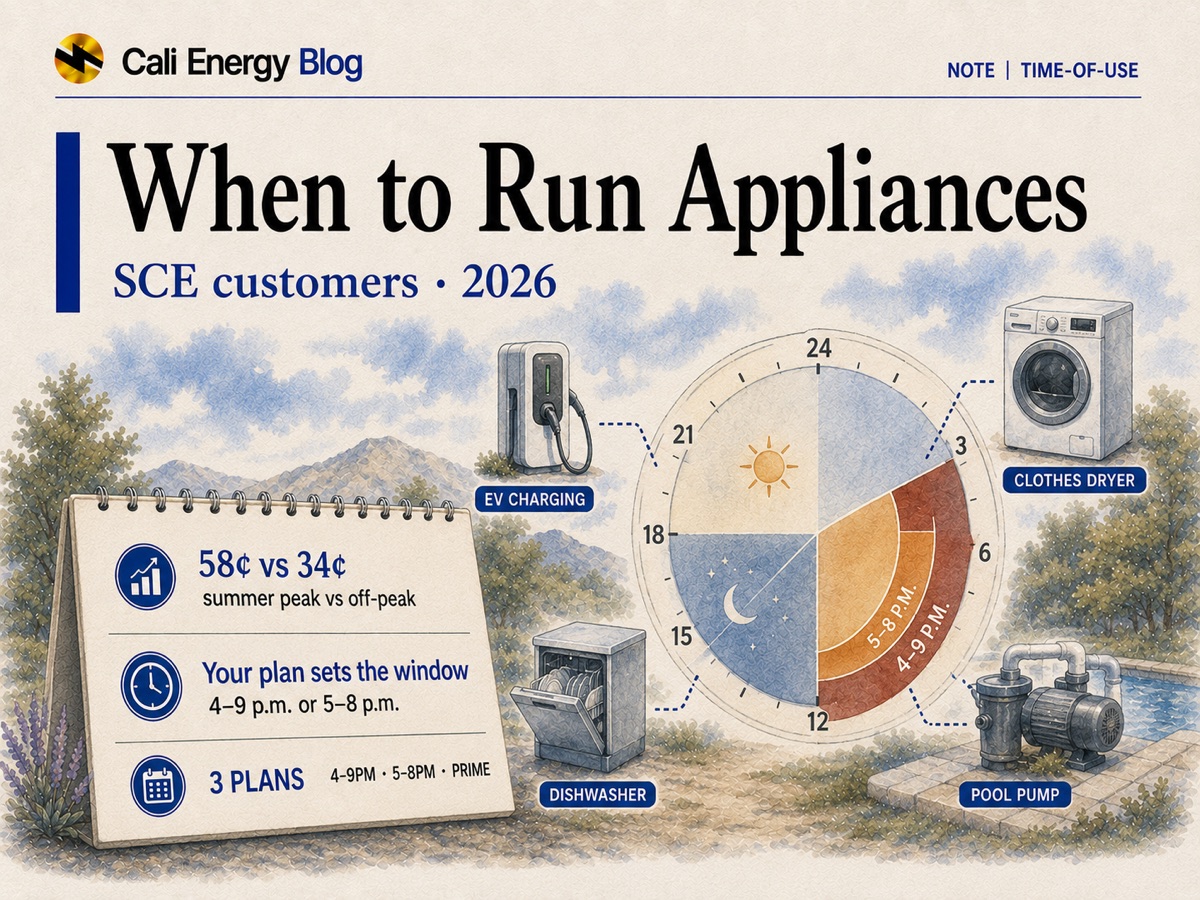
Quick answer
- Stay out of your plan’s peak window on summer weekdays — 4–9 p.m. on TOU-D-4-9PM and PRIME, 5–8 p.m. on TOU-D-5-8PM. From October 1, 2026, TOU-D-4-9PM charges 59¢/kWh in that window against 33¢ off-peak.
- Summer weekends are much cheaper in the same hours — 44¢ instead of 59¢ on 4-9PM, and 51¢ instead of 72¢ on 5-8PM. Shift what you can to Saturday.
- Super off-peak exists only in winter (October–May), from 8 a.m. until the evening window opens: 32¢ on the standard plans, 24¢ on PRIME. It is the cheapest electricity of the year.
- TOU-D-PRIME has the lowest summer off-peak (26¢) but earns no baseline credit, and it is open only to homes with an EV, a battery or a heat pump.
- Season definitions are SCE’s: summer is June through September, winter is October through May.
The rate grid this schedule is built on
Every recommendation below comes from these numbers, not from general advice.
| Plan | Season / day | Peak window | Peak | Off-peak | Super off-peak |
|---|---|---|---|---|---|
| TOU-D-4-9PM | Summer weekday | 4–9 p.m. on-peak | 59¢ | 33¢ | — |
| TOU-D-4-9PM | Summer weekend | 4–9 p.m. mid-peak | 44¢ | 33¢ | — |
| TOU-D-4-9PM | Winter, all days | 4–9 p.m. mid-peak | 50¢ | 36¢ | 32¢ |
| TOU-D-5-8PM | Summer weekday | 5–8 p.m. on-peak | 72¢ | 34¢ | — |
| TOU-D-5-8PM | Summer weekend | 5–8 p.m. mid-peak | 51¢ | 34¢ | — |
| TOU-D-5-8PM | Winter, all days | 5–8 p.m. mid-peak | 55¢ | 37¢ | 32¢ |
| TOU-D-PRIME | Summer weekday | 4–9 p.m. on-peak | 61¢ | 26¢ | — |
| TOU-D-PRIME | Summer weekend | 4–9 p.m. mid-peak | 39¢ | 26¢ | — |
| TOU-D-PRIME | Winter, all days | 4–9 p.m. mid-peak | 45¢ | 30¢ | 24¢ |
Source: SCE — Time-of-Use Residential Rate Plans, rates from October 1, 2026, verified October 6, 2026. Bundled SCE prices in whole cents as published. On TOU-D-4-9PM and TOU-D-5-8PM a 9¢ baseline credit comes off every kWh up to your allowance (59¢ becomes 50¢); PRIME has none — see the SCE baseline guide. All plans add a $0.79 daily Base Services Charge.
What shifting one kilowatt-hour is worth
The price gap between the window you avoid and the one you move into.
| Move | TOU-D-4-9PM | TOU-D-5-8PM | TOU-D-PRIME |
|---|---|---|---|
| Summer weekday: peak → off-peak | 26¢ | 38¢ | 35¢ |
| Summer weekend: mid-peak → off-peak | 11¢ | 17¢ | 13¢ |
| Winter evening → winter mid-day | 18¢ | 23¢ | 21¢ |
| A 30 kWh EV charge moved out of the summer weekday peak | $7.80 | $11.40 | $10.50 |
Cali Energy arithmetic from the rate grid above. The baseline credit is the same at every hour, so it does not change these gaps. 30 kWh is an illustrative overnight EV charge.
The same move is worth very different amounts. A summer-weekday shift saves 26¢ a kWh on TOU-D-4-9PM but 38¢ on TOU-D-5-8PM; on a summer weekend the evening window costs only 11–17¢ more than off-peak, so it is the least urgent shift. In winter the gain comes from moving loads into the mid-day super-off-peak.
The appliance schedule
The window differs by plan, so the schedule does too. Find your plan’s column — using the wrong one costs money.
| Appliance | TOU-D-4-9PM | TOU-D-5-8PM | TOU-D-PRIME |
|---|---|---|---|
| EV charging | after 9 p.m. | after 8 p.m. | after 9 p.m. |
| Air conditioning | pre-cool before 4 p.m. | pre-cool before 5 p.m. | pre-cool before 4 p.m. |
| Clothes dryer | before 4 p.m. or after 9 p.m. | before 5 p.m. or after 8 p.m. | before 4 p.m. or after 9 p.m. |
| Dishwasher | delay to after 9 p.m. | delay to after 8 p.m. | delay to after 9 p.m. |
| Pool pump | avoid 4–9 p.m. | avoid 5–8 p.m. | avoid 4–9 p.m. |
| Heat-pump water heater | heat before 4 p.m. | heat before 5 p.m. | heat before 4 p.m. |
Windows follow each plan’s published peak period: 4–9 p.m. on TOU-D-4-9PM and PRIME, 5–8 p.m. on TOU-D-5-8PM. On the 5-8PM plan the hours from 4 to 5 p.m. and after 8 p.m. are already off-peak — advice written for the 4–9 p.m. window does not apply to it. Source: SCE — Time-of-Use Residential Rate Plans, verified October 6, 2026.
In winter, all three plans add a super-off-peak block starting at 8 a.m. and running until that plan’s mid-peak window opens — 4 p.m. on TOU-D-4-9PM and PRIME, 5 p.m. on TOU-D-5-8PM. That mid-day block is the cheapest electricity of the year on every plan. A heat-pump water heater on TOU-D-4-9PM or 5-8PM also earns extra baseline allowance — 1.9 kWh a day in summer and 2.6 in winter on a Basic account, on request (SCE).
These are bundled SCE rates — SCE delivery plus SCE generation. If your generation comes from a Community Choice Aggregator such as Clean Power Alliance, or a Direct Access provider, your total per-kWh price differs, though the timing of SCE’s delivery periods still applies.
Three things the grid tells you that most advice misses
Summer weekends are a genuine discount, not a rounding error
The evening window does not disappear on Saturday and Sunday — it drops from on-peak to mid-peak. On TOU-D-4-9PM that is 44¢ instead of 59¢, a quarter off. On TOU-D-5-8PM the gap is larger: 51¢ instead of 72¢, nearly 30% off. If a load genuinely cannot move out of the evening, moving it to the weekend is the next best thing.
Winter mid-day is the cheapest electricity you will buy all year
All three plans add a super-off-peak period in winter: 32¢ on 4-9PM and 5-8PM, 24¢ on PRIME. Winter also has no on-peak at all — the evening window is mid-peak every day, weekday or weekend. Anything flexible and heavy, from pool pumps to water heating, belongs in that mid-day block from October through May. Note that PRIME’s winter off-peak (30¢) is now higher than its summer off-peak (26¢): on PRIME the mid-day block matters more in winter than it used to.
The 5-8PM plan punishes mistakes hardest
Its window is only three hours, but at 72¢/kWh on summer weekdays it is the most expensive residential period SCE publishes. The plan rewards households that can reliably clear a narrow window and penalizes those that cannot. If your evenings are unpredictable, the wider but gentler 4–9 p.m. window is the safer structure.
If you have solar or a battery
The schedule above is written for the electricity you buy. Solar changes which hours you are buying in, not what those hours cost.
- Solar without storage: your production peaks around mid-day and falls away before the 4–9 p.m. window opens. That is precisely why the evening rule still applies to you — those are the hours you are most likely to be importing.
- Solar with a battery: the goal is to arrive at 4 p.m. with a full battery and discharge through the expensive window. Most systems can be configured to do this automatically.
- PRIME is required on the Solar Billing Plan. SCE puts NEM 3.0 customers on TOU-D-PRIME; otherwise PRIME is open to homes that confirm an EV or plug-in hybrid, a residential battery, or an electric heat pump for water or space heating (SCE).
- Which plan you are on is a separate decision from scheduling. We compare them in SCE time-of-use plans compared, and the block of usage priced most favorably is covered in the SCE baseline region lookup.
What this page cannot determine
- Your exact savings. That depends on how much of your usage currently falls in the peak window, which only your interval data shows.
- Which plan you should be on. Scheduling and plan selection are different questions; this page assumes your plan is fixed.
- Holiday treatment. SCE’s residential rate page does not spell out how legal holidays are classified. Confirm with SCE if a holiday materially changes your week.
- Rates after the next revision. These are the rates in effect from October 1, 2026, verified on the date shown.
Frequently asked
What are SCE’s peak hours?
On TOU-D-4-9PM and TOU-D-PRIME the peak window is 4–9 p.m.; on TOU-D-5-8PM it is 5–8 p.m. It is on-peak only on summer weekdays (June–September) and mid-peak on summer weekends and every winter day. From October 1, 2026, the summer weekday peak costs 59¢ on 4-9PM, 72¢ on 5-8PM and 61¢ on PRIME (bundled SCE rates).
Does SCE have super off-peak hours in summer?
No. Super off-peak exists only in winter, October through May, from 8 a.m. until the evening window opens — 4 p.m. on TOU-D-4-9PM and PRIME, 5 p.m. on TOU-D-5-8PM. It costs 32¢ on the standard plans and 24¢ on PRIME. In summer every hour outside the evening window is plain off-peak.
What are SCE’s off-peak hours on weekends?
In summer, every hour except the evening window, which drops to mid-peak on weekends: 44¢ instead of 59¢ on 4-9PM, 51¢ instead of 72¢ on 5-8PM and 39¢ instead of 61¢ on PRIME. In winter, weekends are priced exactly like weekdays.
When should I charge my EV on an SCE plan?
After your plan’s peak window ends — after 9 p.m. on TOU-D-4-9PM and PRIME, after 8 p.m. on TOU-D-5-8PM. Summer off-peak is 33–34¢/kWh on the standard plans and 26¢ on PRIME; in winter the mid-day super-off-peak (32¢, or 24¢ on PRIME) is cheaper still. Moving a 30 kWh summer-weekday charge out of the peak saves $7.80–$11.40 depending on the plan.
What is the worst time to use electricity on SCE?
Your plan’s evening window on a summer weekday. TOU-D-5-8PM’s 5–8 p.m. window costs 72¢/kWh, the highest published residential rate; TOU-D-4-9PM charges 59¢ from 4–9 p.m. against 33¢ off-peak.
When is SCE electricity cheapest?
Winter mid-day. From October through May all three plans have a super-off-peak period from 8 a.m.: 32¢ on TOU-D-4-9PM and 5-8PM and 24¢ on PRIME — the lowest residential prices SCE publishes.
What months count as summer for SCE?
June through September. Winter is October through May. Those are SCE’s own season definitions on its time-of-use and tiered rate pages.
Does pre-cooling the house actually save money?
It shifts the cost rather than removing it: you buy the cooling at off-peak rates before your plan’s peak window opens — before 4 p.m. on TOU-D-4-9PM and PRIME, before 5 p.m. on TOU-D-5-8PM — instead of at peak rates during it. Each kWh moved is worth 26–38¢ on a summer weekday; whether it nets out ahead depends on how well your home holds temperature.
Related reading
Sources & methodology
Figures on this page come from the primary sources below and, where noted, from Cali Energy calculations using the stated assumptions. Rates, incentives, and program terms change; each was verified October 6, 2026.
About this reference
Cali Energy is a licensed California contractor (CSLB #1032379) in Northridge. We publish this page as a reference and date it to the day each figure was checked against its source.
Prepared by Cali Energy, October 6, 2026. This article is for general educational purposes only and is not legal, tax, financial, engineering, or utility advice. Rates, incentives, codes, permit requirements, equipment specifications, prices, and program terms may change; figures and timelines are estimates, not guarantees. Confirm current requirements with the applicable utility, AHJ, program administrator, manufacturer, or a licensed professional. See our Content Disclaimer. Cali Energy · 19201 Parthenia St, Unit E, Northridge, CA 91324 · CSLB #1032379 (B, C-10, C-39)