

What Do Shingle Wind and Impact Ratings Mean?
They're laboratory classes for new shingles, and three of them show up on wrappers and data sheets. ASTM D3161 blows air across a test deck for two hours and rates shingles Class A, D or F, for 60, 90 or 110 mph. ASTM D7158 measures how well the sealant strip holds against wind uplift and rates them Class D, G or H, matched to code design wind speeds of up to 116, 155 and 194 mph. UL 2218 drops steel balls of 1.25 to 2 inches on the shingle and rates it Class 1 to 4. California's residential code requires a wind class on the package that fits the design wind speed at the house, and a shingle labeled Class H or Class F fits every row of its table. None of the tests covers installation or aging, and the asphalt roofing manufacturers' association says performance on the roof depends just as much on installing the shingle to the maker's instructions.
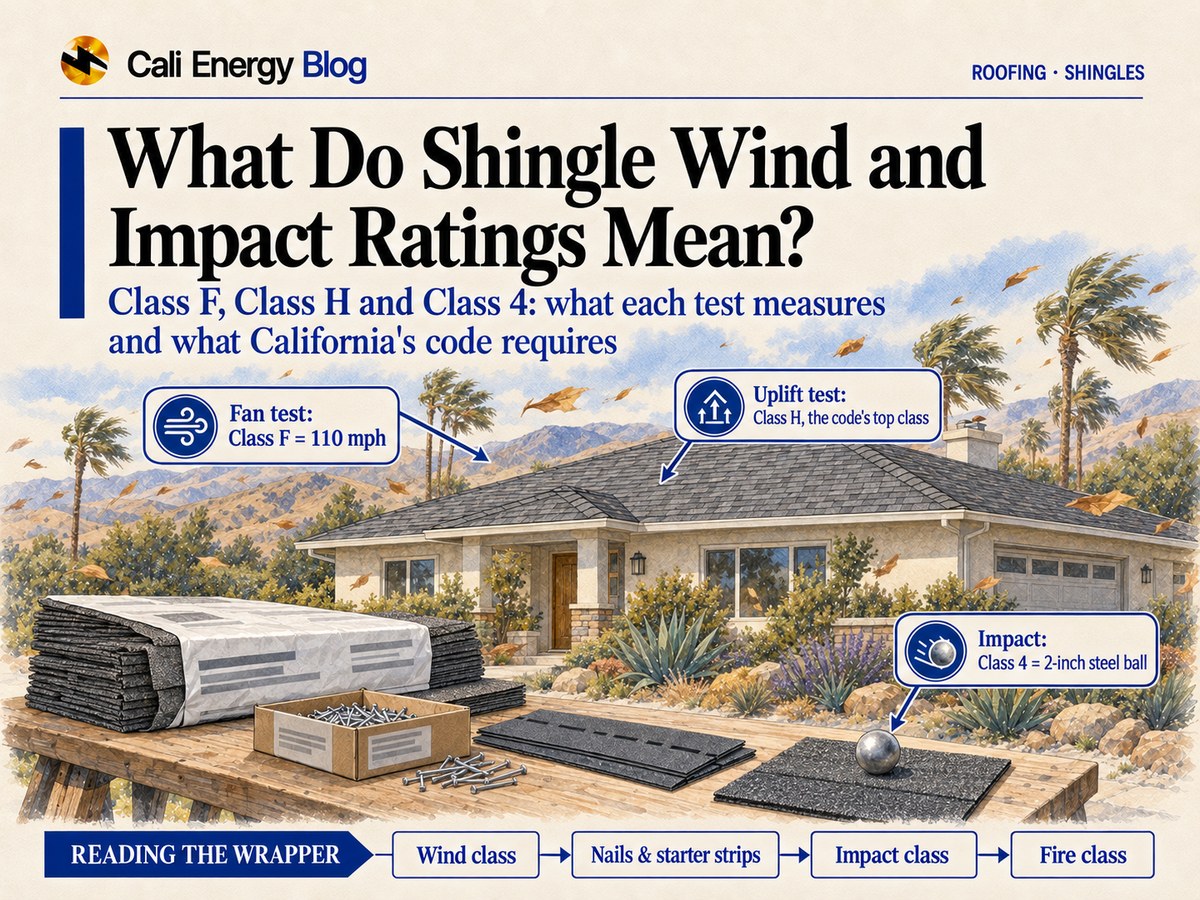
The four tests side by side
Two of the tests are about wind and two about impact. The fourth, FM 4473, was developed for tile and can be used on shingles too. California's residential code requires only a wind class.
| Rating | How the test works | Classes | In California's residential code |
|---|---|---|---|
| ASTM D3161, wind (fan) | A fan blows air across a deck of sealed shingles for two hours; any shingle that lifts fails it | A: 60 mph · D: 90 mph · F: 110 mph | Used only for shingles outside D7158's scope: A, D or F up to a 129 mph design wind speed, F above that |
| ASTM D7158, wind (uplift) | Wind suction on the shingle is measured in a low-speed wind test, the sealant's grip is pulled on 10 samples, and the class is calculated | D, G and H, for design wind speeds up to 116, 155 and 194 mph | The required test: D, G or H up to 116 mph, G or H up to 155 mph, H above that |
| UL 2218, impact (steel ball) | A steel ball hits the same spot twice; the shingle passes if no crack shows on its back | 1: 1.25 in. · 2: 1.5 in. · 3: 1.75 in. · 4: 2 in. | Not required |
| FM 4473, impact (ice ball) | Ice balls are fired at the panel, twice on the same spot | 1 to 4: 1.25 to 2 in. | Not required |
Two wind tests, and why the code prefers one
ASTM D3161 is the original test, from 1972. A fan blows across a deck of shingles that have been given the chance to seal, at 60, 90 or 110 mph, for two hours, and the class is the highest speed at which no part of a shingle lifts. NRCA notes that the standard itself says its results don't directly correlate to wind speeds in service, and IBHS describes the speeds as wind flowing up the roof, not wind loads.
ASTM D7158, first published in 2005 from wind engineering research, works the other way round. It measures how much suction the wind puts on the shingle and how hard its sealant strip holds, then works out from the two, with the wind design method the building codes rely on, the design wind speed the shingle can resist. Its classes are tied to the code's design wind speeds, which are 3-second gusts, and ARMA says the method has a safety factor of about 1.67 built in.
California's residential code requires D7158, with the class printed on the package, and allows D3161 only for shingles that D7158 doesn't cover (CRC R905.2.4.1). D7158's classes assume a building no taller than 60 feet, a site that isn't directly exposed to wind off open water, and no speed-up from hills. For a house outside those assumptions, such as one facing the ocean or on an exposed ridge, the code calls for additional calculations; ARMA's 2026 bulletin gives a table for exposure and height and notes that a hill's speed-up often calls for a higher class.
What the code asks for in Los Angeles
The class has to match the ultimate design wind speed at the house, read from the code's wind map: a 3-second gust 33 feet above open ground, with about a 700-year return period. The map's notes say mountainous terrain, gorges, ocean promontories and special wind regions have to be examined for unusual wind conditions, so on a hillside or canyon lot, ask the building department what design wind speed applies.
For most re-roofs, the label settles it. A shingle labeled D7158 Class H, or D3161 Class F, meets every row of the code's table, up to 194 mph, and the Department of Energy's guide to shingle roofs notes that many manufacturers rate whole product lines Class H or F, including 3-tab, architectural and premium shingles. The four flagship architectural shingles in shingle brands compared all list both.
The code also sets the nails: at least four per strip shingle, or more where the maker's instructions call for them, and galvanized steel, stainless steel, aluminum or copper roofing nails with a 12-gauge shank and a 3/8-inch head, long enough to go 3/4 inch into the deck or through it (CRC R905.2.5 and R905.2.6).
Santa Ana gusts against the ratings
Santa Ana winds blow most often from October through March, and an event usually lasts one to five days, according to research published in a National Weather Service climate bulletin. The windstorm of January 2025 shows how strong they get.
| Station | Area | Highest report |
|---|---|---|
| Mount Lukens Truck Trail, 2,793 ft | San Gabriel Mountains | 100 mph |
| Saddle Peak, 2,385 ft | Santa Monica Mountains | 98 mph |
| Hollywood Burbank Airport | San Fernando Valley | 84 mph |
| Saugus | Santa Clarita Valley | 72 mph |
| Van Nuys Airport | San Fernando Valley | 67 mph |
| Santa Monica Airport | Coast | 59 mph |
| Los Angeles International Airport | Coast | 48 mph |
On the mountain ridges the wind reached 98 to 100 mph; at the valley and coastal stations in the table, 48 to 84 mph. That's below the 110 mph of the Class F fan test and the 116 mph design speed that even Class D covers, but the numbers don't compare directly: a gust lasts seconds, the fan test runs for two hours, and both wind ratings assume shingles that have sealed and are nailed the way the maker specifies.
What decides whether shingles stay on
The tests describe new shingles. ARMA notes that they apply to shingles as manufactured, not after storage or installation, and IBHS that they don't account for weathering, temperature or aging. On the roof, the guidance from IBHS and the Department of Energy comes back to a few details:
- Sealing. The sealant strip is activated by the sun's heat. IBHS says manufacturers recommend 70 to 80°F for sealing and warn that below 40°F shingles may not seal properly; a roof can seal in one to two weeks in summer but can take one to two months or more in less favorable conditions, and until then wind can lift the shingles. A roof put on in late fall or winter can meet its first Santa Ana before it has fully sealed.
- Edges and ridges. Starter strips with a line of sealant run along the eaves and up the rakes, where they protect against uplift at the roof edges, and hip and ridge caps are nailed on each side above their sealant strip.
- Nails. The Department of Energy's guide calls improper nailing one of the common installation errors: nails placed too high or too low, overdriven, underdriven or angled. For high-wind areas it recommends six nails per shingle, placed in the nailing zone, and roof cement under the shingles along the eaves, rakes, hips and ridges.
- The warranty's terms. Wind warranties step up with the same details. Owens Corning's Oakridge, for example, goes from 110 mph with four nails to 130 mph with six nails and its starter shingles at the eaves and rakes, as covered in architectural vs 3-tab shingles; what wind warranties exclude is in roofing warranties explained.
- Age. A rating from the day the roof went on doesn't describe it 20 years later. Missing tabs after wind on an old roof are a reason to look at the whole roof, as in signs you need a new roof.
Impact ratings and hail in Los Angeles County
In UL 2218, Class 4 means the shingle took two hits on the same spot from a 2-inch steel ball dropped 20 feet without cracking. IBHS, the insurance industry's research institute, writes that neither UL 2218 nor the ice-ball FM 4473 test accurately replicates the damage hail does on real roofs and that not all products labeled impact-resistant perform equally; it now rates shingles with lab-made hailstones. Polymer-modified (SBS) asphalt has become the more common way to make an impact-resistant shingle, and the Department of Energy notes it also improves granule adhesion, tear strength and nail-pull resistance.
Large hail is rare here. NOAA's Storm Events Database lists 23 hail reports in Los Angeles County from 1996 through 2025, on 17 days. The largest stone reported was 1.75 inches, in Leona Valley in October 2015; four reports were 1.25 inches or more, and none reached 2 inches. The most recent were in March 2024, up to an inch, in places including Granada Hills and Azusa.
So in Los Angeles, Class 4 is a choice rather than a requirement. ARMA notes that impact ratings may lower insurance costs in some areas and with some insurers; ask yours whether it gives a discount in California before paying more for that reason. Other roofs are sold as Class 4 as well, including stone-coated steel and synthetic slate and shake.
What to check on a quote
1. The wind class on the wrapper or data sheet. ASTM D7158 Class H, or the class your site's design wind speed requires; D3161 Class F where it's listed. The code requires the class on the package.
- What the wind warranty asks for. The number of nails, the maker's starter strips at the eaves and rakes, its hip and ridge caps and any other accessories, by name.
- An exposed site. A ridge-top or oceanfront house is outside D7158's standard assumptions, and canyons can have unusual winds; ask how the class and the nailing were chosen.
- The impact class, if you want one. UL 2218 or FM 4473 Class 4, and whether your insurer gives anything for it.
- The fire class. Wind and impact ratings say nothing about fire; the Class A roof rating is a separate test.
- The season. On a roof going on in the cool months, ask how the shingles will be sealed, following the maker's instructions.
What we've seen on our jobs
When we walk a roof before solar goes on it, a lifted shingle is one of the things we look for, along with a soft deck or an old repair; on a 2025 job in North Hills the walk found nothing that needed doing (the North Hills case). Photos help after wind, too. In Porter Ranch, a household found a metal piece in the yard after a windy night and asked whether it had come off their new solar array; our photos of the roof from before and after the installation showed the rails and clamps in place (the Porter Ranch case).
Frequently asked
Is Class F or Class H better?
Can shingles rated for 110 mph blow off in a 70 mph gust?
Do I need Class 4 shingles in Los Angeles?
What wind rating does a re-roof in Los Angeles need?
What should I check after a Santa Ana windstorm?
Related reading
Sources & methodology
Code sections, rules and figures on this page come from the primary sources below. Codes, local requirements and product terms change; each was verified October 8, 2026.
- California Residential Code 2025, Chapter 9, Roof Assemblies (R905.2.4.1 and Table R905.2.4.1, R905.2.5, R905.2.6)
- California Residential Code 2025, Chapter 3, Building Planning (Figure R301.2(2) and its notes, R301.2.1.4)
- Asphalt Roofing Manufacturers Association, Asphalt Shingle Product and Test Standards
- Asphalt Roofing Manufacturers Association, Technical Bulletin: Using ASTM D7158 Where Standard Conditions Do Not Apply (March 2026)
- Insurance Institute for Business & Home Safety, Roof 101
- Mark S. Graham, NRCA, "The wind resistance of shingles," Professional Roofing, September 2018
- Anne Cope and Ian Giammanco, IBHS, "Hail no!," Professional Roofing, March 2022
- U.S. Department of Energy, Building America Solution Center, Asphalt Shingle Roofs
- National Weather Service Los Angeles/Oxnard, Public Information Statement, 5:53 a.m. PST January 8, 2025 (highest wind reports, past two days),…
- Tom Murphree, Emily Szasz and Kellen Jones, Santa Ana Events in California, NOAA National Weather Service Science and Technology Infusion Climate…
- NOAA National Centers for Environmental Information, Storm Events Database, annual detail files 1996–2025 (hail, Los Angeles County)
- DECRA Roofing Systems, Product Knowledge: Hail, Understanding Impact Resistance (UL 2218 classes)
We'll show you the ratings and the installation behind them
Call (323) 844-7777. We list the shingle's wind and impact ratings on the estimate and name the nailing, starter strips and ridge caps its wind warranty asks for. Have ready the address and the name of any shingle you've already been quoted.
Prepared by Cali Energy, October 8, 2026. This article is for general educational purposes only and is not legal, tax, financial, engineering, or utility advice. Rates, incentives, codes, permit requirements, equipment specifications, prices, and program terms may change; figures and timelines are estimates, not guarantees. Confirm current requirements with the applicable utility, AHJ, program administrator, manufacturer, or a licensed professional. See our Content Disclaimer. Cali Energy · 19201 Parthenia St, Unit E, Northridge, CA 91324 · CSLB #1032379 (B, C-10, C-39)