

Best Time to Replace a Roof in Los Angeles
There's no closed season for a roof replacement in Los Angeles, but there is a wet one. By NOAA's 1991–2020 climate normals, about 82% of the year's rain falls from December through March, both downtown and at Burbank in the San Fernando Valley, while June through September average a fraction of an inch in total. So the easiest months to schedule are spring through fall, and fall, before the storms, is the last good window for a roof that won't last another winter. Winter re-roofs happen too, between storms: roofing goes on a dry deck, so the work waits out the rain. Summer brings its own limit in the valleys, where Burbank averages 12 to 14 days a month of 90°F or more in July and August, and Cal/OSHA's heat rules set what the crew needs on hot days. A roof that's leaking now shouldn't wait for a better month. This is as of October 2026.
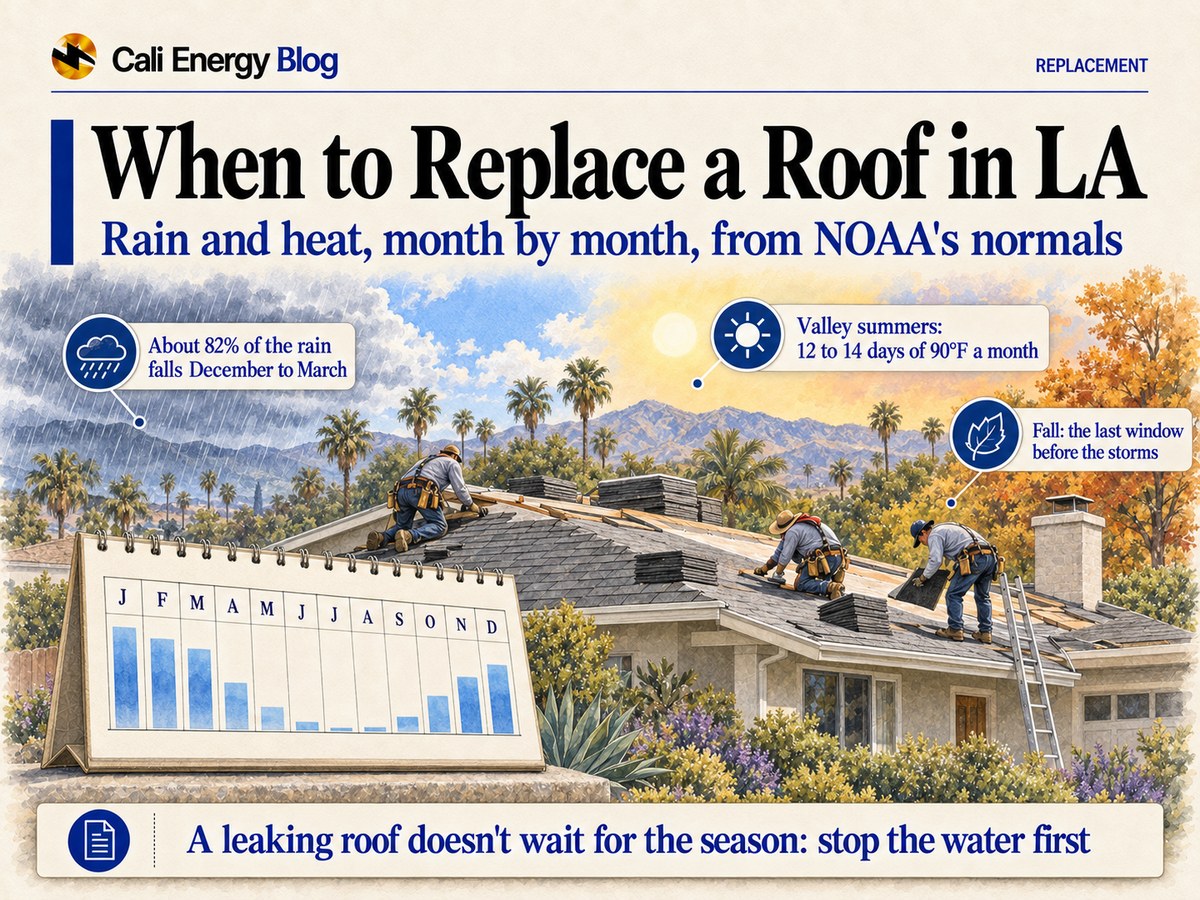
It covers houses in the Los Angeles area. Getting a roof through the rainy season, including the checks to do in the fall, is in getting a roof ready for the rainy season; how long a re-roof takes is in how long a roof replacement takes.
Rain and heat, month by month
NOAA's normals are 30-year averages, not a forecast; a wet March or a dry January happens. They still show the shape of the year that a roofing schedule works around.
| Month | Downtown rain (in) | Downtown days with 0.1 in or more | Downtown normal high (°F) | Burbank normal high (°F) | Burbank days of 90°F or more |
|---|---|---|---|---|---|
| January | 3.29 | 4.4 | 68.0 | 67.0 | 0.1 |
| February | 3.64 | 4.7 | 68.0 | 66.8 | 0.0 |
| March | 2.23 | 3.3 | 69.9 | 69.5 | 0.7 |
| April | 0.69 | 1.4 | 72.4 | 72.7 | 1.7 |
| May | 0.32 | 0.7 | 73.7 | 75.5 | 2.8 |
| June | 0.09 | 0.2 | 77.2 | 80.3 | 4.0 |
| July | 0.02 | 0.1 | 82.0 | 86.7 | 12.0 |
| August | 0.00 | 0.0 | 84.0 | 88.9 | 14.2 |
| September | 0.13 | 0.2 | 83.0 | 86.6 | 11.3 |
| October | 0.58 | 1.1 | 78.6 | 79.4 | 6.0 |
| November | 0.78 | 1.7 | 72.9 | 72.5 | 1.1 |
| December | 2.48 | 3.6 | 67.4 | 66.1 | 0.0 |
The year totals 14.25 inches downtown and 13.91 at Burbank, and December through March carries 11.64 and 11.37 of them. The normal daily low stays above 40°F in every month at both stations, coldest in December at 48.2°F downtown and 44.2°F at Burbank.
Winter: between storms
Rain doesn't close the season; it closes the days it falls on. Roofing goes on a dry surface: modified bitumen makers' instructions rule out applying their sheets with moisture on the roof, and roof coatings need dry hours after they go on. A tear-off is planned around the forecast.
We do re-roofs in winter. A Northridge roof of 31 squares was torn off and covered with cool-roof shingle in February 2023 (the Northridge case), and on a Chatsworth house in January 2026, tile came off under a new array, shingle went down and the final inspection was on January 27 (the Chatsworth case).
Cold is rarely the problem here. Owens Corning's instructions for its Duration shingles add steps only below 40°F, when the adhesive strip may be too cold to bond, and Los Angeles normals stay above that in every month; a cold morning is still possible, and the instructions then ask for hand-sealing the edges of the roof.
Spring and fall: the easy months
From April through November the normals show little rain, and in spring and late fall the valleys aren't yet or no longer hot. October and November are the last months before the wet season, which makes them the time to replace a roof that won't make it through another winter.
Two things to plan around in the fall:
- Material and color. A cool-roof rated product in the color you want may have to be ordered; decide early.
- The permit and inspections. On our jobs, a shingle re-roof has run about 12 days from permit to final; the dates are in how long a roof replacement takes.
Summer: heat in the valleys
July through September are dry, but at Burbank they average 11 to 14 days a month at 90°F or more, and the normal August high is 88.9°F there against 84.0°F downtown. Heat changes the working day more than the season:
- The crew's rules. California's heat illness standard requires shade for roofers once it's over 80°F, and at 95°F or more, construction employers must run high-heat procedures, from regular contact with each worker to watching for signs of heat illness (8 CCR 3395). An early start helps, within the city's work hours.
- The material. Asphalt products soften in heat: CertainTeed's modified bitumen handbook warns about tracking warm asphalt across fresh roofing in very warm weather, and Owens Corning's instructions cap shingle storage at 110°F.
- The work hours. In the City of Los Angeles, construction with loud tools can't start before 7 a.m. on weekdays, or 8 a.m. on Saturdays near homes (LAMC 41.40).
When the roof can't wait
A roof that's leaking isn't a scheduling question. Stop the water first, with a tarp or a temporary repair, and plan the replacement for the next dry stretch; the first steps are in an emergency roof leak in a storm. If the roof is near the end of its life and solar is planned, the roof can go first; see solar removal and reinstall.
Frequently asked
What is the best month to replace a roof in Los Angeles?
Can a roof be replaced in winter in Los Angeles?
Is summer a bad time to replace a roof in LA?
How hot is too hot for roofing?
Should I wait for spring to replace a leaking roof?
Related reading
Sources & methodology
Code sections, rules and figures on this page come from the primary sources below. Codes, local requirements and product terms change; each was verified October 9, 2026.
- NOAA National Centers for Environmental Information, U.S. Climate Normals 1991–2020, monthly normals for Los Angeles Downtown/USC (USW00093134)…
- Owens Corning, Duration Series Shingles Installation Instructions
- California Code of Regulations, Title 8, Section 3395, Heat Illness Prevention in Outdoor Places of Employment
- CertainTeed, Flintlastic Modified Bitumen Application Handbook, third edition (2016), copy published by a distributor
- City of Los Angeles Municipal Code, Section 41.40
We'll find a dry window that fits your roof
Call (323) 844-7777. We look at the roof, how urgent it is and what the job involves, and fit the tear-off into dry days, with a temporary fix in the meantime if the roof is leaking. Have ready the address, photos of the roof and of any leaks, and the months that suit you.
Prepared by Cali Energy, October 9, 2026. This article is for general educational purposes only and is not legal, tax, financial, engineering, or utility advice. Rates, incentives, codes, permit requirements, equipment specifications, prices, and program terms may change; figures and timelines are estimates, not guarantees. Confirm current requirements with the applicable utility, AHJ, program administrator, manufacturer, or a licensed professional. See our Content Disclaimer. Cali Energy · 19201 Parthenia St, Unit E, Northridge, CA 91324 · CSLB #1032379 (B, C-10, C-39)