

Simi Valley, CA · December 2020 – February 2021 · Southern California Edison / City of Simi Valley
The roof was fine. The structure under it had to be proved.
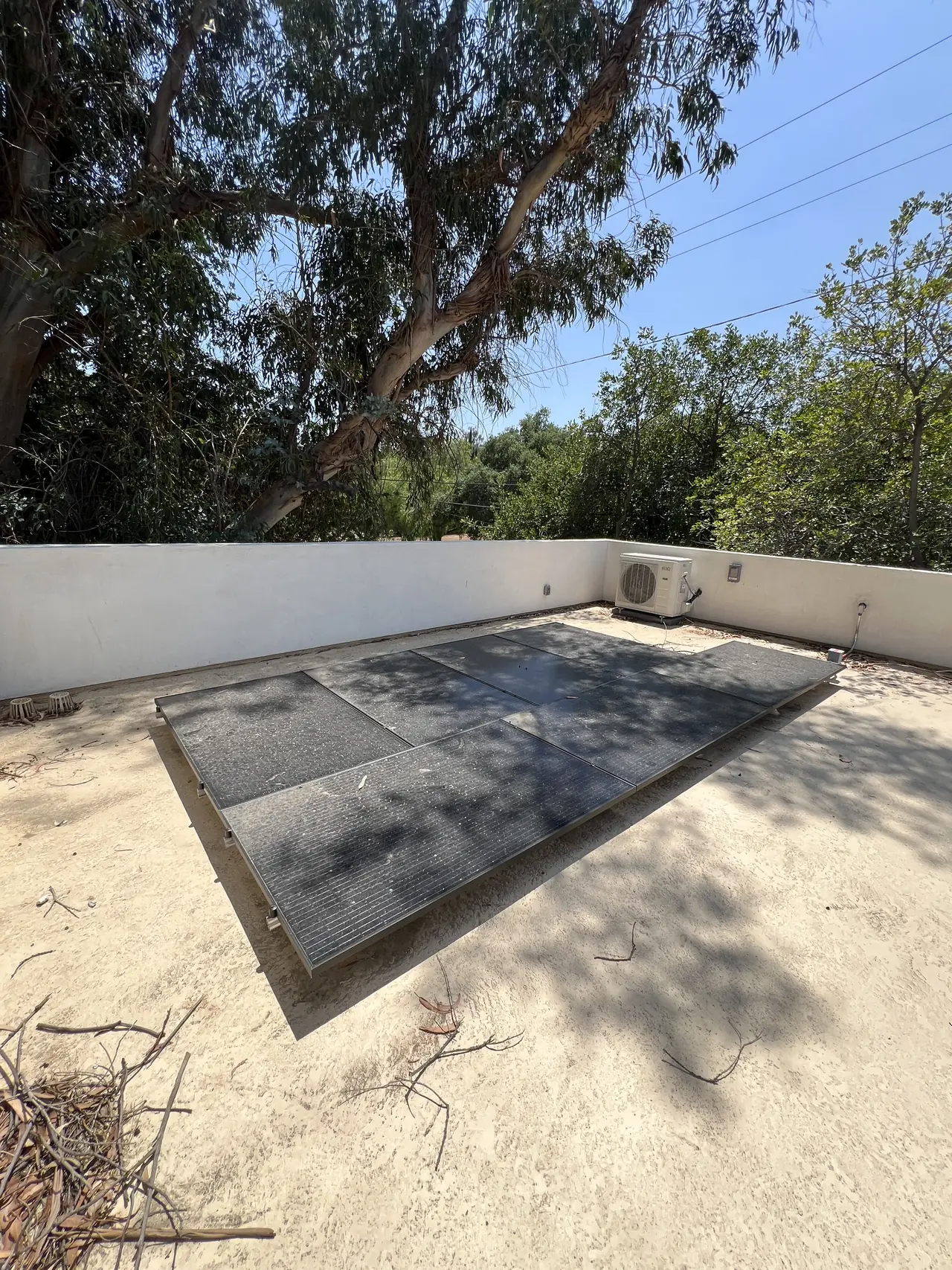
A twelve-module array in Simi Valley that went onto a covered patio instead of the house. The plan check stopped for structural calculations, which is exactly what should happen.
A house roof is engineered, inspected and documented, so a plan checker will accept a standard load calculation for an array on it. A patio cover, a carport or a detached shade structure is none of those things by default, and the city will ask what it was built to carry before it will let anything be bolted to it. On this project the answer was arithmetic: twelve modules at about fifty pounds each, with all rooftop equipment totaling under six hundred pounds, set against calculations for the structure itself. In Simi Valley that question is asked at the counter, before a permit exists.
At a glance
- Modules
- 12, mounted on a covered patio structure
- Array weight
- About 50 lb per module; all rooftop equipment under 600 lb
- Scope
- Solar, roofing and a service panel upgrade in one project
- Utility approval
- 4 January 2021 — 200 A upgrade approved in the existing location
- Plan check opened
- 8 January 2021
- Structural calculations requested
- 8 January 2021
- Permit issued
- 2 February 2021
- Utility / AHJ
- Southern California Edison / City of Simi Valley
The story
The house had a roof and a covered patio, and the patio faced the sun. Putting the array there instead of on the house is a reasonable decision and a common one, and it changes what the city needs to see before it will issue a permit.
Cali Energy submitted the plans on the eighth of January. The counter came back the same morning with a single question: structural calculations, or the manufacturer's tool kit, for this project. Nothing about the electrical design, nothing about the layout. The question was whether the thing being loaded could take the load.
That question is not bureaucratic. A dwelling roof is designed to a code load and inspected when it is framed, so its capacity is on record. A patio cover is often built under a different permit, to a different standard, or as an addition somebody put up decades ago. An array is not heavy in absolute terms, but it is a permanent, distributed, wind-exposed load fixed to a structure whose capacity nobody has checked.
The numbers on this project were small and specific. Twelve modules at approximately fifty pounds each. Total weight of all rooftop equipment, modules and racking together, under six hundred pounds spread across the structure. Set against calculations for the patio framing, that cleared. The same array on a lighter or older structure would not have, and the right place to find that out is at plan check rather than after installation.
One design detail followed from having two separate roofs on one property: a flexible conduit between them. Two structures move independently, seasonally and in a seismic event, and a rigid conduit spanning the gap between them is a fitting waiting to fail. Flex takes the movement. It is the kind of thing that costs almost nothing when it is drawn and costs a service call when it is not.
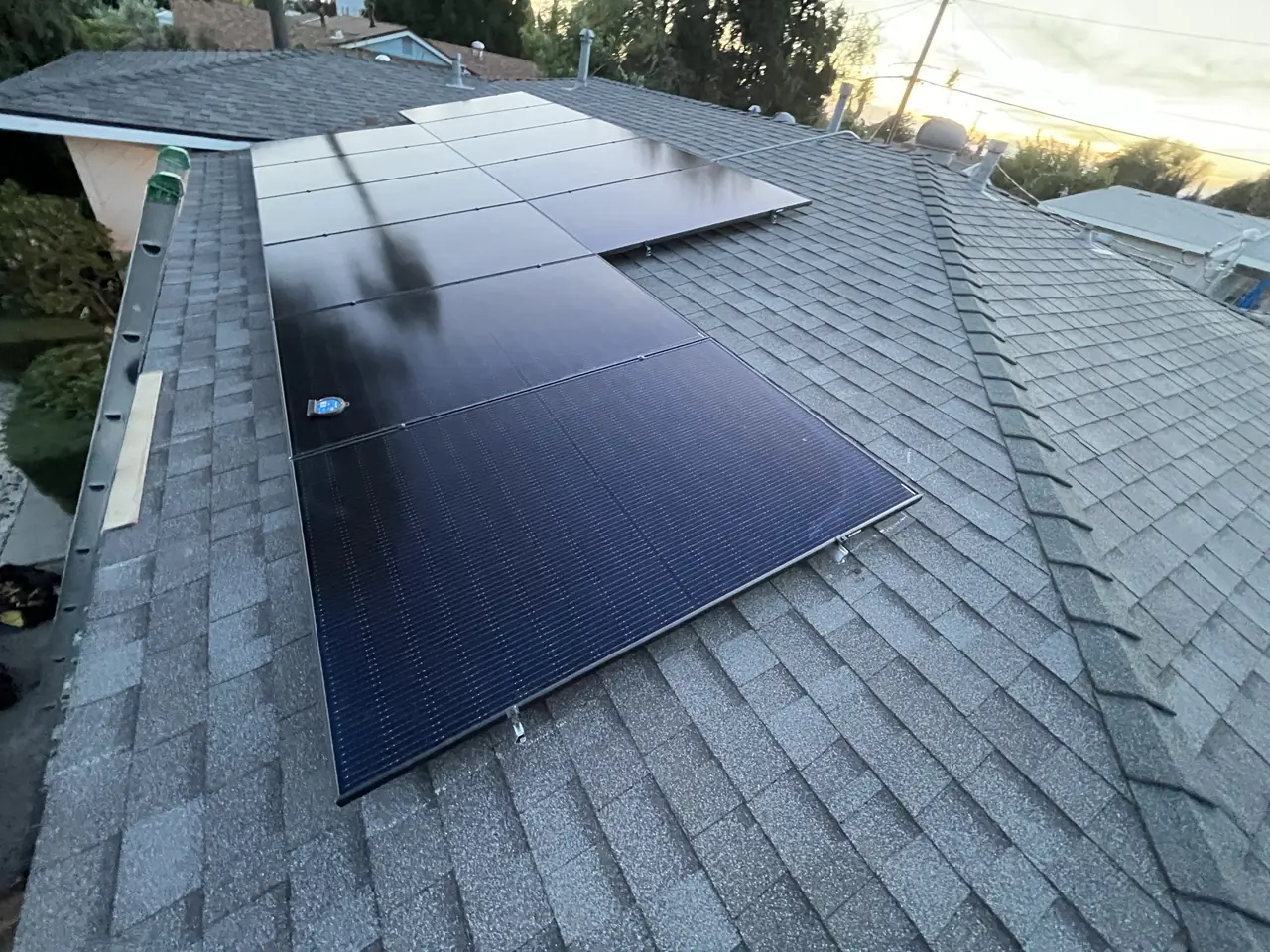
The rest of the project was three trades in sequence, under contracts a homeowner's engineer had reviewed line by line. The roofing went on first, in the second week of January, and passed its own final inspection a few days later. The electric service was upgraded to two hundred amps, in the same location, which the utility had approved after reviewing photographs of the existing equipment. The solar permit issued on the second of February and the array went up the following day.
The city's plan check took three and a half weeks, most of it queue rather than review. That is worth planning around rather than being surprised by.
How it ran
| 29 December 2020 | Contracts signed for solar, roofing and the panel upgrade |
|---|---|
| 30 December 2020 | Meter spot requested from the utility |
| 4 January 2021 | Utility approves a 200 A upgrade in the existing location |
| 8 January 2021 | Plan check application filed; structural calculations requested |
| 8 January 2021 | Structural calculations and drawings submitted |
| 9 January 2021 | Roofing installed |
| 12 January 2021 | Roofing final inspection passed |
| 2 February 2021 | Solar permit issued |
| 3 February 2021 | Array installed |
Five weeks from signed contract to a finished array, with three trades in sequence. This timeline reflects this property and this period.
What we did
- Designed the array for a patio structure rather than assuming a dwelling roof (C-10).
- Answered the city's request for structural calculations the same day it was raised.
- Documented module weight and total rooftop load against the structure's capacity.
- Specified flexible conduit for the run between two independent roofs.
- Requested the utility meter spot and got the panel upgrade approved in place, avoiding a service relocation.
- Replaced the roof under the array and passed its final inspection before solar began (C-39).
- Carried the solar plan check to permit and installed the array the next day.
System specifications
| Modules | 12 |
|---|---|
| Mounting | Covered patio structure, not the dwelling roof |
| Module weight | About 50 lb each |
| Total rooftop equipment | Under 600 lb |
| Interconnection between roofs | Flexible conduit |
| Service | Upgraded to 200 A in the existing location |
| Roof | Replaced under the array before installation |
| Utility / AHJ | Southern California Edison / City of Simi Valley |
Is your project like this one?
- Your best sun is on a patio cover, carport or shade structure, not the house.
- Your plan check has stopped for structural calculations.
- You are combining roofing, a panel upgrade and solar in one project.
- Your array will span two separate roofs on the same property.
- You want the Simi Valley sequence explained in the order it really runs.
Cali Energy in Simi Valley
Simi Valley is a city in Ventura County: permits run through the City of Simi Valley Building & Safety Division, interconnection through Southern California Edison.
Simi Valley sits in Ventura County, so permits run through the city's own Building & Safety Division and interconnection through Southern California Edison. The city reviews solar plans itself, and on anything that is not a house roof it reviews the structure too.
This installation is on the Simi Valley projects page alongside the others, and what the work covers is set out on the Simi Valley service area page.
- License and classifications: CSLB #1032379
- Official reference for this process: City of Simi Valley — Building & Safety Division
- Official reference for this process: California Building Standards Commission — California Building Standards Code
Frequently asked questions
Can solar go on a patio cover or carport?
Often yes, but the structure has to be shown to carry the load. A dwelling roof has a documented design capacity; a patio cover frequently does not, so the city asks for structural calculations before it will permit anything fixed to it. On this project twelve modules at about fifty pounds each, under six hundred pounds of rooftop equipment in total, cleared against calculations for the framing.
Does Cali Energy work in Simi Valley?
Yes. Cali Energy works across Simi Valley on Southern California Edison interconnections and City of Simi Valley permits, and takes on roofing and service work alongside solar where a project needs all three. Fifteen completed Simi Valley projects are on our projects page. Our license is CSLB #1032379.
Why does an array need flexible conduit between two roofs?
Because two structures move independently. Thermal movement across a season and any seismic event will shift one relative to the other, and a rigid conduit bridging the gap concentrates that movement at its fittings. A flexible section absorbs it. It is a small line on a drawing and a common omission on projects that were not drawn carefully.
How heavy is a solar array on a structure?
Lighter than most people assume and heavier than nothing. A residential module with its share of racking runs roughly fifty pounds, so a twelve-module array is a few hundred pounds distributed over the structure rather than concentrated in one place. The load that matters in a calculation is usually wind uplift on the array, not its dead weight.
What this would look like on your roof
Planning solar in Simi Valley? Tell us your utility, your roof and what your bill looks like now, and we will model what a system like this would do on your house before you commit to anything.
Or call +1 (323) 844-7777 · Cali Energy, Northridge · CSLB #1032379 (B, C-10, C-39) — design, permits, install and electrical under one licensed contractor.
Related
This timeline reflects this property and this permitting path. Updated September 2026.