

Built by a Working LA Solar Contractor: The Problems Cali-Graf Was Designed Around
Cali-Graf is developed by Cali Energy, a Los Angeles solar and roofing contractor (CSLB #1032379, classifications B, C-10 and C-39). Its design app was built around the four jobs that sit behind every residential solar proposal — designing the roof, modeling the customer's utility bill, choosing equipment that works together and presenting it to the homeowner — and it comes with a commitment that matters to any installer who competes with Cali Energy: your calculations and your customers stay in your account, and Cali Energy never uses them to sell its own work.
Who is behind Cali-Graf
Cali Energy, Inc. is a licensed California contractor based at 19201 Parthenia St, Unit E, Northridge, CA 91324. It operates Cali-Graf under the platform's terms and privacy policy, and the footer of every Cali-Graf page says who develops it. Cali-Graf's own landing page describes the app as "built around the work of a solar contractor": a workflow that brings together roof design, utility modeling, equipment selection and customer presentation.
That background shapes what the app checks and what it refuses to skip. The sections below take the four jobs one at a time.
Job 1: a roof layout that would survive plan review
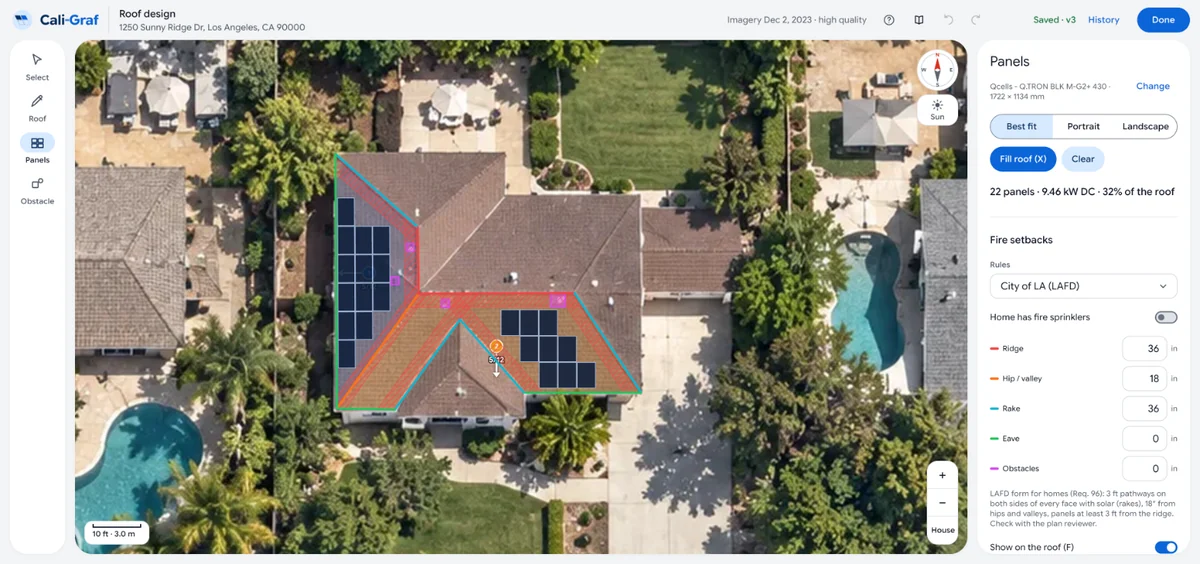
The roof is designed on Google aerial imagery, with each face's pitch and direction measured from Google's 3D height data. The point is not a pretty picture but a layout that holds up later: California's residential code and the City of Los Angeles fire department require open strips on roofs with solar, and Cali-Graf's guidance is blunt — a layout that ignores them won't pass plan review.
So the editor draws fire setbacks as red hatched strips from the first face you trace, using California or City of Los Angeles rules. Fill roof places panels only outside the setbacks and around chimneys, vents and skylights; a panel dragged into a setback turns red; and under California code, when solar covers more than a third of the roof and the ridge setback grows from 18 to 36 inches, Fill roof notices and lays the panels out again.
The plan reviewer and the local fire department still have the final say, and Cali-Graf says so on the same page. What the editor removes is the avoidable mistake of selling a layout that was never going to fit. Details: fire setbacks on the roof.
Job 2: the bill the customer will actually get
A solar proposal is only as convincing as its bill math, and the bill depends on the utility. Cali-Graf's LADWP page puts it this way: "An average $/kWh misses the three things that decide an LADWP solar bill." The same holds for SCE, so the app calculates bills with each utility's own rules:
- LADWP: two-month billing periods, tiers by Zone 1 or Zone 2, solar netted one to one inside each period, and a dollar credit that rolls forward and is never paid out — with the city utility users tax shown on its own line.
- SCE: the customer's time-of-use plan, CARE and baseline region, monthly bills and hourly export credits under the Net Billing Tariff (NEM 3.0).
- Clean Power Alliance: generation rates for the city's default plan where CPA supplies the home.
The utility, rate zone and region come from the address and are shown under it, so the seller can check them against the customer's bill. The app supports only these utilities for bill calculations; homes on Glendale, Burbank, Pasadena or other city utilities, SDG&E or PG&E can be designed but not calculated. Background: LADWP net metering in 2026 and NEM 3.0 explained.
Job 3: equipment that works together
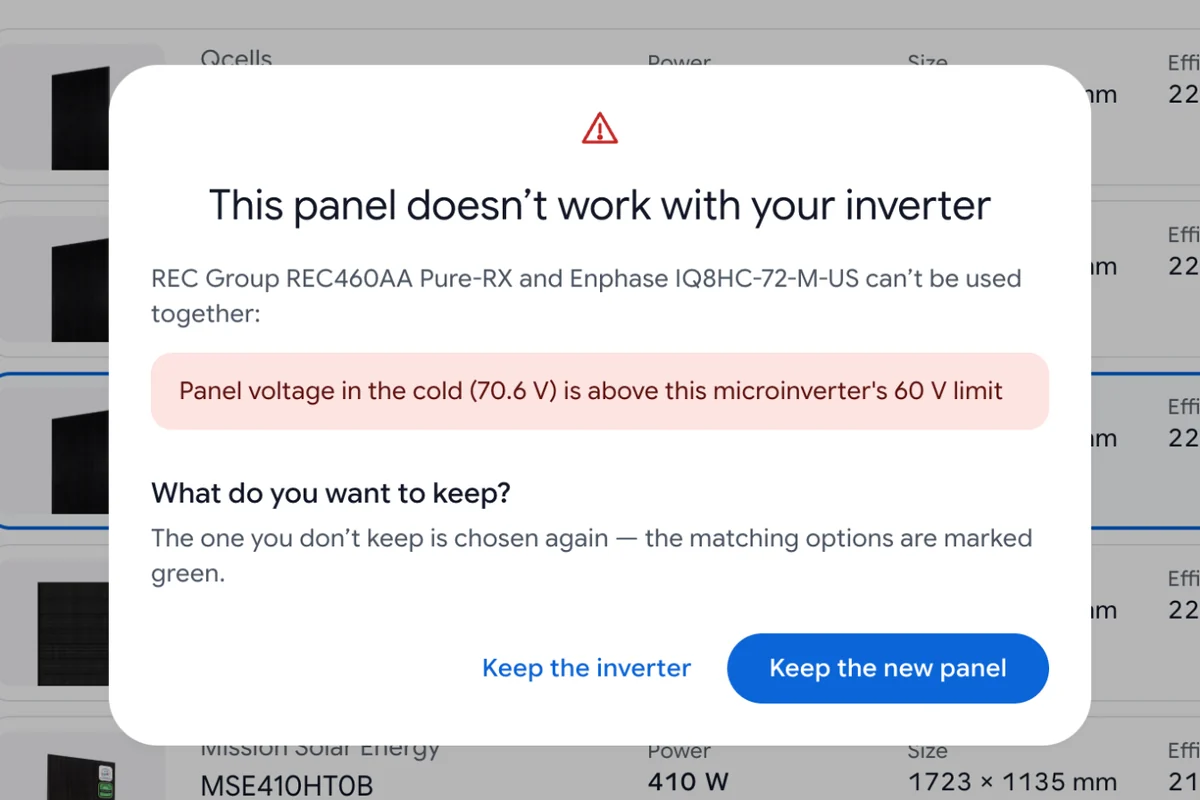
Panels, inverters and batteries come from the California Energy Commission lists, and Cali-Graf checks the combination against the manufacturers' datasheets before it reaches a proposal. A panel whose voltage on a cold morning would exceed the inverter's limit — checked at −10 °C (14 °F), the coldest mornings in Los Angeles County — is marked as not working, and a conflict stops the calculation until matching equipment is chosen. A combination that works but loses some power, such as a panel that will clip at the sunniest hours, is flagged as not ideal.
The same California Energy Commission lists power Cali-Graf's public equipment directory, so the specs a seller uses in the app are the ones a homeowner can look up on cali-graf.com/equipment. Details: equipment compatibility check.
Job 4: a proposal the homeowner can follow
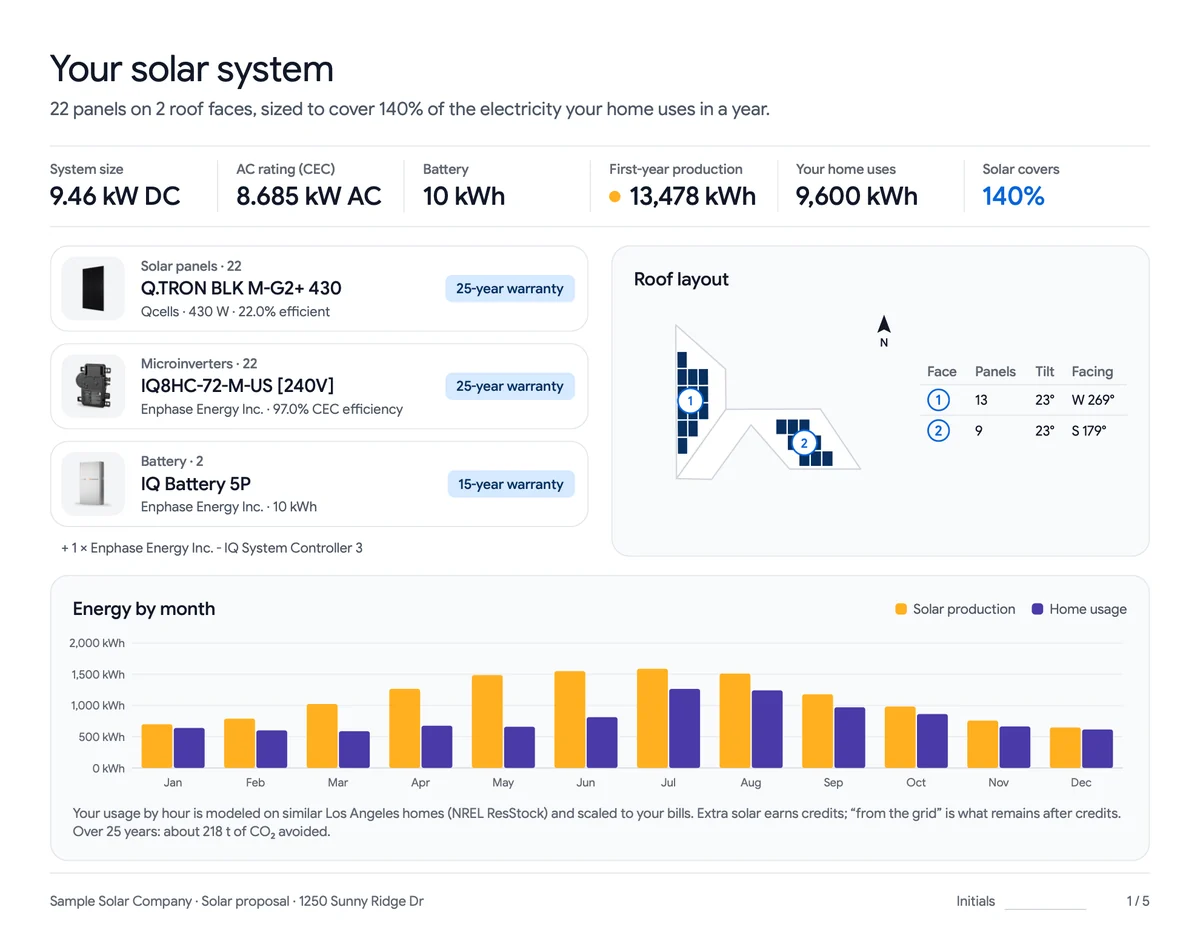
The last job is the conversation with the homeowner. Cali-Graf's proposal is a short document — a cover with the monthly bill today and with solar, the system, the savings month by month and over 25 years, the price and approval page, and the Contractors State License Board's right-to-cancel notice — with the installer's business card on every sheet. Cali-Graf's guidance puts the emphasis on numbers the homeowner can check against their own bills, and on checking every proposal before it goes out, because every number is an estimate. A full sample proposal is public.
For how all four jobs fit into one calculation, see one Cali-Graf calculation, step by step.
See the four jobs on a real roof: design, bill, equipment check and proposal in one calculation — free.
The commitment to installers: your customers stay yours
A tool built by an installer raises an obvious question for other installers: what happens to my customers? Cali-Graf answers it in its privacy policy and help center, and the answer is specific:
| Who | What they see of your work |
|---|---|
| You | All your calculations, roof designs, proposals and customer details |
| Other Cali-Graf users | Nothing — every request is checked against the calculation's owner |
| Cali Energy's sales team | Nothing — your data is never used to market Cali Energy's solar or roofing services, and your customers are never contacted |
| The people who run Cali-Graf | Your data only when you ask for help, to investigate a security or technical problem, or when the law requires it |
| The property address and location, to find the roof and load imagery and shade data |
Under California privacy law, Cali-Graf processes the homeowner details you enter as your service provider; if a homeowner contacts Cali Energy about their information, they are referred back to you. Cali-Graf's own wording: "Cali-Graf is used by companies that may compete with Cali Energy." Details: who can see your calculations.
Where Cali Energy does appear
Cali-Graf is more than the app: it also runs a public directory of licensed contractors and solar equipment. That is the only place Cali Energy shows up as a company, and the rules there are published:
- Rankings follow permits, not ownership. Contractor lists are ordered by building permits in each county, and no company can pay to appear or move — including Cali Energy, which appears only where its own license and permits put it.
- Offers are labeled. On contractor profiles, a homeowner can ask for a second quote through a clearly labeled Get a second quote from Cali Energy button. Those requests come from homeowners who press that button; installers' calculations are never used for Cali Energy's marketing.
- No affiliation is implied. Cali-Graf is not affiliated with the Contractors State License Board, the California Energy Commission or any manufacturer.
Why the app is free
Cali-Graf's help center explains the free model in practical terms: the roof editor, the bill calculation and the proposal PDF have no subscription, credit card or trial period, and daily limits on new houses, calculations and PDFs keep it that way, because each new house costs real money in Google map and roof data. If optional paid features are ever added, Cali-Graf says users will be told in advance and not charged without agreeing. Details: is Cali-Graf free?
For an overview of the whole platform, see what Cali-Graf is.
Frequently asked
Who makes Cali-Graf?
Does Cali Energy see my customers or my calculations?
Will Cali Energy contact the homeowners in my proposals?
Does Cali Energy rank itself higher in the Cali-Graf directory?
Why is a solar contractor's tool free?
Is Cali-Graf affiliated with the CSLB or the California Energy Commission?
Related reading
Sources & methodology
Product facts on this page come from Cali-Graf's own help center and the pages linked below; figures in examples come from the stated inputs. Features, limits and supported utilities change; each was verified October 16, 2026.
- Cali-Graf — Solar design and proposal software ("Built around the work of a solar contractor")
- Cali-Graf — Privacy Policy
- Cali-Graf — Terms of Service
- Cali-Graf Help — Who can see your calculations
- Cali-Graf Help — Fire setbacks on the roof
- Cali-Graf Help — Equipment compatibility check
- Cali-Graf Help — Supported utilities and areas
- Cali-Graf Help — Create the proposal PDF
- Cali-Graf Help — Is Cali-Graf free?
- Cali-Graf — LADWP solar bill explained
- Cali-Graf — About Cali-Graf
- Cali-Graf — How rankings work
- Contractors State License Board — License 1032379
Use the tool a working contractor built
Design the roof, model the LADWP or SCE bill and hand the homeowner a proposal under your own name — free, and your customers stay yours. Homeowners in Los Angeles can ask Cali Energy for a design of their own.
Prepared by Cali Energy, October 16, 2026. This article is for general educational purposes only and is not legal, tax, financial, engineering, or utility advice. Rates, incentives, codes, permit requirements, equipment specifications, prices, and program terms may change; figures and timelines are estimates, not guarantees. Confirm current requirements with the applicable utility, AHJ, program administrator, manufacturer, or a licensed professional. See our Content Disclaimer. Cali Energy · 19201 Parthenia St, Unit E, Northridge, CA 91324 · CSLB #1032379 (B, C-10, C-39)