

Solar Loan Dealer Fees, Explained
Straight answer: a dealer fee is a markup a lender keeps for offering a low interest rate, built into the loan amount on top of the price you would pay in cash. The Consumer Financial Protection Bureau says these fees typically run 10–30% of the cash price and can exceed 50%, and that lenders often don’t show them as a cost of credit. The fix is one question: what is the cash price for the identical system?
Get a free estimate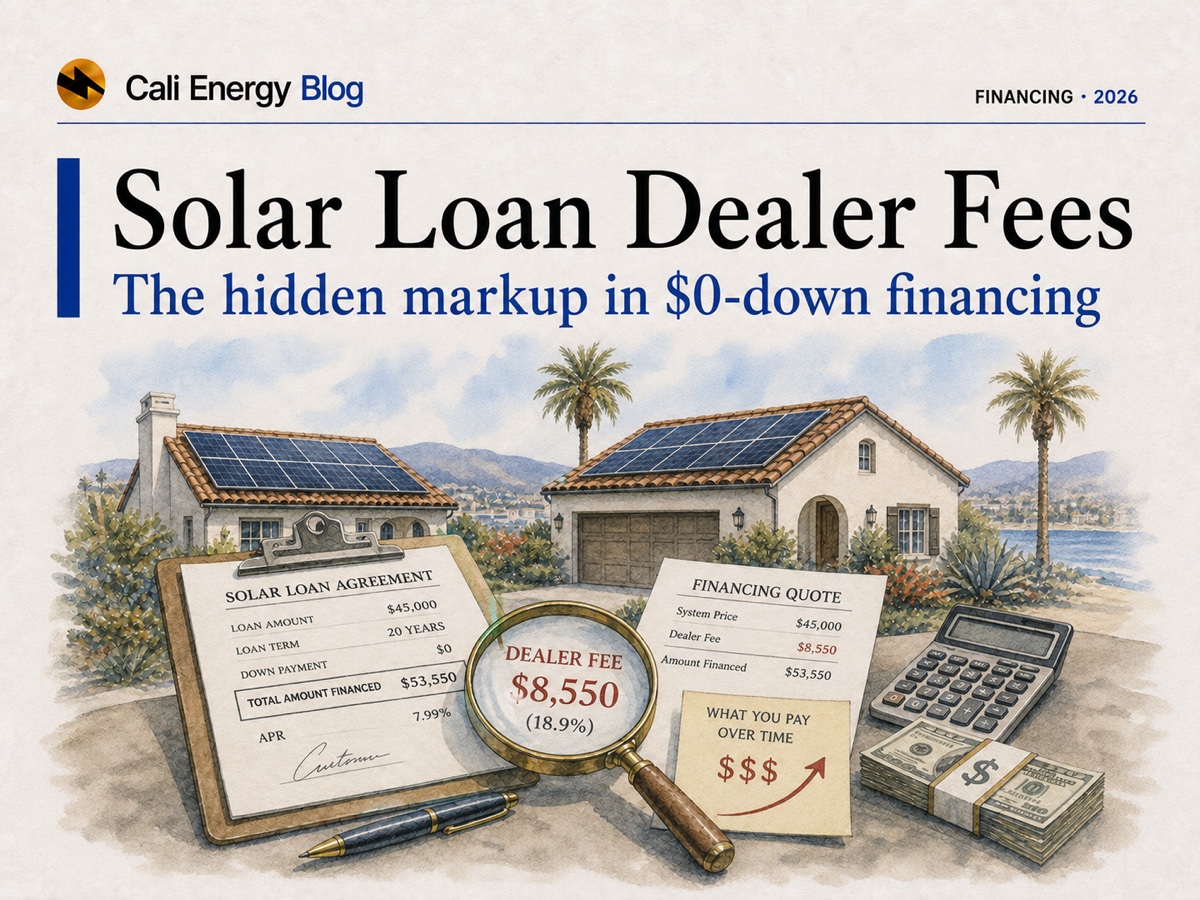
- What it is: the lender pays the installer the cash price and keeps the fee, which you repay as part of the loan principal. It goes by many names: dealer, program, platform or finance fee.
- How big: typically 10–30% of the cash price, sometimes over 50% (CFPB). Berkeley Lab found the median financed system cost $1.20 per watt more than the median cash system in 2024.
- A low APR is not a low cost: in the CFPB’s own example, 1.99% with a 30% fee works out to about 4.4% a year over 25 years, 6.1% if repaid in 8 years and 8.1% in 5.
- The 2026 trap: many solar loans assume a 30% prepayment from the federal tax credit, which no longer exists for homeowners.
- The fix: get the cash price for the identical system in writing and compare it with the loan amount.
What is a dealer fee on a solar loan?
A markup between the cash price and the amount you borrow.
Solar-specific loans arranged through the installer often advertise APRs of 1–7%. To offer those rates, many lenders charge a fee that raises the loan principal above the cash price. The industry calls it a dealer, program, lending, finance or platform fee, or an original issue discount. The CFPB’s example: a system that costs $30,000 in cash carries a $9,000 hidden fee, so the loan documents show $39,000 plus interest. The lender sends the installer $30,000 and keeps $9,000. Typically the fee is not included in the cost of credit shown to the consumer, and the salesperson often doesn’t explain the difference between the cash price and the loan principal (CFPB Issue Spotlight, 2024).
The CFPB says these fees typically range from 10 to 30 percent of the cash price and can exceed 50 percent. Loan terms usually run 8 to 25 years, though industry data show most solar loans are repaid in 7 to 9 years. Some lenders price all their costs into the APR instead and add no markup, but their higher advertised rate is harder to sell next to a 1.99% offer (CFPB).
What a 1.99% solar loan really costs
The fee is paid up front, so the sooner you repay, the more it costs per year.
| Loan with dealer fee | Loan without fee | |
|---|---|---|
| Loan amount | $39,000 (cash price + 30% fee) | $30,000 (cash price) |
| Advertised APR, term | 1.99%, 25 years | 6.99%, 25 years |
| Monthly payment | $165.11 | $211.84 |
| Real rate on the $30,000 cash price if kept 25 years | 4.4% | 6.99% |
| … if repaid after 8 years | 6.1% | 6.99% |
| … if repaid after 5 years | 8.1% | 6.99% |
Cash price and fee from the CFPB Issue Spotlight; 6.99% is within the 1–7% APR range it reports. Cali Energy calculation: the real rate is the one at which the payments, plus paying off the balance early, equal the $30,000 cash price. Illustrative, not a loan offer.
Two lessons. A dealer-fee loan kept for its full term can cost less than a high-rate loan without a fee — about 4.4% a year here. But most solar loans are paid off early, when the house is sold or refinanced, and then the fee is spread over fewer years: about 6.1% a year at 8 years and 8.1% at 5. Compare offers on that real rate, not on the advertised APR.
A prepayment built around a tax credit that ended
Many solar loans are set to re-amortize at a higher monthly payment around the 19th month unless the borrower prepays a large share of the principal — typically 30%, the size of the federal tax credit the sales pitch assumed (CFPB). For a homeowner who buys in 2026 there is no such credit: expenditures after December 31, 2025 do not qualify for the Residential Clean Energy Credit (IRS; what ended). Ask what the payment becomes if you make no prepayment, and judge the loan on that number.
How to find the dealer fee in a quote
Ask for the cash price
Get the price for the identical system, paid in cash, in writing. The difference from the loan amount is the fee.
Read the loan amount
Compare the principal on the loan agreement with the contract price. If the loan is larger, ask what the difference pays for.
Read the cover page
California requires a solar disclosure on the contract’s cover page with the total cost, including financing (B&P §7169); see your rights.
Ask about prepayment
Is the payment set to rise if you don’t prepay 30% by a certain month? Get the higher payment in writing.
Price a no-fee loan
A credit union or home equity loan priced entirely in its APR gives you a comparison point. In PG&E, SCE and SDG&E territory, the state’s GoGreen Home program backs loans from participating lenders for solar bundled with battery storage (California State Treasurer).
Check the price per watt
Divide the cash price by the system size in watts and compare it with real prices; see how to compare solar quotes.
What the price data show
Berkeley Lab’s tracking of US home solar prices separates cash and financed sales. Among 2024 installations, the median cash-purchase price was $3.50 per watt and the median loan-financed price $4.70 — a $1.20 gap, up from $0.60 in 2017. Berkeley Lab attributes the gap partly to loan fees rolled into the up-front price, and cautions that the medians are not adjusted for system size, equipment or installer (Berkeley Lab; solar panel cost). The CFPB also notes that some lenders place a UCC lien on the panels themselves, which can complicate a sale or refinance (CFPB). None of this makes financing wrong; it makes the cash price the number to compare. Cash, loan and lease side by side are in cash vs loan vs lease.
Where to go next
Cali Energy is a licensed Los Angeles solar, battery and electrical contractor (CSLB #1032379). We quote the cash price first and show any financing as separate lines, so the cost of the loan is visible. Call +1-323-844-7777 or get a quote with the cash price.
Frequently asked
What is a dealer fee on a solar loan?
A fee a lender charges to offer a low interest rate, built into the loan principal above the cash price. The lender pays the installer the cash price and keeps the fee. The CFPB says such fees typically run 10–30% of the cash price and can exceed 50%.
Why is the financed price higher than the cash price?
Usually because of the dealer fee. In the CFPB’s example a $30,000 cash price becomes a $39,000 loan. Berkeley Lab found the median loan-financed system in 2024 cost $1.20 per watt more than the median cash system, partly because of such fees.
Is a 0.99% or 2.99% solar APR too good to be true?
Not necessarily, but the advertised rate leaves out the fee. A 1.99% loan with a 30% fee works out to about 4.4% a year on the cash price if kept 25 years, 6.1% if repaid after 8 years and 8.1% after 5. Compare offers on that real rate.
How do I find out the dealer fee on my quote?
Ask for the cash price of the identical system in writing and compare it with the loan amount on the loan agreement; the difference is the fee. The solar disclosure on a California contract’s cover page also shows the total cost including financing.
Are solar loans a bad idea in 2026?
Not by themselves, but check two things: the fee hidden in the loan amount, and whether the payment rises unless you prepay about 30% — a structure built around the federal tax credit, which no longer applies to homeowners who buy in 2026.
Cash vs. loan — which costs less?
Cash, for the same system, because there is no fee and no interest. Among loans, compare the real rate on the cash price, including how long you expect to keep the loan, rather than the advertised APR.
Related reading
Sources & methodology
Figures on this page come from the primary sources below and, where noted, from Cali Energy calculations using the stated assumptions. Rates, incentives, and program terms change; each was verified October 5, 2026.
- CFPB — Issue Spotlight: Solar Financing (August 2024)
- CFPB — Issue Spotlight: Solar Financing, full report (PDF): hidden fees, $30,000 example, prepayment and re-amortization, UCC liens
- Berkeley Lab (LBNL) — Tracking the Sun / U.S. Distributed Solar and Storage, 2025 data update (cash vs financed prices, 2024 installations)
- IRS — Residential Clean Energy Credit (no credit for expenditures after December 31, 2025)
- California Business & Professions Code §7169 — solar energy system disclosure document
- California State Treasurer (CAEATFA) — GoGreen Home: credit enhancement for bundled solar + battery since May 2024, IOU and CCA customers
Ask us for the cash price, too
We’ll quote your system with the cash price first and any financing itemized beside it, so you can see exactly what a loan adds. Estimates, not guarantees.
Get a free estimatePrepared by Cali Energy, October 5, 2026. This article is for general educational purposes only and is not legal, tax, financial, engineering, or utility advice. Rates, incentives, codes, permit requirements, equipment specifications, prices, and program terms may change; figures and timelines are estimates, not guarantees. Confirm current requirements with the applicable utility, AHJ, program administrator, manufacturer, or a licensed professional. See our Content Disclaimer. Cali Energy · 19201 Parthenia St, Unit E, Northridge, CA 91324 · CSLB #1032379 (B, C-10, C-39)