

Max Panels per String in Southern California: Cold-Morning Voltage, Hot-Roof Voltage
String length on a string or hybrid inverter is set by two temperatures. On the coldest morning, each panel's open-circuit voltage (Voc) is at its highest, and the string's total must stay under the inverter's maximum DC input voltage — that sets the maximum number of panels. On the hottest afternoon, each panel's working voltage (Vmp) is at its lowest, and the string must stay above the inverter's MPPT (or start-up) voltage — that sets the minimum. In Southern California's mild winters the cold limit is gentler than in most of the country, but it still decides string length: with a common 400 W panel, a 600 V inverter takes up to 12 panels per string at Los Angeles temperatures. The free string sizing calculator in Cali-Graf — the platform built by Cali Energy, a Los Angeles solar and roofing contractor — runs the check for the panels and inverters most named in Southern California permits; for a permit design, NEC 690.7 and the inverter manual have the final word.
The two formulas
| Limit | Formula | Sets |
|---|---|---|
| Voltage when cold | Voc × (1 + β(Voc) × (T_coldest air − 25 °C)) | Max panels = inverter max DC voltage ÷ cold Voc, rounded down |
| Voltage when hot | Vmp × (1 + β(Vmp) × (T_hottest cell − 25 °C)) | Min panels = MPPT low ÷ hot Vmp, rounded up |
β(Voc) is the panel's Voc temperature coefficient from its datasheet (negative, %/°C). The hot-roof Vmp coefficient is often not published; it can be estimated as the power coefficient minus the current coefficient.
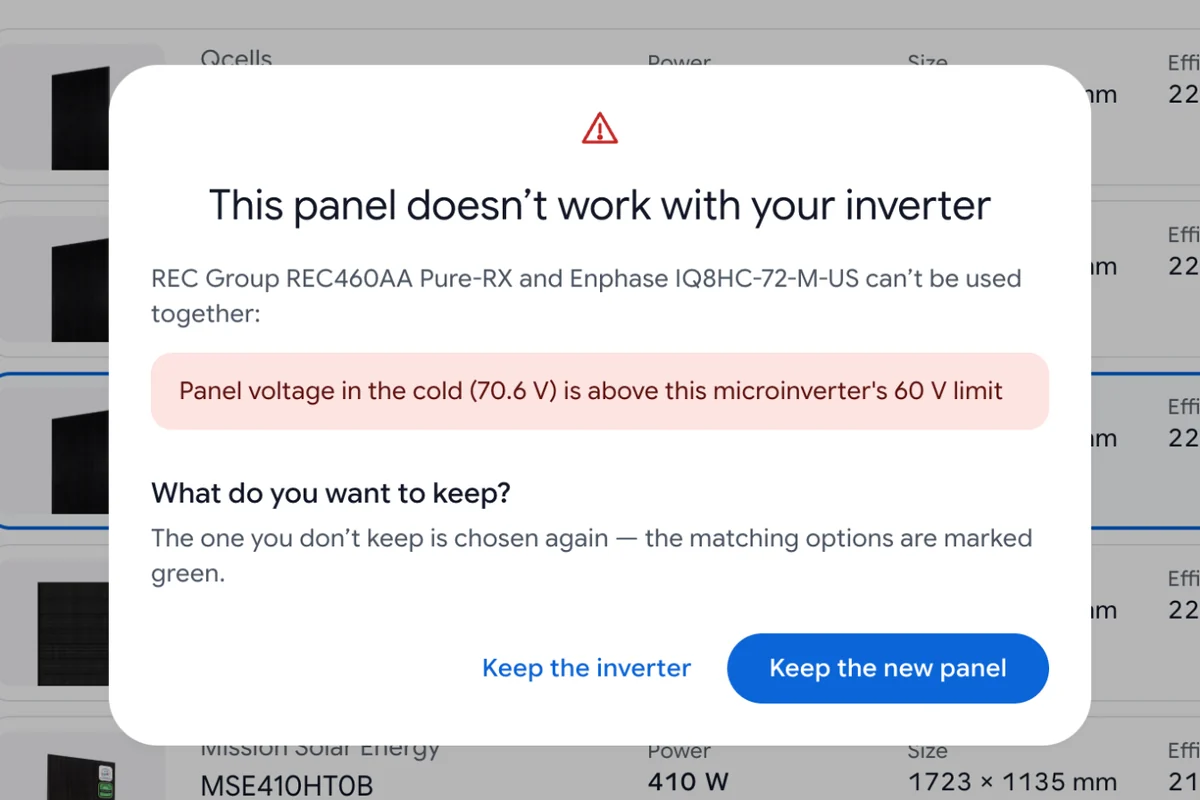
The same cold-voltage formula decides single-panel pairings too. In Cali-Graf's design app, a panel whose voltage on a cold morning would pass a microinverter's limit stops the design until one part is changed:
A worked example
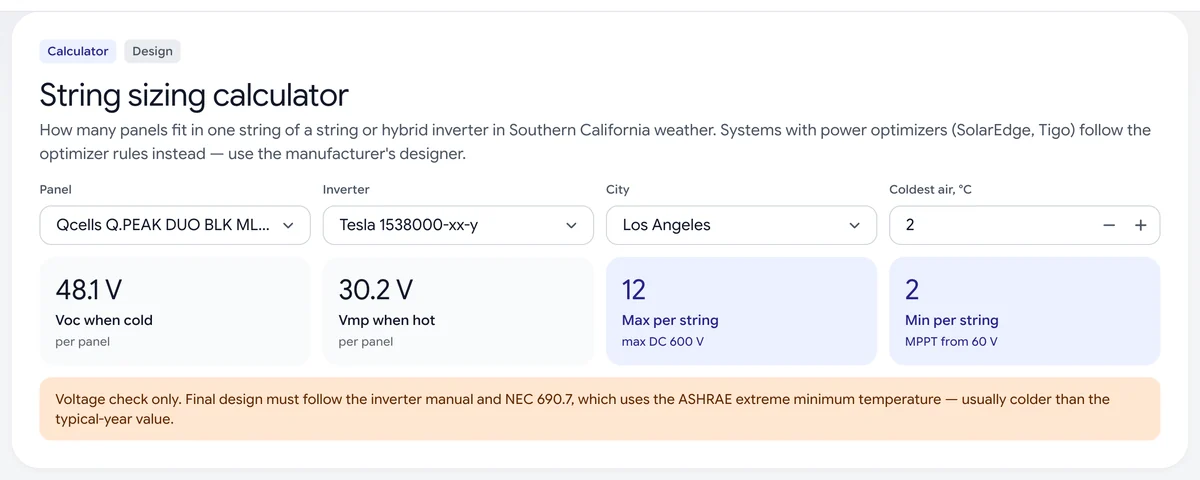
Panel: Qcells Q.PEAK DUO BLK ML-G10+ 400 — Voc 45.30 V, Vmp 37.13 V, β(Voc) −0.27%/°C, Vmp coefficient about −0.38%/°C (from its CEC listing and datasheet, as shown on its Cali-Graf page). Los Angeles typical-year weather: coldest hour about 2 °C, hottest modeled cell about 74 °C.
- Cold Voc: 45.30 × (1 + 0.0027 × 23) ≈ 48.1 V per panel.
- Hot Vmp: 37.13 × (1 − 0.0038 × 49) ≈ 30.2 V per panel.
| Inverter (examples from SoCal permits) | Max DC input | MPPT range | Panels per string |
|---|---|---|---|
| Tesla solar inverter (1538000) | 600 V | 60–480 V | 2–12 |
| Solis S6-EH1P10K-H-US | 600 V | 80–520 V | 3–12 |
| Solis 1P7.6K-4G-US | 600 V | 100–500 V | 4–12 |
| Qcells Q.VOLT H7.6SX | 498 V | 234–498 V | 8–10 |
Checking the cold limit with a colder design temperature of −10 °C — the margin Cali-Graf's design tool uses across Los Angeles County — gives about 49.6 V per panel, and still 12 panels on a 600 V input.
Southern California temperatures
Typical-year extremes the calculator starts from, by city:
| City | Coldest air (typical year) | Hottest cell (modeled) |
|---|---|---|
| Los Angeles | 2 °C | 74 °C |
| Palmdale | 0 °C | 77 °C |
| Santa Clarita | 1 °C | 75 °C |
| Riverside | 0 °C | 76 °C |
| Huntington Beach | 6 °C | 66 °C |
| Chula Vista | 7 °C | 73 °C |
These are typical-year values. NEC 690.7 calculates maximum PV system voltage with the ASHRAE extreme annual minimum temperature for the site, which is usually colder — enter it in the calculator for a permit design. Inland valleys and high desert run colder than the coast; Palmdale's string can be shorter than Huntington Beach's with the same parts.
Plug your panel and inverter into the free string calculator, with your site's coldest morning.
What this check doesn't cover
- Microinverters. One per panel — no strings; the check is the panel's cold Voc and current against the microinverter's limits. See will this panel work with this inverter?.
- Power optimizers. Systems with optimizers (SolarEdge, Tigo) follow the optimizer manufacturer's string rules — use their designer.
- Current, conductors and protection. Per-input current limits, wire sizing, fusing and rapid shutdown are separate checks.
- The proposal tool. Cali-Graf's design and proposal app doesn't size strings (it reports a panels-per-input range for Powerwall 3 as a hybrid inverter); the string calculator lives in the equipment directory, and each panel page has the same check for its own models.
Frequently asked
How do I calculate the maximum number of panels per string?
What temperature should I use for string sizing in Los Angeles?
Why does a hot roof set a minimum string length?
How many panels can go on a 600 V string in Southern California?
Does this apply to microinverters or optimizers?
Related reading
Sources & methodology
Product facts on this page come from Cali-Graf's own help center and the pages linked below; figures in examples come from the stated inputs. Features, limits and supported utilities change; each was verified October 16, 2026.
Run the string check, then the whole design
The free string sizing calculator gives the voltage window for your site; Cali-Graf's design app checks panel–inverter compatibility at −10 °C and models the bill and proposal. Final designs follow the inverter manual and NEC 690.7, which uses the ASHRAE extreme minimum temperature.
Prepared by Cali Energy, October 16, 2026. This article is for general educational purposes only and is not legal, tax, financial, engineering, or utility advice. Rates, incentives, codes, permit requirements, equipment specifications, prices, and program terms may change; figures and timelines are estimates, not guarantees. Confirm current requirements with the applicable utility, AHJ, program administrator, manufacturer, or a licensed professional. See our Content Disclaimer. Cali Energy · 19201 Parthenia St, Unit E, Northridge, CA 91324 · CSLB #1032379 (B, C-10, C-39)