

Tesla Solar Roof vs Solar Panels in California (2026)
Update: Tesla stopped taking orders for the Solar Roof in August 2026, according to Electrek. Before that, on California’s own records a Tesla Solar Roof costs about twice as much per watt as conventional panels — a median of $8.51 per watt for owner-bought systems without a battery interconnected in 2024–2026, against $4.53 for panel systems, with a median Solar Roof project of $102,800. Part of that buys a new roof, so it competes best when the roof needs replacing anyway. Panels also get about 40% more power from the same area, and Solar Roof installs in the state’s investor-owned utility territories fell from 796 in 2021 to 133 in 2025.
Get a free estimate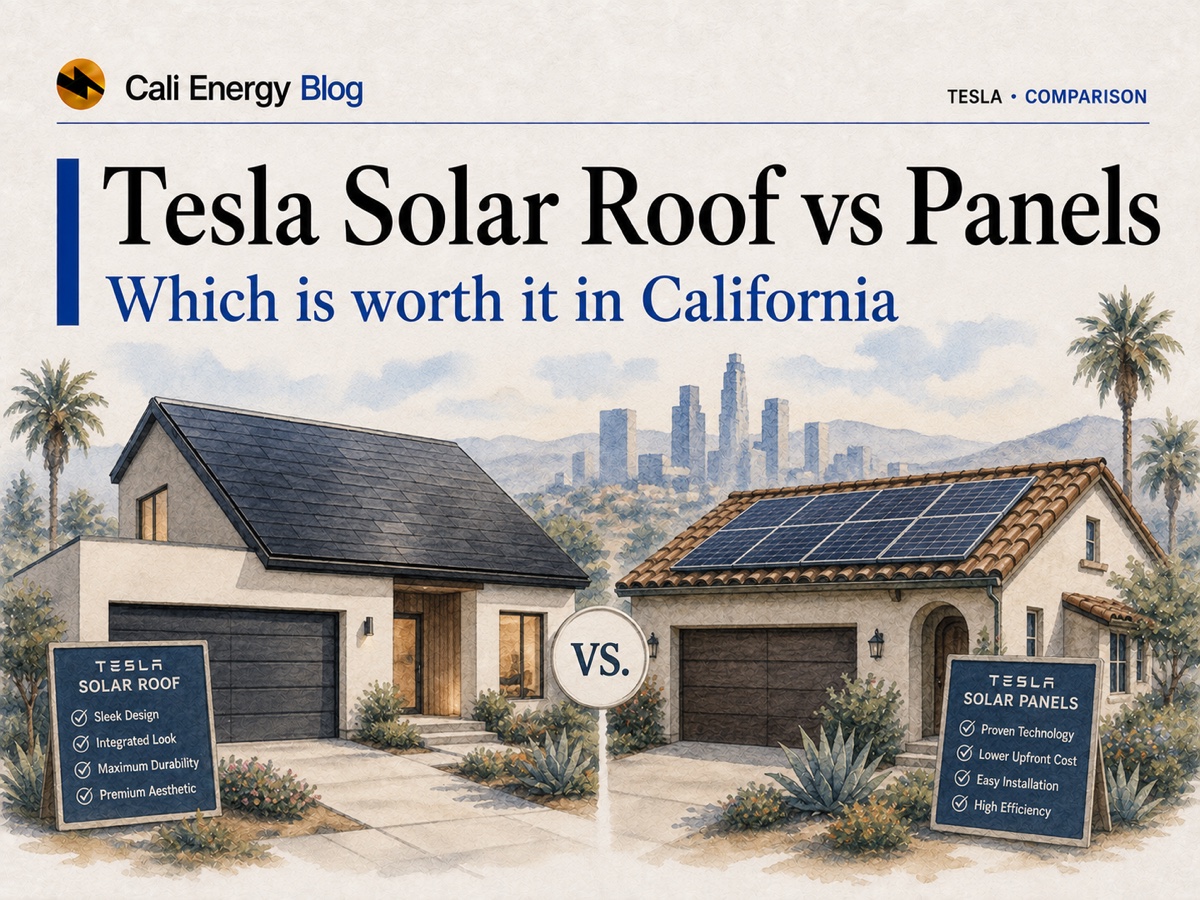
- Cost: 167 owner-bought Solar Roofs without a battery reported a median of $8.51 per CEC-AC watt in 2024–2026, against $4.53 for 133,963 conventional systems — about 1.9 times as much, and $102,800 against $22,700 per project.
- The roof is in the price: at the medians, the gap over a panel system of the same size is about $50,000. Weigh it against a real quote for a new roof plus panels.
- Power per area: Tesla’s 72 W tile delivers about 147 W per square meter; the median panel on the CEC list, 207. The newest 86 W tile reaches 179.
- A shrinking product: 796 Solar Roofs were interconnected in 2021 and 133 in 2025 across PG&E, SCE and SDG&E; Tesla installed most of them, other installers about half since 2024.
- Code: California treats a solar roof as roofing: it must be listed to UL 7103 and carry the roof’s fire classification.
Tesla has stopped selling the Solar Roof. According to Electrek, Tesla told its certified installers in August 2026 that Solar Roof tiles are no longer available to order and that it will supply only conventional panels; its Solar Roof web page now redirects to its solar panel page (Electrek, August 20, 2026). Tesla has not issued a public announcement. For a new home project that settles the comparison: panels, on a new roof if the old one is near the end of its life. The data below still matters for the homes that already have a Solar Roof — for service, warranty and resale.
Two different products
One replaces the roof; the other sits on it.
A Tesla Solar Roof is building-integrated photovoltaics: glass roof tiles, some of them active solar tiles and the rest matching inactive tiles, installed after the old roof is torn off to the deck. The roof and the solar system become one product. The California Energy Commission’s equipment list carries Tesla’s tiles from the 58.47 W SR60T1 through the 72 W SR72 series to the 86 W SR86T3R (CEC). Conventional panels are separate modules, today mostly 380–480 W each, mounted on racking above a roof that stays independent: the roof can be replaced under them, and any qualified contractor can remove, reset or swap them. Which panels suit a California roof is in the best solar panels for California.
What Californians actually paid
Every grid-connected system in PG&E, SCE and SDG&E territory is filed with its equipment and, for owner-bought systems, its cost.
| System | Systems | Median per watt (CEC-AC) | Middle half | Median size, kW-AC | Median total |
|---|---|---|---|---|---|
| Tesla Solar Roof, no battery | 167 | $8.51 | $6.68–11.82 | 11.5 | $102,800 |
| Tesla Solar Roof, with battery | 163 | $12.57 | $6.53–16.22 | 10.6 | $115,700 |
| Conventional panels, no battery | 133,963 | $4.53 | $3.19–5.88 | 4.8 | $22,700 |
| Conventional panels, with battery | 73,628 | $5.41 | $4.24–6.86 | 7.2 | $37,500 |
Source: CPUC California DG Stats, Interconnected Project Sites (data through August 31, 2026), Cali Energy analysis. Solar Roof means any system listing Tesla SR-series roof tiles. Costs are as reported by the applicant; a Solar Roof’s cost includes the roof. LADWP and other city utilities are not in this data.
Per watt, the Solar Roof ran about 1.9 times the price of conventional panels, and Solar Roof projects were bigger — 11.5 kW-AC at the median against 4.8 — so the totals differ by much more. For context, $4.53 per CEC-AC watt is about $3.90–4.00 per DC watt, in line with the figures in our solar cost guide. Solar Roof prices also moved up over the period, on small samples: the median for systems without a battery was $7.13 per watt in 2023 (253 systems) and $11.12 in 2025 (36).
The fair comparison is a Solar Roof against panels plus a new roof. At the medians, an 11.5 kW panel system would cost about $52,100, so the Solar Roof’s extra $50,700 is what the integrated roof costs over panels. If your roof needs replacing anyway, put a real roofing quote next to that number; if it does not, you would be paying for a roof you do not need. See replacing your roof before solar. Either way, there is no federal credit in 2026: expenditures after December 31, 2025 do not qualify for the Residential Clean Energy Credit (IRS).
Power per square foot
For the same patch of roof, panels carry more watts.
On the CEC list, Tesla’s 72 W SR72 tiles are rated at about 147 W per square meter of tile, while the median conventional panel in the 380–480 W range is rated at 207 — about 40% more power from the same area. The newest 86 W tile narrows the gap to 179 W per square meter (CEC). On a roof with limited good sun, that difference decides how much of the bill the system can cover; on a large, unshaded roof it matters less, because the Solar Roof covers the whole surface anyway.
Who installs and services a Solar Roof
The interconnection records answer this directly.
Of the 2,595 residential Solar Roofs interconnected in PG&E, SCE and SDG&E territory since 2019, Tesla’s installation company put in 2,158 and SolarCity, which Tesla owns, another 207 — 91% together. Since 2024 that has shifted: Tesla installed 194 of 373, and other contractors the rest. Installs peaked at 796 in 2021 and fell to 133 in 2025, with 72 in the first eight months of 2026; Los Angeles County has 376 of them, nearly all owner-bought (CPUC DG Stats). For a homeowner the practical point is service: the tiles are a Tesla product, so repairs depend on Tesla or the handful of contractors that install it, while panels on racking can be serviced, removed and reset by any qualified solar or roofing contractor.
What California code requires of a solar roof
A solar roof is regulated as a roof as well as a solar system.
The 2025 California Residential Code requires building-integrated PV roof coverings and roof assemblies to be listed and labeled to UL 7103, to meet the roofing chapter’s sections written for BIPV, and to carry the fire classification the roof requires (CRC §R329.3.1, R329.5). Rooftop solar normally needs firefighter pathways at least 36 inches wide; BIPV listed to UL 3741, where cutting away parts of it does not expose firefighters to shock, is exempt (§R329.6). Conventional panels must instead be listed to UL 61730 (or the older UL 1703), and racking listed to UL 2703 must be installed per its listing. A tile roof brings its own installation details; see solar on clay-tile roofs.
When each one makes sense
New construction or a full re-roof
The roof is being bought anyway, so part of the Solar Roof’s premium is money you would spend regardless. This is its strongest case.
The look matters most
No visible panels and a uniform roof, with the budget to pay about twice as much per watt.
A sound roof
Panels avoid paying for a roof you do not need, at about half the cost per watt.
Limited roof area
Panels produce about 40% more per square meter than the common Solar Roof tile.
Long-term service
Panels can be serviced by many contractors; the Solar Roof depends on Tesla and the few contractors that install it.
Cost per watt and payback
On the state’s records, conventional panels win in every year shown above.
We install panels and do roofing
Cali Energy is a licensed Los Angeles solar, battery, electrical and roofing contractor (CSLB #1032379, including C-39 roofing). We install conventional panels and re-roof homes, so when a roof is at the end of its life we can do both together. We are not a Tesla Solar Roof installer; that product goes through Tesla or a contractor that installs it.
Where to go next
Panel and roof warranties work differently; see roof warranty vs solar warranty. Call +1-323-844-7777 or ask for an itemized panel and roof comparison.
Frequently asked
Can you still buy a Tesla Solar Roof?
Not new from Tesla, according to Electrek: in August 2026 Tesla told its certified installers that Solar Roof tiles are no longer available to order and that it will supply only conventional panels, and its Solar Roof page now redirects to solar panels. Tesla has not made a public announcement.
What is a Tesla Solar Roof, exactly?
A roof of glass tiles, some of them active solar tiles and the rest matching inactive ones, installed after the old roof is torn off to the deck — building-integrated photovoltaics. The CEC equipment list carries Tesla’s tiles at 58.47 to 86 W each, against 380–480 W for most conventional panels.
How much does a Tesla Solar Roof cost in California?
In CPUC interconnection records, 167 owner-bought Solar Roofs without a battery approved in 2024–2026 reported a median of $8.51 per CEC-AC watt and $102,800 per project, for a median 11.5 kW-AC. Conventional panel systems reported $4.53 per watt and $22,700 for a median 4.8 kW. These are reported costs, not quotes.
Is a Solar Roof cheaper than panels plus a new roof?
Compare it directly. At the medians, an 11.5 kW panel system would cost about $52,100, leaving about $50,700 of the Solar Roof’s price for the roof itself. If your roof needs replacing, put a real roofing quote next to that number.
Are Solar Roof tiles as efficient as solar panels?
No. Tesla’s 72 W tiles are rated at about 147 W per square meter on the CEC list, against a median of 207 for 380–480 W panels, so panels produce about 40% more from the same area. The newest 86 W tile reaches 179.
Who can install or repair a Tesla Solar Roof?
Tesla and the contractors that install it. Tesla and SolarCity installed 91% of the 2,595 Solar Roofs in PG&E, SCE and SDG&E territory; since 2024 about half went through other contractors. Cali Energy installs conventional panels and does roofing, not the Solar Roof.
Is there still a federal tax credit for a solar roof in 2026?
No. Expenditures after December 31, 2025 do not qualify for the 30% Residential Clean Energy Credit, for a Solar Roof or for panels. This is general information, not tax advice.
Related reading
Sources & methodology
Figures on this page come from the primary sources below and, where noted, from Cali Energy calculations using the stated assumptions. Rates, incentives, and program terms change; each was verified October 5, 2026.
- Electrek — Tesla discontinues its Solar Roof tiles (August 20, 2026)
- CPUC — California DG Stats, Interconnected Project Sites data set (PG&E, SCE, SDG&E; data through August 31, 2026)
- California Energy Commission — Solar Equipment List, PV modules (data as of October 1, 2026)
- 2025 California Residential Code — Section R329, Solar Energy Systems (UL 7103 BIPV listing, roof access exceptions)
- IRS — Residential Clean Energy Credit
Solar roof or panels? Get an honest comparison
Tell us about your roof and recent bill and we’ll give you an itemized panel estimate — and a straight take on whether a new roof belongs in the same project.
Get a free estimatePrepared by Cali Energy, October 5, 2026. This article is for general educational purposes only and is not legal, tax, financial, engineering, or utility advice. Rates, incentives, codes, permit requirements, equipment specifications, prices, and program terms may change; figures and timelines are estimates, not guarantees. Confirm current requirements with the applicable utility, AHJ, program administrator, manufacturer, or a licensed professional. See our Content Disclaimer. Cali Energy · 19201 Parthenia St, Unit E, Northridge, CA 91324 · CSLB #1032379 (B, C-10, C-39)