

How to Add Solar Without a Main Panel Upgrade
Straight answer: often, yes. On the common modern setup — a 200-amp busbar with a 200-amp main — the code’s 120% busbar rule leaves room for an inverter of about 7.68 kW with no panel work. Past that there are four code-compliant paths before a panel change: a smaller main breaker where a load calculation allows it, a supply-side connection ahead of the main, a listed power control system, or the sum-of-breakers method. Which one works is settled by an electrician’s calculation and plan review, not by a sales promise.
Get a free estimate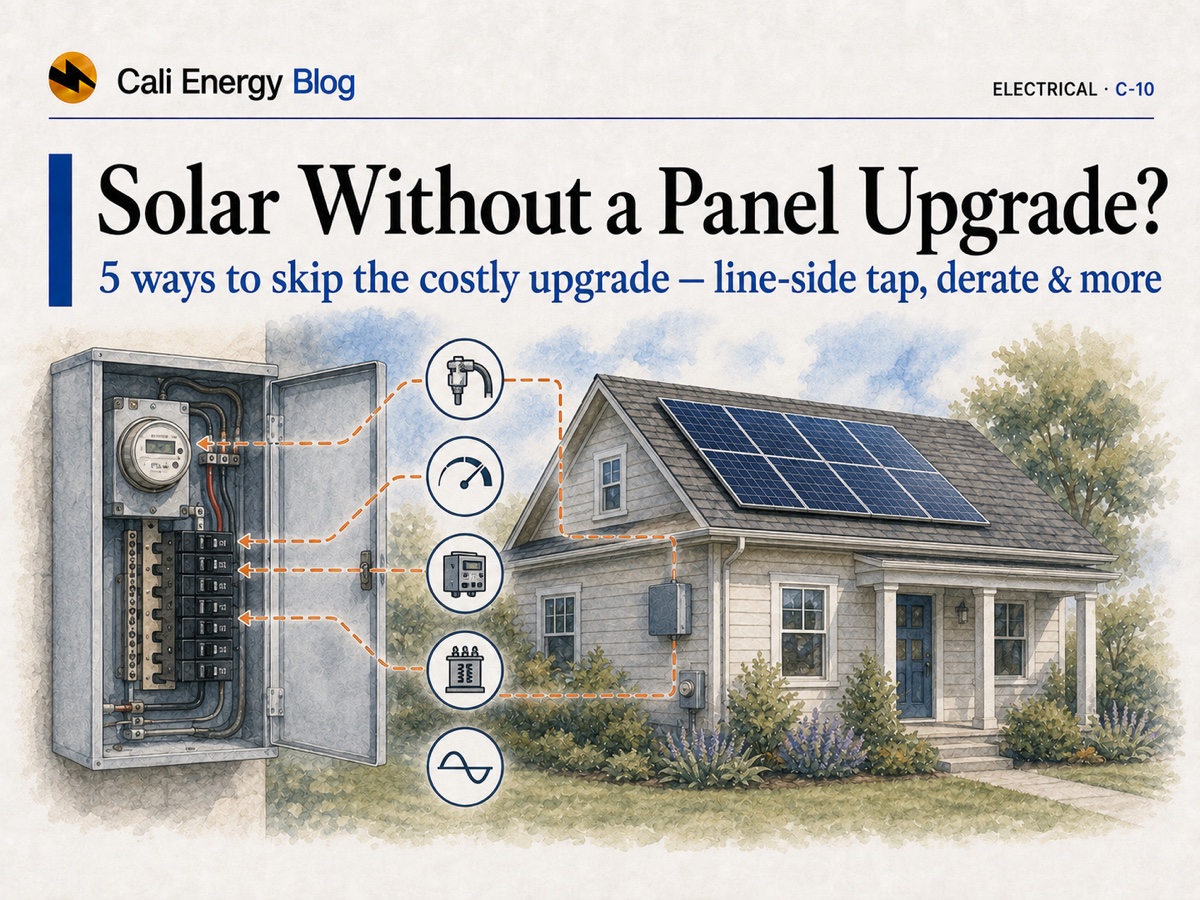
- The rule: 125% of the inverter’s output current plus the main breaker may not exceed 120% of the busbar rating, with the solar breaker at the opposite end (705.12(B)(2) in the 2025 California Electrical Code, in force since January 1, 2026).
- A 200 A busbar with a 200 A main allows a 7.68 kW inverter; a 225 A busbar with a 200 A main allows 13.44 kW.
- Beyond that: the sum-of-breakers method, a main-breaker derate backed by a load calculation, a supply-side connection, or a listed power control system — each with its own conditions.
- A smart panel that only sheds loads does not change the busbar math, and an EV charger is a load, not a source.
- In LADWP territory, a project up to 30 kW without a service panel upgrade stays on the simpler Type 1 interconnection path.
Why solar runs into the panel at all
Every breaker clips onto the panel’s busbar. The utility feeds one end through the main breaker; a load-side solar system feeds the other end through a backfeed breaker. Because current can arrive from both ends, the code caps the total: the sum of 125% of the power source’s output circuit current and the rating of the device protecting the busbar may not exceed 120% of the busbar’s rating. The 125% applies to the inverter’s continuous output current, not to the backfeed breaker’s rating. California’s 2025 electrical code, based on the 2023 NEC, has carried the rule at 705.12(B)(2) since January 1, 2026; a job permitted earlier stays under the 2022 code, where the arithmetic is the same (California Building Standards Commission; NFPA 70).
Solar and a battery that can export are sources in that calculation. An EV charger, a heat pump or a range are loads: they enter the service load calculation instead, so a fix for one problem does not automatically fix the other. The full diagnosis — reading your panel label and when an upgrade really is required — is in do you need a main panel upgrade for solar?
| Busbar / main | 120% of busbar | Headroom | Inverter it permits |
|---|---|---|---|
| 100 A / 100 A | 120 A | 20 A | 16 A · 3.84 kW |
| 125 A / 125 A | 150 A | 25 A | 20 A · 4.80 kW |
| 200 A / 200 A | 240 A | 40 A | 32 A · 7.68 kW |
| 225 A / 225 A | 270 A | 45 A | 36 A · 8.64 kW |
| 225 A / 200 A | 270 A | 70 A | 56 A · 13.44 kW |
Headroom = 120% of the busbar minus the main breaker; inverter current = headroom ÷ 1.25; kW at 240 V. Cali Energy calculation from the code rule, as in the panel upgrade guide. The state’s Solar Permitting Guidebook (Table 4) lists the same 20, 25 and 40 A limits for breakers on 100, 125 and 200 A panels — and zero where the solar breaker cannot go at the opposite end.
Five ways to add solar without a new panel
Each is code-compliant where its conditions are met; none is automatic.
| Path | How it works | Worked example | What it takes |
|---|---|---|---|
| Size the system to the headroom | Choose an inverter, or a number of microinverters, whose combined continuous output fits the room the panel has | 200 A / 200 A: up to 32 A, 7.68 kW AC | A system that covers your usage at that size |
| Sum-of-breakers method (705.12(B)(3)) | The ratings of all breakers on the busbar, loads and sources, excluding the main, may not exceed the busbar rating; no position rule | Rarely works on a full 200 A panel | A lightly loaded panel, plus a warning label |
| Main-breaker derate | A smaller main frees busbar headroom | 200 A → 175 A main: +25 A headroom, +4.8 kW of inverter | A load calculation that justifies the smaller main; not below the 100 A minimum for a one-family dwelling |
| Supply-side connection (705.11) | The solar connects ahead of the service disconnect, so the busbar rule does not apply | The limit moves to the service: power-source output on the service may not exceed the service conductors’ ampacity | A listed service-rated disconnect or tap, sized conductors, and the utility’s review |
| Listed power control system | A controller listed for power control limits what the sources put on the busbar; the code uses its setpoint in the busbar math | A setpoint within the headroom lets a larger array or a battery connect | Equipment listed for power control, in its listed configuration, accepted in plan review |
Sources: NFPA 70 (NEC) 705.11, 705.12, 705.13 · California Electrical Code. Worked figures: Cali Energy calculation at 240 V.
Where each path works — and where it doesn’t
Sizing to the headroom is often the simplest option. If about 7.7 kW of inverter covers your usage, a 200 A panel needs nothing done to it. With microinverters, the combined continuous output current of all units is what enters the calculation, so the unit count can be set to fit the room.
A derate trades service capacity for solar room. Dropping a 200 A main to 175 A frees 25 A of headroom — 20 A of inverter current, about 4.8 kW — but only where a load calculation shows the house runs comfortably on the smaller main, and never below the 100 A the code requires for a one-family dwelling’s service. That floor is why the derate cannot help the panels that need help most: a 100 A service cannot be derated at all. The more large loads on the panel — an electric range, central air, EV charging — the harder it is for the load calculation to allow a smaller main.
A supply-side connection lands the solar ahead of the main, where the busbar rule does not reach. The limit moves rather than disappears: the power-source output on the service, other than any controlled by a listed power control system, may not exceed the ampacity of the service conductors. It needs a listed, service-rated disconnect or tap and correctly sized conductors, and the service equipment has to offer a place to make the connection; in Los Angeles the utility has its own say.
A power control system is easy to confuse with a smart panel. The code lets a device listed for power control stand in for the inverter’s output current in the busbar math, using the controller’s setpoint. Some battery equipment carries that listing: Tesla’s Powerwall 3 datasheet lists UL 1741 PCS certification, and FranklinWH’s aGate lists UL 1741 PCS within its UL 1741 listing (Tesla; FranklinWH). A smart panel that switches off loads is a different thing: it helps a load problem such as adding an EV charger, but unless it is listed for power control it does not change the source calculation. Our smart panel guide covers the products.
A battery that can export counts as a source too, so adding one later reopens the busbar question unless a listed power control system limits its output. Plan the battery and the panel together.
What avoiding the upgrade changes in Los Angeles
Permits and interconnection get simpler. LADBS’s express solar permit covers systems of 10 kW or less on one- or two-family rooftops at 120/240 V with a service panel no larger than 225 A (LADBS). LADWP’s Type 1 interconnection covers systems up to 30 kW that do not include a service panel upgrade; including one moves the project to Type 2, with engineering review (LADWP). The permit and interconnection timeline is in permit to PTO in Los Angeles.
Cost comes off the quote. A panel swap typically runs $3,000–$4,500 in Cali Energy’s 2026 work, and a full service upgrade with trenching or relocation $6,000–$15,000 or more — typical ranges with the city permit included, not a quote. The closest independent benchmark, a national Berkeley Lab survey, puts the median single-family main panel replacement at $3,500 (LBNL). On the utility side, LADWP says that where a service is upgraded and its existing service is already adequate for the new demand, there are generally no installation charges (LADWP). The breakdown is in main panel upgrade cost in Los Angeles.
Sometimes the upgrade is still the right call: a 100 A panel, a panel with no free position at the opposite end, or a house that will add a battery, an EV charger and a heat pump in the next few years. A good electrician says so.
A calculation by an electrician, not a workaround promised by a salesperson
We hold a California C-10 electrical classification (CSLB #1032379), so the busbar and load calculations are done in-house. We use a derate, a supply-side connection or a listed power control system where it fits the code, and we say plainly when a panel upgrade is the better choice. Ask anyone quoting you an upgrade for three numbers: the busbar rating, the main breaker rating, and whether the far-end position is free.
See if you can skip the upgradeFrequently asked
Can I add solar without upgrading my main panel?
Often. A 200 A busbar with a 200 A main allows a load-side inverter of about 7.68 kW under the 120% rule, and a 225 A busbar with a 200 A main about 13.44 kW. Beyond that, a derate, a supply-side connection, a listed power control system or the sum-of-breakers method may work, depending on the panel and loads.
What is the 120% rule for solar?
With the solar breaker at the opposite end of the busbar from the main, 125% of the inverter’s output current plus the main breaker rating may not exceed 120% of the busbar rating. On a 200 A / 200 A panel that leaves 40 A, which permits a 32 A inverter.
Can I derate my main breaker to fit solar?
Sometimes. Going from a 200 A to a 175 A main frees 25 A of headroom, about 4.8 kW more inverter, but only where a load calculation justifies the smaller main, and a one-family dwelling service cannot go below 100 A — so a 100 A panel cannot be derated.
What is a supply-side (line-side) connection?
A connection ahead of the service disconnect, under NEC 705.11, so the busbar rule does not apply. The limit moves to the service: the power-source output may not exceed the ampacity of the service conductors. It needs listed service-rated equipment, a place in the service equipment to make the connection, and the utility’s review.
Does a smart panel let me skip a panel upgrade for solar?
Only if it is listed for power control. The code lets a listed power control system’s setpoint stand in for the inverter current in the busbar math; a panel that just switches off loads helps with loads such as an EV charger but does not change the solar calculation.
Does an EV charger count against the 120% rule?
No. An EV charger is a load, not a source, so it is not a term in the 120% calculation. It does count in the service load calculation and under the sum-of-breakers method, which is often what forces an upgrade on a smaller panel.
Related reading
Sources & methodology
Figures on this page come from the primary sources below and, where noted, from Cali Energy calculations using the stated assumptions. Rates, incentives, and program terms change; each was verified September 29, 2026.
- California Electrical Code (Title 24, Part 3) — California Building Standards Commission
- NFPA 70 (National Electrical Code) — free read-only access (705.11, 705.12, 705.13, 230.79)
- California Solar Permitting Guidebook — Table 4, maximum combined supply OCPDs by busbar rating
- Tesla — Powerwall 3 datasheet (certifications include UL 1741 PCS)
- FranklinWH — aGate X 1.1 datasheet (UL 1741 listing including PCS)
- LADBS — solar photovoltaic permits and requirements (express permit limits)
- LADWP — interconnection program for NEM (PV), BESS and cogeneration projects (Type 1 / Type 2)
- LADWP — charges and fees for electric service requests
- Lawrence Berkeley National Laboratory — Understanding the Costs and Barriers of Residential Electrical Panel and Service Upgrades (August 2026)
See if you can skip the panel upgrade
We hold a C-10 electrical license (CSLB #1032379), so we run the busbar and load calculations ourselves — and recommend a main-panel upgrade only when the code leaves no other path. Send a photo of your open panel's label and we'll tell you your options.
Get a free estimatePrepared by Cali Energy, September 29, 2026. This article is for general educational purposes only and is not legal, tax, financial, engineering, or utility advice. Rates, incentives, codes, permit requirements, equipment specifications, prices, and program terms may change; figures and timelines are estimates, not guarantees. Confirm current requirements with the applicable utility, AHJ, program administrator, manufacturer, or a licensed professional. See our Content Disclaimer. Cali Energy · 19201 Parthenia St, Unit E, Northridge, CA 91324 · CSLB #1032379 (B, C-10, C-39)