

Can You Add a Home Battery Without Solar?
Yes. A battery without panels charges from the grid when power is cheap and runs the house when it is expensive or out. Whether that pays depends almost entirely on your utility. On SCE’s TOU-D-PRIME rate, each kWh moved from overnight into a summer 4–9 p.m. evening saves about 32¢ after losses. On LADWP’s time-of-use rate the gap is about 6¢ in summer and nothing in winter — there it is backup you are buying. Few people do it: 1.5% of SGIP-funded home batteries in 2024–25 had no solar.
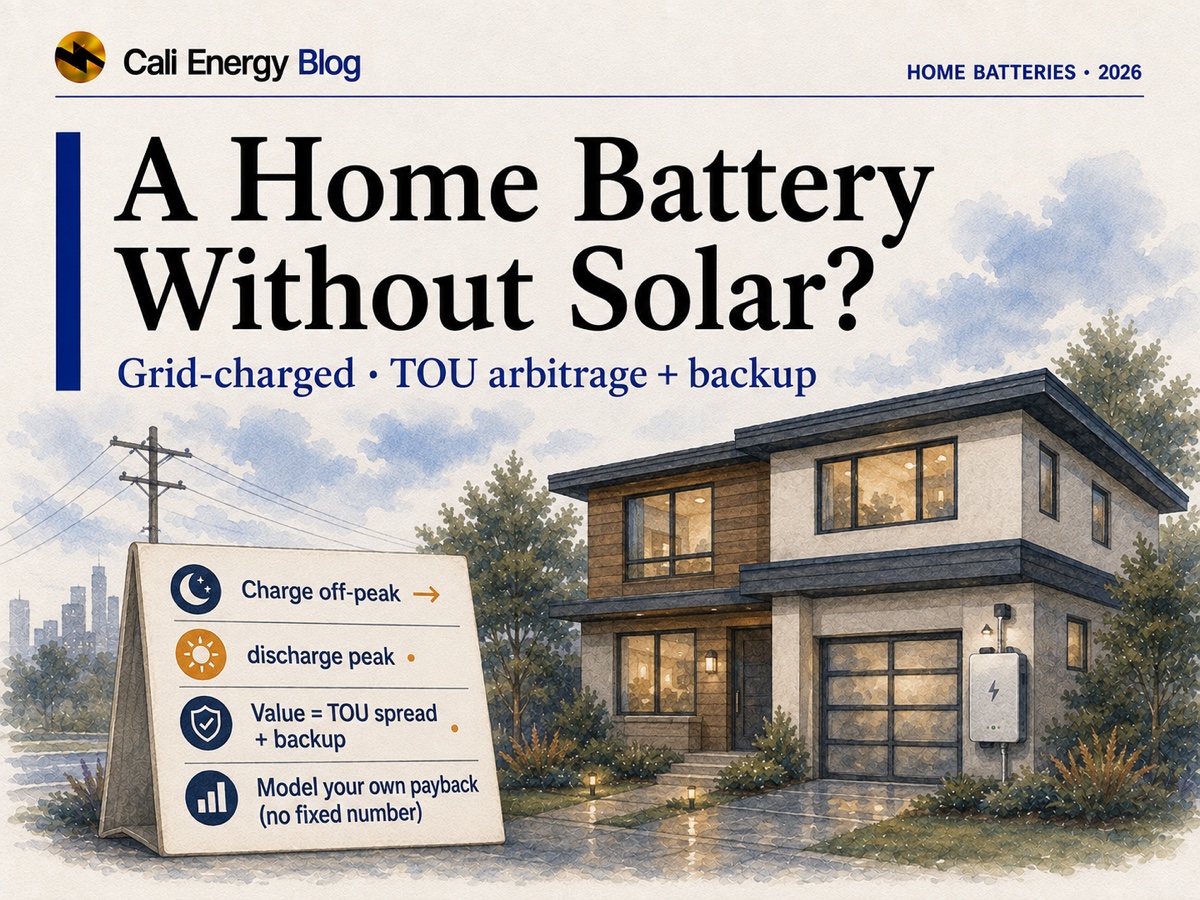
- It works: the battery fills from the grid at off-peak prices and powers the house at peak or in an outage.
- SCE: PRIME’s gap between about 26¢ off-peak and 61¢ on summer evenings leaves about 32¢ per kWh after losses; about 16¢ against the 45¢ winter peak.
- LADWP: R-1B’s summer high peak is 35.1¢ against a 26.5¢ base, about 6¢ after losses — and its peak is 1–5 p.m., not the evening.
- In an outage it runs down and stays down until the grid returns: one 13.5 kWh battery covers essentials for about 1.9 days.
How a battery saves money without solar
With solar, a battery stores your own midday power. Without it, the battery buys low and uses high: it charges from the grid in cheap hours and discharges in expensive ones, so you draw less peak-priced power. The saving on each kWh is the peak price minus the off-peak price divided by the battery’s efficiency — about 90% round trip for the FranklinWH aPower 2 (datasheet) and 89% solar-to-battery-to-home for the Tesla Powerwall 3 (datasheet). With no solar there is no net metering, so the battery serves the house rather than exporting; utility records list such systems as non-export standalone storage (DG Stats).
What each kWh is worth on SCE and LADWP
| Rate | Charge at | Discharge at | Saving per kWh |
|---|---|---|---|
| SCE TOU-D-PRIME, summer weekday | ~26¢ off-peak | ~61¢ 4–9 p.m. | ~32¢ |
| SCE TOU-D-PRIME, winter | ~26¢ off-peak | ~45¢ 4–9 p.m. | ~16¢ |
| LADWP R-1B, summer weekday | 26.5¢ base | 35.1¢ high peak, 1–5 p.m. | ~6¢ |
| LADWP R-1B, winter | 25.3¢ base | 27.6¢ peak | about zero |
Sources: SCE time-of-use plans (TOU-D-PRIME, rates as worked out in SCE TOU plans compared) · LADWP residential rates (R-1B, before the 10% city tax). Saving = peak − off-peak ÷ 0.9. Cali Energy arithmetic; rates change, and PRIME’s overnight super-off-peak hours are cheaper in the cooler months.
On SCE, a battery that moves 10 kWh a day out of the summer evening peak saves about $3.20 each weekday, before fixed charges. On LADWP the same battery saves well under $1, and its high-peak window is 1–5 p.m. rather than the evening. PRIME is SCE’s plan for homes with batteries, EVs and heat pumps. See LADWP rates explained and the same math with solar.
Backup without panels: how long it lasts
In an outage a standalone battery runs the backed-up circuits until it is empty, and then waits for the grid; there are no panels to refill it. Essentials — fridge, lights, Wi-Fi, a furnace fan — use about 7.2 kWh a day, so one 13.5 kWh battery lasts about 1.9 days; central AC or an EV charger shortens that to hours. With no solar there are no net-metering limits on grid charging, so the battery can simply be kept full ahead of a forecast shutoff. See batteries in outages and PSPS and how PSPS shutoffs work.
How common it is
Not very. Of 4,788 home batteries in SGIP’s general residential budget for program years 2024–2025, 74 — 1.5% — were installed without solar; in Los Angeles County, 15 of 937. Their reported total project cost was higher too: a median of $21,700 against $17,500 for batteries paired with solar (SGIP weekly report, September 27, 2026).
Incentives in 2026
Federal credit: ended
The 30% credit covered batteries of at least 3 kWh from 2023, but not property placed in service after December 31, 2025 (IRS).
SGIP: income-qualified only
The general budget took its last applications on December 30, 2025 (handbook); the equity budget was waitlisted for SCE, LADWP and SoCalGas customers on October 5, 2026. See incentives in 2026.
Warranty fit
Grid-charging for time-of-use is “time-based control” in Tesla’s warranty, which has no cycle cap; see how long batteries last.
Add solar later?
An AC-coupled battery works with panels added afterwards; see batteries and existing solar.
Where to go next
For the inside of the box, see how a home battery works; for sizing, the battery sizing calculator; and for the same math with panels, do you need a battery under NEM 3.0?
Frequently asked
Can you add a home battery without solar?
Yes. It charges from the grid and powers the house during expensive hours or an outage. Without solar it does not export or earn net-metering credit.
Is a battery without solar worth it in Los Angeles?
On SCE’s TOU-D-PRIME it saves about 32¢ per kWh moved into a summer evening and about 16¢ in winter, after losses. On LADWP’s R-1B it saves about 6¢ in summer and roughly nothing in winter, so there it is mainly a backup purchase.
How long will a battery without solar power my house?
Until it is empty: one 13.5 kWh battery runs essentials for about 1.9 days and much less with central AC or EV charging. Without panels it cannot recharge until the grid returns.
Can I charge my battery before a power shutoff?
Yes. Without solar there are no net-metering limits on grid charging, so the battery can be kept full ahead of a forecast Public Safety Power Shutoff.
Is there a rebate or tax credit for a battery without solar?
Not federally after 2025. SGIP’s remaining money is income-qualified and was waitlisted for SCE, LADWP and SoCalGas customers on October 5, 2026.
How common are batteries without solar?
Rare: 74 of 4,788 SGIP home batteries in 2024–25 (1.5%) had no solar, and their median reported project cost was higher than paired systems.
Can I add solar to the battery later?
Yes. An AC-coupled battery works with panels added later; a hybrid battery such as the Powerwall 3 can also take panels directly.
Related reading
Sources & methodology
Figures on this page come from the primary sources below and, where noted, from Cali Energy calculations using the stated assumptions. Rates, incentives, and program terms change; each was verified October 5, 2026.
- SCE — Time-of-Use residential rate plans (TOU-D-PRIME)
- LADWP — Residential electric rates (R-1B time-of-use)
- FranklinWH — aPower 2 datasheet (90% round-trip efficiency)
- Tesla — Powerwall 3 datasheet (89% solar-to-battery-to-home)
- Tesla — Powerwall Limited Warranty (USA), Rev. 2.6 (time-based control, unlimited cycles)
- SGIP — Program Metrics and Weekly Statewide Report (September 27, 2026)
- SGIP — 2026 Handbook (general budget closed December 30, 2025)
- IRS — Residential Clean Energy Credit (battery storage ≥ 3 kWh, 2023–2025)
- California DG Stats — Interconnected Project Sites (non-export standalone storage)
About this guide
An educational reference from Cali Energy’s research team. Rates and incentive budgets change often — check your utility’s current schedule and SGIP status before deciding.
Prepared by Cali Energy, October 5, 2026. This article is for general educational purposes only and is not legal, tax, financial, engineering, or utility advice. Rates, incentives, codes, permit requirements, equipment specifications, prices, and program terms may change; figures and timelines are estimates, not guarantees. Confirm current requirements with the applicable utility, AHJ, program administrator, manufacturer, or a licensed professional. See our Content Disclaimer. Cali Energy · 19201 Parthenia St, Unit E, Northridge, CA 91324 · CSLB #1032379 (B, C-10, C-39)