

Unpermitted Roof Work: Risks at Sale and Insurance
It doesn't go away with time. In the City of Los Angeles, replacing a roof takes a permit from the Department of Building and Safety (LADBS), and a roof done without one tends to surface in three places: when you sell, because the seller's disclosure form asks whether you know of alterations or repairs made without necessary permits (Civil Code 1102.6); when you apply for the next permit, because an unpermitted item on the house can hold it up; and when LADBS finds it, because the department can charge investigation fees for work done without a permit and can require covered work to be exposed for inspection, at no expense to the City. Making it legal means a permit after the fact, with extra fees, and inspections of work that's already covered. This page covers the City of Los Angeles; other cities have their own codes and fees, and it isn't legal advice.
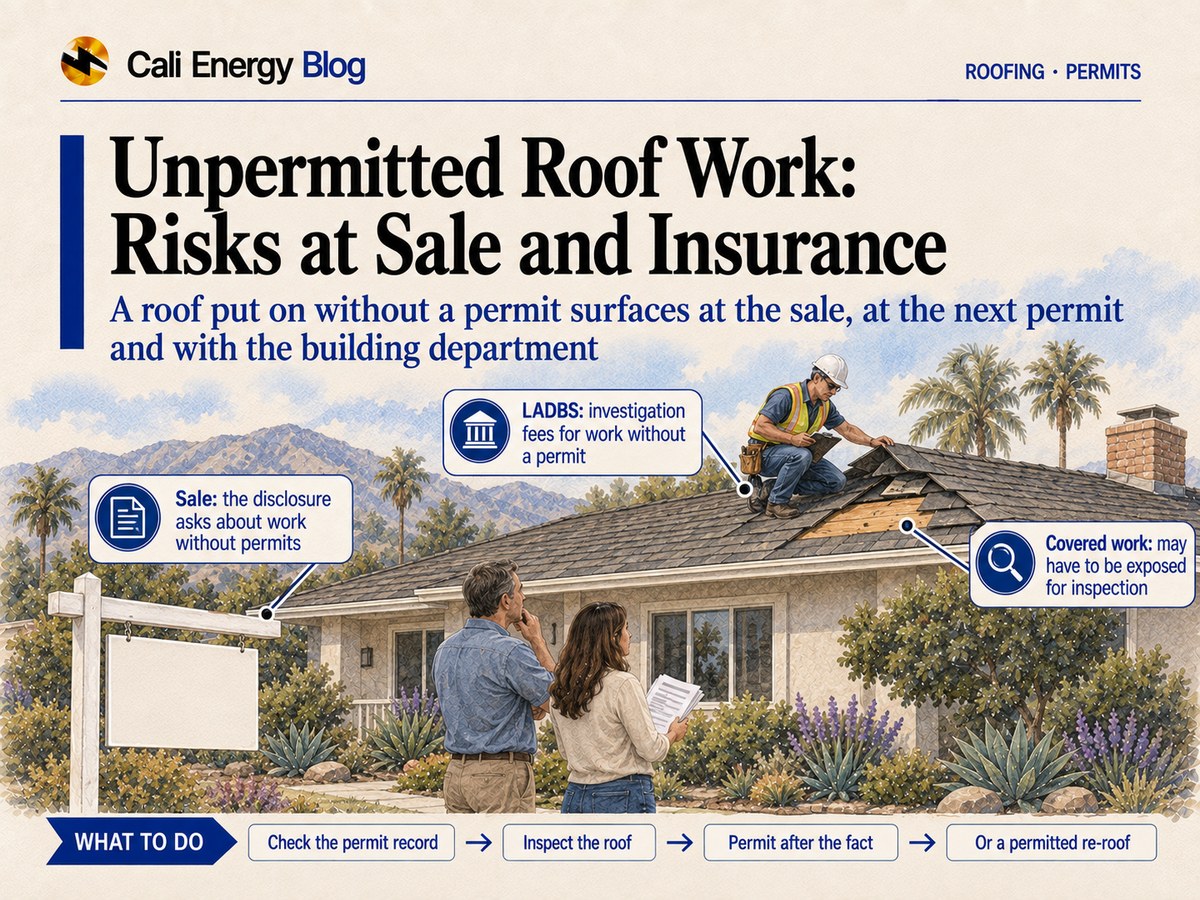
Where an unpermitted roof shows up
An unpermitted roof is invisible from the street, and the problems arrive with paperwork.
| When | What happens | Source |
|---|---|---|
| Selling | The Transfer Disclosure Statement asks whether you know of alterations or repairs made without necessary permits, or not in compliance with building codes | Civil Code 1102.6 |
| The next permit | An unpermitted item on the house can hold up a new permit until it's legalized | Our 2023 Calabasas job, below |
| LADBS finds it | Investigation fees for work done without a valid permit, plus fees to cover the cost of bringing it into compliance or permitting it after the fact | LABC 2026, 91.107.5.1–91.107.5.2 |
| Inspection | Work that needed inspection but was covered first has to be exposed for examination on written notice, and exposing and recovering it is not at the City's expense | LABC 2026, 91.104.2.2 |
| Proving the roof's age | The disclosure form gives only the roof's approximate age; a finaled permit is the public record of when it was replaced | Civil Code 1102.6; LADBS records |
How the disclosure works at a sale is in roof certification for a California home sale, and why the roof's age matters to insurers is in roof age and home insurance.
Is your roof actually unpermitted?
A missing permit isn't always a problem. In the City of Los Angeles, a re-roof on a detached single-family house by a certified licensed contractor can go without a permit under a program in which the contractor notifies LADBS, certifies the work in place of LADBS inspections and files a certificate of compliance, and small repairs valued at $2,500 or less can be exempt; both are explained in roof permits with LADBS. The other way around, no permit on file doesn't prove the roof is original; it may have been replaced without one.
Start with the record. LADBS's Permit & Inspection Report shows re-roof permits for the address and whether each was finaled, as covered in checking that a re-roof permit was finaled. An open permit, issued but never finaled, or one that expired, is a different problem; how to close one is in the same guide.
Getting a permit after the fact
The code sets the terms. LADBS can collect investigation fees for work done without a valid building permit (LABC 91.107.5.1), and a fee to cover its added costs of obtaining code compliance or issuing a permit for work done before the required permit was obtained (91.107.5.2). Inspections still apply: work isn't supposed to go past an inspection point without approval or be covered until authorized (91.108.4), and work that was covered before its inspection has to be exposed on the department's written notice (91.104.2.2).
On a roof, the parts an inspector can't see on a finished roof are the deck and the underlayment, so what has to be opened is the department's call. If the roof is near the end of its life anyway, a permitted replacement can be the simpler path than legalizing the old one; what a permitted re-roof requires is in California re-roof code requirements.
What we've seen
On a 2023 Calabasas job combining a new roof, a panel upgrade and solar, the city asked for an aerial view with the work area outlined, and the aerial showed an air-conditioning condenser on the roof with no permit on record. Building and Safety wouldn't issue the re-roof permit until the condenser was approved where it stood; the city agreed to legalize it, the homeowner got the mechanical permit on February 7, 2023, and the re-roof permit was issued the next day (the Calabasas case). Paperwork can stop a finished job too: on a 2021 Santa Clarita project, a completed array couldn't get its final inspection until the permit itself turned up (the Santa Clarita case).
Frequently asked
Do I have to disclose an unpermitted roof when I sell?
How do I find out if my roof was permitted?
Can I get a permit for a roof that's already on?
Will my insurer care?
Is a small roof repair without a permit illegal?
Related reading
Sources & methodology
Code sections, rules and figures on this page come from the primary sources below. Codes, local requirements and product terms change; each was verified October 8, 2026.
We check the permit record and the roof before you decide
Call (323) 844-7777. We look up the permit history for the address, inspect the roof and attic, and tell you in writing what a permit after the fact would likely involve or what a new roof would. Have ready the address and any papers from the last re-roof.
Prepared by Cali Energy, October 8, 2026. This article is for general educational purposes only and is not legal, tax, financial, engineering, or utility advice. Rates, incentives, codes, permit requirements, equipment specifications, prices, and program terms may change; figures and timelines are estimates, not guarantees. Confirm current requirements with the applicable utility, AHJ, program administrator, manufacturer, or a licensed professional. See our Content Disclaimer. Cali Energy · 19201 Parthenia St, Unit E, Northridge, CA 91324 · CSLB #1032379 (B, C-10, C-39)