

Your Roofer and Your Insurance Claim: California Rules
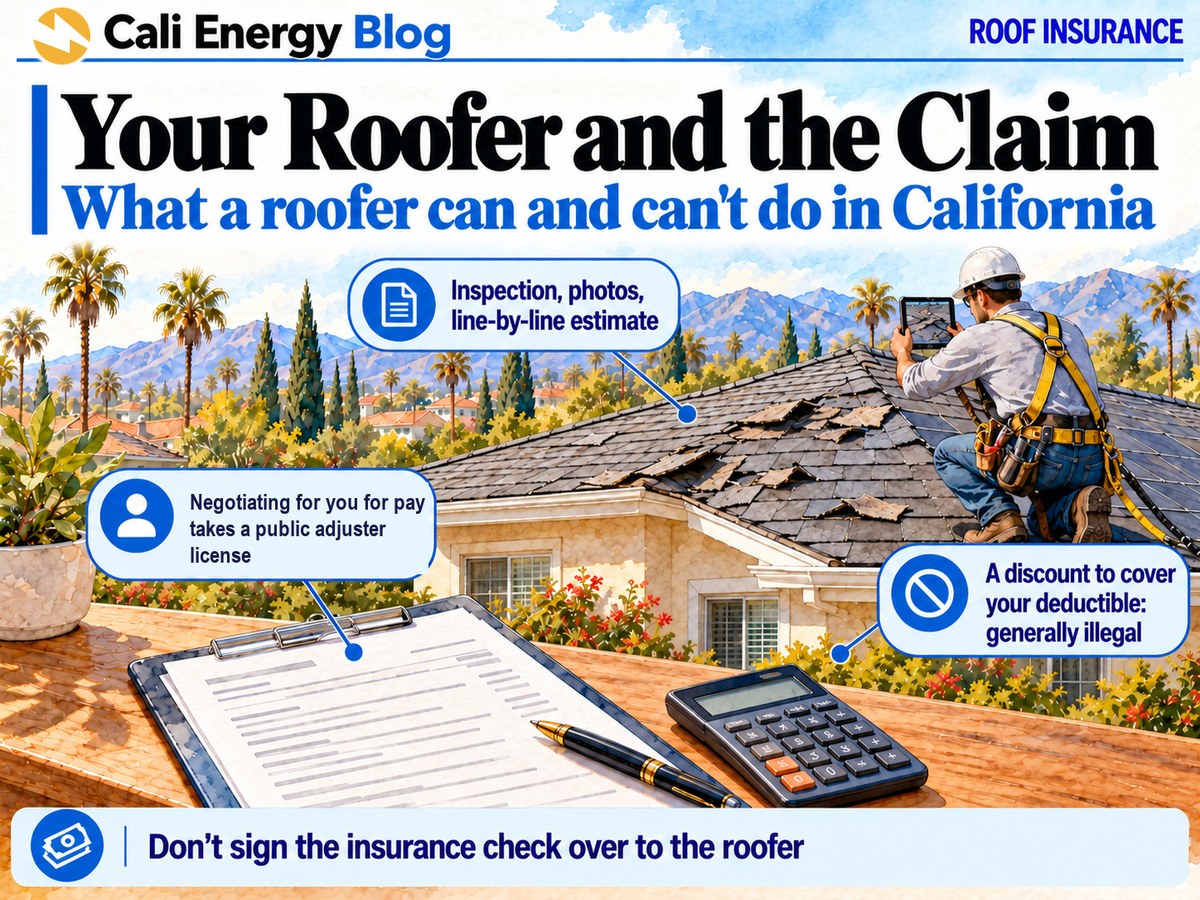
Your roofer can do a lot for a roof claim in California, but not everything. It can inspect the roof, photograph the damage and write the line-by-line estimate that you send to your insurer, and the insurer can't require you to use a different company. Negotiating or settling the claim on your behalf is another matter: California treats anyone who does that for compensation as a public insurance adjuster, who needs a license from the Department of Insurance (Insurance Code 15006, 15007), contractors aren't among the exceptions (15008), and a licensed public adjuster can't have a financial interest in the company repairing the same claim (15028(b)). A contractor also can't knowingly offer or give a discount meant to cover your deductible, except where the insurer has already set the amount of the claim and the work follows it (Penal Code 551(b)); whether an offer fits that exception is a question for a lawyer, and the insurer still has to see the real price: adding the deductible to the bill the insurer sees is insurance fraud (Penal Code 550). This page sets out the rules as of October 2026; it isn't legal advice.
How the claim itself works is in how to file a roof insurance claim in California, and how to read the adjuster's numbers in how to read an insurance roof estimate.
What your roofer can and can't do
The roofer's part is the roof: what's damaged, what the repair takes and what it costs. Settling the money is between you and your insurer, or someone you designate or hire to represent you.
| What | Can a roofer do it? | The rule |
|---|---|---|
| Inspect the roof, photograph the damage and write a line-by-line estimate | Yes | The Department of Insurance advises getting written bids from licensed contractors with prices listed line by line; the claims regulations provide for a written estimate you get from a contractor of your choice and require the insurer to respond to it (10 CCR 2695.9(d)) |
| Do the repair you choose it for | Yes | An insurer can't require you to have the property repaired by a particular company (10 CCR 2695.9(b)) |
| Negotiate or settle the claim for you, for compensation | No | Without a public adjuster license it's unlicensed adjusting: anyone who, for compensation, acts for you or aids you in any manner in negotiating or settling a property claim is a public insurance adjuster (Insurance Code 15007, 15006), and contractors aren't exempt (15008); whether being paid for the roof counts as compensation isn't settled; with a license, a public adjuster can't have a financial interest in the company repairing the same claim (15028(b)) |
| Be designated to handle the claim for you | Not under the claims regulations | The people you can designate are an insurance adjuster, a public adjuster or a family member, in a signed and dated writing that says they're authorized to handle the claim and is sent to the insurer; an attorney can also represent you (10 CCR 2695.2(c), 2695.5(c)) |
| Offer a discount to cover your deductible | No, unless the insurer has already set the claim amount and the work follows it | Penal Code 551(b); whether an offer fits that exception is a question for a lawyer, and the insurer still has to see the real price. With more than $950 at stake, punishable by up to three years, a fine of up to $10,000, or both |
| Add the deductible to the estimate or invoice the insurer sees | No | Knowingly presenting a false claim, or a document to support one, can be charged as a felony, including for anyone who knowingly helps (Penal Code 550) |
| Offer or pay an insurance agent, broker or adjuster for sending you its way | No | Penal Code 551(a) |
| Take your insurance check signed over to it | The CSLB says don't | The Contractors State License Board advises against signing over any payment checks from your insurer; payments shouldn't get ahead of the work (Business and Professions Code 7159.5) |
The insurer can still talk to your roofer about the damage and the repair, though it may ask for your written OK first. If the roofer is there when the adjuster inspects, it can show what it found and explain its estimate; you decide what to accept, and you can talk to your insurer directly at any time. The law doesn't spell out where explaining a repair estimate ends and helping to negotiate begins, or whether being paid for the roof counts as compensation, so if a roofer offers to "handle the insurance" at no extra charge, keep the negotiating with you or with a licensed public adjuster or attorney.
Someone to negotiate for you: public adjusters
If you want someone to argue the claim for you, the licensed options are a public adjuster or an attorney. The Department of Insurance suggests first trying to settle the claim directly with your insurer, and says you keep the right to hire either one.
- The license. A public adjuster has to be licensed by the Department of Insurance; check the license before you sign. Someone acting as one without a license faces a civil penalty of up to $10,000, or $25,000 if it's willful, and you can void the contract with them and owe nothing for their services (Insurance Code 15006).
- The contract. It has to be in writing, titled "Public Adjuster Contract," on a form the Department of Insurance has approved, and has to say "WE REPRESENT THE INSURED ONLY." It states the fee, as a percentage and the base it applies to, with your initials beside it (Insurance Code 15027).
- The fee. You pay it, usually out of the claim money. Section 15027 sets no maximum percentage, but the fee can't leave you with less than what the insurer paid you before you signed, and the adjuster takes it as a percentage of each payment, not all of it from the first check.
- The check. The contract can't require your insurer to issue a payment only in the adjuster's name (15027(c)).
- Canceling. You can cancel within three business days of signing and getting the signed contract, or within five calendar days if the loss is in a declared catastrophic disaster area (15027(b), (y)); business days here follow the home-solicitation law, which counts Saturdays (15027(k)). A catastrophic disaster is narrower than a declared emergency: one with mass casualties and region-wide damage, declared by the president or the governor (15001(c)); a city or county emergency doesn't make it one, so if you aren't sure, cancel within three business days.
- When they can approach you. Not while the loss is going on, including while an evacuation order is in effect at the property, and neither they nor anyone else offering those services for a fee between 6 p.m. and 8 a.m. unless you ask (15027(d), (e)). After a catastrophic disaster, a public adjuster can't solicit you to sign for your home until seven calendar days after the loss conditions there end, such as the evacuation order being lifted, unless you contact them first; it may only send or leave accurate written material, without personal contact (15027.1(c)).
- Ties to the roofer. A public adjuster can't take money from, or have a financial interest in, a repair company that gets work from a claim it's adjusting (15028(b)), and has to tell you about any payment from a contractor; if it doesn't, you can rescind the contract (15027.5).
The Los Angeles County District Attorney warns about adjuster and contractor collusion, where an adjuster sends you to a contractor for a fee, and advises getting at least one bid from a contractor you found on your own.
Your deductible
The deductible is the part of the loss you pay before your insurance pays, according to the Department of Insurance. California's Penal Code limits what a contractor can do to make it disappear.
- A discount to cover it. A contractor can't knowingly offer or give a discount intended to offset your deductible. The ban doesn't apply where the insurer has determined the amount of the claim and the work is done in accordance with that determination or with estimates the insurer accepted (Penal Code 551(b)). Whether a particular offer fits that exception is a question for a lawyer.
- A padded bill. Raising the estimate or the invoice to cover the deductible puts false information in front of the insurer. Knowingly presenting a false claim, or preparing a document to support one, can be charged as a felony punishable by two, three or five years and a fine of up to $50,000 or double the amount of the fraud, whichever is greater, and that applies to anyone who knowingly helps, a homeowner included (Penal Code 550). A civil penalty of $5,000 to $10,000, plus up to three times the claim, can be added (Insurance Code 1871.7).
- What it looks like. The Department of Insurance lists people who want to cover their deductible among those who commit insurance fraud. Our advice: for the same work, the price your insurer sees and the price in your contract should be the same; upgrades you pay for yourself go on separate lines.
Right after a disaster
After a declared disaster, the law adds protection against contracts signed in a hurry away from the contractor's office.
- Void contracts. A repair contract you sign anywhere other than the contractor's place of business, such as at your door, a shelter or a motel, on or after the day a disaster damages the house and up to midnight of the seventh business day after it, is void, unless you, your agent or your insurance representative asked the contractor for it, including by calling its office (Civil Code 1689.14, 1689.5). A disaster here means one for which the president, the governor or a city or county has declared an emergency. Business days include Saturdays; only Sundays and listed holidays are skipped (1689.5(e)).
- Canceling the rest. A contract like that which isn't void can be canceled until midnight of the seventh business day after you sign it, by written notice (Civil Code 1689.6(c)), unless you called the contractor for an emergency repair and signed a separate waiver (1689.13), or it's a small service-and-repair job that has already started (1689.15). A contract you sign at the contractor's office isn't covered by either rule. The other cancellation rights are in California roofing contract law.
The signs of a storm-chaser and the disaster licensing rules are in how to spot a roofing scam after a fire or storm.
Before you sign with a roofer during a claim
1. Check the license. Check the roofer's license on the CSLB site; anyone you'd pay to negotiate the claim for you, other than an attorney, needs a public adjuster license from the Department of Insurance (Licensing Hotline 1-800-967-9331), and can't be the company doing the repair.
- Get your own bid. Have at least one estimate from a contractor you found yourself.
- Keep the claim in your hands. Send the roofer's estimate to your insurer yourself, and keep talking to your insurer directly.
- Keep the check. Don't sign it over; pay as the work is done, with a down payment of no more than $1,000 or 10% of the contract price, whichever is less, unless the contractor has a CSLB-approved bond or joint control (Business and Professions Code 7159.5).
- Be wary of deductible offers. Before your insurer has set the claim amount, say no; after that, ask a lawyer and make sure the insurer sees the price you actually pay. The Department of Insurance's consumer hotline is 1-800-927-4357.
Frequently asked
Can my roofer talk to my insurance company?
Is it legal for a roofer to pay my deductible in California?
Does my roofer need a public adjuster license to handle my claim?
How much do public adjusters charge in California?
Can a roofer sign me up right after a disaster?
Related reading
Sources & methodology
Code sections, rules and figures on this page come from the primary sources below. Codes, local requirements and product terms change; each was verified October 15, 2026.
- California Insurance Code §15001
- California Insurance Code §15006
- California Insurance Code §15007
- California Insurance Code §15008
- California Insurance Code §15027
- California Insurance Code §15027.1
- California Insurance Code §15027.5
- California Insurance Code §15028
- California Insurance Code §1871.7
- California Penal Code §550
- California Penal Code §551
- California Civil Code §1689.14
- California Civil Code §1689.5
- California Civil Code §1689.6
- California Civil Code §1689.13
- California Civil Code §1689.15
- California Business and Professions Code §7159.5
- California Code of Regulations, title 10, §2695.2
- California Code of Regulations, title 10, §2695.5
- California Code of Regulations, title 10, §2695.9
- California Department of Insurance, Don't Get Scammed After a Disaster
- California Department of Insurance, Insurance Fraud is a Felony
- California Department of Insurance, Residential Property Claims Guide (updated February 2025)
- California Department of Insurance, consumer alert on wildfire recovery, January 11, 2025
- Contractors State License Board, press release 25-01, January 17, 2025
- Los Angeles County District Attorney, Disaster Fraud (March 2025)
We inspect the roof and write the estimate; the claim stays yours
Call (323) 844-7777. We inspect the roof, photograph the damage and write a line-by-line repair estimate you send to your insurer yourself; the amount of the claim stays between you and your insurer. What the repair takes shows only once we've been on the roof and in the attic. Have ready your claim number and the adjuster's estimate, if you have one.
Prepared by Cali Energy, October 15, 2026. This article is for general educational purposes only and is not legal, tax, financial, engineering, or utility advice. Rates, incentives, codes, permit requirements, equipment specifications, prices, and program terms may change; figures and timelines are estimates, not guarantees. Confirm current requirements with the applicable utility, AHJ, program administrator, manufacturer, or a licensed professional. See our Content Disclaimer. Cali Energy · 19201 Parthenia St, Unit E, Northridge, CA 91324 · CSLB #1032379 (B, C-10, C-39)