

Who’s My Electric Utility in the LA Area — and Why It Decides My Solar Rules
Straight answer: the utility named on your electric bill — not your city or ZIP code — decides your solar rules. Most of Los Angeles County outside the City of Los Angeles is Southern California Edison territory, where new solar has been on the state’s Net Billing Tariff (NEM 3.0) since April 15, 2023. LADWP in the City of Los Angeles and the city utilities of Burbank, Glendale, Pasadena, Azusa and Vernon set their own rules, and they differ: LADWP still nets exports at the retail price, while Burbank moved new systems to avoided-cost credits in 2026.
Get a free estimate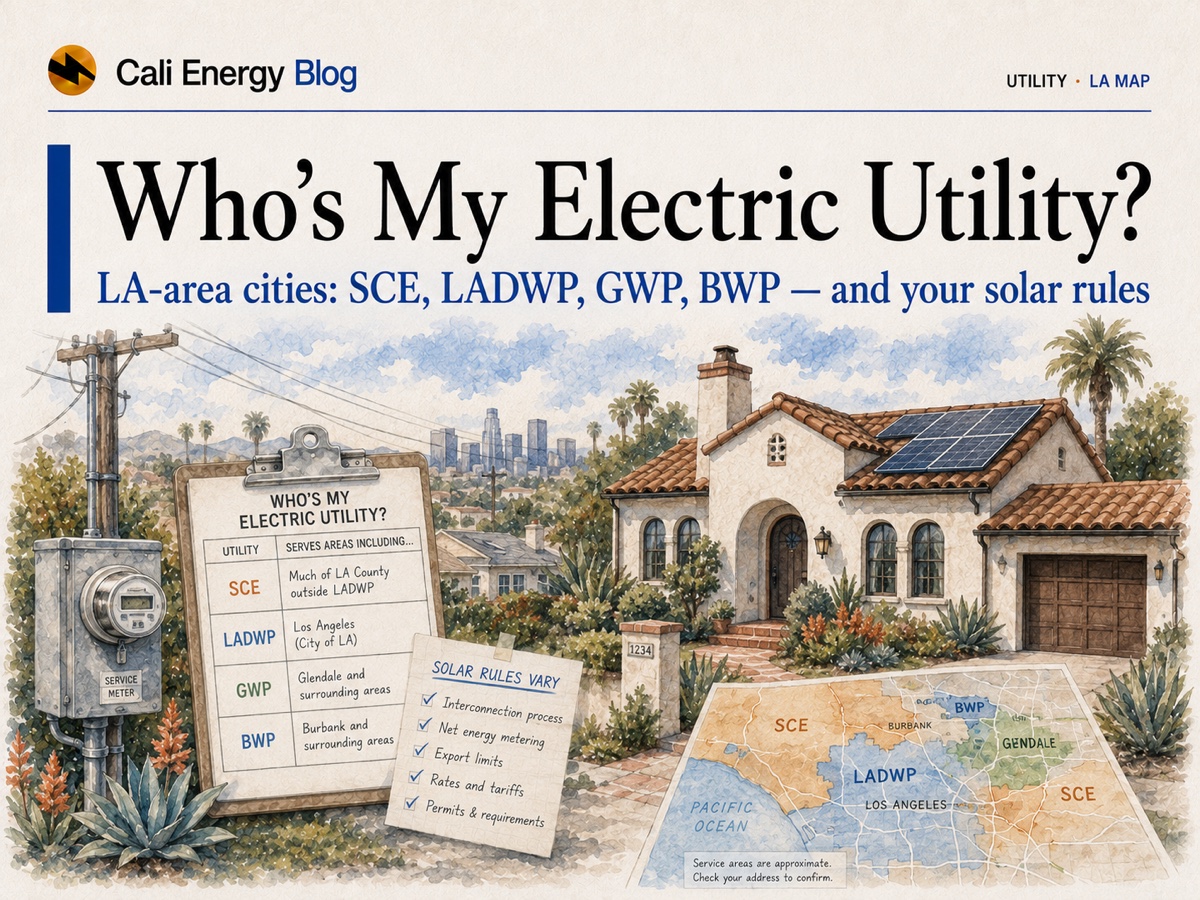
- The bill decides. The utility printed on it sets your solar rules. City and neighborhood names don’t: SCE’s own list of the communities in its territory includes Los Angeles, Glendale and Pasadena.
- SCE: solar applications from April 15, 2023 are on the Net Billing Tariff. An exported kWh from a 2026 system averages about 6¢ on a summer day and 3¢ on a winter day, plus 1.6¢ for nine years.
- City utilities each run their own plan: LADWP nets kWh at the retail price; Glendale and Pasadena net usage and pay a set rate for surplus; Burbank credits exports from systems permitted since 2026 at its avoided cost; Anaheim pays 4.8–11.9¢ by the hour.
- Clean Power Alliance and the other community choice suppliers change who generates your power, not who runs the wires: new solar in their areas is on both their solar billing plan and SCE’s.
- Cerritos has a city utility, but it supplies businesses; homes there are on SCE.
Why the utility, not the city, sets your solar rules
Two kinds of utility serve Los Angeles County, and they answer to different regulators.
The Net Billing Tariff, known as NEM 3.0, is a California Public Utilities Commission rule for the investor-owned utilities: Southern California Edison, PG&E and SDG&E (CPUC). City-owned utilities answer to their own city councils and boards, and each sets its own solar rules. In Los Angeles County, the state’s register of publicly owned utilities lists the Los Angeles Department of Water and Power, Burbank Water and Power, Glendale Water and Power, Pasadena Water and Power, Azusa Light and Water, the City of Vernon, the Cerritos Electric Utility and the City of Industry (California Energy Commission). Most of the rest of the county is SCE territory.
LA-area utilities and the solar rules each one sets
Who serves what, and what an exported or surplus kilowatt-hour earns in 2026.
| Utility | Serves | Rule for new solar | What an export or surplus earns |
|---|---|---|---|
| Southern California Edison (investor-owned) | Most of LA County outside the City of Los Angeles — Long Beach, Santa Monica, Torrance, Santa Clarita, Lancaster, Palmdale and more | Net Billing Tariff for interconnection applications from April 15, 2023 | Hourly credit: for a 2026 system about 6¢ on an average summer day and 3¢ on a winter day, plus 1.6¢ for nine years |
| LADWP | City of Los Angeles | Its own net metering, under a rider dated September 1, 2008 | Exports netted kWh for kWh at the retail price; a surplus becomes a credit that is not paid out |
| Burbank Water and Power | Burbank | Solar Net Billing for permits applied for from January 1, 2026; earlier systems keep net metering until 2046 | Exports credited at BWP’s avoided cost of energy at the time, applied to the next bill |
| Glendale Water and Power | Glendale | Net metering | Surplus credited; GWP’s published NEM compensation rate was $0.05639 per kWh for 2025 |
| Pasadena Water and Power | Pasadena | Net metering with surplus compensation | Surplus at PWP’s energy charge (9.1–10.1¢) plus 2.5¢, and 6.6¢ more on monthly or bi-monthly billing |
| Azusa Light and Water | Azusa | Net metering up to 10 kW DC, with a net-generation buy-back rate; co-energy metering above that | Set by Azusa Light and Water |
| Anaheim Public Utilities | Anaheim (Orange County) | NEM 2.0, a wholesale-based plan; Anaheim says it is not going to NEM 3.0 | $0.0477, $0.0795 or $0.1194 per kWh exported, by hour and season |
Sources: CEC register of load-serving entities · SCE Solar Billing Plan and Schedule NBT · LADWP · Burbank Water and Power · Glendale Water and Power · Pasadena Water and Power · Azusa Light and Water · Anaheim Public Utilities. Vernon, an industrial city, also runs its own utility. Every utility can change its plan; its own page has the final word.
On SCE: the Net Billing Tariff
Most LA-area homes outside the City of Los Angeles land here.
New solar on SCE goes on the Net Billing Tariff if its interconnection application was submitted on or after April 15, 2023. A complete application filed by April 14, 2023, for a project finished within three years, stayed on NEM 2.0 for 20 years from permission to operate (CPUC). Under the tariff, solar power you use at home still saves the full retail price, but each exported kilowatt-hour earns an hourly credit: for a system starting in 2026, about 6¢ on an average summer day and 3¢ on a winter day, plus a fixed 1.6¢ for nine years (SCE). Evening power on SCE’s time-of-use rates costs many times that, which is why storage is part of most SCE designs. The mechanics are in NEM 3.0 explained, and whether a battery pays in do I need a battery under NEM 3.0.
City-owned utilities: a rulebook each
Not being on NEM 3.0 does not mean the same deal everywhere.
LADWP
Nets the kWh you export against the kWh you draw over each billing period, usually two months, at the full retail price — 26–41¢ a kWh on the standard rate in summer 2026. A surplus becomes a dollar credit that never expires but is never paid out. Leases qualify; PPAs don’t. See LADWP net metering.
Burbank
Systems whose permits were applied for from January 1, 2026 are on Solar Net Billing: exports earn BWP’s avoided cost of energy at the time, the credit goes to the next bill, and a balance can be paid by check once a year on request. Output may reach 150% of the past year’s use; systems of 10 kW CEC-AC or less skip that review. Older systems keep net metering until January 1, 2046 unless the system is enlarged or the home is sold outside the immediate family; adding a battery does not end it (BWP).
Glendale
GWP still offers net metering: excess generation becomes a bill credit applied when needed, and its published NEM compensation rate was $0.05639 per kWh for 2025, down from $0.0762 in 2024. Systems up to 10 kW CEC-AC are exempt from its 110% usage cap and may add up to 30 kWh of storage (GWP).
Pasadena
PWP nets usage and pays for surplus: on annual billing at its average energy charge plus 2.5¢, on monthly or bi-monthly billing at its energy charge — 9.127¢ in winter, 10.053¢ in summer — plus 2.5¢ and 6.6¢. A surplus over $50 can be cashed out (PWP).
Anaheim
Anaheim Public Utilities, in Orange County, runs a wholesale-based NEM 2.0 and says it is not going to NEM 3.0: each exported kWh earns $0.0477, $0.0795 or $0.1194 by hour and season, under rates that run to June 30, 2027. NEM 1.0 systems stay grandfathered unless they expand (Anaheim).
Azusa and Vernon
Azusa Light and Water offers net metering with a net-generation buy-back rate for systems up to 10 kW DC and co-energy metering for larger ones (Azusa). Vernon, an industrial city, also runs its own utility; check its schedule directly.
Clean Power Alliance and other community choice suppliers
A second name on an SCE bill changes who generates your power, not who runs the wires.
Community choice aggregators buy electricity for their communities while SCE delivers it, reads the meter and sends the bill. In Los Angeles County the state lists Clean Power Alliance, Lancaster Energy, Energy for Palmdale’s Independent Choice and Pico Rivera Innovative Municipal Energy (CEC). For solar, each side of the bill has its own plan. Clean Power Alliance customers whose systems SCE approved by April 14, 2023 stay on CPA’s and SCE’s net metering for their 20-year legacy period; systems approved from April 15 to August 31, 2023 have CPA’s net metering on the generation side and SCE’s Solar Billing Plan on the delivery side; and anyone applying after August 31, 2023 is on both CPA’s and SCE’s Solar Billing Plans (Clean Power Alliance). In practice, new solar in a Clean Power Alliance community works like NEM 3.0.
Check the address, not the city or neighborhood
- Northridge, Van Nuys, Woodland Hills, San Pedro and Venice are neighborhoods of the City of Los Angeles, not separate cities, and LADWP is the city’s utility.
- Santa Monica, Culver City, Beverly Hills, West Hollywood and Torrance are separate cities with no city electric utility of their own: SCE territory.
- Cerritos runs the Cerritos Electric Utility, but it supplies businesses, with SCE still delivering the power; homes are on SCE (City of Cerritos).
- SCE’s own Index of Communities — its list of the cities and communities in its service territory — includes Los Angeles, Glendale and Pasadena, and LA neighborhood names such as Northridge, Woodland Hills and San Pedro (SCE). A community name can straddle a utility line; only the service address settles it.
How to find your utility in about a minute
1. Read the bill
The name at the top — Southern California Edison, LADWP, Glendale Water & Power — is your utility. If a second supplier such as Clean Power Alliance appears on an SCE bill, SCE is still your utility.
2. Check the address
Buying or moving? LADWP and SCE check whether an address is in their territory when you start service. Use the street address, not the city or neighborhood name. LADWP: 1-800-DIAL-DWP (1-800-342-5397), weekdays 7 a.m.–7 p.m. (LADWP); SCE: 1-800-655-4555 (SCE).
3. Match it to the rules
SCE means the Net Billing Tariff; a city utility means that utility’s own plan, from the table above. Ask your installer to put the utility and its plan in writing before the design.
Where to go next
Rates differ as much as solar rules: see electricity rates in Los Angeles and San Fernando Valley electricity rates. On LADWP, the programs are in LADWP solar and battery incentives. Cali Energy is a licensed Los Angeles solar, battery and electrical contractor (CSLB #1032379) working with LADWP, SCE, Burbank and Glendale customers. Call +1-323-844-7777 or confirm your utility and its solar rules.
Frequently asked
How do I find out who my electric utility is?
Read the name at the top of your electric bill. If you are moving or buying, check the street address with the utility when you start service. A city or neighborhood name is not enough: SCE’s own list of the communities in its territory includes Los Angeles, Glendale and Pasadena.
Is LADWP on NEM 3.0?
No. NEM 3.0, the Net Billing Tariff, is a CPUC rule for SCE, PG&E and SDG&E. LADWP runs its own net metering, which nets each exported kWh against one you buy at the retail price; a surplus becomes a credit that is not paid out.
Which LA-area cities have their own electric utility?
In Los Angeles County, the city-owned utilities that serve homes are LADWP in Los Angeles and those of Burbank, Glendale, Pasadena, Azusa and Vernon. Cerritos and the City of Industry also run utilities, and Cerritos’s supplies businesses while homes are on SCE. Anaheim, in Orange County, runs one too. Most other cities are SCE territory.
Is Burbank still on net metering?
For systems whose permits were applied for before January 1, 2026, yes, until January 1, 2046, unless the system is enlarged or the home is sold outside the immediate family. Newer systems are on Solar Net Billing, which credits exports at Burbank Water and Power’s avoided cost of energy at the time.
I’m with Clean Power Alliance — am I on NEM 3.0?
If you applied to connect solar after August 31, 2023, you are on both Clean Power Alliance’s and SCE’s Solar Billing Plans, which work like NEM 3.0. Systems approved by April 14, 2023 stay on net metering for their 20-year legacy period, and those approved between April 15 and August 31, 2023 are split between the two plans.
Does my utility really matter for solar?
Yes. It sets what an exported kilowatt-hour is worth — about 3–6¢ on an average day for a new SCE system, the full retail price netted on LADWP, 4.8–11.9¢ in Anaheim — and with it whether a battery is close to essential.
Related reading
Sources & methodology
Figures on this page come from the primary sources below and, where noted, from Cali Energy calculations using the stated assumptions. Rates, incentives, and program terms change; each was verified October 5, 2026.
- California Energy Commission — Electric load-serving entities (publicly owned utilities and community choice aggregators)
- SCE — Index of Communities (cities and communities in SCE’s service territory)
- CPUC — Net Billing Tariff
- SCE — Solar Billing Plan (average Energy Export Credit values for 2026 systems)
- SCE — Schedule NBT, Net Billing Tariff
- LADWP — Service Rider NEM, Net Energy Metering
- Burbank Water and Power — Solar Net Billing
- Burbank Water and Power — Solar Net Billing FAQ
- Glendale Water and Power — Net Energy Metering program (compensation rates)
- Pasadena Water and Power — Net Surplus Compensation
- Anaheim Public Utilities — Solar Energy and Net Metering
- Anaheim Public Utilities — NEM 2.0 excess solar energy rates
- Azusa Light and Water — Solar PV system installation procedures
- City of Cerritos — Cerritos Electric Utility
- Clean Power Alliance — Solar and Net Energy Metering
- LADWP — Start or Add Service (Customer Contact Center 1-800-DIAL-DWP, hours)
- SCE — customer line 1-800-655-4555 (outage preparedness page)
Confirm your utility and what its solar rules mean for your roof
Tell us your address and your recent bill — we’ll confirm which utility serves you and walk you through its solar plan before you sign anything.
Get a free estimatePrepared by Cali Energy, October 5, 2026. This article is for general educational purposes only and is not legal, tax, financial, engineering, or utility advice. Rates, incentives, codes, permit requirements, equipment specifications, prices, and program terms may change; figures and timelines are estimates, not guarantees. Confirm current requirements with the applicable utility, AHJ, program administrator, manufacturer, or a licensed professional. See our Content Disclaimer. Cali Energy · 19201 Parthenia St, Unit E, Northridge, CA 91324 · CSLB #1032379 (B, C-10, C-39)