

Can’t pay your electric bill in California? Your options and protections
There is no open LADWP bill-forgiveness program in 2026 — the pandemic credits that cleared $700 million of Los Angeles utility debt are finished — but LADWP now spreads a past-due balance over up to 48 months with no interest, and SCE customers can still have up to $8,000 forgiven. Your rights depend on who bills you: PG&E, SCE and SDG&E follow CPUC rules, while LADWP and other municipal utilities set their own. Both routes are below, kept separate.
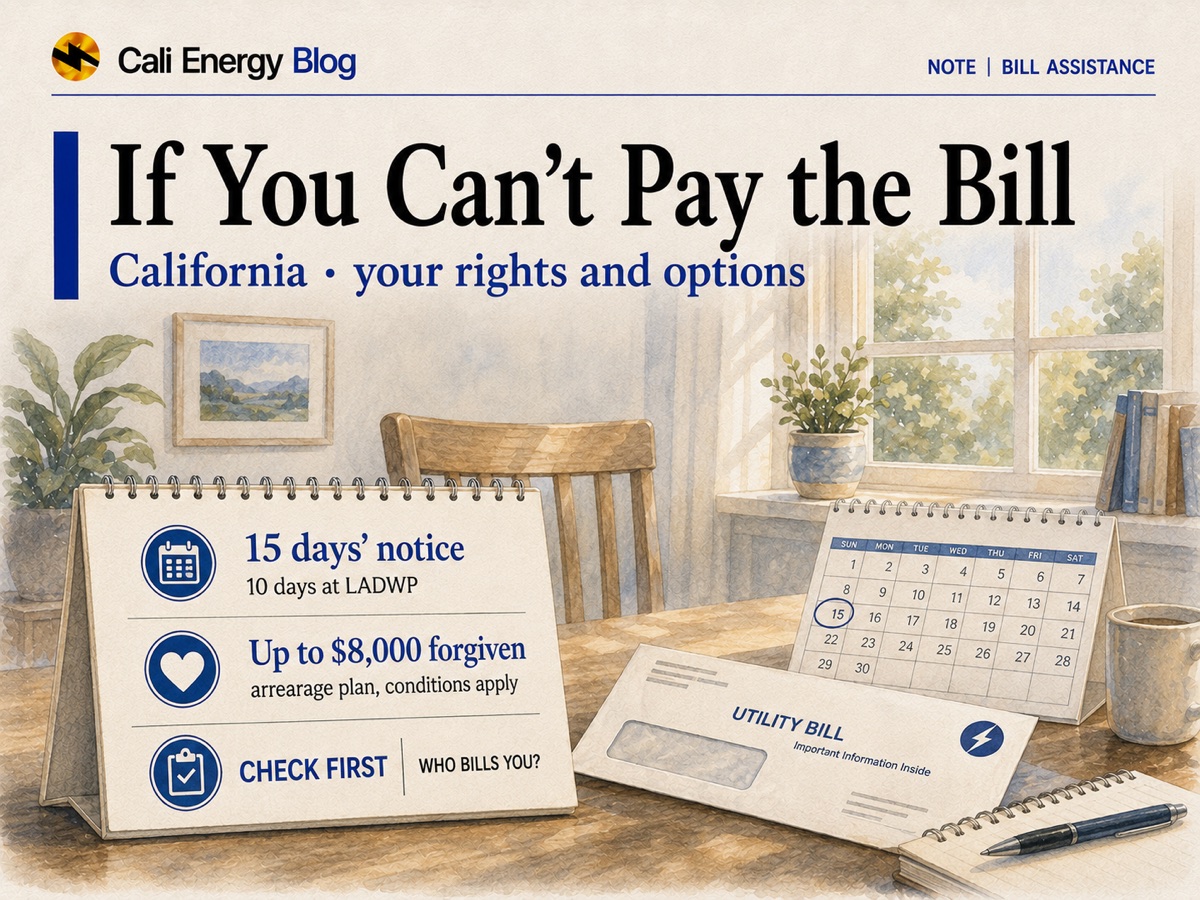
Quick answer
- You are far from alone. As of May 2026, 2,424,244 customer accounts — 20.6% — at PG&E, SCE and SDG&E were behind, owing $619 on average. (Accounts, not households; the PG&E figure includes gas customers.)
- At a CPUC-regulated utility you get 15 days’ written notice, then a second notice at least 48 hours ahead. At LADWP the published minimum is 10 days.
- CPUC-regulated utilities may not disconnect on a weekend or legal holiday, absent a safety issue. This CPUC rule does not bind municipal utilities.
- CARE cuts the bill 30–35% (32.5% at SCE); FERA cuts it 18%. Both are income-based and go forward, not backward.
- Past debt is handled separately, through the Arrearage Management Plan — but solar customers on NEM are not eligible.
- LIHEAP is open to LADWP customers too, with a benefit of up to $1,500.
Is there LADWP bill forgiveness in 2026?
Not as a program you can apply to — but the options for clearing a balance are better than they were.
The forgiveness people remember was pandemic money. California’s arrearage programs paid LADWP $202.8 million (CAPP 1.0) and $76.1 million (CAPP 2.0) for electric debt, plus $253.6 million for water and sewer, all applied automatically as bill credits for balances built up between March 2020 and December 2022 (LADWP). By June 2024 LADWP said it had distributed $700 million to 417,729 accounts since 2021, including the final state funds (LADWP news release). There is no comparable open program in 2026, and LADWP does not offer the CPUC’s Arrearage Management Plan.
What LADWP does offer now (LADWP Cares):
- Payment arrangements with no down payment, no interest and no fees: up to 48 months for income-qualified customers and up to 24 months for everyone else.
- Level Pay — a fixed monthly bill based on the past 12 months, with any past-due balance spread over 12, 24 or 36 months; the 24- and 36-month terms are only for accounts in arrears (LADWP).
- LIHEAP — up to $1,500, tax free, toward power bills for income-qualified households.
- EZ-SAVE, the Lifeline Rate for customers 62 or older or with a disability, and a Physician Certified Allowance discount.
LADWP also states that it never shares customer information with immigration enforcement agencies. For SCE, PG&E and SDG&E customers, the closest thing to forgiveness is the Arrearage Management Plan below — up to $8,000.
Find your situation
The right move depends entirely on how far along the process is.
| Where you are | What it means | What to do |
|---|---|---|
| The bill is due and you cannot pay it | Nothing has been shut off; no notice yet | Ask the utility for a payment arrangement, and check CARE/FERA eligibility now — it is a discount going forward, not a fix for past debt. |
| You received a disconnection notice | You have at least 15 days from that written notice | Call the utility the same day. Ask about a payment plan and, if you have arrears, about the Arrearage Management Plan. Check LIHEAP. |
| The notice says 24–48 hours | This is the crisis stage | This is one of the crisis indicators LIHEAP’s Energy Crisis Intervention Program (ECIP) recognizes. Contact your local LIHEAP provider immediately — income limits, their assessment and available funding still apply. |
| It is a weekend or a legal holiday | You cannot be disconnected today, absent a safety issue | CPUC-regulated utilities may not disconnect on weekends or legal holidays. Use the time to call first thing on the next business day. |
| Service is already disconnected | Reconnection terms apply | Contact the utility about reconnection requirements, and contact your local LIHEAP provider — ECIP covers termination, not only threatened termination. |
| Someone in the home uses medical equipment | Separate protections and allowances exist | Apply for Medical Baseline with your utility. At SCE this adds 16.5 kWh per day year-round on top of the standard allowance. |
Notice periods and the weekend/holiday rule from the CPUC Consumer Affairs Branch FAQ. Verified October 6, 2026. These are CPUC rules and do not apply to municipal utilities such as LADWP — see the separate section below.
How many SCE customers are behind — and when shutoffs happen
SCE files a disconnection report with the CPUC every month. In July 2026, 764,586 residential customers were in arrears — about one account in six — owing $640.9 million, and 39% of those dollars were more than 180 days old. Shutoffs are strongly seasonal: they climb through spring and drop sharply in July, when heat protections start to bite.
| Month | Customers sent notices | Disconnected |
|---|---|---|
| January | 76,610 | 4,292 |
| February | 112,634 | 17,162 |
| March | 141,466 | 22,827 |
| April | 172,852 | 27,707 |
| May | 174,395 | 28,732 |
| June | 176,828 | 26,680 |
| July | 103,825 | 5,599 |
| January–July | 958,610 | 132,999 |
Source: SCE monthly disconnect data report for July 2026, filed with the CPUC on August 20, 2026 (R.18-07-005) · totals are Cali Energy sums. Roughly one notice in seven ended in a shutoff. SCE’s residential base was 4,689,413 accounts. Of July’s disconnected customers, 1,809 were being disconnected for at least the second time that year.
The same report shows how common the alternatives are: 165,575 SCE customers had ongoing payment plans in July 2026, and 139,037 asked for bill assistance that month. Asking early is normal, not exceptional.
The disconnection timeline, exactly
Before a CPUC-regulated utility disconnects you, it must send written notice 15 days in advance stating the reason for disconnection, the amount you must pay to avoid it, and the earliest date you would be disconnected. If that goes unpaid, the utility must send a second notice at least 48 hours before disconnecting.
And one protection worth knowing on a Friday afternoon, in the CPUC’s own words:
“Utilities may not disconnect or terminate service on the weekend or on a legal holiday, unless there is a safety issue that requires the service to be disconnected.”
If a shutoff date lands on a Saturday, you have until at least Monday.
Other protections worth asking about by name. These are not automatic — you have to request them:
- A payment arrangement or installment plan. The first thing to ask for, and the most commonly granted. Note that at SCE you cannot be on an installment plan and the Arrearage Management Plan at the same time.
- Medical Baseline. If someone in the home relies on qualifying electrically-operated medical or mobility equipment, this adds allowance and flags the account. At SCE it is an additional 16.5 kWh per day, year-round, and it requires its own application.
- A LIHEAP pledge. A local provider can commit funds toward the bill; tell the utility a LIHEAP application is in progress.
- Extreme-weather protection. Since 2020, PG&E, SCE and SDG&E may not disconnect a home for non-payment when temperatures above 100°F or below 32°F are forecast within 72 hours. In July 2026 the CPUC ordered them to switch the heat trigger to Level 2 of the state’s CalHeatScore index within six months, with 90°F as the interim and fallback threshold (Resolution E-5468).
- Reconnection after a first shutoff. A customer disconnected for the first time must be reconnected with no condition beyond enrolling in a payment plan, with extra protections for the following three months; reconnection is due within 24 hours remotely or one business day in the field (CPUC D.25-06-012).
- One-time help at SCE. SCE’s Energy Assistance Fund pays up to $200 once a year to eligible customers, and Budget Billing splits a year of costs into 11 equal payments (SCE).
Notice periods and the weekend/holiday rule: CPUC Consumer Affairs Branch FAQ. Verified October 6, 2026. Confirm program details with your own utility — terms differ.
Ongoing discounts: CARE and FERA
These reduce what you are billed from here on. They do not clear existing debt.
- CARE — a 30–35% discount on the electric bill; SCE states 32.5%. With cost exemptions and Base Services Charge treatment, the CPUC’s Public Advocates Office puts the total discount at approximately 40%. Eligibility: household income at or below 200% of federal poverty guidelines, or enrollment in CalFresh, Medi-Cal, SSI, WIC and similar programs.
- FERA — 18% off electricity for households between 200% and 250% of the guidelines. Offered by SCE, SDG&E and PG&E only.
Income limits run June 1, 2026 through May 31, 2027. At SCE the CARE ceiling is $43,280 for a one- or two-person household, $54,640 for three, $66,000 for four, $77,360 for five and $88,720 for six, rising $11,360 per additional person.
Sources: CPUC — CARE/FERA Program and SCE — CARE & FERA. Verified October 6, 2026.
Existing debt: the Arrearage Management Plan
Forgiveness of up to $8,000 — with conditions most articles omit.
AMP forgives 1/12 of your past-due balance for each on-time payment of your current bill. After 12 on-time payments the remaining debt is forgiven in full, up to $8,000.
To qualify at SCE you need all of the following:
- enrollment in CARE or FERA;
- a past-due balance over $500, some of it more than 90 days overdue;
- at least six months as an SCE customer;
- at least one on-time payment in the past 24 months;
- agreement to pay every monthly bill on time for the next 12 months.
Read this part if you have solar. SCE states plainly that “Net Energy Metering (NEM), Direct Access (DA), and master metered customers are not currently eligible.” A household with rooftop solar on a NEM tariff cannot use AMP. That is an unwelcome result and it is not widely reported, which is exactly why it belongs near the top of any honest guide. CARE, FERA, LIHEAP and payment arrangements remain available.
Source: SCE — Arrearage Management Plans. Verified October 6, 2026. Terms differ by utility; confirm with yours.
Emergency help: LIHEAP and ECIP
California administers the federal Low Income Home Energy Assistance Program through the Department of Community Services and Development.
- HEAP provides one-time financial assistance toward a utility bill.
- ECIP, the Energy Crisis Intervention Program, covers households in crisis. A 24–48 hour disconnect notice or service termination is one of the qualifying crisis indicators — it is not by itself an entitlement. Income eligibility, the local provider’s assessment and available funding all still apply.
Applications go through your local service provider, found via the agency’s Find Services portal. One caution the program states itself: federal funding is limited and providers prioritize the most vulnerable households, so some eligible households will not receive a benefit. Apply early rather than at the last possible moment.
Source: California Department of Community Services and Development — LIHEAP. Verified October 6, 2026.
If LADWP is your utility, the rules are different
Everything above applies to utilities regulated by the CPUC. LADWP is a municipal utility and is not one of them. CARE, FERA and AMP are not available to LADWP customers, and the CPUC notice rules described above are not LADWP’s rules.
LADWP runs its own assistance instead:
- EZ-SAVE — income-qualified discount. Income limits from July 1, 2026 are $43,280 for one- and two-person households, $54,640 for three, $66,000 for four, $77,360 for five, $88,720 for six, $100,080 for seven and $111,440 for eight, plus $11,360 for each additional person (LADWP). Notably, proof of income is not required to enrol, though eligibility may be checked afterwards. Phone 1-800-342-5397.
- Lifeline Rate — a City of Los Angeles program for customers 62 or older or living with a disability, offering the deepest available discounts. LADWP directs eligible customers here rather than to EZ-SAVE.
- Level Pay — evens out monthly payments and spreads a past-due balance over 12, 24 or 36 months.
Disconnection notice at LADWP. LADWP publishes its own minimum: “Current LADWP policy provides for no less than 10 days notification prior to discontinuance of service for non-payment.” That is shorter than the CPUC’s 15 days, and the CPUC weekend and holiday rule does not apply here.
Payment Arrangements at LADWP stretch a past-due balance beyond 60 days for customers with a billing problem or extreme hardship (terms and conditions) — up to 48 months for income-qualified customers and 24 months for others, with no down payment, interest or fees (LADWP Cares).
LIHEAP is available to LADWP customers. LADWP states the program “can offer a benefit of up to $1,500” toward heating or cooling bills, including in an emergency or energy crisis such as a utility disconnection, and can also fund in-home weatherization. The benefit is not taxable and does not affect public charge determinations.
If you are unsure which applies to you, check the utility name on your bill before spending time on a program you cannot use.
Sources: LADWP — Payment Arrangement terms and conditions and LADWP — LIHEAP. Verified October 6, 2026.
Source: LADWP — Assistance Programs. Verified October 6, 2026.
What this page cannot determine
- Whether you personally qualify. Only your utility and your local LIHEAP provider can decide that.
- Reconnection costs. Deposit and reconnection-fee rules are not stated in the CPUC consumer FAQ; ask your utility directly.
- Whether a specific program will pay. LIHEAP funding is limited and providers prioritize the most vulnerable households; qualifying does not guarantee a benefit.
- Legal advice. This is general information about published programs and rules, nothing more.
Frequently asked
Is there LADWP bill forgiveness in 2026?
Not as an open program. LADWP’s debt forgiveness came from California’s pandemic arrearage programs, applied automatically to balances from March 2020 to December 2022, and those funds have been distributed. In 2026 LADWP offers payment arrangements of up to 48 months for income-qualified customers (24 for others) with no interest or fees, Level Pay over up to 36 months for past-due balances, EZ-SAVE, the Lifeline Rate and LIHEAP up to $1,500.
How long before my electricity is shut off in California?
It depends who bills you. At a CPUC-regulated utility (PG&E, SCE, SDG&E) the minimum is 15 days’ written notice, then a second notice at least 48 hours before disconnection. At LADWP the published minimum is 10 days — its policy states “no less than 10 days notification prior to discontinuance of service for non-payment.”
How long can you go without paying your electric bill in California?
There is no fixed grace period, but there is a minimum timeline. PG&E, SCE and SDG&E must give 15 days’ written notice and a second notice at least 48 hours before shutting off, never on a weekend or holiday and not during forecast extreme heat or cold. LADWP’s minimum notice is 10 days. Calling for a payment plan stops the clock far more reliably than waiting.
Can my power be shut off during a heat wave?
Not at PG&E, SCE or SDG&E when temperatures above 100°F or below 32°F are forecast within 72 hours, and the CPUC ordered in July 2026 a lower interim heat trigger of 90°F while the utilities move to the CalHeatScore index. These CPUC rules do not bind LADWP; ask LADWP directly about its practice.
Can my power be shut off on a weekend or holiday?
No, absent a safety issue. The CPUC states: “Utilities may not disconnect or terminate service on the weekend or on a legal holiday, unless there is a safety issue that requires the service to be disconnected.” This applies to PG&E, SCE and SDG&E, not to municipal utilities such as LADWP.
Can solar customers get arrearage forgiveness?
Not through AMP at SCE. SCE states that “Net Energy Metering (NEM), Direct Access (DA), and master metered customers are not currently eligible.” If you have rooftop solar on a NEM tariff you must use other routes — CARE or FERA if income-eligible, LIHEAP, or a payment arrangement.
How much debt can the Arrearage Management Plan forgive?
Up to $8,000. AMP forgives 1/12 of the past-due balance for each on-time payment of the current bill; after 12 on-time payments the balance is forgiven in full up to that cap. Qualifying at SCE requires CARE or FERA enrollment, over $500 past due with some over 90 days, six months of service, and at least one on-time payment in the past 24 months.
What help exists if I have a 48-hour shutoff notice?
LIHEAP’s Energy Crisis Intervention Program (ECIP). Its stated triggers include receiving a 24–48 hour disconnect notice or service termination. Apply through your local LIHEAP service provider via the California CSD Find Services portal. Funding is limited, so eligibility does not guarantee a benefit.
Do CARE and FERA clear what I already owe?
No. They reduce future bills — CARE by 30–35% (32.5% at SCE), FERA by 18%. Existing debt is handled separately through the Arrearage Management Plan or a payment arrangement. Enroll in CARE or FERA anyway: AMP eligibility at SCE requires it.
I'm an LADWP customer — do these programs apply?
Partly. CARE, FERA and AMP are CPUC programs and do not cover LADWP. LADWP runs EZ-SAVE (income-qualified discount, no proof of income required to enroll), the Lifeline Rate for customers 62+ or with a disability, Level Pay, and payment arrangements of up to 48 months for income-qualified customers. LIHEAP does cover LADWP customers — up to $1,500. LADWP’s disconnection notice minimum is 10 days, and the CPUC weekend/holiday rule does not apply to it.
Related reading
Sources & methodology
Figures on this page come from the primary sources below and, where noted, from Cali Energy calculations using the stated assumptions. Rates, incentives, and program terms change; each was verified October 6, 2026.
- CPUC — Consumer Affairs Branch FAQ (disconnection rules)
- SCE — Arrearage Management Plans
- CPUC — CARE/FERA Program
- SCE — CARE & FERA discounted rates
- California CSD — LIHEAP (HEAP and ECIP)
- LADWP — Assistance Programs
- CPUC Public Advocates Office — Q2 2026 Electric Rates Report (PDF)
- LADWP — LADWP Cares (payment arrangements up to 48/24 months, Level Pay, LIHEAP, privacy)
- LADWP — CA State Utility Bill Assistance (CAPP and CWWAPP credits, March 2020–December 2022)
- LADWP News — $700 million in financial assistance since 2021 (June 12, 2024)
- LADWP — Level Pay
- LADWP — EZ-SAVE Program (income limits effective July 1, 2026)
- LADWP — Payment Arrangement terms and conditions (10-day notice)
- SCE — Monthly Disconnect Data Report, July 2026 (filed August 20, 2026, R.18-07-005)
- CPUC — D.25-06-012, SB 1142 and extreme heat disconnection protections (June 12, 2025)
- CPUC — Resolution E-5468, heat-triggered disconnection thresholds (July 16, 2026)
- SCE — Help paying your bill (Energy Assistance Fund, payment plans, Budget Billing)
About this reference
Cali Energy is a licensed California contractor (CSLB #1032379) in Northridge. We publish this page as a reference and date it to the day each figure was checked against its source.
Prepared by Cali Energy, October 6, 2026. This article is for general educational purposes only and is not legal, tax, financial, engineering, or utility advice. Rates, incentives, codes, permit requirements, equipment specifications, prices, and program terms may change; figures and timelines are estimates, not guarantees. Confirm current requirements with the applicable utility, AHJ, program administrator, manufacturer, or a licensed professional. See our Content Disclaimer. Cali Energy · 19201 Parthenia St, Unit E, Northridge, CA 91324 · CSLB #1032379 (B, C-10, C-39)