

North Hollywood, CA · April – June 2025 · LADWP / LADBS
The homes were finished. The utility's system said address not found.
Two accessory dwelling units in one new two-storey building, two separate solar systems on one shared roof, and two separate interconnections — after the addresses existed on the ground but not yet in the utility's records.
A newly built dwelling has a certificate of occupancy before it has a utility record. Until that record exists, an interconnection request filed against the address is returned as not found. The fix is not technical: it is getting each dwelling established as its own service, then filing one request per dwelling.
At a glance
- Building
- New two-storey, two ADUs
- Recorded by the utility
- 2.59 kW per dwelling, on two work requests
- Systems
- Two, one per dwelling
- Interconnections
- Two separate work requests
- Roof
- Flat, white-coated
- First obstacle
- Address not in the utility's records
- Filing to PTO
- Eight weeks
- Utility / AHJ
- LADWP / LADBS
The story
This is new construction. The City permitted it as a new two-storey structure containing two accessory dwelling units, drawn under the state ADU law and the City's own ordinance, and it carries a certificate of occupancy. On the same parcel stands an older apartment building that had itself gained a dwelling a few years earlier, when a rec room was converted into a unit.
That permit was still being adjusted. Supplementals ran for more than a year after the main permit — the north side yard setback shortened by five inches, the building height revised from eighteen feet to nineteen feet nine, the Title 24 energy calculations redone. The last of those was finalised two weeks before we filed the solar, and one more followed five days after the systems went on the roof.
Then came the part that is specific to new construction. In the middle of April we filed the interconnection, and the application came back the same day with a message that has nothing to do with roofs, panels or wiring: the address was not found. It came back that way five times.
That is not a system failing. It is a system telling the truth. The dwellings were built, inspected and occupied, but the utility keeps its own register of service addresses, and a brand-new unit is not in it until it is put there. Until then there is nothing for a solar application to attach itself to. On a building whose permit was still collecting supplementals that same month, the gap is easy to understand.
The way through is unglamorous: get each dwelling established as its own service address, then file one interconnection per dwelling rather than one for the building. Two days later there were two work requests open, one for each unit, with fees paid on both.
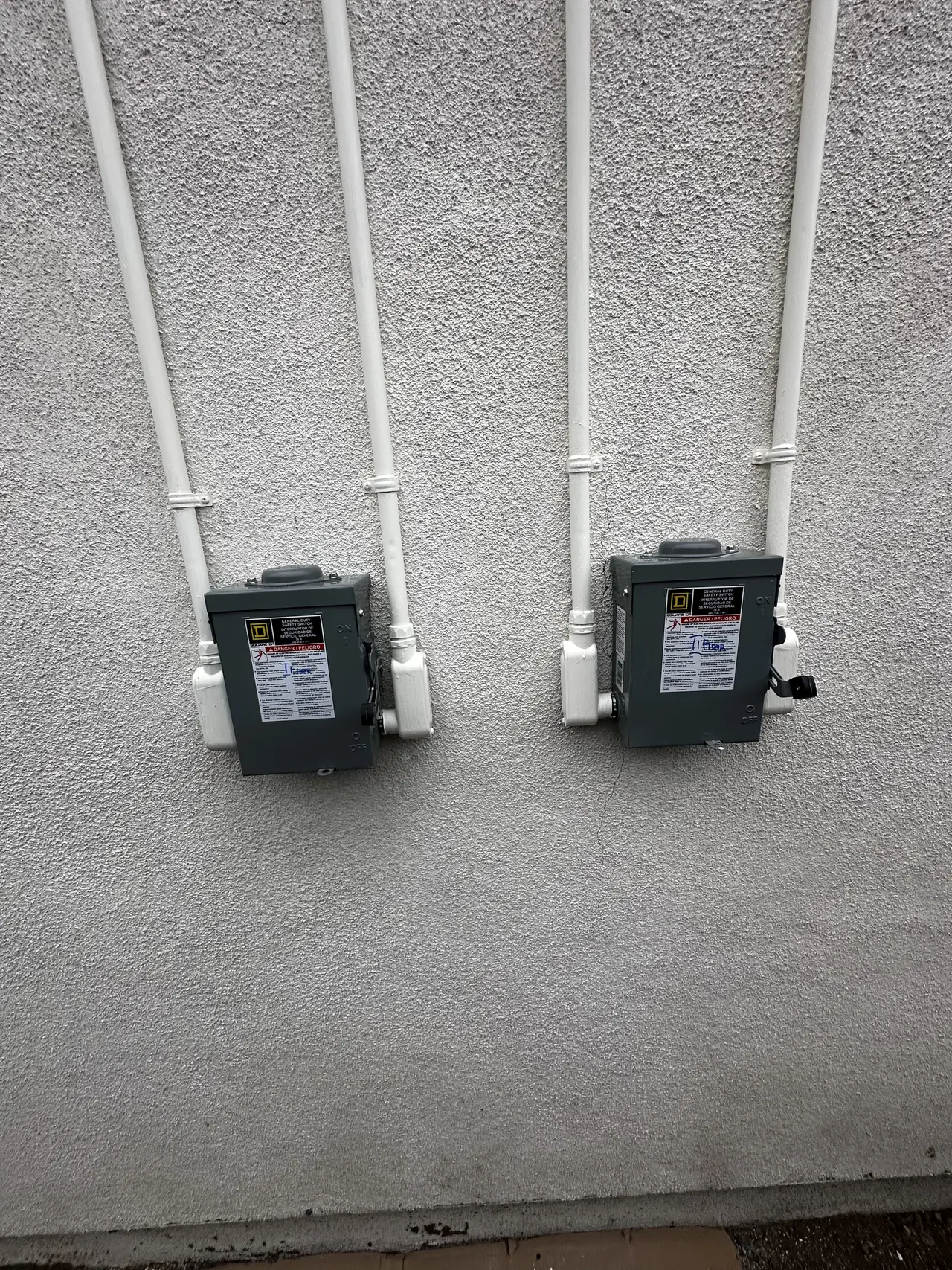
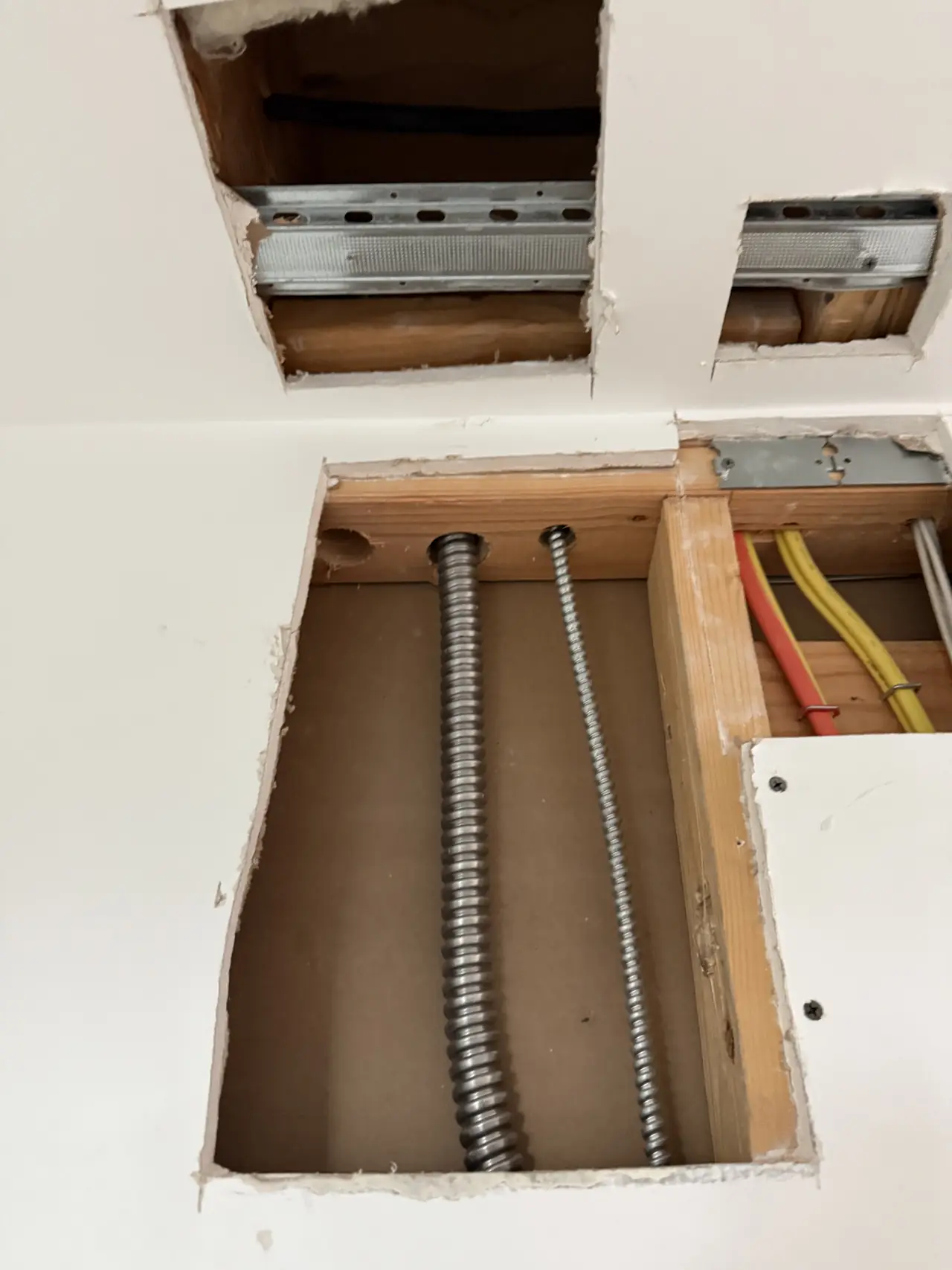
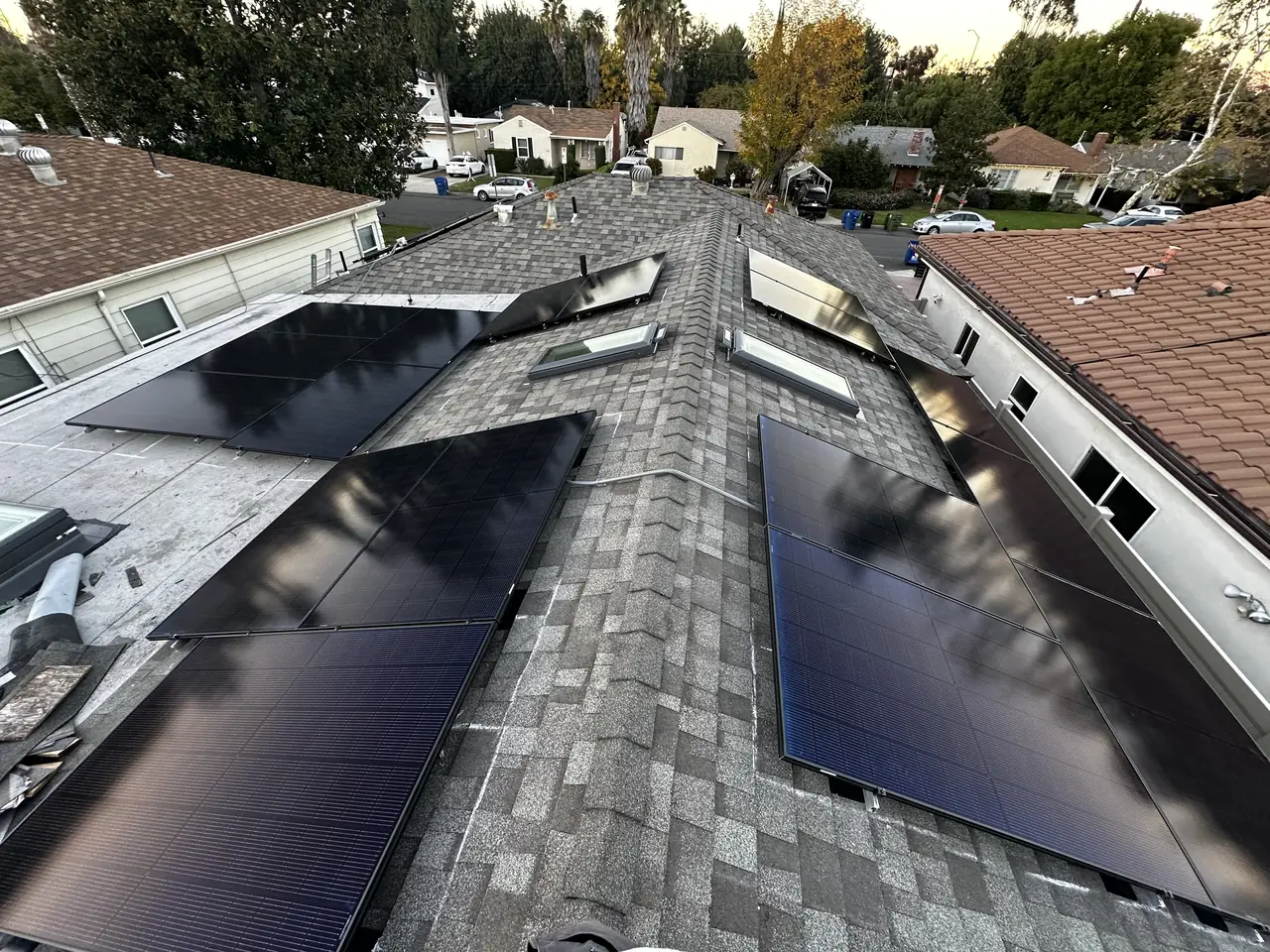
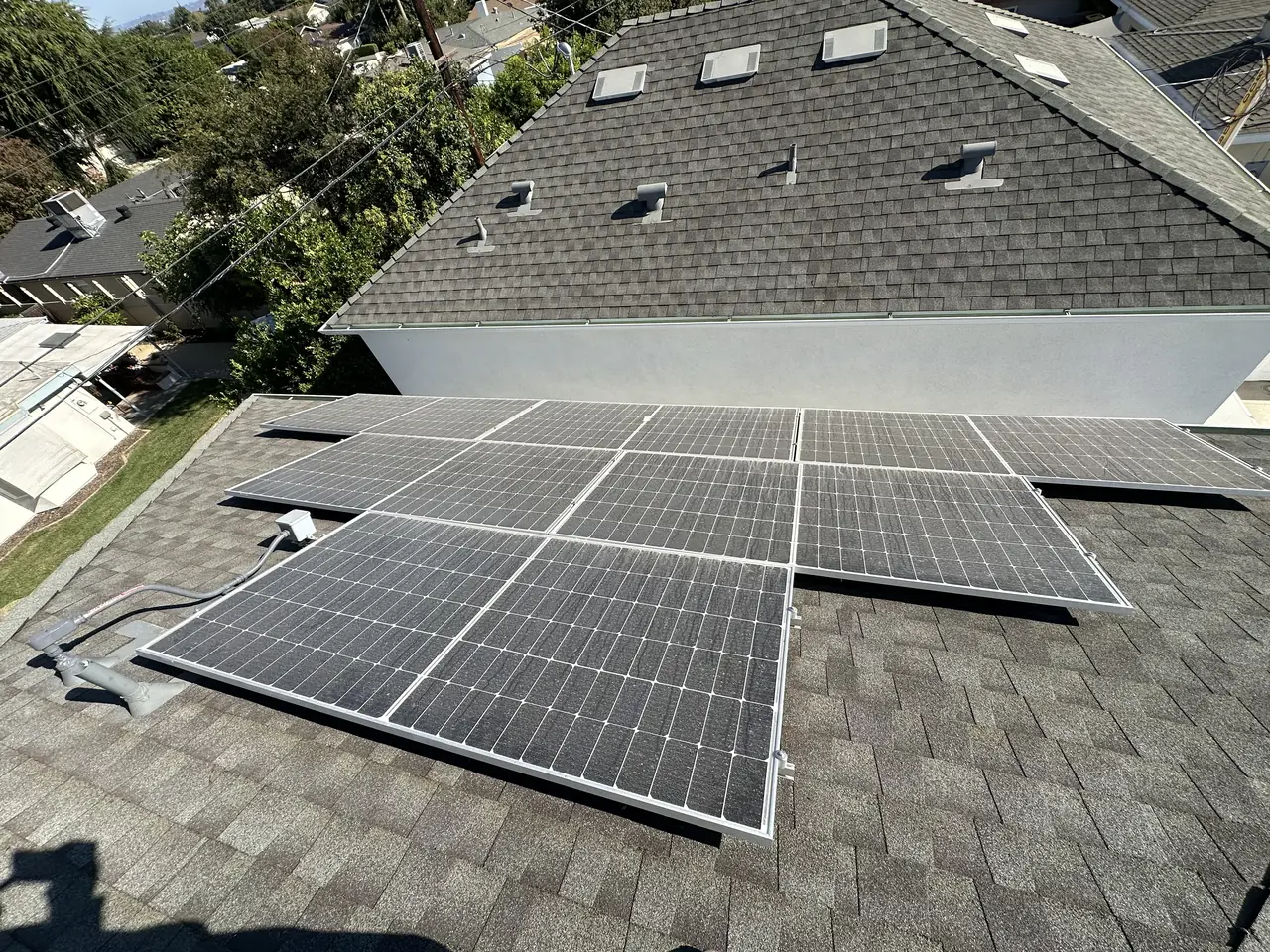
Everything after that was ordinary, and the electrical side shows why it had to be planned early. The conduit runs go up through the framing to the roof and back down the outside wall to two separate disconnects — one per dwelling. The two systems never touch. Each one has its own conduit, its own disconnect, its own meter and its own interconnection agreement.
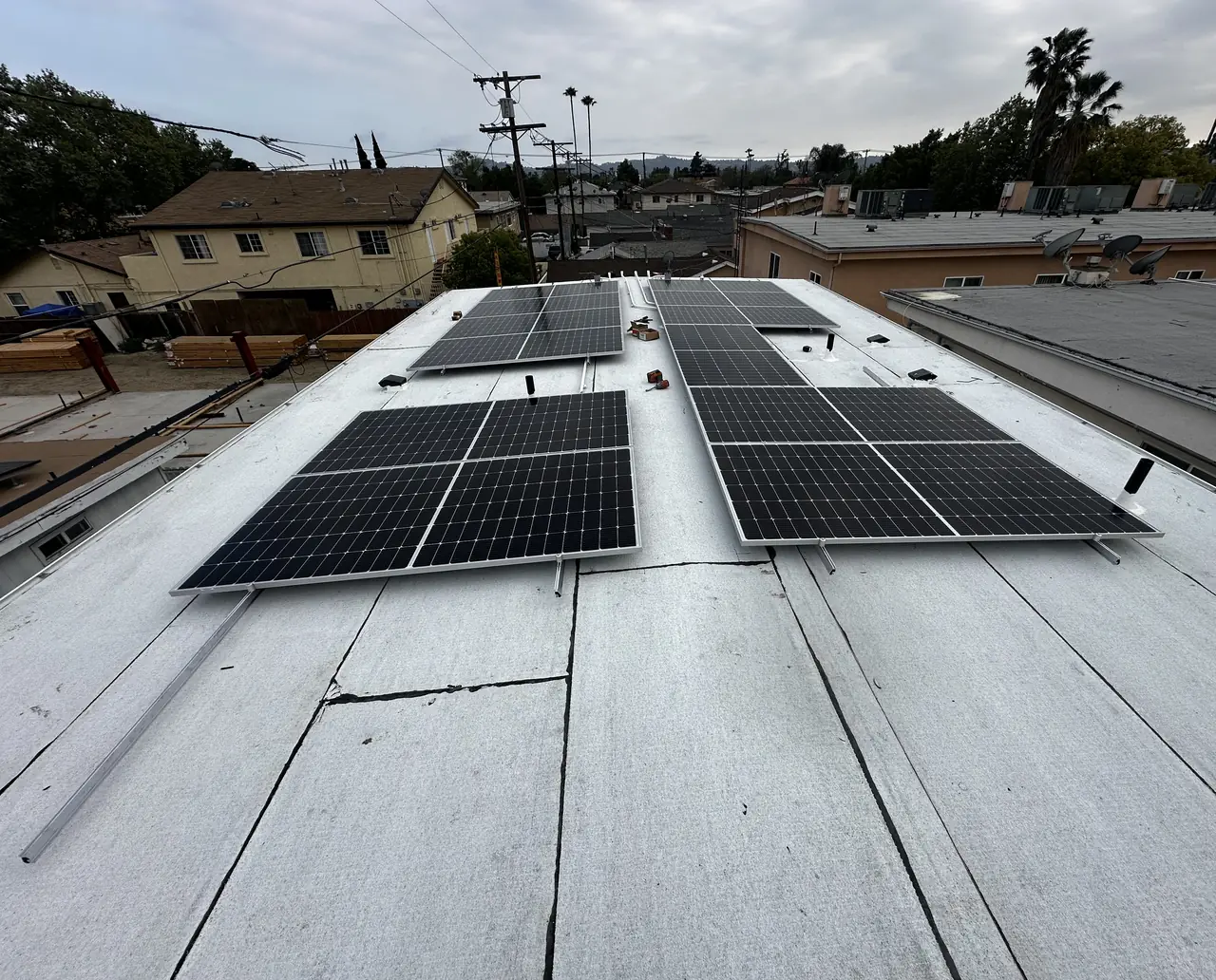
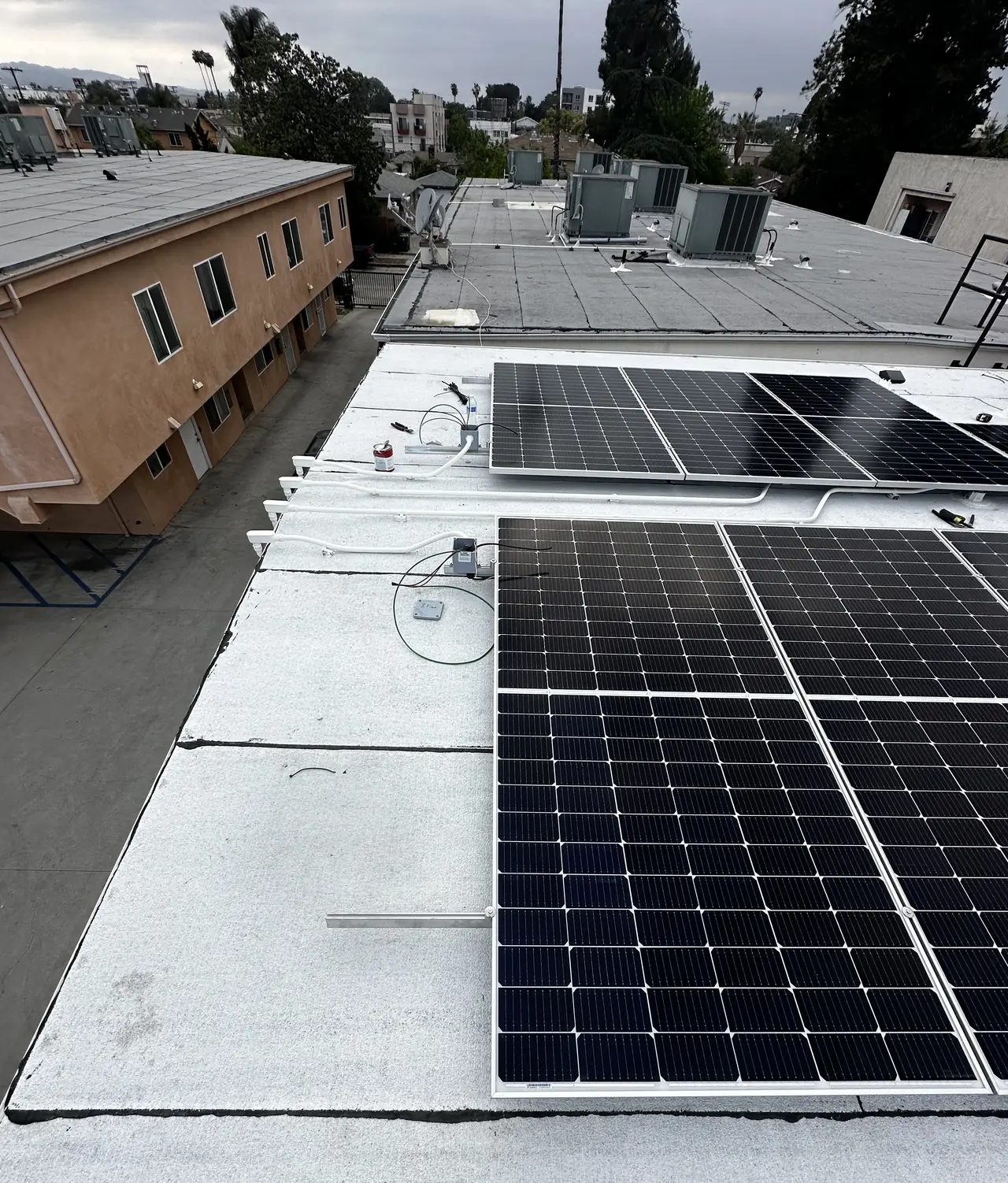
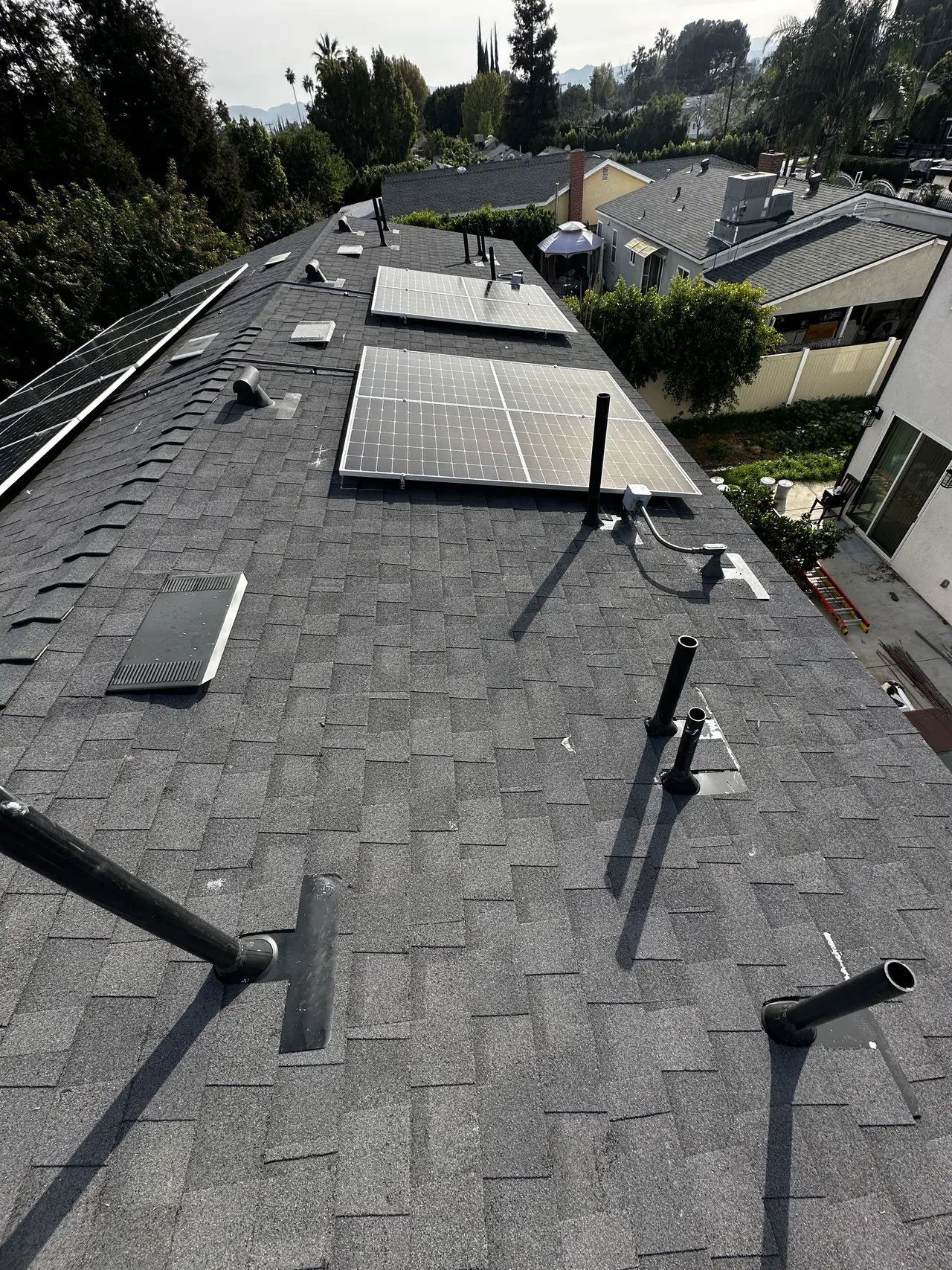
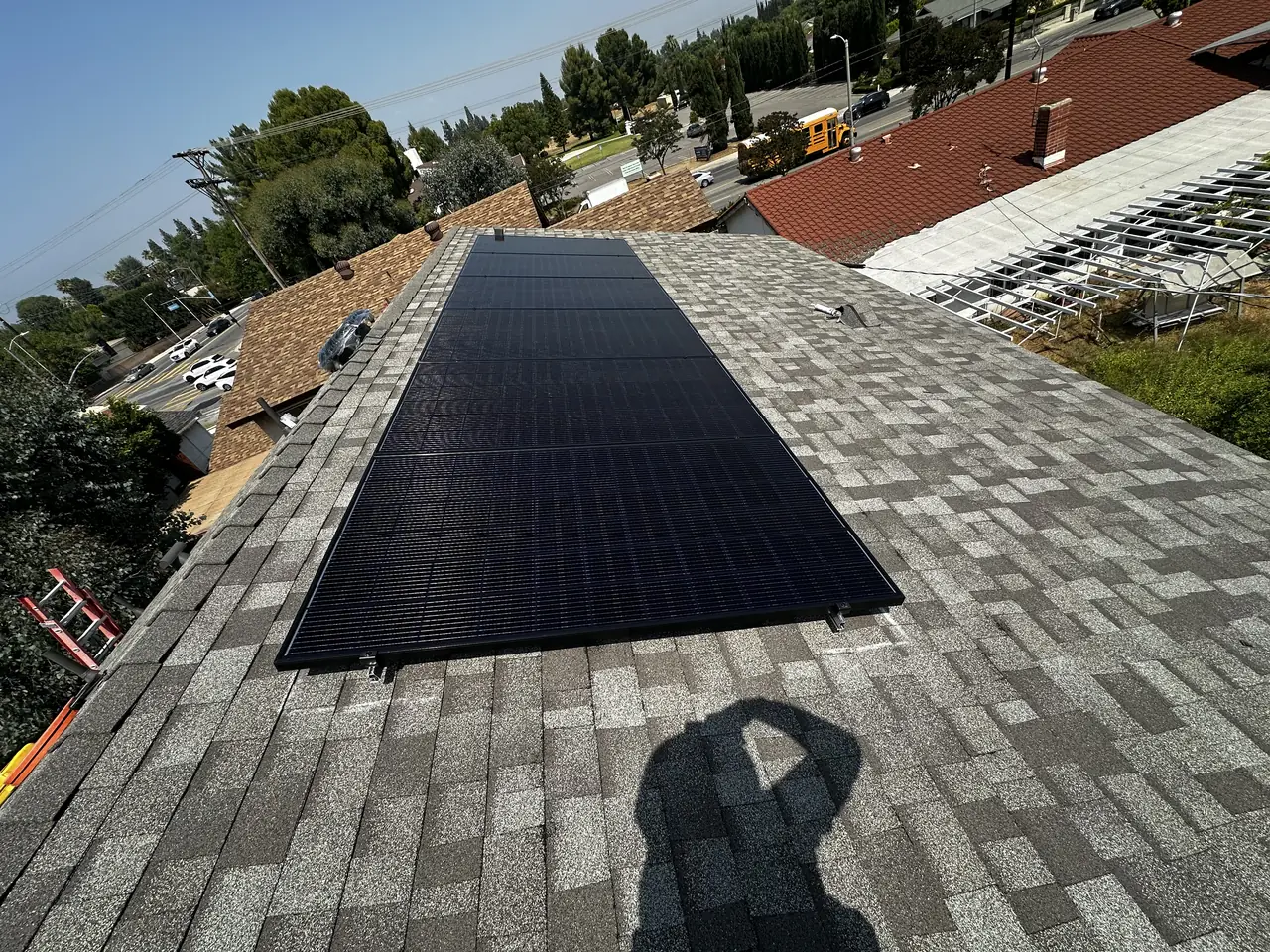
The two arrays are matched: the utility recorded each dwelling at 2.59 kilowatts, on its own work request, and they were laid on tilt legs because the roof is flat and white-coated and has no pitch of its own to borrow.
The design took a while to settle. Between April and August the building was drawn several different ways — different module counts, modules flat against modules tilted — because a flat roof offers choices a pitched one does not, and because two dwellings sharing a roof have to come out even. What the utility recorded at the end of it was 2.59 kilowatts on each.
The last stretch was not paperwork, and this is the part worth knowing. Both systems were finished and had passed their final inspections by the start of May. What permission was actually waiting on was a meter swap: the dwellings already had ordinary meters fitted for the new units, and the utility has to take those off and put solar ones on before it will authorise the systems to run.
It moved when photographs of the installed meters went across. We sent them on the twenty-second of May; the representative replied that both jobs were now scheduled for the solar meter installation and permission. Permission to operate arrived on consecutive days in the middle of June — one dwelling on the tenth, the other on the eleventh — with the permanent solar meter recorded on the second a few days after that.
Eight weeks from filing, and the only lever anybody had on the last four of them was a set of photographs.
If you are building an ADU and plan to put solar on it, the useful thing to know is that the interconnection follows the service, and the service follows the address. Get the dwelling on the utility's books first. Everything else is a normal installation.
How it ran
| Spring 2024 | Certificate of occupancy for the two dwellings |
|---|---|
| 16 April 2025 | Interconnection filed — returned five times, address not found |
| 18–19 April 2025 | Two work requests opened, one per dwelling; fees paid on both |
| Late April 2025 | Both systems installed; final inspections passed |
| 5 May 2025 | Building department final release recorded by the utility on both |
| 22 May 2025 | Photographs of the installed meters sent to the utility |
| 28 May – 4 June 2025 | Both jobs scheduled for the solar meter swap |
| 10–11 June 2025 | Permission to operate, one dwelling then the other |
| 14 June 2025 | Permanent solar meter recorded on the second dwelling |
Two of everything, three days apart at the end.
What we did
- Designed two independent systems for one shared roof rather than one system for the building.
- Ran the conduit through the framing while the structure was still open.
- Established each dwelling as its own service address after the interconnection was returned as not found.
- Filed and carried two separate work requests, with separate disconnects, meters and agreements.
- Installed both systems in a single day on a flat roof, on tilt legs.
- Took both dwellings to permission to operate eight weeks after the first filing.
System specifications
| Building | New two-storey structure containing two accessory dwelling units |
|---|---|
| Array | 5.34 kW DC — 12 modules at 445 W |
| Layout | Two independent systems, one per dwelling |
| Roof | Flat, white-coated; modules on tilt legs |
| Electrical | Separate conduit runs, disconnects and meters per dwelling |
| Interconnection | Two work requests, two agreements, two PTOs |
| Same lot | An older apartment building, itself extended by one unit earlier |
| Utility / AHJ | LADWP / LADBS |
Is your project like this one?
- You have built an ADU and the utility has no record of the address yet.
- You have two or more dwellings on one lot and want to know how solar gets divided.
- Your interconnection request was rejected and the reason made no sense to you.
- Your roof is flat and shared between units, and you want to know how that is split.
- You are a builder coordinating solar alongside a certificate of occupancy.
Cali Energy in North Hollywood
North Hollywood is inside City of Los Angeles boundaries: permits run through LADBS, interconnection through LADWP.
North Hollywood has been adding dwellings faster than almost anywhere in the Valley: garages become homes, back yards get second buildings, and a single lot can end up with three addresses on it.
This installation is on the North Hollywood projects page alongside the others, and what the work covers is set out on the North Hollywood service area page.
- License and classifications: CSLB #1032379
- Official reference for this process: LADWP interconnection requirements
- Official reference for this process: LADBS — accessory dwelling units
Frequently asked questions
My new ADU has a certificate of occupancy but the utility says the address does not exist. Why?
Because they are two different records. The building department signs off that the dwelling is built and safe to occupy; the utility keeps its own register of service addresses, and a new unit is not in it until it is added. On this project the interconnection came back as address not found five times before each dwelling was established as its own service.
Can two ADUs share one solar system?
It depends on how they are metered. On this building each dwelling is its own customer with its own meter, so each one got its own system, its own conduit, its own disconnect and its own interconnection. The only thing they share is the roof they sit on.
Does that mean paying twice for the interconnection?
There were two work requests and fees on both, because there are two services. That is worth knowing before the design, since it changes what a two-unit project costs compared with one system of the same total size.
When should the solar wiring go in on a new build?
While the framing is still open. On this building the conduit runs go through the structure to the roof and back down the outside wall; doing that after the walls close turns the same work into a retrofit on a brand-new building.
Why are the modules tilted on a flat roof?
A flat roof gives the array no angle, so the angle has to come from the racking. Here the modules sit on tilt legs above a white-coated membrane.
Does Cali Energy work on ADUs in North Hollywood?
Yes, including new construction where the solar is designed in alongside the building. Cali Energy holds B, C-10 and C-39 classifications under CSLB #1032379. North Hollywood is inside City of Los Angeles boundaries, so permits run through LADBS and interconnection through LADWP.
What this would look like on your roof
Planning solar in North Hollywood? Tell us your utility, your roof and what your bill looks like now, and we will model what a system like this would do on your house before you commit to anything.
Or call +1 (323) 844-7777 · Cali Energy, Northridge · CSLB #1032379 (B, C-10, C-39) — design, permits, install and electrical under one licensed contractor.
Related
This timeline reflects this property and this permitting path. Updated September 2026.