

Do Solar Panels Affect Home Insurance in California?
Usually not in kind, often in amount. Rooftop panels are attached to the house, and a California homeowners policy’s Coverage A protects “your house and attached structures,” so they are typically covered against the same perils as the roof. Two things decide whether that protection is real: whether your dwelling limit was raised to include the system — the Department of Insurance asks homeowners to report improvements in writing — and which perils your policy covers. The FAIR Plan’s basic dwelling policy covers fire, lightning, internal explosion and smoke; wind, hail and vandalism only if added.
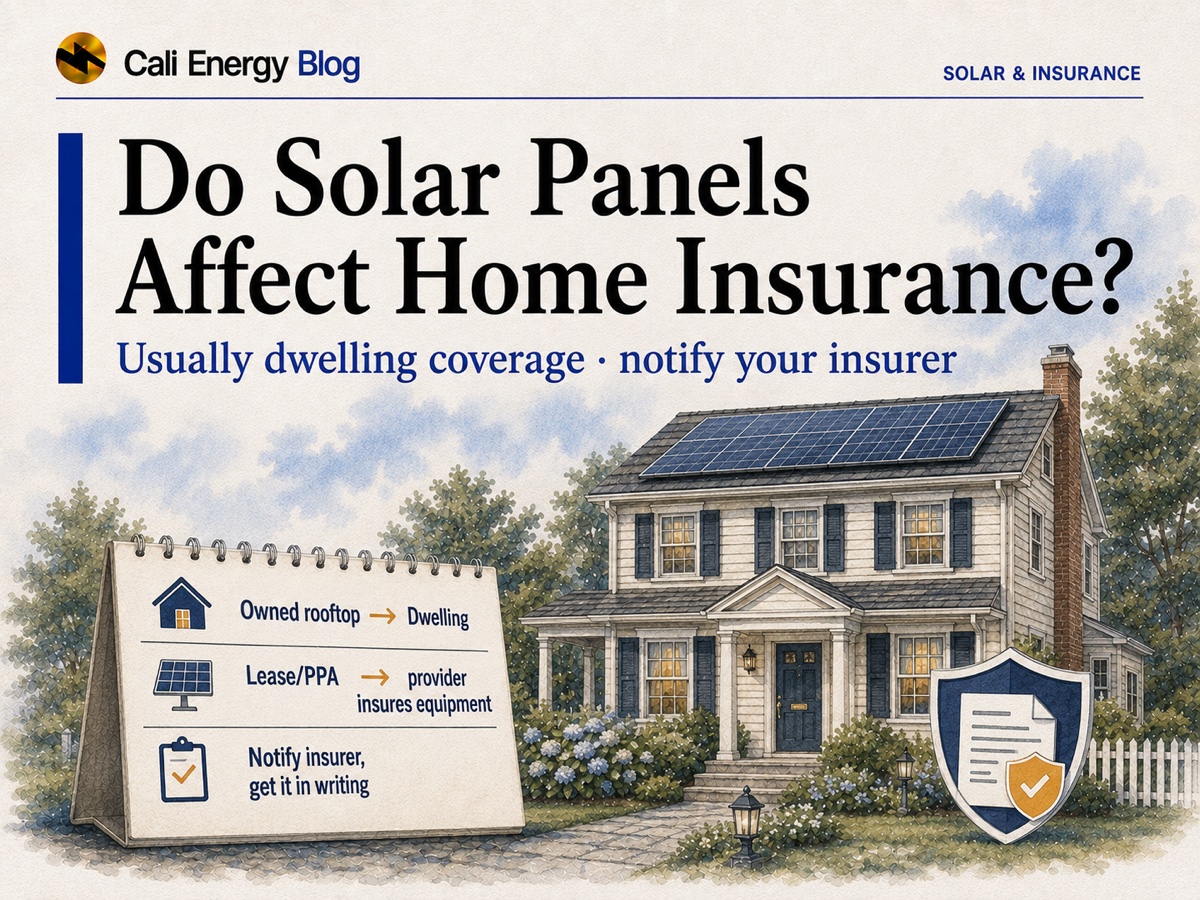
- Attached panels are part of the house in a standard policy; panels on a detached garage or a ground mount fall under “other structures,” usually capped at 10% of the dwelling limit.
- Raise the limit, in writing: the system adds to what it costs to rebuild, and the Department of Insurance names underinsurance as a main problem after past wildfires.
- On the FAIR Plan, check the boxes: wind and hail (“Extended Coverages”) and vandalism are add-ons, and there is no theft or liability cover; the state suggests a difference-in-conditions policy alongside it.
- Leased or PPA systems belong to the provider; the contract says who insures them and what happens after a disaster.
Where solar panels sit in a policy
| Coverage | What it protects (CDI) | Where solar usually fits |
|---|---|---|
| A — Dwelling | Your house and attached structures | Panels on the house roof, attached inverters and wiring |
| B — Other structures | Structures not attached to the dwelling, normally limited to 10% of A | A ground mount, or panels on a detached garage or carport |
| E — Personal liability | Claims against you for injury or damage | Not on a FAIR Plan policy; see below |
Sources: California Department of Insurance, Residential Insurance Guide · FAIR Plan dwelling policy CFP 00 01. How a specific insurer classifies a battery or ground mount is up to the policy; ask for it in writing.
The FAIR Plan’s policy form uses the same idea: Coverage A covers the dwelling “including structures attached to the dwelling,” and up to 10% of that limit can be used for other structures. See ground-mount solar and solar carports.
The limit is the part people miss
A system adds to what it would cost to rebuild your home. If the dwelling limit isn’t raised to match, a total loss can leave you short — and the Department of Insurance says many homes in past California wildfires were underinsured. Its guide asks homeowners to keep records of improvements, to “discuss any modifications to your home, in writing” with the agent or insurer when they change the replacement cost, and to review the limit at every renewal. If the insurer gives you a replacement-cost estimate, you are entitled to a copy. Also check whether the policy pays replacement cost or actual cash value: the second deducts for age.
Whether the premium rises depends on that limit and your insurer’s rating; we found no state data on how much solar changes California premiums, so this page doesn’t quote one.
If you are on the FAIR Plan
| Peril | Covered |
|---|---|
| Fire or lightning; internal explosion; smoke | Yes, in the base policy |
| Windstorm or hail, explosion, riot, aircraft, vehicles, volcanic eruption | Only if “Extended Coverages” is selected |
| Vandalism or malicious mischief | Only if selected |
| Theft (burglary), personal liability | No — consider a difference-in-conditions policy |
Sources: FAIR Plan Dwelling Policy CFP 00 01 (05/2026) · CDI Residential Insurance Guide · FAIR Plan dwelling policies.
The FAIR Plan exists for property owners who can’t get coverage from private insurers because the property is considered high risk. Its basic policy protects attached panels against fire, but a wind-blown panel, hail or stolen equipment needs the options or a private difference-in-conditions policy, which the Department of Insurance suggests considering alongside it.
Wildfire: roof class and discounts
Under the state’s Safer from Wildfires regulation, every listed mitigation qualifies for an insurance discount, starting with a Class A fire-rated roof — which most asphalt shingle, tile and metal roofs are. Rooftop solar is part of that rating: the 2025 residential code requires the array to carry a fire classification as a system with the roof (CRC R902.4, UL 2703), so a code-compliant install should not cost the roof its class. See solar, roof fire class and WUI and what a Class A rating means. Batteries have their own placement rules; see home battery fire safety.
Leased and PPA systems
With a lease or power purchase agreement the provider owns the equipment. The CPUC’s Solar Consumer Protection Guide tells buyers to ask whether an insurance policy comes with the system or whether they need more homeowner’s coverage — “especially important” in fire-prone areas — and what the contract requires if the system stops working after a disaster. The roof, and any damage the system does to it, may still be yours to insure. See cash vs loan vs lease and if your installer goes out of business.
After a fire or other disaster
Two records speed a claim: the permit with final sign-off and the utility’s permission-to-operate letter, plus equipment models and serial numbers. On SCE, a NEM 1.0 or 2.0 customer whose system is destroyed in a declared emergency keeps the original PTO date and 20-year term if the same customer rebuilds a system sized to a year of use and it reaches PTO within four years. See NEM 2.0 grandfathering.
Checklist
Tell the insurer, in writing
Report the system, its installed value and whether it is owned or leased; ask how it is classified.
Raise the dwelling limit
Ask for the updated replacement-cost estimate and a copy of it.
Read the perils
On the FAIR Plan, check Extended Coverages and vandalism, and price a difference-in-conditions policy.
Keep the paperwork
Permit, PTO letter, equipment list, warranties and photos of the installed array.
Where to go next
For the roof side, see do solar panels damage your roof? and fire-resistant roofing in Los Angeles. This page is general information, not insurance advice; your policy and insurer decide coverage.
Frequently asked
Does homeowners insurance cover solar panels in California?
Usually, as part of the house. Coverage A protects the house and attached structures, so rooftop panels are typically covered against the same perils as the roof, up to your dwelling limit. Confirm with your insurer in writing.
Do solar panels raise your home insurance premium?
They can, mainly by raising the dwelling limit you need. We found no state data on the average change, so ask your insurer for a quote with the higher limit.
Do I need to tell my insurer I installed solar?
Yes. The Department of Insurance asks homeowners to discuss modifications that change the replacement cost in writing with their agent or insurer, and to review the limit at every renewal.
Does the California FAIR Plan cover solar panels?
Attached panels are part of the dwelling on a FAIR Plan policy, covered for fire, lightning, internal explosion and smoke. Wind, hail and vandalism need the optional coverages, and theft and liability are not covered; a difference-in-conditions policy can fill those gaps.
Who insures leased or PPA solar panels?
The contract decides. The provider owns the equipment and often insures it, but the CPUC tells buyers to ask what insurance comes with the system and what happens after a disaster, especially in fire-prone areas.
Are ground-mounted panels covered the same way?
Usually under other structures (Coverage B), which is normally limited to 10% of the dwelling limit, so a large ground mount may need a higher B limit.
Can solar affect my wildfire insurance discount?
It shouldn’t if installed to code: the array must be fire-classified with the roof, so a Class A roof stays Class A, and a Class A roof is one of the Safer from Wildfires discount items.
Related reading
Sources & methodology
Figures on this page come from the primary sources below and, where noted, from Cali Energy calculations using the stated assumptions. Rates, incentives, and program terms change; each was verified October 5, 2026.
- California Department of Insurance — Residential Insurance Guide (coverages, limits, FAIR Plan, DIC)
- California FAIR Plan — Dwelling Policy CFP 00 01 (05/2026), sample
- California FAIR Plan — Dwelling policies
- California Department of Insurance — Safer from Wildfires
- CPUC — California Solar Consumer Protection Guide (insurance questions)
- California Residential Code 2025 (R329, R902.4 fire classification)
About this guide
An educational reference from Cali Energy’s research team, not insurance advice. Coverage depends on your policy and insurer; confirm details in writing and read any lease or PPA in full.
Prepared by Cali Energy, October 5, 2026. This article is for general educational purposes only and is not legal, tax, financial, engineering, or utility advice. Rates, incentives, codes, permit requirements, equipment specifications, prices, and program terms may change; figures and timelines are estimates, not guarantees. Confirm current requirements with the applicable utility, AHJ, program administrator, manufacturer, or a licensed professional. See our Content Disclaimer. Cali Energy · 19201 Parthenia St, Unit E, Northridge, CA 91324 · CSLB #1032379 (B, C-10, C-39)