

Cash vs Loan vs Lease vs PPA: How to Pay for Solar in California (2026)
Short answer: cash has the lowest lifetime cost and you own the system; a solar loan also makes you the owner but adds interest and sometimes a financing fee; a lease or PPA asks little or nothing upfront, but a third party owns the panels, payments normally escalate every year by an amount written into the contract, and it adds steps when you sell. Here's the full trade-off, side by side.
Get a free estimate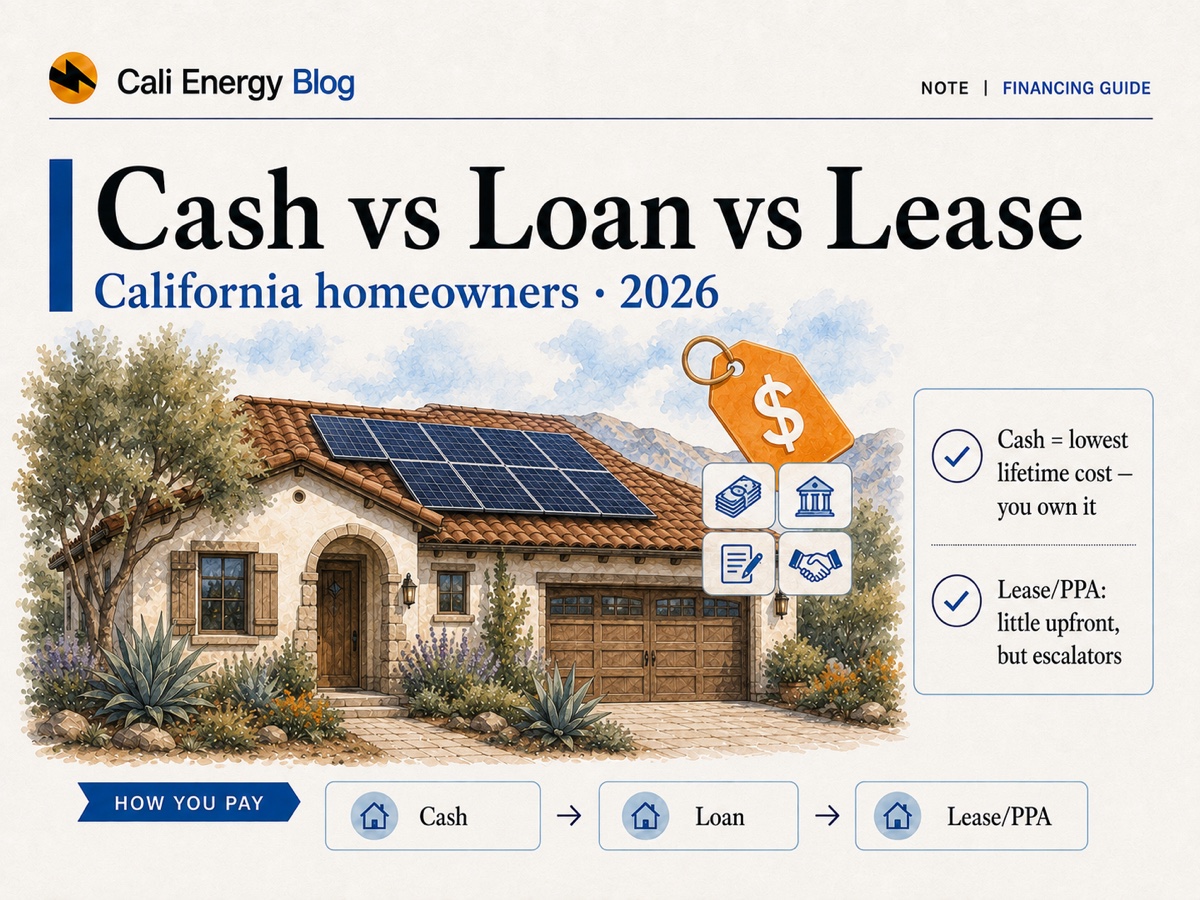
- Cash and loan make you the owner of the panels; lease and PPA leave a third party as the owner.
- Cash is normally the lowest lifetime cost. A loan adds interest and sometimes a financing/dealer fee, but you still own the system.
- Lease/PPA means little or nothing upfront, but the state’s own guide warns that payments “will typically increase by a specified amount every year” under an escalator — the rate is in your contract, not in any published average — and a third-party-owned system adds steps when you sell your home.
- In 2026 the 30% federal credit is gone for owner-bought systems. A lease/PPA provider may claim a separate business credit — you don't.
The four ways to pay for solar
Almost every residential solar deal in California is one of four payment structures — plus a fifth, PACE, that the state lists alongside them and that deserves its own warning below. The panels can be identical — what changes is who fronts the money, who owns the system, and what you pay over the next 20–25 years.
Cash (buy outright) — you pay the installed price once and own the system. Solar loan — a lender pays the installer, you repay over ~10–25 years with interest, and you own the system. Lease — a company installs and owns the panels on your roof; you pay a fixed monthly rent to use them. PPA (power-purchase agreement) — similar to a lease, but instead of a flat rent you pay a per-kWh rate for the electricity the system produces. Both lease and PPA are commonly marketed as "$0 down."
PACE, and why it is different at resale
Property Assessed Clean Energy financing covers the upfront cost and you repay it on your property tax bill; the CPUC lists it beside the other four and notes that with PACE “you own the system.” The part to understand before signing is what it does to the house. In the state’s own words, “PACE financing results in a first-priority lien on your property. Your bank may require you to pay off the PACE assessment prior to refinancing. If you do not make your PACE payments, this could result in foreclosure or make it more difficult to sell your home or refinance your mortgage.” That is a heavier consequence than anything in the four options above, and it is why we treat PACE as a separate conversation rather than a fifth column in the table. See do solar panels increase home value in California? for what it means at closing.
Side by side: the four options at a glance
This is the whole decision in one table. "Lifetime cost (relative)" compares the total you'd pay over ~20–25 years for the same system — it's a general ranking, not a quote, and your own numbers depend on price, interest rate, escalator, and utility.
| Cash | Solar loan | Lease | PPA | |
|---|---|---|---|---|
| Upfront cost | Full system price | $0–low down (financed) | Often $0 down | Often $0 down |
| Who owns the panels | You | You | The provider | The provider |
| Lifetime cost (relative) | Lowest | Higher (interest ± fee) | Varies; escalator raises it | Varies; escalator raises it |
| Federal credit in 2026 | None (ended Dec 31, 2025) | None (ended Dec 31, 2025) | You don't claim it; provider may claim a business credit | You don't claim it; provider may claim a business credit |
| Effect on selling your home | Owned asset, transfers with house | Loan usually paid off or assumed at closing | Buyer must assume the contract or you buy it out | Buyer must assume the contract or you buy it out |
| Best for | Have the cash; want lowest total cost | Want ownership without paying all at once | Little cash; want a predictable, hands-off bill | Little cash; comfortable paying per kWh produced |
Credit status per IRS — Residential Clean Energy Credit; lease and PPA mechanics per the CPUC California Solar Consumer Protection Guide. The CPUC guide puts typical escalators at “a 1 percent to 3 percent increase above the rate you paid in the previous year” and tells homeowners to “be cautious of entering into a contract with an escalator higher than that” — your own rate is in your contract. Lifetime-cost ranking is a general comparison, not a quote.
Cash: lowest lifetime cost, you own it
Paying cash means you pay the installed price once and own the system with no interest, no lender, and no monthly payment. It's normally the lowest total cost of the four options because you're not paying anyone to finance it. The trade-off is obvious: it ties up a chunk of money up front, and there's no 30% federal credit in 2026 to soften that. See what systems actually cost in solar panel cost in California (2026).
Solar loan: you still own it, but interest and fees add up
A solar loan lets you own the system without paying the full price on day one. You repay over ~10–25 years, and because you're the owner, the panels transfer cleanly with the house and you carry no lease contract. Two catches, and the state names one that has nothing to do with the rate: “Some solar loans place a lien on your property. In those cases, if you do not make your payments, this could result in foreclosure or make it more difficult to sell your home or refinance your mortgage.” Ask in writing whether the loan places a lien, and on what. The other catch is cost: you pay interest over the term, and many financed deals also roll in a financing or dealer fee. The federal consumer bureau, which studied this market, found such fees “typically range from between 10 to 30 percent of the cash price but can exceed 50 percent”, and that lenders generally do not fold them into the cost of credit they disclose — so the fee never appears in the APR conversation. Its worked example is a $30,000 cash price financed as a $39,000 principal, the lender passing $30,000 to the installer and keeping $9,000. That gap is the thing to ask about before you sign. A useful habit, with one trap inside it: compare quotes on cash price divided by DC watts — never the monthly payment, and never the total from the disclosure page, because that total includes finance charges and will make any financed quote look expensive beside a cash one. Ask every provider for the cash price, then compare like with like. Our solar quote comparison checklist walks through exactly what to ask for.
Ask for the cash price and the financed price
Request both the cash price and the financed price for the same system, plus the interest rate and term. If the financed price is meaningfully higher than cash for identical equipment, the difference may include financing or rate-buydown charges — a normal part of many loan products, but you should see it itemized in writing and decide it's worth it. A higher total can also be justified by better equipment, roof work, or an electrical upgrade; the goal is an itemized number you understand, not suspicion.
Lease and PPA: little upfront, but a third party owns the panels
A lease or PPA is the low-upfront path: a provider installs, owns, and maintains the system, and you pay to use it — a fixed monthly rent (lease) or a per-kWh rate for what it produces (PPA). Many are marketed as "$0 down." The CPUC lists two genuine advantages on this side that an owned system does not come with: the provider is “responsible for all monitoring, maintenance, and repairs,” and a “minimum energy production” is often guaranteed. It lists the matching risk in the same table — the provider “could go out of business during the contract period.” Two things to read carefully. First, the escalator. The CPUC’s consumer guide puts it plainly: payments “will typically increase by a specified amount every year based on an ‘escalation clause’ or ‘escalator,’” and it gives the range to expect — “typically in the range of a 1 percent to 3 percent increase above the rate you paid in the previous year” — with the warning to “be cautious” above that. Some prepaid leases have no escalator at all, and a payment late in a 20- or 25-year term can sit well above year one. Second, ownership: because the provider owns the panels, the arrangement adds steps when you sell (more on that below). And a third question the state tells you to ask outright — who keeps the renewable energy credits. The CPUC guide’s instruction is to “ask your solar provider who will own the RECs, and check the contract fine print”: on a lease or PPA they normally stay with the provider, which means the environmental attributes of the power on your roof are not yours to claim.
Whether a lease or PPA works out depends on your escalator against how your utility’s rates actually move — and neither number is knowable in advance. California does publish a benchmark, and it is the most useful sentence in the state’s whole guide for anyone weighing a lease: escalators are “typically in the range of a 1 percent to 3 percent increase above the rate you paid in the previous year,” and the CPUC adds, in the same breath, “Be cautious of entering into a contract with an escalator higher than that.” So a quoted 3.9% is not simply the going rate — it is above what the regulator tells you to watch for. The rate that binds you is still the one written into the contract in front of you. The good news is that California makes the consequence easy to see without any modelling. Under Business and Professions Code §7169, every solar contract — including a lease — must carry on its front page, in boldface 16-point type, the total cost and payments for the system including financing costs. On a lease or PPA that total is the escalator’s whole effect, already added up for you. Read it, then compare it with what you would pay to own. Model your own case with the California solar payback calculator, and see how California rates have actually moved rather than assuming they outrun any escalator.
What Californians are actually choosing — from the state’s own interconnection data
Every grid-connected solar system in the three big utility territories files an interconnection application, and the CPUC publishes the resulting dataset. We read it so this page could answer the question with numbers rather than impressions: 1,325,805 residential solar interconnections in PG&E, SCE and SDG&E territory, through the 31 May 2026 release.
The headline is a shift that happened fast. Third-party ownership — lease and PPA together — ran at about a quarter of new residential systems through 2022 and 2023. Then it nearly doubled.
| Year | Systems | Third-party owned | Of that, PPA | Of that, lease |
|---|---|---|---|---|
| 2022 | 243,740 | 25.2% | 81.0% | 13.5% |
| 2023 | 271,724 | 24.5% | 79.3% | 16.2% |
| 2024 | 154,890 | 43.1% | 84.6% | 13.4% |
| 2025 | 145,031 | 45.4% | 91.5% | 6.9% |
| 2026 through 31 May | 59,561 | 41.0% | 84.8% | 11.9% |
Counted from the CPUC Interconnected Project Sites Data Set, release of 31 May 2026, filtered to residential photovoltaic projects. “Of that” columns are shares of the third-party-owned group, using the dataset’s own Third Party Owned Type field; the remainder is recorded as “Other”. The 2026 row is a partial year.
Two things worth taking from that table before you decide anything.
The shift is real, not a reporting quirk. We checked each utility separately, because a jump like that is exactly what a change in how one company files its data would look like. It appears in all three: PG&E went from 21.7% to 39.2% between 2023 and 2024, SCE from 29.2% to 48.7%, SDG&E from 20.2% to 38.6%. In SCE territory in 2025, more than half of new residential solar — 51.5% — was owned by somebody other than the homeowner. The field is populated on essentially every record, so this is not missing data changing shape.
“Lease or PPA” is now mostly PPA. Of third-party systems in 2025, 91.5% were power purchase agreements and under 7% were leases. If you are being pitched a no-money-down arrangement in California today, the odds are heavily that it is a PPA — you will be buying the power by the kilowatt-hour, not renting the hardware for a flat monthly figure. Read the sections above with that in mind.
We have not tried to explain the shift here, and you should be suspicious of anyone who does so confidently: net metering changed in April 2023, the federal residential credit ended after 2025, and interest rates moved, all in the same window. What the data supports is the fact of the shift, not a single cause for it.
And what an owned system actually costs
The same dataset records a total system cost for host-owned projects, which gives a real distribution to compare a quote against — instead of a round number from a marketing page.
| Year | Systems | 25th percentile | Median | 75th percentile |
|---|---|---|---|---|
| 2023 | 180,878 | $3.37 | $4.25 | $5.18 |
| 2024 | 58,143 | $3.28 | $4.25 | $5.19 |
| 2025 | 45,775 | $3.03 | $4.25 | $5.40 |
| 2026 through 31 May | 19,932 | $2.73 | $3.96 | $5.50 |
Total System Cost divided by System Size DC, for residential projects recorded as not third-party owned and without storage, from the same CPUC dataset. Systems with a battery are excluded because the cost field includes the battery while the size field does not — counting them together would inflate the figure, and battery attachment jumped from 10.7% of new systems in 2023 to 44.2% in 2025. Cost is as reported by the applicant and the dataset warns that what it includes varies, so read these as a distribution to place a quote in, not as a price list. Covers PG&E, SCE and SDG&E only — LADWP, Burbank and Glendale customers are not in this dataset.
The useful part is the spread, not the middle. Half of owned California systems land between roughly $3 and $5.40 per DC watt, and the median has sat at $4.25 for three years running while the bottom quartile has drifted down. A quote near $3 is not automatically a bargain and one near $5 is not automatically a rip-off — scope explains most of the distance, which is why the flag to watch is an unexplained price rather than a high one. Take your own quote, divide the cash price by DC watts, and see where it falls.
The 2026 tax-credit difference
This is where 2026 changed things. The 30% federal Residential Clean Energy Credit (Section 25D) ended on December 31, 2025 under the law signed in July 2025, so homeowners who buy with cash or a loan in 2026 get no federal credit — the sticker price is the real price (IRS). With a lease or PPA, a third party owns the system and may still qualify for a separate business clean-energy credit, but that depends on the project's ownership, construction start, and in-service timing — and you, the homeowner, don't claim it. If a salesperson frames a lease as "getting you the tax credit," that credit (if any) belongs to the provider; ask how, or whether, it's reflected in your rate. Full detail in is solar still worth it in California? This is general information, not tax advice — confirm your situation with a tax professional.
What each option does when you sell your home
Ownership drives what happens at closing. With cash, the system is an owned asset that transfers with the house — owned solar is generally associated with added home value. With a loan, the balance is typically paid off from proceeds at closing (or, in some products, assumed), and the panels transfer as an owned asset. With a lease or PPA, the contract is tied to the home. The CPUC states the options bluntly: the new owner must agree to take on the agreement, you keep making the payments, or you buy it out — and a buyout “could be thousands of dollars.” That is an extra step that can slow a sale if a buyer is hesitant about assuming a third-party contract. None of this makes a lease "bad," but it's a real difference worth planning for. We cover the resale angle in do solar panels increase home value in California?
Which path fits you? A 20-second decision tool
Answer four questions and the tool points to the two most logical options for your situation and the trade-off between them. It’s a starting point, not financial advice — your exact numbers decide the rest.
Ownership decision tool
Cash, loan, or lease/PPA — which makes sense for you?
Which one is right for you?
Choose cash if…
You have the funds and want the lowest lifetime cost and full ownership, with no lender, no contract, and the simplest home sale.
Choose a loan if…
You want to own the system but not pay all at once. Confirm the interest rate and any financing fee, and compare the financed price to the cash price.
Consider a lease/PPA if…
You have little cash, want a hands-off arrangement with maintenance handled, and you've read the escalator and buyout terms and are comfortable with them.
Whatever you choose…
Get the numbers in writing, compare owner-bought quotes on price per watt, and read any lease/PPA contract's escalator and end-of-term options before signing.
You generally have a right to cancel
If you signed somewhere other than the contractor’s own business premises — your kitchen table, your doorstep — you have until midnight of the third business day after you receive a signed, dated copy of the contract that includes the cancellation notice — the fifth if you are 65 or older. Two details decide real cases: California counts Saturday as a business day, and the clock only starts once the seller has given you a compliant Notice of Cancellation, so a missing form can mean the window never closed. We work all of that through in how the cancellation right actually works. If a deal is only good “today,” that is a reason to slow down, not speed up. See the CPUC California Solar Consumer Protection Guide.
Cali Energy installs owner-bought solar, batteries, and the roofing and electrical work that sometimes comes with them (CSLB #1032379). We're happy to price a system as cash or a loan and show you an itemized number so you can compare it against any lease or PPA you're weighing.
Get a free, itemized estimateFrequently asked
What's the cheapest way to pay for solar in California?
Paying cash is normally the lowest lifetime cost, because you avoid interest, financing fees, and any lease/PPA escalator — and you own the system outright. A solar loan costs more over time due to interest and sometimes a financing fee, but still makes you the owner. Leases and PPAs require little or nothing upfront but often include an annual escalator (while others use a fixed rate or prepaid structure) that can raise the total over 20–25 years.
Do I get the federal tax credit with a solar lease or PPA in 2026?
No. With a lease or PPA a third party owns the system, so the homeowner claims no federal residential credit — and as of 2026 there is none to claim on a purchase either: the 30% Residential Clean Energy Credit under Section 25D is unavailable for property placed in service after 31 December 2025. The provider may still qualify for a separate business clean-energy credit, depending on the project's ownership and timing, and may or may not reflect it in your rate. If a salesperson frames a lease as “getting you the tax credit,” that credit is theirs, not yours — ask how it shows up in your payment. While you are asking: the CPUC also tells homeowners to ask who keeps the renewable energy credits, which on a lease or PPA normally stay with the provider. General information, not tax advice.
What is a solar escalator?
An escalator is a clause that raises your lease or PPA payment automatically every year. The CPUC's consumer guide describes it as payments that “will typically increase by a specified amount every year based on an ‘escalation clause’ or ‘escalator.’” The specified amount is set in your contract — some agreements use a flat rate, some prepaid leases have none — and the CPUC publishes a benchmark for it: escalators are “typically in the range of a 1 percent to 3 percent increase above the rate you paid in the previous year,” with the instruction to “be cautious of entering into a contract with an escalator higher than that.” So a 3.9% escalator is not simply the market rate — it is above the level the regulator flags. Two numbers settle it for your own deal: the escalator rate written into the contract, and the total of payments that Business and Professions Code §7169 requires on the front page of every solar contract, lease included, in boldface 16-point type. That total already contains the escalator's whole effect over the term, so you do not have to model it — you just have to read it and compare it with the cost of owning.
Does a lease or PPA make it harder to sell my house?
It adds a step. The CPUC puts the options plainly: when you sell before the term ends, the new owner must agree to take on the lease or PPA, you continue making the payments, or you buy the agreement out — and a buyout “could be thousands of dollars.” In practice a buyer usually has to qualify and assume the contract, which can slow a sale if they are hesitant about a third-party agreement on the roof. An owned system — cash, or a loan paid off at closing — transfers as an asset with the house instead. None of that makes a lease a bad deal; it is a real difference worth planning for before you list.
Is a solar loan a bad deal?
Not inherently — it lets you own the system without paying all at once, and ownership keeps a home sale simple. The cost to watch is interest plus any financing or dealer fee; the federal consumer bureau found such fees “typically range from between 10 to 30 percent of the cash price but can exceed 50 percent”, and that lenders generally leave them out of the cost of credit they disclose, so the fee never shows up in the APR. Ask for both the cash price and the financed price for the same equipment so you can see the difference and decide if it's worth it.
Cash vs loan vs lease vs PPA — which should I choose?
Cash if you have the funds and want the lowest total cost and full ownership. A loan if you want to own but spread the cost, after checking the rate and any fee. A lease or PPA if you have little cash and want a hands-off system — provided you've read the escalator and buyout terms. Compare owner-bought quotes on price per watt, and read any lease/PPA contract in full before signing.
Related reading
Sources & methodology
Figures on this page come from the primary sources below and, where noted, from Cali Energy calculations using the stated assumptions. Rates, incentives, and program terms change; each was verified September 21, 2026.
- CPUC / California DG Stats — Interconnected Project Sites Data Set (release of 31 May 2026), the source for the ownership and price figures on this page
- IRS — Residential Clean Energy Credit
- CPUC — California Solar Consumer Protection Guide (leases, PPAs, escalators, RECs and selling the home)
- California Business and Professions Code §7169 — Solar Energy System Disclosure Document, required on the front page of every solar contract
- California Business and Professions Code §7159.5 — home improvement contract down-payment limit
- California Civil Code §1689.5 — definitions: home solicitation contract, appropriate trade premises, business day, senior citizen (65 or older)
- California Civil Code §1689.6 — the right to cancel a home solicitation contract
- CFPB — Issue Spotlight: solar financing dealer fees (August 2024)
Compare your solar options with a real number
Tell us your roof and a recent bill and we'll give you an itemized cash and loan price for your own system — something you can hold up against any lease or PPA you're considering.
Get a free estimatePrepared by Cali Energy, September 21, 2026. This article is for general educational purposes only and is not legal, tax, financial, engineering, or utility advice. Rates, incentives, codes, permit requirements, equipment specifications, prices, and program terms may change; figures and timelines are estimates, not guarantees. Confirm current requirements with the applicable utility, AHJ, program administrator, manufacturer, or a licensed professional. See our Content Disclaimer. Cali Energy · 19201 Parthenia St, Unit E, Northridge, CA 91324 · CSLB #1032379 (B, C-10, C-39)