

Why SCE Electricity Bills Have Risen — and What Comes Next
Southern California Edison bills have climbed over recent years, mostly for wildfire mitigation, grid hardening, wildfire claims and transmission. This guide lists every SCE rate change since 2024, explains the one that mattered most — October 2025 — and what the CPUC approved, and sets out what is known about 2027.
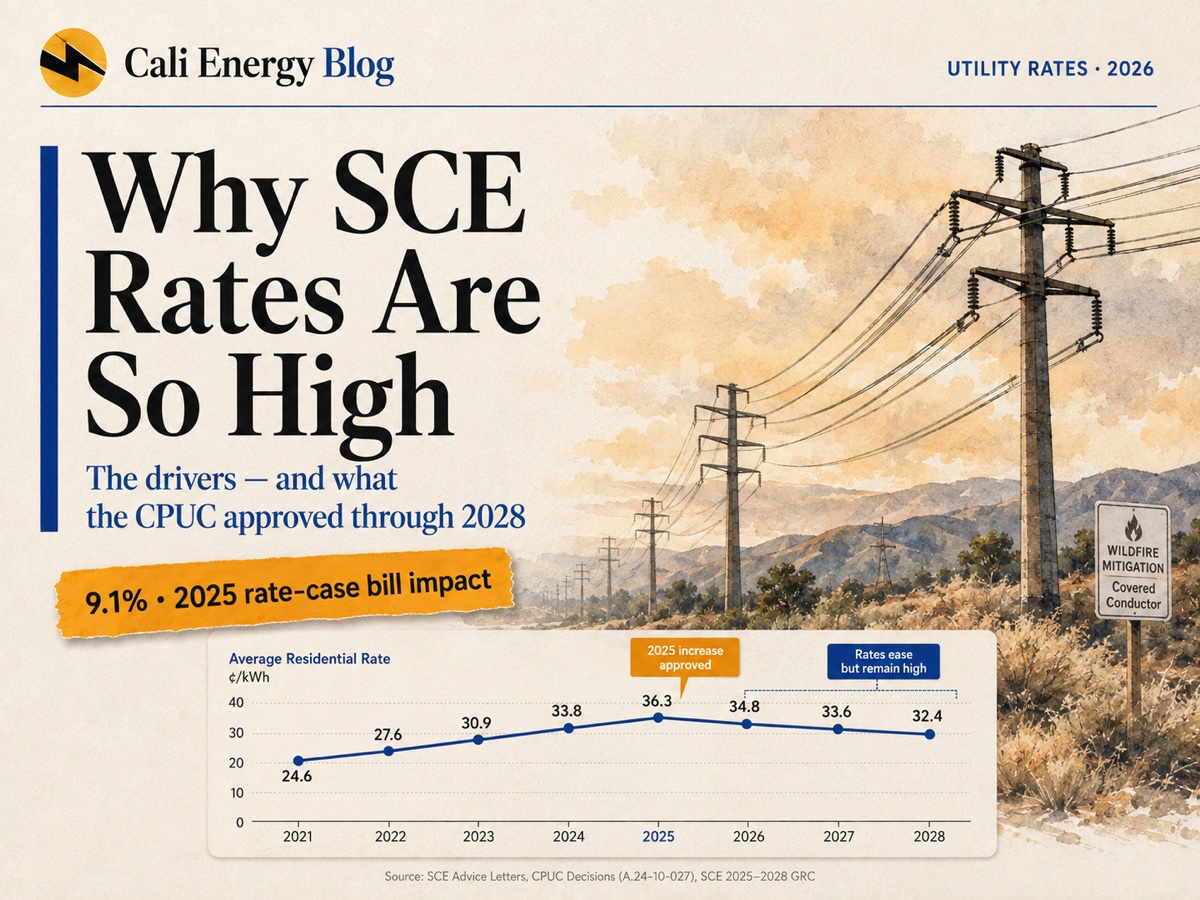
- The main cost drivers are wildfire mitigation, grid hardening, wildfire-claim costs and transmission — reviewed and approved by the CPUC.
- The biggest single jump in years came on October 1, 2025: the average residential rate went from 31.2¢ to 35.3¢/kWh, and SCE estimated a typical 500 kWh bill rose 12.9%, mostly from its 2025 rate case and past wildfire costs.
- Since then the changes have been small: 34.5¢ in January 2026, 34.4¢ in June and 34.5¢ from October 1, 2026.
- Over the longer run SCE’s average home price roughly doubled from 2016 to 2024 (EIA) — yet it is still below PG&E’s and SDG&E’s.
Every SCE rate change since 2024
SCE publishes a rate advisory each time its rates change. The average residential rate before and after each change:
| Effective | Average residential rate | Change | Typical 500 kWh bill (SCE estimate) |
|---|---|---|---|
| Jan 1, 2024 | 33.1¢ → 33.4¢ | +0.3¢ | — |
| Mar 1, 2024 | 33.4¢ → 33.8¢ | +0.4¢ | — |
| Jun 1, 2024 | 33.8¢ → 33.2¢ | -0.6¢ | — |
| Oct 1, 2024 | 33.2¢ → 32.5¢ | -0.7¢ | — |
| Jan 1, 2025 | 32.5¢ → 31.6¢ | -0.9¢ | — |
| Mar 1, 2025 | 31.6¢ → 31.4¢ | -0.2¢ | — |
| Jun 1, 2025 | 31.4¢ → 31.2¢ | -0.2¢ | — |
| Oct 1, 2025 | 31.2¢ → 35.3¢ | +4.1¢ | $171.17 → $193.23 (+12.9%) |
| Jan 1, 2026 | 35.3¢ → 34.5¢ | -0.8¢ | — |
| Jun 1, 2026 | 34.5¢ → 34.4¢ | -0.1¢ | — |
| Oct 1, 2026 | 34.4¢ → 34.5¢ | +0.1¢ | $185.85 → $188.64 (+1.5%) |
Two things stand out. Most changes are a fraction of a cent either way, and several went down. And one change dominates: October 2025, when the 2025 General Rate Case took effect along with older wildfire costs. The rate is now higher than at any point in 2024, but 2026 itself has been flat.
Source: SCE rate advisories (2024–2026) · verified October 6, 2026. Averages exclude the Climate Credit.
What actually drives the cost
SCE recovers its costs through CPUC-reviewed rate cases, wildfire proceedings and fuel-and-power reviews. SCE’s own explanations of the last three changes show the mix:
- October 2025 (+12.9% for a typical bill): $1.685 billion for the 2025 General Rate Case; $536 million for wildfire-risk work done in 2022–2023 and restoration after 2020–2022 disasters; and the end of a $751 million generation refund from lower gas and power prices — partly offset by removing $665 million of fully recovered costs.
- January 2026 (down to 34.5¢): $476 million more for 2026 rate-case funding and $122 million for bonds that financed Thomas Fire and Montecito Debris Flow claims, outweighed by decreases including $151 million for Diablo Canyon.
- October 2026 (+1.5%): the rate case’s cost-allocation phase shifted a modestly larger share of costs to homes; Woolsey Fire restoration ($49.7 million) and bonds for Woolsey claims ($140.1 million); offset by removing $628 million of fully recovered costs.
Behind those line items sit the same long-term drivers: wildfire mitigation (covered conductor, undergrounding, inspections, vegetation management), grid hardening and load growth, transmission, and the cost of past wildfire claims, financed with bonds that customers repay over years.
Sources: SCE rate advisory, October 1, 2025 · SCE rate advisory, January 1, 2026 · SCE rate advisory, October 1, 2026 · verified October 6, 2026.
The 2025 rate case: what was approved
On September 18, 2025 the CPUC decided SCE’s 2025 General Rate Case (Decision 25-09-030). It approved $41.78 billion of revenue for 2025–2028 — $4.39 billion less than the $46.17 billion SCE asked for — including $553.5 million for vegetation management and targeted undergrounding and covered conductor in high fire-threat districts. The CPUC estimated the decision alone raised a typical 500 kWh residential bill by 9.1% in 2025; SCE’s 12.9% for October 2025 also includes the wildfire costs and the end of the refund described above.
How much grid hardening was trimmed: SCE asked for $4.232 billion over four years to underground 580 miles of line and add 1,250 miles of covered conductor. The proposed decision authorized $2.213 billion — $941 million for 177 miles of undergrounding and $1.272 billion for 1,653 miles of covered conductor — and tied revenue increases in 2026, 2027 and 2028 to the consumer price index, with a maximum of 5% a year.
Sources: CPUC — decision in Edison rate case (September 18, 2025) · CPUC — SCE 2025 GRC fact sheet (proposed decision) · CPUC — SCE GRC proceeding · verified October 6, 2026.
The longer view: SCE vs its neighbors
EIA’s annual utility data give the average price SCE’s bundled residential customers paid each year:
| Year | Average price per kWh |
|---|---|
| 2016 | 15.84¢ |
| 2018 | 16.30¢ |
| 2020 | 18.22¢ |
| 2021 | 21.33¢ |
| 2022 | 24.62¢ |
| 2023 | 32.33¢ |
| 2024 | 32.43¢ |
The price roughly doubled between 2016 and 2024, with the steepest step from 2022 to 2023. Still, in 2024 SCE’s 32.43¢ was below PG&E’s 39.62¢ and SDG&E’s 43.63¢ — and well above LADWP’s 23.84¢. For the statewide picture, see California electricity rate history; for the municipal comparison, LADWP rates explained.
Source: EIA-861 annual utility data (2016–2024 final; revenue ÷ sales for bundled residential service) · Cali Energy calculation.
What comes next (2027)
No 2027 rate change has been announced yet. What is known: the rate case allows SCE’s base revenue to rise in 2027 and 2028 with inflation, capped at 5% a year, and separate proceedings — wildfire cost recovery, fuel-and-power reviews, transmission rates set each January — can move rates up or down on their own. SCE typically adjusts rates on January 1, so its next advisory is the place to look. Undergrounding and wildfire spending are planned to keep growing, which is why the long-run pressure remains upward even in a flat year.
For how this shows up on your own bill, see why your electric bill is higher; to choose among SCE’s plans, SCE time-of-use plans compared.
Frequently asked
Did SCE rates go up in 2026?
Will SCE rates go up in 2027?
Why are SCE rates so high?
How much did the 2025 rate case raise bills?
What did the CPUC approve for 2025 through 2028?
Did SCE raise rates 12.9%?
Related reading
Sources & methodology
Figures on this page come from the primary sources below and, where noted, from Cali Energy calculations using the stated assumptions. Rates, incentives, and program terms change; each was verified October 6, 2026.
- SCE — Rate advisories (current: October 1, 2026; archive 2024–2026)
- SCE — Rate advisory, October 1, 2025
- SCE — Rate advisory, January 1, 2026
- CPUC — Decision in Edison rate case (September 18, 2025)
- CPUC — SCE 2025 General Rate Case fact sheet (proposed decision)
- CPUC — SCE GRC proceeding
- EIA — Form EIA-861 annual utility data (2016–2024)
About this guide
This reference is maintained by the Cali Energy research team to explain what drives SCE rates and what the CPUC has authorized. Rate figures change with each advisory; confirm current numbers with SCE and the CPUC.
Prepared by Cali Energy, October 6, 2026. This article is for general educational purposes only and is not legal, tax, financial, engineering, or utility advice. Rates, incentives, codes, permit requirements, equipment specifications, prices, and program terms may change; figures and timelines are estimates, not guarantees. Confirm current requirements with the applicable utility, AHJ, program administrator, manufacturer, or a licensed professional. See our Content Disclaimer. Cali Energy · 19201 Parthenia St, Unit E, Northridge, CA 91324 · CSLB #1032379 (B, C-10, C-39)