

California Solar Incentives in 2026: What’s Left
Less than most ads suggest. The 30% federal credit is gone for any homeowner-owned system placed in service after December 31, 2025, and California has no state solar tax credit. What almost every owner still gets is the property-tax exclusion — and under current law it covers only systems completed before January 1, 2027. The cash programs are income-qualified, and on October 5, 2026 every SGIP battery budget open to Los Angeles homeowners was on a waitlist.
Get a free estimate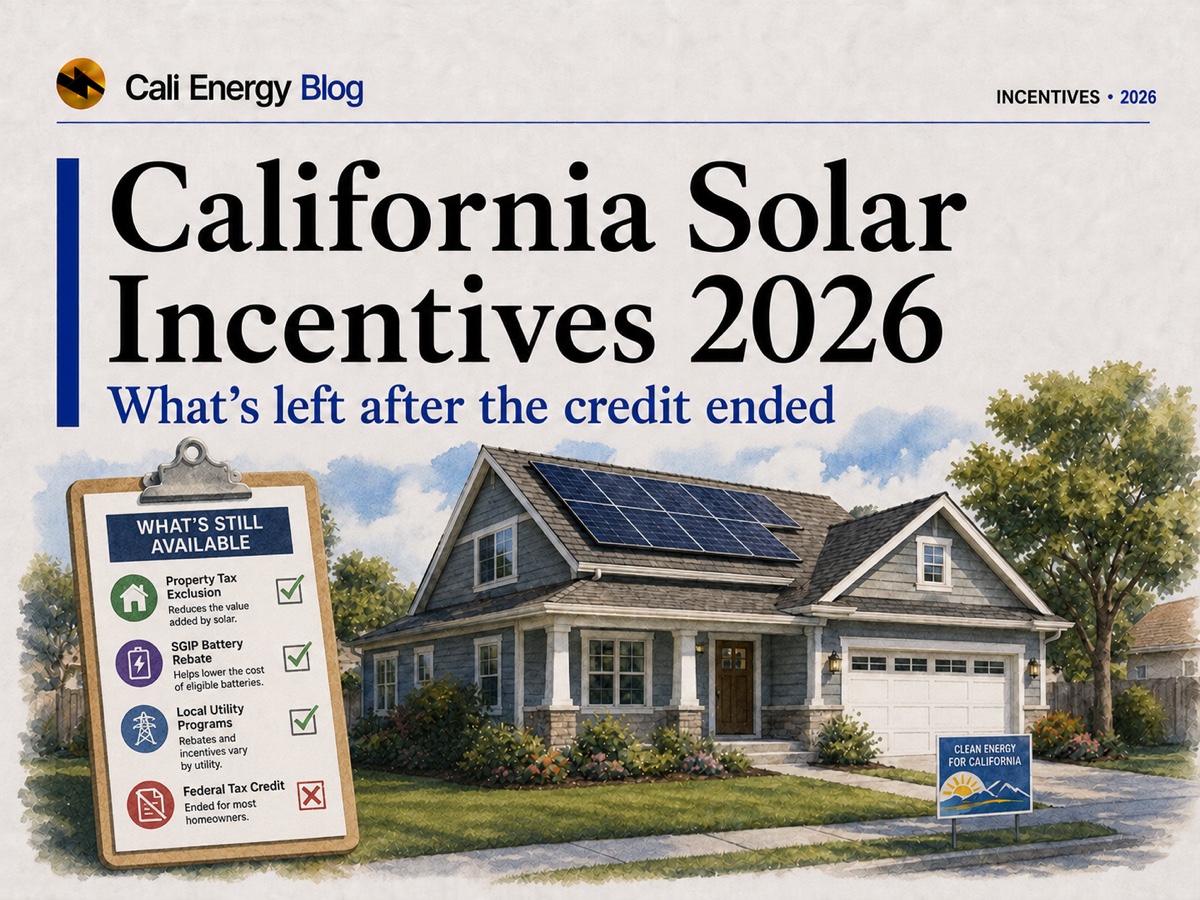
- Federal: nothing for systems you own placed in service after 2025. A lease or PPA company can still claim a business credit on systems in service by the end of 2027; whether you see any of it is up to them.
- Property tax: the exclusion is the one benefit nearly every owner gets, and it covers systems completed before January 1, 2027. An extension bill stalled in May 2026.
- SGIP: the general battery rebate closed to new applications at the end of 2025. The income-qualified budget pays $1.10 per Wh of storage, but SCE, LADWP and the SoCalGas budget that serves Glendale, Burbank and Pasadena were all waitlisted on October 5, 2026.
- Income-qualified solar (DAC-SASH, community solar discounts, SOMAH) is real money — in SCE territory, not LADWP’s.
What’s left at a glance
| Incentive | Who gets it | Value | Status |
|---|---|---|---|
| Federal Residential Clean Energy Credit (25D) | Homeowners who bought the system | Was 30% | Ended for property placed in service after Dec 31, 2025 |
| Federal business credit (48E) on leases and PPAs | The company that owns the system | Its own credit; pass-through not required | Systems in service by end of 2027, or later if construction began by July 4, 2026 |
| Property-tax exclusion (R&T Code §73) | Owned or leased systems, storage included | Added value not assessed | Systems completed before Jan 1, 2027 |
| SGIP general market (battery) | Any IOU customer | $0.15/Wh at the last step | Closed to new applications after Dec 30, 2025 |
| SGIP Residential Solar and Storage Equity | Income at or below 80% of area median, or enrolled in CARE, FERA, ESA or (DAC-)SASH | $1.10/Wh storage, $3.10/W solar | Waitlist for SCE, LADWP and SoCalGas customers |
| DAC-SASH | CARE/FERA-eligible homeowners in disadvantaged communities | $3/W toward no-cost solar | $10M a year through 2030; SCE, PG&E, SDG&E only |
| DAC-GT and Community Solar Green Tariff | Customers in disadvantaged communities | 20% off the bill | IOU and CCA customers, not LADWP |
| SOMAH | Owners and tenants of multifamily affordable housing | Incentives for solar and storage | Target 300 MW by 2032 |
| Net metering at retail | LADWP solar customers | Exports credited at the retail rate | In effect; SCE customers are on the Solar Billing Plan instead |
Sources: IRS · IRS Notice 2025-42 · BOE · SGIP Program Metrics and 2026 Handbook · CPUC · SOMAH · LADWP. Budgets change daily; check each source before relying on it.
Federal: what ended, and the one route that didn’t
The IRS is plain about it: the Residential Clean Energy Credit “is not available for any property placed in service after December 31, 2025.” A system you buy with cash or a loan in 2026 gets nothing federal. The home-improvement credit that helped pay for heat pumps and electrical panel upgrades ended at the same time. California has no state income-tax credit to replace them — the Franchise Tax Board’s list of personal credits has none for solar.
Leases and PPAs are different because the installer or financier owns the system and claims a business credit (section 48E). Under IRS Notice 2025-42, that credit ends for solar placed in service after December 31, 2027 unless construction began by July 4, 2026. A 2025 change did shut off the business credit for some leased home equipment, but the IRS instructions limit that to the property in section 25D(d)(1) and (4) — solar water heating and small wind — not solar panels. Whether a lease is priced lower because of the credit is the company’s choice; compare it on total cost. See what the end of the federal credit means and cash vs loan vs lease.
Property tax: the one most owners get, with a deadline
California’s active solar energy system exclusion (Revenue and Taxation Code §73) keeps a qualifying system out of your assessed value, owned or leased, including storage that is part of the solar system. No form is needed for an existing home; the assessor learns about it from the permit. Under current law the Board of Equalization applies it to systems completed before January 1, 2027, and a system excluded once stays excluded until the home changes hands. AB 2389, which would have extended it, was held in committee on May 14, 2026.
On October 5, 2026 that leaves under three months. A project that is designed, permitted and installed in that time qualifies; one finished in January does not, unless the Legislature acts first. See does solar raise your property tax?
SGIP battery rebates: who administers yours, and its status
The general SGIP battery rebate — $0.15 per watt-hour at its last step — took its last new applications on December 30, 2025, and its waitlists closed the same day (SGIP 2026 Handbook). What remains is the Residential Solar and Storage Equity budget funded by AB 209: $280 million statewide, paying $1.10 per watt-hour of storage and $3.10 per watt of solar. On paper that is $14,850 for a 13.5 kWh battery, subject to program caps. For a single-family home you qualify with household income at or below 80% of area median, or through enrollment in CARE, FERA, ESA, SASH or DAC-SASH. Your administrator depends on your electric utility:
| Your electric utility | SGIP administrator | Budget | Status |
|---|---|---|---|
| SCE, including Clean Power Alliance customers | SCE | $86.3M | Waitlist |
| LADWP | LADWP | $32.4M | Waitlist |
| Glendale, Burbank, Pasadena or Vernon city utility | SoCalGas | $13.5M | Waitlist |
Sources: SGIP Program Metrics (as of Oct 5, 2026) · AB 209 administrator assignments · SGIP 2026 Handbook.
A waitlist is not a closed door: applications and waitlist entries are accepted until June 30, 2028, and money freed by cancelled projects is offered to waitlisted applications. But nobody can promise a date, so a project should make sense without it. See SGIP battery incentives.
Batteries can also earn by helping the grid. The Energy Commission’s Demand Side Grid Support program pays for discharging during grid emergencies, but only through an approved aggregator, and terms change by provider and season. See what a battery can earn in a virtual power plant.
Income-qualified solar: DAC-SASH, community solar, SOMAH
DAC-SASH
No-cost rooftop solar for CARE- or FERA-eligible homeowners in disadvantaged communities, at $3 per watt; $10 million a year through 2030 (CPUC). SCE, PG&E and SDG&E territory only.
DAC-GT and CSGT
For households in disadvantaged communities that can’t put solar on their own roof: a 20% bill discount backed by solar elsewhere.
SOMAH
Incentives for solar and storage on multifamily affordable housing, with benefits for tenants; the program targets 300 MW by 2032 (SOMAH).
Not on LADWP
These are CPUC programs for investor-owned utilities and their community choice providers. LADWP customers use LADWP’s own programs below.
LADWP vs SCE: where the real money is
For most Los Angeles homeowners the largest ongoing benefit is not a rebate but how the utility credits exported power. LADWP nets exports at the full retail price under its net metering rider. It also runs Solar Rooftops, which pays $30–75 a month for 20 years to put an LADWP-owned system on your roof, with the power going to LADWP. SCE customers are on the Solar Billing Plan, which credits exports at hourly values that are low at midday — the reason most new SCE systems now include a battery. Neither is an incentive in the rebate sense, but either can matter more to payback than any program above. See LADWP solar and battery incentives and SCE solar billing explained.
Financing is not an incentive
Loans, leases, PPAs and PACE change how you pay, not how much the system costs. Solar loans can carry dealer fees built into the price; see solar loan dealer fees. PACE is repaid through your property-tax bill and stays with the house; Los Angeles County no longer administers a residential PACE program itself. Compare offers on total cost over the term. See is solar worth it in California in 2026?
Before you sign
Know your utility
SCE, LADWP or a city utility decides which programs and which billing rules apply. It is on your bill.
Check the completion date
Ask when the system will be finished, not when work starts; the property-tax exclusion turns on completion before January 1, 2027.
Check SGIP on the day
Look up your administrator’s status on the SGIP tracker yourself; a waitlist is not money.
Price it without incentives
If a quote only works with a rebate or credit, ask to see it without one.
Where to go next
Cali Energy designs solar and battery systems in Los Angeles for SCE and LADWP customers and can check which of these programs apply to your home. Call +1-323-844-7777 or ask for a review — program status changes, so treat every incentive as confirmed only once the program confirms it.
Frequently asked
Is there still a solar tax credit in California in 2026?
Not for a system you own. The federal 30% credit is not available for property placed in service after December 31, 2025, and California has no state solar tax credit. A leasing company can still claim a business credit on systems in service by the end of 2027.
Does solar raise my property taxes in California?
Not if the system is completed before January 1, 2027. Under Revenue and Taxation Code §73 a qualifying system, storage included, is excluded from your assessed value and stays excluded until the home changes hands. An extension bill stalled in May 2026.
Are SGIP battery rebates available in 2026?
Only for income-qualified households, and with a wait. The general-market budget took its last applications on December 30, 2025. The equity budget pays $1.10 per watt-hour, but on October 5, 2026 it was waitlisted for SCE, LADWP and SoCalGas customers; applications are accepted until June 30, 2028.
What is DAC-SASH and can I get it?
It is a CPUC program that pays $3 per watt for no-cost rooftop solar for homeowners in disadvantaged communities who are eligible for CARE or FERA. It covers SCE, PG&E and SDG&E customers, not LADWP.
Are there government grants for home solar in Southern California?
Not general ones. The money that exists is income-qualified (SGIP equity, DAC-SASH, SOMAH) or tied to a utility program such as LADWP’s Solar Rooftops. Ads promising “free government solar” to anyone are usually selling a lease or loan.
Is net metering an incentive?
It is a billing rule, not a rebate, but it is often worth the most. LADWP credits exports at the retail price; SCE’s Solar Billing Plan credits them at hourly export values that are low at midday.
Can a solar lease still get the federal tax credit?
The leasing company can, not you: it claims the business credit (section 48E) on systems placed in service by the end of 2027, or later if construction began by July 4, 2026. Whether that lowers your payment depends on the company’s pricing.
Related reading
Sources & methodology
Figures on this page come from the primary sources below and, where noted, from Cali Energy calculations using the stated assumptions. Rates, incentives, and program terms change; each was verified October 5, 2026.
- IRS — Residential Clean Energy Credit (not available for property placed in service after Dec 31, 2025)
- IRS — Energy Efficient Home Improvement Credit (improvements through Dec 31, 2025)
- IRS — Notice 2025-42: beginning of construction for wind and solar under §§ 45Y and 48E
- IRS — Instructions for Form 3468: no 48E credit for leased § 25D(d)(1) or (4) property
- 26 U.S. Code § 25D (d)(1) solar water heating, (d)(2) solar electric, (d)(4) small wind
- California Franchise Tax Board — Personal credits
- California Revenue and Taxation Code § 73
- California State Board of Equalization — Active Solar Energy System Exclusion
- AB 2389 (2026) — bill history: held under submission May 14, 2026
- SGIP — Program Metrics (budget status as of October 5, 2026)
- SGIP — 2026 Handbook (V3): AB 209 allocations, deadlines, eligibility
- SGIP — AB 209 Program Administrator Assignments
- CPUC — Solar in Disadvantaged Communities (DAC-SASH, DAC-GT, CSGT)
- SOMAH — About the program
- LADWP — Solar Programs
- LADWP — Service Rider NEM, Net Energy Metering
- SCE — How the Solar Billing Plan works
- California Energy Commission — Demand Side Grid Support Program
- Los Angeles County ISD — PACE program information
See what actually applies to you
Get an itemized 2026 estimate for your home, with any incentive checked on the official source rather than assumed.
Get a free estimatePrepared by Cali Energy, October 5, 2026. This article is for general educational purposes only and is not legal, tax, financial, engineering, or utility advice. Rates, incentives, codes, permit requirements, equipment specifications, prices, and program terms may change; figures and timelines are estimates, not guarantees. Confirm current requirements with the applicable utility, AHJ, program administrator, manufacturer, or a licensed professional. See our Content Disclaimer. Cali Energy · 19201 Parthenia St, Unit E, Northridge, CA 91324 · CSLB #1032379 (B, C-10, C-39)