

Do Solar Panels Increase Home Value in California?
Yes — for systems the homeowner owns. That ownership condition comes from Berkeley Lab, which measured about $4 per watt (roughly $15,000 on the study's average 3.6 kW system) for host-owned solar across 22,822 U.S. home sales. Zillow, separately and without separating owned from leased systems, measured +3.6% in the Los Angeles metro and +4.4% in San Francisco on 2018–19 sales. Whether any of that reaches your appraisal is decided by a different rule: how the panels were paid for. Under Fannie Mae's Selling Guide, leased and PPA systems contribute nothing to appraised value.
Get a free estimate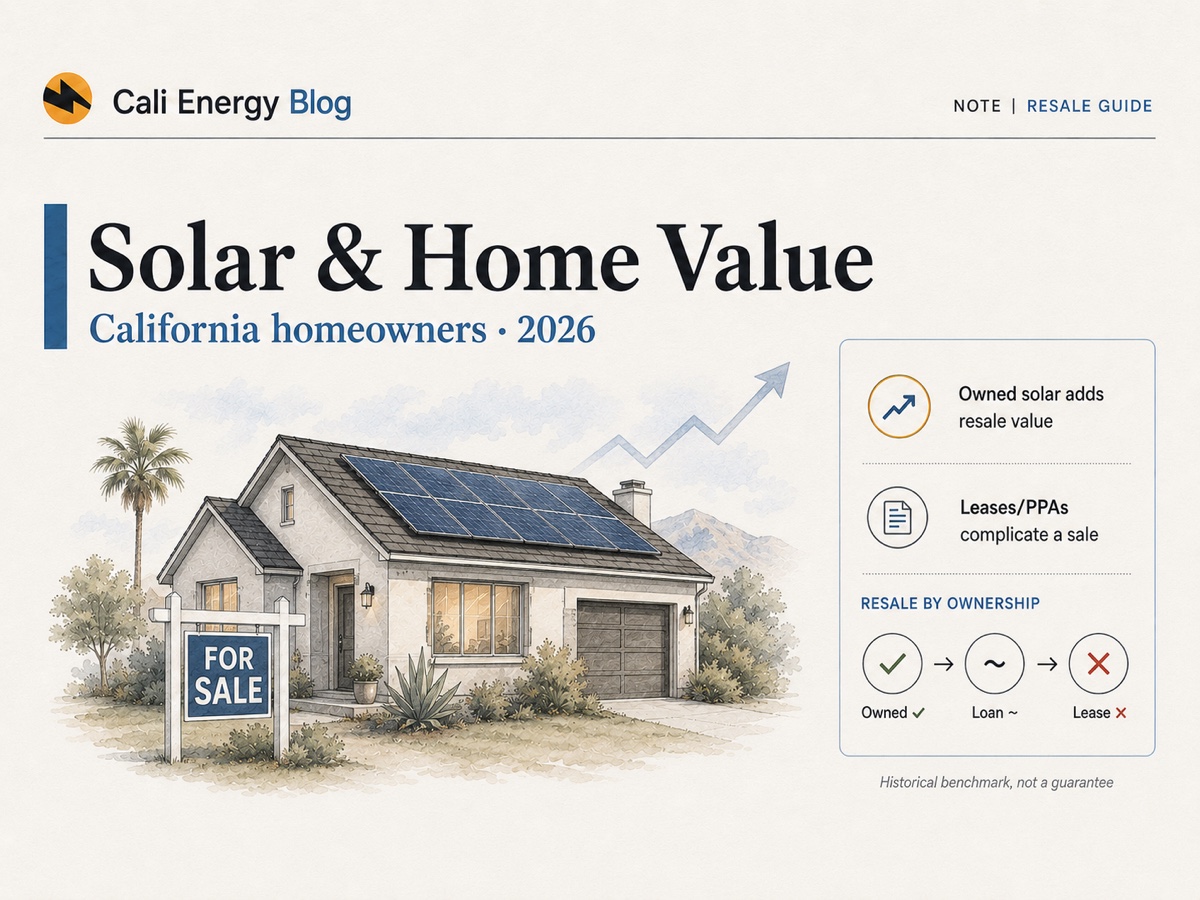
The short answer, and the rule that decides it
Owned solar adds value. Whether that value reaches your appraisal is a separate question.
Every widely cited study of solar and resale value measures the same thing: homes where the seller owns the system. Lawrence Berkeley National Laboratory, working with Sandia National Laboratories, universities and practising appraisers, put the premium at about $4 per watt for host-owned systems. Zillow, on a later and separate dataset, measured a percentage premium that in California ran from 2.7% in the Riverside metro to 4.4% in San Francisco.
What almost no guide tells you is that a second, entirely different rule decides whether an appraiser is permitted to count your system at all. It is not a study or an opinion — it is the underwriting standard the buyer's lender has to follow, and it turns on one thing: how the panels were paid for. Under it, a leased system contributes nothing to appraised value no matter what the research says about solar in general. Both halves are below, with the exact sources.
What the evidence actually says
Independent research, with the sample and period each figure actually comes from.
| Study | Finding | Sample and period | Ownership |
|---|---|---|---|
| Berkeley Lab, Selling into the Sun | ~$4 per watt (~$15,000 on a 3.6 kW system) | 22,822 sales, 3,951 with PV, 8 states, transactions 2002–2013 | Host-owned only |
| Zillow research — national | +4.1% (~$9,274 median) | Listed and sold Mar 1, 2018 – Feb 28, 2019; solar homes identified by key words in the listing description | Not distinguished |
| Zillow — San Francisco metro | +4.4% | Same dataset; solar homes identified by key words in the listing description | Not distinguished |
| Zillow — Los Angeles metro | +3.6% | Same dataset; solar homes identified by key words in the listing description | Not distinguished |
| Zillow — Riverside metro | +2.7% (~$9,926 median) | Same dataset; solar homes identified by key words in the listing description | Not distinguished |
| SolarReviews, replicating Zillow's method | +6.9% | Over 400 listings paired into comparisons, sales within 3 years of 2025 | Not distinguished |
Sources: Lawrence Berkeley National Laboratory, Selling into the Sun · Zillow Research (2019) · SolarReviews solar home value report. Zillow controlled for bedrooms, bathrooms, square footage, home age and location. Verified August 13, 2026.
Three things about this table matter more than the headline numbers.
The per-watt figure does not scale. Berkeley Lab's own wording is “approximately $4/W or $15,000 for an average-sized 3.6-kW PV system” — roughly half the size of a system installed in California today. The same researchers reported that a PV “green cachet” might exist: buyers appearing to pay a baseline amount for having solar at all, and only incrementally more as system size rose. Multiplying $4 per watt by a modern 10 kW system to produce a $40,000 premium — an arithmetic you will find on several competing pages — is not something the study supports.
The premium depreciates with age. Berkeley Lab found that the market appears to depreciate PV systems in their first 10 years at a rate exceeding both efficiency losses and straight-line depreciation. A twelve-year-old array with an inverter near end of life is not the asset the studies measured.
Newer does not mean better. The 6.9% figure is the most recent, but it rests on just over 400 listings paired into comparisons and does not separate owned from leased systems, so it carries far less weight than Berkeley Lab's ~22,000 sales. We include it because it is current and widely quoted, not because it is stronger.
The rule that decides whether your solar counts
Fannie Mae's underwriting standard, updated October 8, 2025 — this is what the buyer's lender applies.
Most California buyers finance with a conventional mortgage, and a loan sold to Fannie Mae has to satisfy its Selling Guide; Freddie Mac and portfolio lenders apply their own, broadly similar standards. Its section on properties with solar panels sets out, structure by structure, whether the appraiser may assign your system any value. The single most consequential sentence reads:
The repossession test
“Separately financed solar panels must not contribute to the value of the property unless the related documents indicate the panels cannot be repossessed in the event of default on the associated financing.”
Quoted from the section “Properties with Solar Panels.” If your loan documents permit the lender to take the panels back, the appraiser is instructed to assign them no contributory value.
| Your situation | May the appraiser credit the panels? | What the rule requires |
|---|---|---|
| Owned outright — cash, included in the purchase price, financed and repaid in full, or secured by the existing first mortgage | Yes | Standard appraisal, insurance and title requirements apply. Nothing extra to clear. |
| Solar loan with a UCC-1 fixture filing recorded in the land records | Yes, conditionally | The appraiser is instructed to consider the panels provided they cannot be repossessed on default. The debt counts in the buyer's DTI and CLTV. If the fixture filing sits senior to the mortgage it must be subordinated — not removed. |
| Solar loan where the panels are collateral but nothing appears on the title report | No | The appraiser is instructed not to provide contributory value, because the panels are collateral for another debt and are treated as personal property. |
| Lease or power purchase agreement | No | “The value of the solar panels cannot be included in the appraised value of the property.” The home must also keep access to an alternate source of electric power, and the equipment owner must be responsible for any damage from installation, malfunction or removal. |
| PACE financing (including California HERO-type programs) | No — and it blocks the loan | The property is not eligible for delivery to Fannie Mae unless the PACE loan is paid in full before or at closing. |
| Ownership unclear or undocumented | No, by default | No value may be attributed unless the lender obtains a UCC personal property search confirming the panels are not claimed as collateral by a non-mortgage lender. |
Source: Fannie Mae Selling Guide B2-3-04, Special Property Eligibility Considerations — “Properties with Solar Panels” (published 10/08/2025). Applies to conventional loans sold to Fannie Mae; FHA, VA and portfolio lenders set their own rules. Verified August 13, 2026.
Check your own situation
Enter your home and system, then pick how you paid. The tool applies the rule above and the measured premium range together.
The figure applies Zillow's measured sale-price premium for your metro to the home value you entered — it is market evidence, not a contributory value an appraiser has assigned. Zillow did not separate owned from leased systems. Neither figure is an appraisal. Eligibility text reflects Fannie Mae Selling Guide B2-3-04 (10/08/2025) for conventional loans.
A worked example you can reproduce
A 7.2 kW system on an $850,000 home, financed two different ways
Step 1 — the measured premium. The Los Angeles metro figure is 3.6%. On $850,000 that is 0.036 × $850,000 = $30,600. The Riverside figure of 2.7% would give $22,950 and the San Francisco figure of 4.4% would give $37,400 — the spread between California metros in the same dataset.
Step 2 — the Berkeley Lab cross-check. At ~$4 per watt, 7,200 W implies $28,800. That lands close to the Zillow figure here, but only by coincidence of system size: the study's average system was 3.6 kW, so at 12 kW the same arithmetic would imply $48,000, which the research does not support.
Step 3 — the rule, which is a different measure entirely. Steps 1 and 2 are sale-price premiums observed across many homes. What Fannie Mae governs is something narrower: the contributory value an appraiser may assign on a single report. If the system was bought with cash, the appraiser may credit it, and the measured premium above is the market evidence a seller can point to. If the identical system carries a solar loan with the panels pledged as removable collateral and nothing recorded in the land records, the appraiser is instructed to assign it $0 — and the balance still has to be settled at closing. Same panels, same roof, same production: the financing structure alone decides whether any of that market evidence can reach the appraisal at all.
Illustrative, using the published figures cited above and the stated home value. Not an appraisal. Actual appraised value depends on comparable sales, system age and condition, and the appraiser's analysis.
Why California specifically
Electricity is expensive here
California's average residential price was 33.25¢/kWh in May 2026 against a U.S. average of 18.44¢ — about 80% higher. A paid-off system offsetting that is a saving the buyer inherits. EIA Table 5.6.A →
The tariff can be worth more than the panels
A system interconnected before April 15, 2023 with SCE, PG&E or SDG&E is on NEM 1.0 or 2.0, which pays far more for exports than the Net Billing Tariff. That grandfathering runs with the system, and informed buyers now ask for it. How NEM grandfathering works →
No property-tax penalty, for now
A qualifying system is excluded from reassessment under Revenue & Taxation Code §73, so the value does not raise your tax bill. The exclusion is scheduled to sunset January 1, 2027. The exclusion and the 2027 sunset →
Appraisers have a purpose-built method
Beyond comparable sales, appraisers can value the production stream directly using PV Value®, a tool built by Sandia National Laboratories under a DOE programme and supported by the Appraisal Institute, fed by the Institute's Residential Green and Energy Efficient Addendum. Sandia on PV Value® →
What shrinks the premium — or erases it
Thin comparable sales
The sales-comparison approach needs solar homes that have recently sold nearby. Where there are none, an appraiser may be unable to support a premium even on a system that qualifies under the rule.
Age and condition
Berkeley Lab found the market appears to depreciate PV systems in their first 10 years faster than efficiency losses alone would imply. A due inverter replacement, visible degradation, or a roof that needs work before the panels come off all pull against it.
Missing paperwork
If ownership cannot be documented, the default is no value — reversible only if the lender runs a UCC personal-property search. Interconnection agreement, permit sign-off, invoices and payoff letters are what prevent this.
The wrong loan structure
A repossessable, personal-property solar loan gets $0 credited while the balance still has to be cleared at closing. Where the terms allow it, converting or paying off before listing is the single highest-value fix.
None of this changes the panels on the roof. It changes whether the number reaches the appraisal — which is the number the sale actually turns on. The paperwork and disclosure side of a solar sale, including how a lease or PPA is assigned to a buyer, is covered separately in selling a house with solar in California.
Frequently asked
Do solar panels increase home value in California?
How much value does solar add to a California home in dollars?
Does a leased solar system or PPA add any value when I sell?
What happens to my solar loan when I sell my house?
Does adding solar raise my property taxes in California?
Does the age of the system change what it is worth at resale?
Is the federal solar tax credit still available in 2026?
Related reading
Sources & methodology
Figures on this page come from the primary sources below and, where noted, from Cali Energy calculations using the stated assumptions. Rates, incentives, and program terms change; each was verified August 13, 2026.
- Fannie Mae — Selling Guide B2-3-04, Special Property Eligibility Considerations (Properties with Solar Panels, 10/08/2025)
- Lawrence Berkeley National Laboratory — Selling into the Sun: price premiums for U.S. solar home sales
- Lawrence Berkeley National Laboratory — Selling into the Sun (full report, LBNL-6942E)
- Zillow Research — Homes With Solar Panels Sell for 4.1% More (2019)
- Zillow — Going Green: Homes with Solar Panels Sell for 4.1% More (press release, Apr 16, 2019)
- SolarReviews — solar home value report (replication of Zillow's method)
- Sandia National Laboratories — PV Value® appraisal tool
- California State Board of Equalization — Active Solar Energy System New Construction Exclusion
- California SB 710 (2025) — active solar energy systems, bill text
- U.S. EIA — Electric Power Monthly, Table 5.6.A (average residential price by state)
- IRS — Residential Clean Energy Credit
Want to know what your system would actually appraise for?
Send us your interconnection paperwork and how the system was financed, and we'll tell you which row of the Fannie Mae table you're in and what to clear before you list. Cali Energy installs owned systems that transfer cleanly, with in-house crews across LADWP and SCE territory. Call (323) 844-7777.
Get a free estimatePrepared by Cali Energy, August 13, 2026. This article is for general educational purposes only and is not legal, tax, financial, engineering, or utility advice. Rates, incentives, codes, permit requirements, equipment specifications, prices, and program terms may change; figures and timelines are estimates, not guarantees. Confirm current requirements with the applicable utility, AHJ, program administrator, manufacturer, or a licensed professional. See our Content Disclaimer. Cali Energy · 19201 Parthenia St, Unit E, Northridge, CA 91324 · CSLB #1032379 (B, C-10, C-39)